|
Fascism Part II: The Rise of American Fascism
by  - May 15, 2004 - May 15, 2004
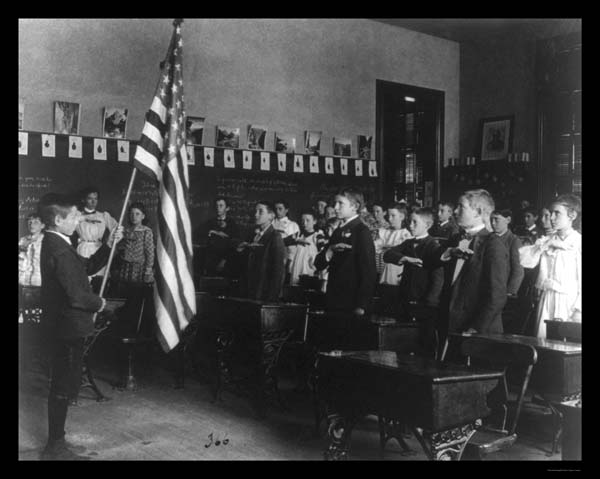
Students reciting the Pledge of Allegiance in school on Flag Day in
1899
The rise of fascism itself is a complex story, much less the rise of
American fascism. Just as understanding the rise of fascism in Europe
requires understanding the conditions of the time, so too understanding
fascism in America requires understanding the conditions leading up to
its transformation into a fascist state.
Before getting to that, though, it has to be clear that this is not
about proving that something is good or bad, or trying to demonize
American policy by associating it with fascism. In some respects
American fascism could be considered "benevolent fascism." The rise of
fascism in America was a multi-faceted process that took place over
time, and was really a part of a larger trend in the 20th century that
included other nations as well. As was stated in Part I, fascism
developed as a solution to perceived social and economic problems from a
certain perspective - a "right-wing" perspective. This is an analysis of
American policy and society and the correlations with fascist ideology
as described in Part I of this series:
Fascism Part I: Understanding Fascism
and Anti-Semitism
Setting the Stage for Fascism in America
The beginning of the story of American fascism starts with the
conclusion of the Civil War and the start of Reconstruction. This is a
complicated story in itself and one that I am not going to go into in
detail. A very interesting thing about American fascism is the way in
which American society has been reflected in the evolution of Pledge of
Allegiance itself.  The Pledge of Allegiance was
written in 1892 by Francis Bellamy. The Pledge was written by Bellamy
for a national Columbus Day celebration ceremony, the program of which
was published in The Youth's Companion magazine. It
reflected his idea of a united America after the Civil War. At the time
the country was still very much divided because of the conflict between
North and South. The Pledge reinforced the idea of ONE NATION,
something important to many after the Civil War and the attempts of the
South to secede. The Pledge of Allegiance was
written in 1892 by Francis Bellamy. The Pledge was written by Bellamy
for a national Columbus Day celebration ceremony, the program of which
was published in The Youth's Companion magazine. It
reflected his idea of a united America after the Civil War. At the time
the country was still very much divided because of the conflict between
North and South. The Pledge reinforced the idea of ONE NATION,
something important to many after the Civil War and the attempts of the
South to secede.
Francis Bellamy was vice president of the Society of Christian
Socialists. This was an organization that promoted the view that society
should be organized based on the teachings of Jesus Christ and was
critical of capitalism and individualism as corrupting forces in
society. Francis Bellamy was actually the cousin of another influential
Christian Socialist activist of the time, Edward Bellamy. Both Francis
and Edward were involved in the Nationalist movement as well. Some 167
Nationalist Clubs sprang up around the United States after Edward
Bellamy published his best selling book, Looking Backward.
Both men were involved in these clubs, though Edward was better known
at the time. Looking Backward was essentially Edward's "answer"
to the recently written Communist Manifesto. It was a book that
attacked the positions of Communism, declared that any good society had
to be founded on God's word, and basically took up some of the positions
of the Socialist movement, but from a Christian perspective.
The Nationalist and Christian Socialist movements of the Bellamys
were their "alternatives" to the Marxist movements of the day. While the
Marxists were promoting rebellion against the State, the Bellamys
promoted duty to the State.
After Columbus Day became a nationally recognized holiday on July 21,
1892, Francis Bellamy and others involved in the Nationalist movement
helped to put together a national school program for the celebration of
the event.
National School Celebration of Columbus Day - The Official
Programme, was published in the September 8, 1892 issue of The
Youth's Companion. As there was no real national means to
distribute information to all the schools in the country at the time,
this publication served as the means to organize the official events.
The subtext of the article title read:
Let every pupil and friend of the Schools who reads The Companion,
at once present personally the following programme to the Teachers,
Superintendents, School Boards, and Newspapers in the towns and
cities in which they reside. Not one School in America should be
left out in this Celebration.
The program for the National Celebration of Columbus Day was to be
the first unified national celebration in the country's history, with
every single school taking part in the ceremony according to a time
table in perfect unison. The address, also written by Francis Bellamy,
which was to be given at a certain part of the ceremony, started out:
The spectacle America presents this day is without precedent in
history. From ocean to ocean, in city, village, and country-side,
the children of the States are marshaled and marching under the
banner of the nation: and with them the people are gathering around
the schoolhouse.
Men are recognizing to-day the most impressive anniversary since
Rome celebrated her thousandth year-the 400th anniversary of the
stepping of a hemisphere into the world's life; four completed
centuries of a new social order; the celebration of liberty and
enlightenment organized into civilization.
And while, during these hours, the Federal government of these
United States strikes the keynote of this great American day that
gives honor to the common American institution which unites us all,
- we assemble here that we, too, may exalt the free school that
embodies the American principle of universal enlightenment and
equality: the most characteristic product of fours centuries of
American life.
Veterans of the Civil War were also expected to attend the ceremonies
and be recognized during the course of the program, as well as lead the
Color-Guard of the pupils.
The original Pledge read as follows:
I pledge allegiance to my Flag and the Republic for which it
stands, one nation, indivisible, with liberty and justice for all.
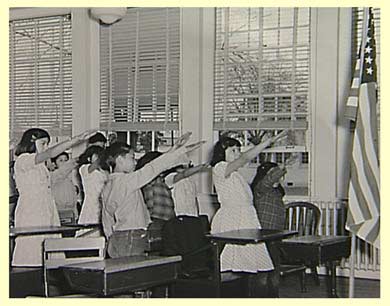
From this time up until 1942, the salute used while saying the pledge
was to make a military salute to the chest or brow, and then
extend the arm straight out with the palm facing the flag, as shown
below. This type of salute originated in ancient Rome and has been used
by many groups. The salute is most widely recognized now as a "Nazi
salute," but in fact it was Mussolini who adopted it before Hitler as
apart of his fascist party, precisely because of its Roman origin. The
Nazis later adopted it from the Italians. Its use in America prior to
this time has no direct relationship to the fascists, however, it was a
nationalist salute to the State. In the Italian and German usage the
salute was to the leader himself, as it was used in Rome to "Hail
Caesar" ("Heil Hitler").
At a signal from the Principal the pupils, in ordered ranks, hands to
the side, face the Flag. Another signal is given; every pupil gives
the flag the military salute -- right hand lifted, palm downward, to
a line with the forehead and close to it. Standing thus, all repeat
together, slowly, "I pledge allegiance to my Flag and the Republic
for which it stands; one Nation indivisible, with Liberty and
Justice for all." At the words, "to my Flag," the right hand is
extended gracefully, palm upward, toward the Flag, and remains in
this gesture till the end of the affirmation; whereupon all hands
immediately drop to the side. Then, still standing, as the
instruments strike a chord, all will sing AMERICA- "My Country, tis
of Thee."
Source: The Youth's Companion, 65
(1892): 446-447
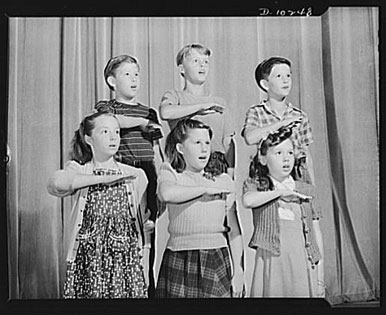
After reciting the Pledge students were often instructed to say:
"One Country! One Language! One Flag!"
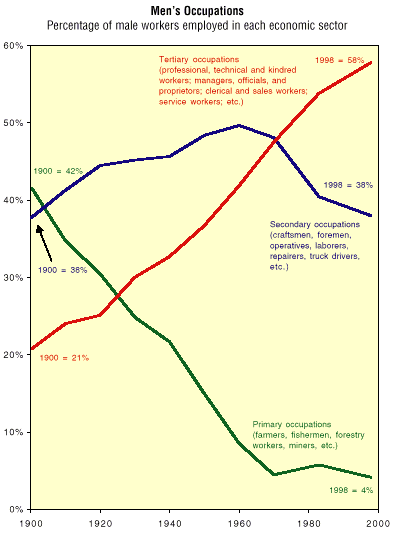
At the turn of the 20th century America was undergoing a
transformation from a society of farmers to an industrial society. This
is obviously known as the Industrial Revolution, and as with the
Industrial Revolutions in Europe this change brought a new level of
economic disparity and fragility to the American economy.
President Theodore Roosevelt was one of the first prominent Americans
to both recognize this fact, have a genuine desire to solve the problems
the country faced, and to take action in doing so. Theodore Roosevelt
was actually one of the most progressive presidents in the history of
the United States and was a man of firm convictions. Roosevelt became
popularly known as a "trust buster" - one who broke up large business
cooperatives. Roosevelt attacked monopolies and big business and stated
that he realized the State could actually be used to promote a "healthy"
business environment. He supported unions and helped to resolve strikes,
something that no other president had done before and something that was
actually outside the duties of president.
Roosevelt had a real concern for justice and he knew that big
business was not acting in ways that were fair and just. Roosevelt's
administration marked the beginning of serious changes in American
economic policy, but it was just the beginning.
As America became more and more industrialized, laissez-faire
practice presented more and more problems. Men like J.P. Morgan, John
Rockefeller and Andrew Carnegie owned huge shares of America's economy.
J.P. Morgan was arguably the most powerful man in the country during the
height of his career, with far more influence than even the President of
the United States. A small handful of men controlled virtually all of
the financial capital in the country to the degree that people realized
that in many ways the government was not in charge of the country, this
small group of private citizens were. These individuals had no oversight
or democratic responsibilities - they were beholden, basically, to no
one.
However, it was not only the common man that was troubled by the
outcome of laissez-faire practice, but increasingly the capitalists
themselves were also looking to the State for protection. One example of
this was the popular food processor H.J. Heinz's lobbying and support
for the Pure Food and Drug Act of 1906, signed by Teddy Roosevelt. Heinz
supported this act not only out of a desire to promote healthy food,
which his company already did, but also to legally eliminate
competition. The Heinz food company had, at that time, one of the
cleanest food product lines in the world, and Heinz helped to ensure
that the legislation was written in such a way that the company would
already meet the requirements of the act, while the majority of his
competition's products would not meet the requirements. When the act
passed many of Heinz's competitors went out of business because they
were unable to make the changes needed to meet the requirements in a
cost competitive and timely manner.
This is just one example of the fact that, while the State was taking
some power away from private corporations, it was also aiding corporate
interests in some cases. This led to an increased closeness between
wealthy Americans and government as they realized that the government
was something that could work in their interests, but would
only be likely to do so if they were actively involved with it.
All of this marked a new role for the State in the American economy
and signaled the beginning of the end of laissez-faire practices in ways
that both public and private interests would do their best to take full
advantage of.
Rise of American Eugenics
At this point, things need to be seen in a larger perspective.
Throughout the late 1800s, the twilight of the Enlightenment era, a new
world-view was being increasingly adopted. Marxism, socialism, and
scientific sociology were having a profound impact on society. In the
late 1800s and the early 1900s the idea was being advanced that people
are the products of their social environments - that poverty is a social
condition and that people become criminals because of social and
economic conditions, etc.
Those advancing these views were largely calling for major social
changes to correct these socially created problems. It was in contrast
to these ideas that fascism began to develop in societies around the
world, especially in America. The idea that poverty, crime and ignorance
are a product of social conditions was a threat to the dominant members
of society because the call was for these dominant members of society to
reform their ways to create increased equality for all people.
In this social climate, those who opposed the idea that society
created the problems of individuals put blame on race and bloodline
instead. The ideology developed that the "socialists" were wrong, and
that society's problems were not caused by oppressive economic
conditions, but rather that social problems were caused by genetic
inferiority. This is an ideology that was adopted by many wealthy and
upper-class Americans and was related to the development of the ideology
of "Social Darwinism," the idea that certain people were "genetically"
more fit and that the more fit legitimately had the right to rule
the inferior. It is out of all of these ideas that the American eugenics
programs began, funded by wealthy Americans such as Andrew Carnegie and
John Rockefeller. The idea was that people were born poor or born
criminal, etc. They were "bad seeds", and thus the problem of poverty
was not really a social problem, it was a problem of bloodline, to be
fixed by selective breeding programs, forced sterilization, and the
maintenance of "racial purity". Racial purity was the idea that races
"should not mix" out of the fear that if whites and blacks mixed the
inferior black bloodline would "corrupt" the white bloodline, leading to
more crime, poverty, and ignorance.
In the 1890s Indiana prisons were performing castrations on convicts,
both to "cure" them of masturbation, and to prevent them from "breeding
more criminals." Dr. Albert Ochsner advocated the sterilization of
convicts "to eliminate all habitual criminals from the possibility
of having children." In 1902 Dr. Harry Clay Sharp stated: "We
make choice of the best rams for our sheep... and keep the best dogs...
how careful then should we be in begetting of children!" Sharp also
advocated that every state institution should "render every male
sterile who passes its portals, whether it be an almshouse, insane
asylum, institute for the feeble minded, reformatory, or prison."
In 1902 Blood of a Nation was published in America by David
Starr Jordan. Jordan stated that, "The pauper is the victim of
heredity, but neither Nature nor Society recognizes that as an excuse
for his existence." Dr. J.N. Hurty, who was State Health Officer of
Indiana and also became the president of the American Public Health
Association, stated that, "Men and women are what they are largely
because of the stock from which they sprang."
All of this of course stood in stark contrast to the ideas of
"leftist" sociologists who were saying that people were born virtually
equal and that differences arose from environmental conditions. These
people promoted the idea of rehabilitation of prisoners and the changing
of economic conditions to promote economic equality and provide greater
access to opportunity for those who were born into poverty.
In 1907 Indiana became the first place in the world to legalize
forced sterilization of the poor, prisoners, and mentally ill.
Washington, Connecticut, California, Virginia, Nevada, Iowa, New Jersey,
and New York all followed suit. In fact, New Jersey's eugenics bills
were signed into law by then governor, soon to be president, Woodrow
Wilson.
American scientists began working with European scientists,
especially in Germany. In 1911 a meeting of the First International
Congress on Eugenics was held, including attendees from America,
Belgium, England, France, Germany, Italy, Spain, and Norway. Winston
Churchill, Alexander Graham Bell, and other highly established
individuals were in attendance.
In 1912 the Rockefeller Foundation was created, supported by oil
billionaire John D. Rockefeller. The Rockefeller Foundation funded
eugenics programs, endorsed by John Rockefeller Jr. himself.
By 1914 eugenics had been adopted in America as a valid field of
study and was even taught in high schools.
Source: War Against the Weak by Edwin
Black
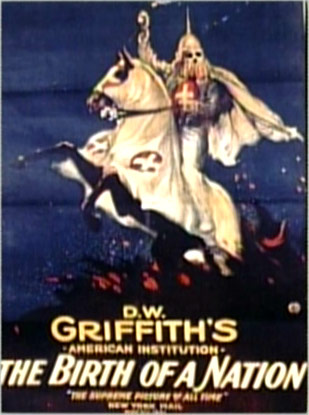
In 1915 D.W. Griffith's silent film, The Birth of a Nation,
was released and it quickly became a national hit. The film did cause
controversy, but went on to become the highest grossing silent film of
all time.
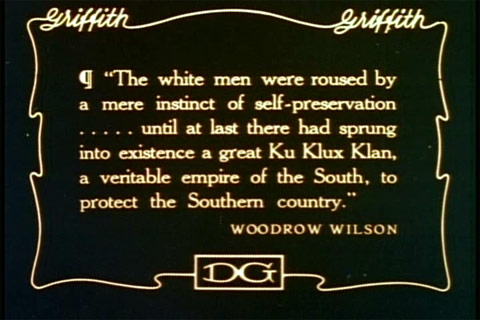
President Woodrow Wilson's History of the American People
was quoted in the film to describe how Northerners and blacks were using
deception and abuse of power to "put the white South under the heal of
the black South."
Birth of a Nation described how Lincoln had undermined state
sovereignty and created a powerful federal government. It depicted
Northern blacks and freed slaves as monstrous villains who were
destroying white civilization and abusing their new-found power after
the Civil War. The major villain of the film is a mulatto, a man
of "mixed white and black race".
Near the final climax of the film, where the Ku Klux Klan unites to
save a town from "Negro anarchy", the film's protagonists retreat to a
cabin that is occupied by a Union Civil War veteran and the following
scene commences:
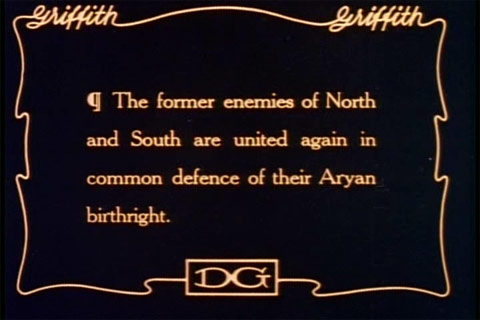
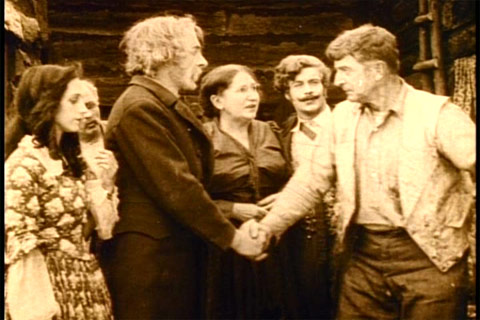
Though it is often said today that the concept of an "Aryan race" was
invented by Hitler or the Nazis, this is not true. The concept of an
Aryan race certainly predates the rise of Nazism. Here, in 1915, in the
most popular film in American history up to that time, the entire story
focused on the concept of defending the Aryan race.
The Great War
America was generally a pacifist country by and large after the Civil
War. The memory of that war had turned many people against armed
conflict. Americans did rally around the Spanish-America War to a
degree, but there was also a large and loud segment of anti-war
protestors during that war as well.
When the United States entered World War I in 1917, three years after
it had begun, it was partly because the war was being brought to America
via the sinking of ships like the Lusitania and Germany's offer to help
Mexico invade America to regain the territory that Mexico lost to the
United States in the Mexican-American War. There were economic reasons
as well.
On the whole, though, America was a pacifist country that opposed
involvement in major wars. Woodrow Wilson was elected based on his
promise to keep America out of war, and he was then re-elected in 1916
with the popular campaign slogan, "He kept us out of
war."
After World War I America quickly went back to it's pacifist
attitudes, with a great many people resenting the American involvement
in the war. America suffered 364,800 casualties during WWI, however this
was a very small fraction of the total number of casualties. Despite the
fact that America came late to the war and suffered less than 1% of the total war casualties (Russia and
Germany suffered the most) Americans still felt as though it was unfair
that Americans had to die in a war in which they felt they had no real
stake. In addition, American soldiers returning from the war made it
very clear in public speaking tours and books that modern warfare was
absolutely horrific.
Europe was generally resentful of the nature of the American
involvement as well. Though the Allies were very happy that America did
finally come in to help turn the tide, at wars end American industry had
made enormous profits from the war. America was viewed to have suffered
relatively nothing and Europe was still in a state of disaster.
Americans were taking much of the credit for winning the war as well,
yet the Europeans had been in the war since 1914. Britain lost 60,000
men on the very first day of war, and the war effort was extremely
costly to all of Europe. Because of this, the Europeans felt that
Americans were doing too much boasting for the relatively small
sacrifice that they contributed.
Below is a listing of pre-war vs. intra-war profits for American
companies involved in World War I.
|
Company |
Average profits in the last pre-war year |
Average profits during the four years
of war |
|
U. S. Steel
|
$105,331,000
|
$259,653,000
|
|
Du Pont
|
$6,092,000
|
$58,076,000
|
|
Bethlehem Steel
|
$6,840,000
|
$49,427,000
|
|
Anaconda Copper
|
$10,649,000
|
$34,549,000
|
|
Utah Copper
|
$5,776,000
|
$21,622,000
|
|
American Smelting
|
$11,566,000
|
$18,602,000
|
|
Republic Iron and Steel
|
$4,177,000
|
$17,548,000
|
|
International Mercantile
|
$6,690,00
|
$14,229,000
|
|
Atlas Powder
|
$485,000
|
$2,374,000
|
|
American and British Man.
|
$172,000
|
$325,000
|
|
Canadian Car & Foundry
|
$1,335,000
|
$2,201,000
|
|
Crocker Wheeler
|
$206,000
|
$666,000
|
|
Hercules Powder
|
$1,271,000
|
$7,430,000
|
|
Niles, Bement Pond
|
$656,000
|
$6,146,000
|
|
Scovill Mfg. Co.
|
$655,000
|
$7,678,000
|
|
General Motors
|
$6,954,000
|
$21,700,000
|
What did take place in America was that a small handful of companies
in military related industries, such as DuPont, US Steel, and General
Motors, not only made huge profits, but they were also recognized to be
of importance to national security and these companies and their top
officials gained a new level of influence in government.
The Bolshevik Revolution and the Rise of
"Americanism"
Arguably one of the most important outcomes of World War I was the
Bolshevik Revolution in Russia, which resulted in the withdrawal of
Russia from the war.
After World War I was over 22 countries, including the United States,
sent troops to Russia to fight on the side of the Czars in the Russian
Civil War between the Reds (the Communists) and the Whites (the
Czarists). American leadership, like the leadership of all other
established capitalist countries, was deeply opposed to Communism in
principle, and so immediately there was an international effort to
overthrow the Bolshevik regime and put the Czars back in power, despite
the fact that the Czars themselves had a long and public record of
abuses and mistreatment of the Russian people.
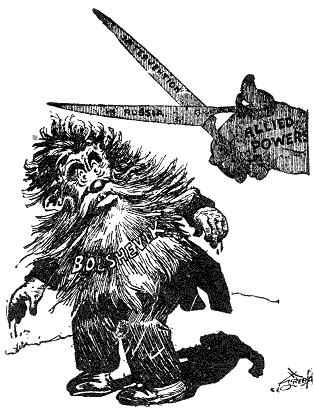
In for a Trimming: The cartoon shows the hand of the "Allied
Powers" wielding the scissors of "Intervention in Russia" to trim back
Bolshevism.
It was in 1917 that The American's Creed was born, written
by US House of Representatives clerk William Tyler Page as part of a
contest. The Creed was adopted by the House of Representatives
in 1918. The American's Creed signified the beginning the new
"Americanism", which would grip the US during the 1920s. The
American's Creed reads as follows:
I believe in the United States of America as a Government of the
People, by the People, for the People; whose just powers are derived
from the consent of the governed; A democracy in a republic, a
sovereign Nation of many Sovereign States; a perfect Union, one and
inseparable; established upon those principles of Freedom, Equality,
Justice, and Humanity for which American Patriots sacrificed their
Lives and Fortunes.
I therefore believe it is my duty to my country to Love it; to
Support its Constitution; to obey its laws; to Respect its Flag; and
to defend it against all enemies.
The Creed, like the Pledge, reflected the new nationalism
that developed after the Civil War, with its emphasis on "a perfect
Union, one and inseparable," but it goes farther as well and is a
reaction to the revolutionary tendencies that were growing throughout
Western Civilization, which were emboldened by the Bolshevik Revolution.
The Creed was to reinforce loyalty of citizens to the State and
counteract revolutionary socialist ideology.
Shortly afterward, in 1919, the "Red Scare" hit the United States.
The Red Scare of 1919 is a complex issue in itself, but to sum it up
briefly, it was a national fear of Communism in which every left-leaning
institution was suspected of being part of international Bolshevik
Revolution.
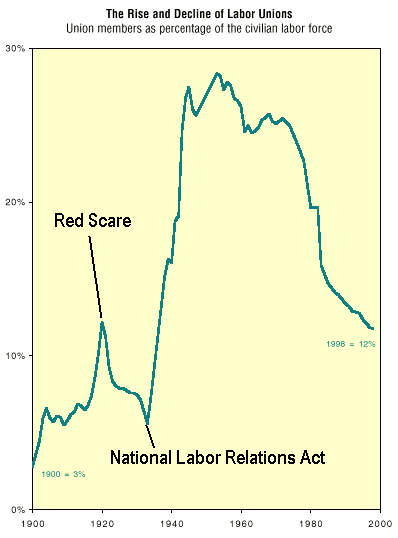
Shortly prior to the Red Scare labor unions had been making
significant progress in America. Unions were becoming more popular and
gaining broader support from the public. With the coming of the Red
Scare politicians and businessmen used the public's fear of Communism to
significantly hurt labor unions and membership dropped radically.
As you can see in the graph below, excerpted from The First Measured Century, the Red Scare had a
significant impact on organized labor in America.
Universities were suspect of teaching radicalism, the Socialist Party
was outlawed, publicly elected officials who were members of the
Socialist Party were thrown out of office, ten thousand people were
imprisoned for being affiliated with socialism (primarily members of
unions), and 800 were deported.
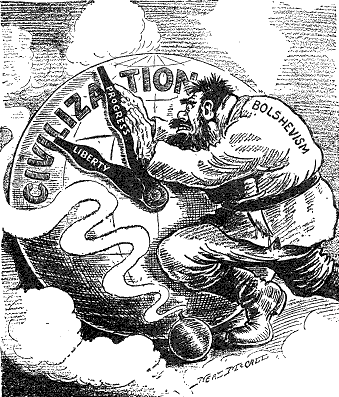 He Would Turn the Clock Back 1,000 Years: (1919)
|
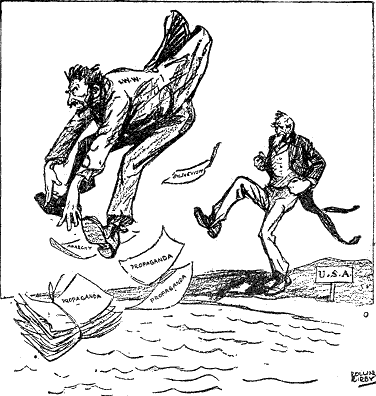 Git!: (1919) Depicting Uncle Same kicking the
International Workers of the World out of America
|
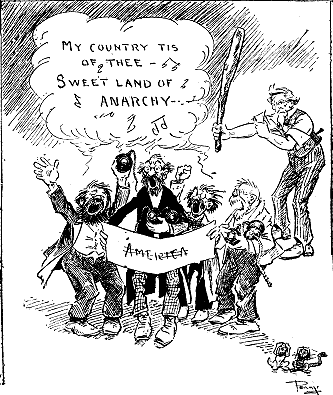 Not if Your Uncle Sam Has His Way: (1919)
|
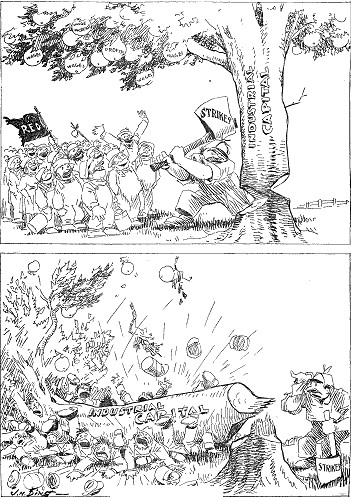 Surely There Must Be a Better Way to Gather the Apples:
(1920)
|
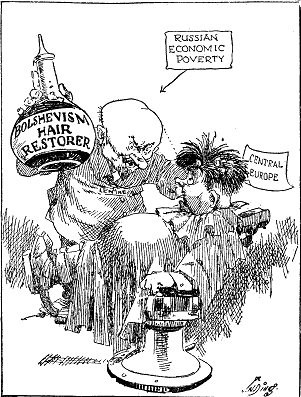 Another Case of the Bald Headed Barber: (1920)
|
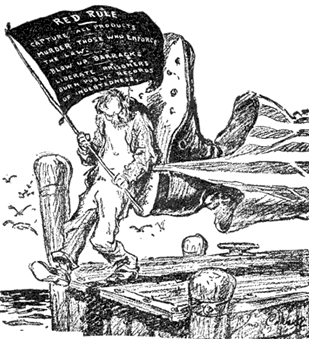 Beat It!: (1920) The flag reads: "Red Rule. Capture
all Products. Murder Those Who Enforce the Law. Blow Up
Barracks. Liberate Prisoners. Burn Public Records of
Indebtedness."
|
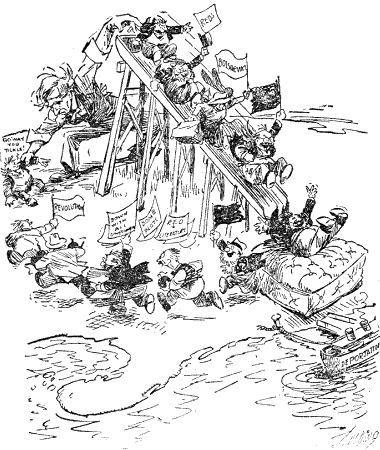 Deporting the Reds: (1920) The Reds carry signs
reading Reds, Bolshevik, Red Literature, Bomb Plots, Down with
All Government and Revolution. The person Uncle Sam is grabbing
is saying, "Go'way you tickle." The ship tied to the land at the
foot of the slide is labeled "Deportation."
|
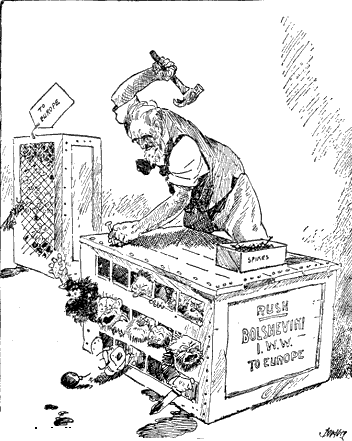 Hurry Up That Shipment Uncle Sam: (1920) Depicts
Uncle Sam boxing up "Bolshevists" and members of the
International Workers of the World to ship back to Europe.
|
America returned to a more pro-business attitude during the post war
boom of the "Roaring 20s" in part because of the Red Scare and its
impact on politics, which gave leverage to free-market proponents, and
because of the public's desire to distance themselves from Communism.
During the 1920s American society became increasingly polarized. In
1920 Prohibition went into effect and organized crime gained a strong
foothold in the American economy. In order to combat the effects of
organized crime, which were largely caused by Prohibition and
facilitated by weapons surpluses from World War I, the FBI was given
increased powers.
Apart from the issue of organized crime for the purpose of profits,
there was another major issue brewing during the 1920s in America, that
of racism and extreme right-wing organizations like the Ku Klux Klan.
The Klan has a long history, going back to the early days of
Reconstruction after the Civil War, but the Klan reached its peek of
influence in the mid 1920s. In 1924 the Ku Klux Klan is reported to have
had over 4.5 million members and held great political power in Oregon,
Oklahoma, Texas, Arkansas, Indiana, Ohio, and California. Approximately
20% of adult white males in the South were members of the KKK at this
time. The Klan's strongest state was Indiana. In 1924 Klansman Edward
Jackson was elected governor of Indiana. As was previously stated,
Indiana was also one of the places where the eugenics movement was
strongest as well.
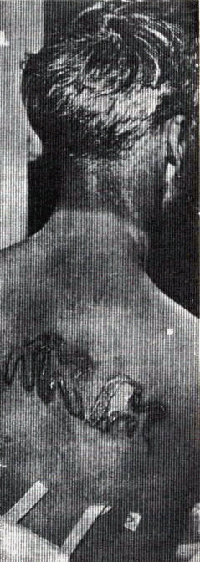
Branded by the KKK for a public speech against cross burning
in 1924 |
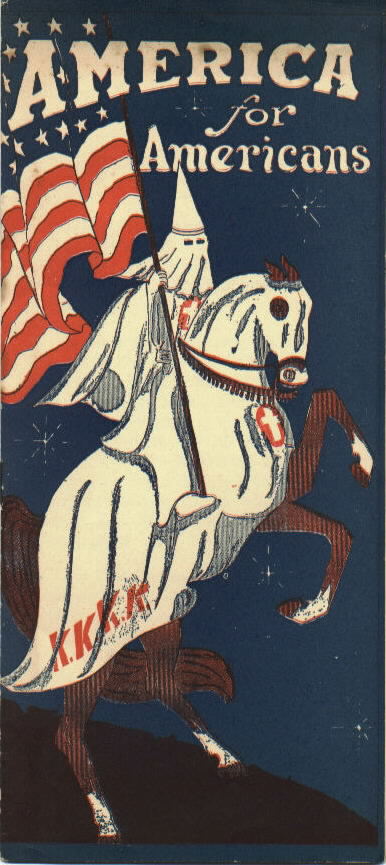
Knights of the Ku Klux Klan |
|
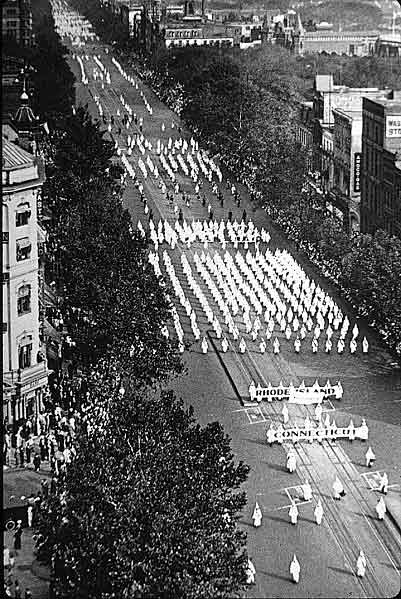
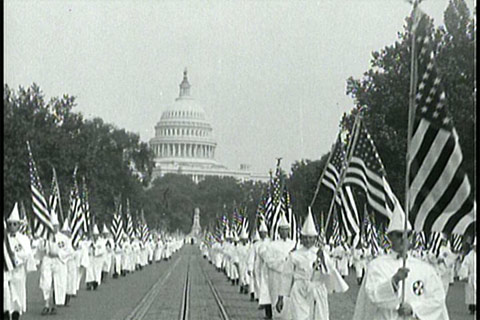
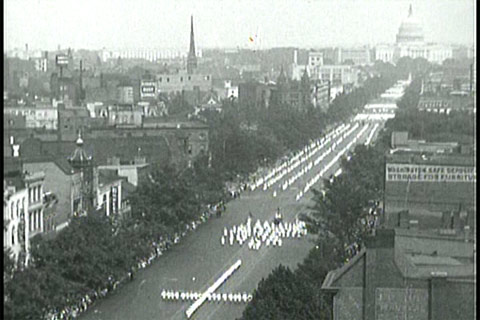
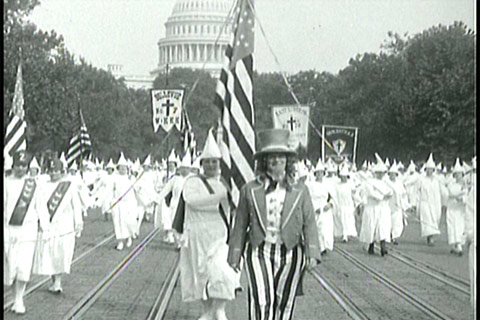
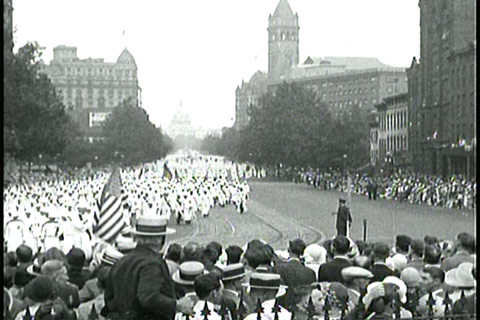
1925 KKK parade in Washington D.C. Over 400,000 members in
attendance
|
The Klan was, and is, a Protestant based organization opposed to
blacks, Jews, Catholics, and immigrants in general. Though the Klan was
dominant in the South its influence during the 1920s was nation wide.
During its peak the Klan was seen by a large portion of the American
population as a respectable organization that stood for order and
preservation of traditional values. The Klan also opposed Marxism,
homosexuality, atheism, and liberalism in general. In fact Klan ideology
and Nazi ideology are virtually identical and, like the later Nazis, the
Klan presented themselves as a pillar of virtue, and in many ways they
were accepted as such by society until a series of scandals ruined their
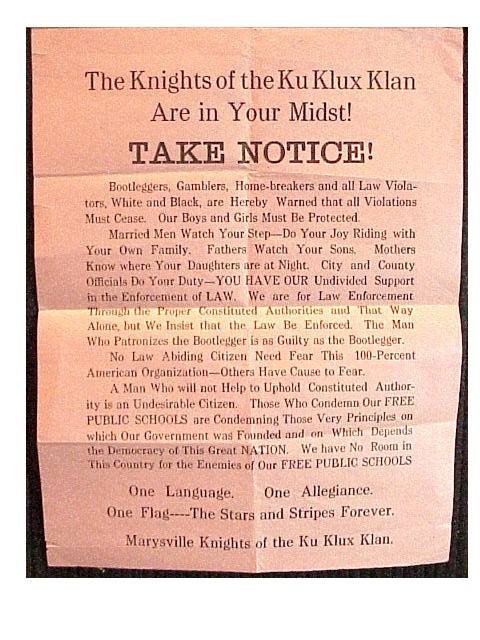
image. The Klan were also supporters of Prohibition on the grounds that
drinking was sinful, as is evidenced in the 1920's flyer below.
Their image was not ruined by lynchings or their racist attitudes and
actions, but rather it was ruined by the exposure of fraud within the
organization and the raping to death of a young woman by "Grand Dragon"
D.C. Stephenson.
The Klan had billed itself as a pillar of virtue and an upholder of
American values, and when the extent of the Klan's illegal activities
became fully exposed the organization lost virtually all of its
credibility, however what is important to note is that while Klan
membership dropped in the late 1920s it was not because people no longer
identified with the "values" of the Klan, but rather because the Klan
had lost its credibility in upholding those "values." The Pledge of Allegiance was changed in
the 1920s as well, reflecting changing American attitudes. In 1924 the
American Legion (a conservative pro-nationalist organization)
participated in having the words "my Flag" changed to
"the Flag of the United States of America".
"The American Legion's constitution includes the following goal:
"To foster and perpetuate a one hundred percent Americanism." One of its
major standing committees was the "Americanism Commission" and its
subsidiary, the "Counter Subversive Activities Committee." To the fear
of immigrants, it added the fear of communism."
http://archive.aclu.org/news/move/pledgeorigin.html
A variety of right-wing political groups were active in America
during the 1920s who promoted "100% Americanism", the KKK and American
Legion being just two of them. The changes to the Pledge that they
supported were partly a reaction to the Bolshevik Revolution, and also a
reaction to growing numbers of immigrants from Europe, such as Jews,
Italians and Irish. These "nativists" made every effort to indoctrinate
immigrants with the ideas of "Americanism." Americanism was seen as a
reinforcement of white male Protestant values and promoted white male
Protestant cultural domination.
In conjunction with this there was growing popular anti-Semitism in
America as well, and this anti-Semitism was largely adopted by these
various nativist groups. Henry Ford was a major voice of anti-Semitism
in the 1920s. Protestant Henry Ford, who started an anti-Semitic
periodical called The Dearborn Independent
in 1921, went on to publish The Protocols of the Learned Elders of
Zion, a fraudulent writing which was claimed to be the secret
hidden agenda of Jews to rule the world, and then published
The International Jew: The World's
Foremost Problem.
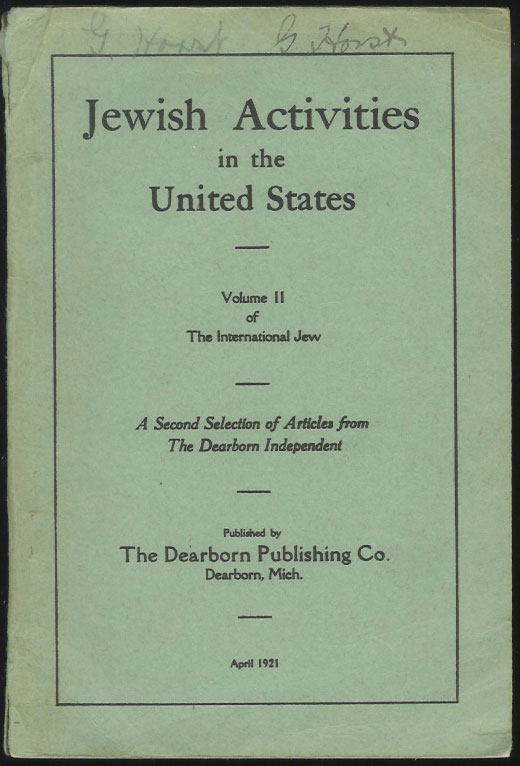
Ford and the other writers of Dearborn Publishing promoted the
view of superiority built on race, and opposed Jews and other minorities
as racially and culturally inferior. According to this view the ideas of
socialism, liberalism and Marxism were plots used by inferior races to
promote equality and thereby elevate themselves to the level of the
superior Anglo-Saxon Protestants, or to lower Anglo-Saxon Protestants to
their "inferior" level.
Below is a small example of the material found in The Dearborn
Independent and The International Jew:
WHAT TO DO ABOUT IT?
Simply identify the source and nature of the influence which has
overrun our schools and universities. Let the students know that
their choice is between the Anglo-Saxons and the Tribe of Judah. Let
the students decide, in making up their allegiance, whether they
will follow the Builders or those who seek to tear down. It is not a
case for argument. The only absolute antidote to the Jewish
influence is to call college students back to a pride of race.
We often speak of the Fathers as if they were the few who
happened to affix their signatures to a great document which marked
a new era of liberty. The Fathers of our nation were the men of the
Anglo-Saxon-Celtic race. The men who came from Europe with
civilization in their blood and in their destiny. The men who
crossed the Atlantic and set up civilization on a bleak and
rock-bound coast; the men who drove north to Alaska and west to
California; the men who opened up the tropics and subdued the
arctics; the men who mastered the African veldt; the men who peopled
Australia and seized the gates of the world at Suez, Gibraltar and
Panama; men who have given form to every government and a livelihood
to every people and an ideal to every century. They got neither
their God nor their religion from Judah, nor yet their speech nor
their creative genius- they are the Ruling People. Chosen throughout
the centuries to Master the world, by building it ever better and
better, and not by breaking it down.
Into the camp of this race, among the sons of the rulers, comes a
people that has no civilization to point to, no aspiring religion,
no universal speech, no great achievement in any realm but the realm
of "get," cast out of every land that gave them hospitality, and
these people endeavor to tell the Sons of the Saxons what is needed
to make the world what it ought to be!
If our sons follow this counsel of dark rebellion and
destruction, it is because they do not know whose sons they are, of
what race they are the scions. Let there be free speech to the limit
in our universities and free intercourse of ideas, but let Jewish
thoughts be labeled Jewish, and let our sons know the racial secret.
NAME THE ENEMY!
Judah has begun the struggle. Judah has made the invasion. Let it
come. Let no man fear it. But let every a man insist that the fight
be fair. Let college students and leaders of thought know that the
objective is the regnancy of the ideas and the race that have built
all the civilization we see and that promises all the civilization
of the future; let them also know that the attacking force is
Jewish.
That is all that will be necessary. It is against this that the
Jews protest. "You must not identify us," they say, "You must not
use the term 'Jew'." Why? Because unless the Jewish idea can creep
in under the assumption of other than Jewish origin, it is doomed.
Anglo-Saxon ideas dare proclaim themselves and their origin. A
proper proclamation is all that is necessary today. Compel every
invading idea to run up its flag!
Ford's promotion of the 5 day work week, 8 hour work day, and his $5
a day program had some lesser known motivations as well. Ford was
extremely opposed to unions and began promoting and adopting these
policies as a way to make concession in order to prevent unionization in
his plants. In addition he was interjecting an element of Biblical
moralism into his policies as well. This was largely motivated by the
fact that there was an association between atheism and the Socialist
movement, which Ford opposed.
Ford had developed a "Sociological Department" for his company, the
goal of which was to "put a soul into the company." Ford told
the head of the department that he wanted him to, "put Jesus Christ
in my factory." In order to qualify for the $5 a day wage that Ford
was offering a worker had to submit to corporate surveillance of his
lifestyle by the Sociological Department. Employees were subject to home
inspections, had to prove they were sober, prove they regularly saved a
portion of their paycheck, and prove that they were not "living
riotously," which included activities such as gambling or staying out
late.
Ford cooperated with the American Protective League, an organization
of about 250,000 members, who's members were stationed in factories and
mingled with the public, profiling working men and women. The objective
of the APL was to profile workers and bring pressure against any workers
who were organizing unions or getting involved in labor movements.
Information collected by the APL was passed on to the Justice
Department, military, and local law enforcement.
Ford's Sociological Department later developed into his "Service
Department." In the book The Five Dollar Day, author Steven
Meyer quotes Jonathon Norton Leonard from 1924:
"No one who works for Ford, is safe from spies-from
superintendents on down to the poor creature who must clean a certain
number of toilets an hour. There are spies who ask embarrassing
questions of visitors' guides, spies who worm their way into labor
unions, spies who speak every language under the sun. The system does
not stop at the factory gates. An anonymous letter accusing a man of
stealing Ford parts is enough to bring him before the 'Service
Department.' He is forced to sign a 'Permission for Search' which allows
Ford detectives to ransack his home, turn out all his poor possessions
in hopes of finding a Ford incandescent lamp or a generator armature.
There are spies to watch these in turn."
FDR's Economic Fascism
When the Stock Markets crashed in 1929, the beginning of the Great
Depression, it changed American attitudes about the economy.
Unemployment rates sky rocketed and support grew for increased
government involvement in the management of the national economy.
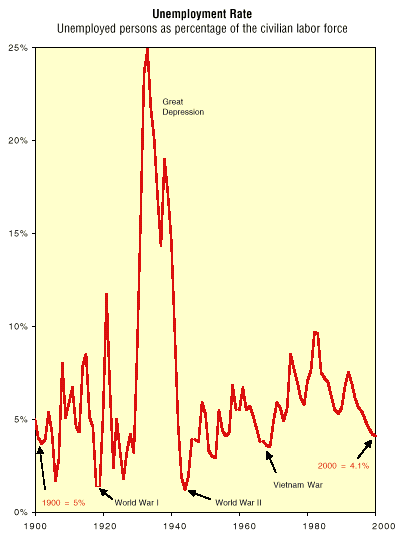
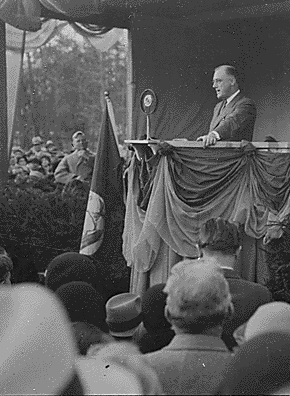
In 1932 governor of New York, Franklin D. Roosevelt, was elected
President of the United States. When Roosevelt came into office he began
work on a wide range of economic policies that would take several years
to sign into law. These policies would become collectively known as "The New Deal".
When Roosevelt began work on his economic reforms after his election,
he did so with a large team of economists, businessmen, policy makers,
and bankers; people from all different perspectives and backgrounds. By
the time the Great Depression hit America and FDR had come into office,
Benito Mussolini was at the height of his success and many Americans
viewed Mussolini's programs as a proven and successful way to deal with
the problems of economic depression.
Like the fascists in Europe, Americans were generally opposed to both
Communism and "high finance," that is to say the extremely powerful
capitalists who had come to dominate the American economy, and who many
felt had far too much control over American life.
Since the time of Mussolini's rise to power men like US Ambassador to
Italy Henry Fletcher, Secretary of State Frank Kellogg, Charles
Lindbergh, State Department head Norman Davis, and many others all
agreed that his regime represented "solid opposition to
communists, socialists, and anarchists."
Eleanor Roosevelt wrote that FDR's appointed American Ambassador to
Italy, Breckenridge Long, had been "rhapsodizing about the
achievements of Mussolini's new 'corporate state'" saying:
"Italy today is the most interesting experiment in government to
come above the horizon since the formulation of the Constitution 150
years ago. [Mussolini] is one of the most remarkable persons . . . And
they are doing a unique work in an original manner, so I am enjoying it
all."
In 1931 Major General Smedley Butler publicly relayed a story about
Mussolini, apparently told to him by Cornelius Vanderbilt Jr., in which
Mr. Vanderbilt was riding with Mussolini and Mussolini hit a child with
his car but kept on going and refused to stop. Butler's public telling
of the story caused international outrage and Butler was then arrested,
court-martialed by Secretary of War Stimson and told to apologize to
Mussolini. Butler refused, deciding instead to retire. Nevertheless this
illustrates the degree to which Mussolini and fascism were respected in
America at the time.
In 1934 the American State Department proclaimed that the 99% victory
of the Fascist Party in Italian elections "demonstrate incontestably
the popularity of the Fascist regime."
The State Department, as late as 1937, praised Italian Fascism
stating that it "brought order out of chaos, discipline out of
license, and solvency out of bankruptcy." The State
Department continued to embrace fascism because of its anti-Communist
position. Italy and Germany were being "made safe" by the fascists for
American investment, and this is what was important in economic
terms, especially during the Great Depression in America.
The New Deal policy makers took many cues from Mussolini's public
works programs, and the way in which he organized labor and corporations
in order to promote employment. These are all of the same basic types of
programs that were implemented with the New Deal.
New Deal legislation saw the creation of a wide range of federal
agencies and programs, which are listed below:
Works Projects Administration (WPA)
Civilian Conservation Corps (CCC)
National Youth Administration (NYA)
Farm Security Administration (FSA)
National Recovery Administration (NRA)
Public Works Administration (PWA)
Federal Emergency Relief Administration
Agricultural Adjustment Act
National Housing Act
Federal Securities Act
Social Security Act
National Labor Relations Act
The net effect of all of this was to increase the role of the State
in the economy for the purpose of creating stability, providing security
for average citizens and businessmen alike, and to give the government a
hand in directing the development of the national economy.
Mussolini, "instituted a program of public works hitherto
unrivalled in modern Europe. Bridges, canals and roads were built,
hospitals and schools, railway stations and orphanages, swamps were
drained and land reclaimed, forest were planted and universities were
endowed." Along those same lines FDR promoted many public works
projects, such as the Rural Electrification project and the building of
many dams through the Tennessee Valley Authority, including the Hoover
Dam. As with all of these projects, they were not done by the
government, they were done by private companies with funding
from the government. This is one crucial difference between
fascist economies and socialist economies. In a fascist economy public
taxation is used to funnel money to private corporations through the
government, whereas in a socialist economy like that of the Soviet Union
there is no taxation and industry itself is run by the government for
profit.
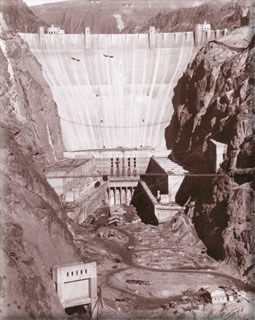
A company called Six Companies is who won the bid for the Hoover Dam
and the project was very successful for them. All of the public works
programs brought corporations and the State closer together and allowed
companies to build projects that they would have otherwise not been able
to get the funding for. This also helped to provide much needed jobs for
large numbers of unemployed Americans.
Also like the fascists of Europe, FDR held rallies and parades to
promote his economic agenda, and encouraged citizens to show their
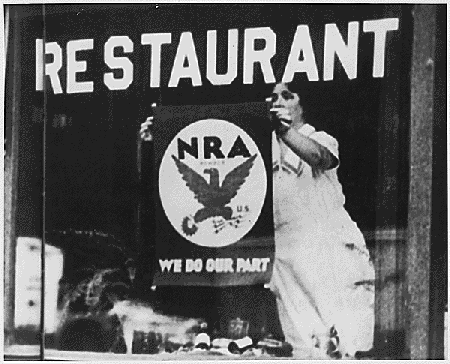
support. In 1933 a public relations campaign was launched by the NRA to
bolster popular support the organization and its initiatives. Business
were encouraged to hang banners with the NRA logo and motto in their
windows showing that they were complaint with NRA regulations.
Much is made about the eventual backing of the New Deal by the
Communist Party of America in 1935, however the Communist Party backing
only came as part of the "Popular Front" movement, which was when
American Communists decided to support New Deal legislation in an effort
to prepare American industry for conflict with the European fascists.
Despite the Popular Front backing of the New Deal though, Marxists
continued to criticize the plan as essentially American fascism.
Whether or not their charges were correct or not is actually beside the
point, the point is that the New Deal does not represent left-wing
socialist ideology, as is often thought, and despite the apparent
support for the New Deal by left-wing political groups, much of that
support actually came more in the form of "the enemy of my enemy is my
friend" type support, Roosevelt and his New Deal being the enemy of
European fascism. These views were reflected in many American Communist
publications, such as this October 1941 publication of The Communist.
The New Deal was seen by the radical American left as the best hope
to mobilize America in preparations for a fight against European
fascism, which was always something that far left political groups were
more concerned about than the average citizen. During the early and mid
1930s the average American citizen was not overly concerned with the
goings on in Europe, and in fact many supported the Fascist regimes
there because of their anti-Communist and pro-order policies, but the
far American left was acutely aware of the magnitude of the problems in
Europe and was opposed to the Fascist regimes from the start, because of
course the Fascists were anti-leftist regimes.
This is why, even during the mid 1930s, members of the American far
left were already thinking about war with the Fascist powers of Europe
and indeed they were participating in that war early by volunteering to
fight against the fascists in the Spanish Civil War, the precursor to
WWII, and this is why the New Deal was seen by the American far left in
a different light than that of the American mainstream. To them it was
about more than just domestic policy, they recognized it as the
mobilization of industry to prepare for war, and as such backed the New
Deal on those terms. The American Communist Party opposed the FDR
administration's lack of support for anti-lynching legislation and what
was seen as a weak stance on issues of racial and gender justice.
In 1965 Libertarian author Murray Rothbard observed:
Thus, in 1934, the British Leninist theoretician R. Palme Dutt
published a brief but scathing analysis of the New Deal as "social
fascism" - as the reality of fascism cloaked with a thin veneer of
populist demagogy. No Conservative opponent has ever delivered a
more vigorous or trenchant denunciation of the New Deal. The
Roosevelt policy, wrote Dutt, was to "move to a form of dictatorship
of a war-type"; the essential policies were to impose a State
monopoly capitalism through the NRA (National Industrial Recovery
Act), to subsidize business, banking, and agriculture through
inflation and the partial expropriation of the mass of the people
through lower real-wage rates and to the regulation and exploitation
of labor by means of government-fixed wages and compulsory
arbitration. When the New Deal, wrote Dutt, is stripped of its
"social-reformist 'progressive' camouflage," "the reality of the new
Fascist type of system of concentrated State capitalism and
industrial servitude remains," including an implicit "advance to
war." Dutt effectively concluded with a quote from an editor of the
highly respected Current History Magazine:
'The new America [the editor had written in mid-1933] will not be
capitalist in the old sense, nor will it be socialist. If at the
moment the trend is towards fascism, it will be an American fascism,
embodying the experience, the traditions, and the hopes of a great
middle-class nation.'
In a 1934 interview of Joseph Stalin by H.G. Wells,
Joseph Stalin and H. G. Wells, Marxism VS.
Liberalism: An Interview, published in 1937, Stalin explained
that what was taking place in America under FDR was not in any way the
same thing that was taking place in the U.S.S.R. Stalin stated:
"The United States is pursuing a different aim from that which we
are pursuing in the U.S.S.R. The aim which the Americans are
pursuing arose out of the economic troubles, out of the economic
crisis. The Americans want to rid themselves of the crisis on the
basis of private capitalist activity without changing the economic
basis. They are trying to reduce to a minimum the ruin, the losses
caused by the existing economic system. Here, however, as you know,
in place of the old destroyed economic basis an entirely different,
a new economic basis has been created. Even if the Americans you
mention partly achieve their aim, i.e., reduce these losses to a
minimum, they will not destroy the roots of the anarchy which is
inherent in the existing capitalist system. They are preserving the
economic system which must inevitably lead, and cannot but lead, to
anarchy in production. Thus, at best, it will be a matter, not of
the reorganization of society, not of abolishing the old social
system which gives rise to anarchy and crises, but of restricting
certain of its bad features, restricting certain of its excesses.
Subjectively, perhaps, these Americans think they are reorganizing
society; objectively, however, they are preserving the present basis
of society."
It must be noted that while the Communist Party USA (CPUSA) gave
official support to the New Deal and President Roosevelt in 1935, it
retracted that support and began opposing FDR in 1939 when the
Molotov-Ribbentrop pact, also known as the Soviet-Nazi pact
or Stalin-Hitler pact, was signed between the Soviet Union and Nazi
Germany. The Soviets signed this pact in an effort to prevent what they
felt would be an imminent invasion by the Germans had they not signed
it, and Germany promoted the offer in an attempt to annex Poland without
causing war. Nonetheless, Britain and France did declare war on Germany
when the Germans invaded Poland. During the time between the signing of
this pact and the invasion of the Soviet Union by Germany, the CPUSA, at
the direction of Moscow, called for non-involvement on the part of the
United States in the European War and waged a campaign against FDR. The
effect of the CPUSA's campaign was minor on the general public, but it
did cause many members of the CPUSA to break ranks with the party and
the party lost considerable credibility.
Neither Winston Churchill nor FDR were in favor of Communism, but
they began more and more to view Germany and Italy as greater rising
threats to the capitalist interests of their countries than was the
Soviet Union. Churchill was very outspoken in his contempt for the
Bolsheviks, but he, along with FDR, began trying to court Russia in what
amounted to a containment strategy of Germany. This was a program that
FDR himself felt very strongly about, but he faced a nation of citizens
who were either extremely pacifistic, anti-war, or were sympathizers of
the European fascists.
This is not to say that everyone during this time understood what was
going on, the intentions of the various players in the situation, or the
actual implications of the policies being implemented. FDR, while
popularly supported overall, still received strong criticism from the
"right" and "far left." The New Deal was representative of the types
measures that were observed to work for the Fascists in Italy in pushing
back Communist political advances, and in addition it was simply a
pragmatic way to deal with the real problems of laissez-faire
capitalism. The New Deal embodied measures of collectivism and
centralization, but not with the same goals of socialist measures. The
New Deal made no attempt to fundamentally change the American economic
system, only to stabilize it and strengthen the capitalist system.
The New Deal was implemented with all of the best intentions in mind.
In 1933 US Ambassador to Germany, William E. Dodd issued a speech
titled Dilemma in the United States in
Berlin at an American Club Dinner about the situation in America. Dodd
was also a professor of history.
Parts of this speech read:
"The Federal Constitution is a balanced instrument of most
limited powers, and all executive functions are subject to
legislative and judicial approval. Only in time of war may a
President take any decisive action. Lincoln violated the
Constitution to save the Union, and Wilson sometimes transcended his
powers for the obvious common good, though actual violations of the
fundamental law were not a part of his practice. Might men
interpret the events of March 1933 as warlike?
In the chaotic situation, with banks closing their doors
everywhere, President Roosevelt acted as if he were in a state of
war. He declared a bank holiday and hastened the assembling of
congress. Excitement was everywhere as great as in 1917.
Senators and Representatives recognized urge of the hour; but they
also felt the pull of the American Legion and the pressure of local
demands. It was a situation which legislators are apt to
convert into an impasse, witness the panicky times of Andrew Jackson
and Grover Cleveland when all Presidential action was defeated. But
Roosevelt had converted his long struggle for recovering his health
into a ten-year study of history and economics. He had learned how
men behaved in past crises.
He held conferences with the greater committees of both houses
of Congress; he consulted experts on subjects on which expert
opinion was needful; he coaxed semi-hostile newspaper folk to delay
their opposition; and he postponed appointments to ten thousand
offices in which mere politicians were interested. It was a
human picture, a Jefferson urging Southerners to abolish slavery,
lest they themselves be abolished; a Wilson urging war to end war.
And Roosevelt was successful. A banking war was enacted which gave
the Federal Government powers which must paralyze all state
systems. A control over the issue of securities was enacted which
would probably have prevented the depression if applied in
1921-1929. The farmers of the West were told in legal form how
much wheat they might plant, and cotton growers were ordered to plow
up ten million acres of the 1933 crop. If railroads were to
operate, their managers must submit to orders from the White
House. The whole economic life of the country was taken in hand upon
mandates voted by both houses of Congress. There had never been
anything like it before, but some way to recovery must be sought,
else even greater catastrophe than that of 1929 might come. It was
not revolution as men are prone to say. It was a popular
expansion of governmental powers beyond all constitutional grants;
and nearly all men everywhere hope the President may succeed.
If he is able to put half the unemployed back to work; if the new
banking law and corporation control yield half the desired results,
the cause of democracy and personal liberty may survive the
onslaughts of our times."
This is a fairly accurate account of what happened and the perception
of the conditions under which it did happen. It was a change, a
significant change, of that there is no doubt, and it was a change of
the economically fascist type, but that is not meant in a negative way
per-se. It was a change that brought the economy under a new level of
control by the federal government, and it was done for much the same
reasons that it was done in Italy and Germany, in order to save the
economy from collapse or vulnerability. Unlike Italy and Germany
however, the "threat of communism" was essentially nonexistent in
America, whereas in Italy and Germany communists held significant
political power, which was part of the reason why regimes there were
much more extreme.
FDR himself would have in no way considered any of his policies
"fascist," nor would he ever have compared himself to the fascists of
Europe, of that there is little doubt. FDR despised dictatorship and he
despised the actions of the Nazis especially, yet the fact remains that
fundamentally they were all walking along many of the same lines. Their
objectives and ideologies were very different but they were all faced
with the same issues and all arrived at similar solutions. The problems
inherent in laissez-faire capitalism and the opposition to Marxist
ideology resulted in the middle ground development of economic fascism
in all three places, and there was a measure, especially early on, of
admiration and imitation of the Italian system by contributors to the
New Deal.
As was the case in Germany and Italy, people began to look more and
more to the State, and to Roosevelt himself, as their savior. The State
was playing a much larger role in people's lives under Roosevelt than at
any other time in American history.
In addition to his economic agenda, FDR shared some other traits of
fascist leaders of the day as well, such as his "cult of personality."
FDR was, and perhaps still is, one of the best loved presidents of all
time. He was an excellent speaker and motivator and unlike any president
before or since he made a connection to the people. FDR held frequent
radio addresses to the public, his "Fireside Chats", which took on the air of a personal
conversation.
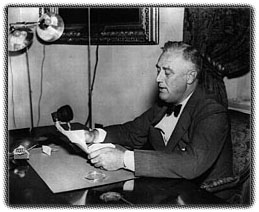
Much like the Italians and Germans did with Mussolini and
Hitler, the American public identified strongly with FDR as "their
leader," however FDR's approach and message was much different than that
of the European fascists. FDR did not preach hate or conquest, or try to
fill people's heads with messages of superiority. It has to be
remembered too though that in fact the majority of the message of the
fascists of Europe was not one of hate, they too spoke primarily about
unity and building a stronger nation.
Though much is made about the fact that FDR served an amazing four
terms in office, what is often overlooked is that FDR was ready to
retire after his second term, in fact he nearly declined the 1940
Democratic Party nomination. It was at first said that FDR would not run
for office again, but at the Democratic National Convention he received
a standing ovation and chants of "We want Roosevelt, We want
Roosevelt," and indeed he did finally accept by saying
"If nominated and elected, I could not in these times refuse to take
the inaugural oath, even if I knew I would be dead in thirty days."
(a reference to his poor health)
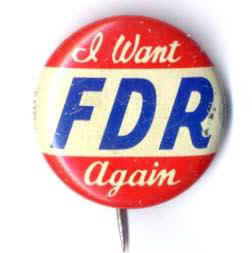
His four terms were served at public request because he was very
popular; he inspired people, and the same can be said of the European
fascists; they all had developed a "cult of personality." They
were inspiring people, as a member of the SS said of Hitler:
"As far as Hitler is concerned, we regarded him as a true man. He
was only a corporal when he earned the Iron Cross First Class in World
War I. In those days that was quite an achievement. When he spoke at
meetings or rallies he managed to captivate his audience. He was able to
get us in a mood where we believed everything he said and we left fired
with enthusiasms. Everyone I met respected and trusted Hitler and I
myself shared these feelings and opinions."
-
Standartenoberjunker Jan Munk - SS
The Term "Liberal" Redefined
The term "liberal" in America has been redefined from its classical
meaning. Liberalism, in the classical sense of the word is a
laissez-faire approach to economics and social issues. Liberalism in the
true sense of the word means "hands off," "let people do what they
will".
In America the term "liberal" has become synonymous with "big
government." This is because FDR proclaimed himself to be a
champion of liberalism. Thus what happened during FDR's 12-year term in
office is that he single handedly changed the American perception of
what "liberal" meant.
Below are a few quotes from FDR that demonstrate how FDR really
created the modern image of what it means to be "a liberal" by
proclaiming himself to be a liberal and proclaiming that his actions
were of a liberal nature.
"A radical is a man with both feet firmly planted-in the air. A
conservative is a man with two perfectly good legs who, however, has
never learned to walk forward. A reactionary is a somnambulist walking
backwards. A liberal is a man who uses his legs and his hands at the
behest of his head." - date unknown
"Throughout the world, change is the order of the day.... In most
nations social justice, no longer a distant ideal, has become a definite
goal. We seek it through tested liberal traditions.
We find our population suffering from old inequalities.... In
spite of our efforts... we have not weeded out the overprivileged and we
have not effectively lifted up the underprivileged. .
We have, however, a clear mandate from the people, that Americans
must forswear... the acquisition of wealth which, through excessive
profits, creates undue private power over private affairs and, to our
misfortune, over public affairs as well...." - 1935 Inaugural
Address
Speaking about very wealthy American capitalists:
"The "privileged princes of these new economic dynasties,
thirsting for power, reached out for control over Government itself.
They created a new despotism and wrapped it in the robes of legal
sanction...." They erected a "new industrial dictatorship" which
controlled the "hours men and women worked, the wages they received, the
conditions of their labor...."
"For too many of us the political equality we once had won was
meaningless in the face of economic inequality. A small group had
concentrated into their own hands an almost complete control over other
people's property, other people's money, other people's labor-other
people's lives. For too many of us life was no longer free; liberty no
longer real...."
"Against economic tyranny such as this, the American citizen
could appeal only to the organized power of Government. The collapse of
1929 showed up the despotism for what it was. The election of 1932 was
the people's mandate to end it. Under that mandate it is being ended
..." - 1936
FDR's 1944 "Economic Bill of Rights":
"It is our duty now to begin to lay the plans and determine the
strategy for the winning of a lasting peace and the establishment of an
American standard of living higher than ever before known. We cannot be
content, no matter how high that general standard of living may be, if
some fraction of our people-whether it be one-third or one-fifth or
one-tenth-is ill-fed, ill-clothed, ill-housed, and insecure.
This Republic had its beginning, and grew to its present
strength, under the protection of certain inalienable political
rights-among them the right of free speech, free press, free worship,
trial by jury, freedom from unreasonable searches and seizures. They
were our rights to life and liberty.
As our nation has grown in size and stature, however-as our
industrial economy expanded-these political rights proved inadequate to
assure us equality in the pursuit of happiness.
We have come to a clear realization of the fact that true
individual freedom cannot exist without economic security and
independence. "Necessitous men are not free men." People who are hungry
and out of a job are the stuff of which dictatorships are made.
In our day these economic truths have become accepted as
self-evident. We have accepted, so to speak, a second Bill of Rights
under which a new basis of security and prosperity can be established
for all-regardless of station, race, or creed.
Among these are:
The right to a useful and remunerative job in the industries or
shops or farms or mines of the nation;
The right to earn enough to provide adequate food and clothing
and recreation;
The right of every farmer to raise and sell his products at a
return which will give him and his family a decent living;
The right of every businessman, large and small, to trade in an
atmosphere of freedom from unfair competition and domination by
monopolies at home or abroad;
The right of every family to a decent home;
The right to adequate medical care and the opportunity to achieve
and enjoy good health;
The right to adequate protection from the economic fears of old
age, sickness, accident, and unemployment;
The right to a good education.
All of these rights spell security. And after this war is won we
must be prepared to move forward, in the implementation of these rights,
to new goals of human happiness and well-being.
America's own rightful place in the world depends in large part
upon how fully these and similar rights have been carried into practice
for our citizens."
There is some merit to the way in which FDR used the word liberalism
as well though. When FDR used the word liberalism or when he described
his policies as "liberal", what he meant was that private power
was becoming anti-liberal. In other words, private power was becoming
controlling. Wealthy capitalists had consolidated so much power in
America that by government taking a "hands off" approach all it was
doing was allowing these private institutions and individuals to dictate
the country's economic conditions and thereby allowing these private
entities to become controlling forces in people's lives.
So, in that respect FDR saw his policies of taking some of that power
away from the private institutions as "liberal" in the sense that is was
restoring liberty to the common man.
FDR's policies dramatically increased the scope and power of the
federal government and thus became associated with "big government" and
"tax and spend," when in fact neither the idea of "big government" or
"tax and send" are "liberal ideas." They are in fact fundamentally
fascist qualities, which were implemented for the purpose of solving
real problems that existed in the American economy. What has to be
remembered is that aside from all the bad things which we now associate
with fascism, the fascists did develop some successful policies and they
were popularly supported at the time.
The entire world was facing many of the same issues. The period of
the 1920s and 1930s represented a worldwide crisis in capitalism. The
crisis was in laissez-faire capitalism and fascism was the means of
"saving" capitalism by: number one: stopping the blatant abuses of the
system, and number two: preventing an overthrow of capitalism by
socialism and communism.
American Race relations during Roosevelt's
administration
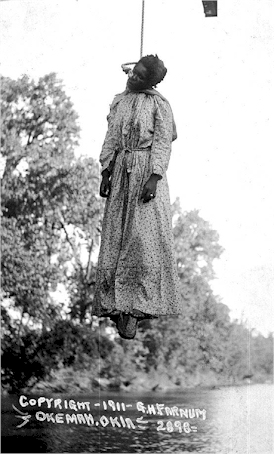
"District Judge Caruthers convened a grand jury in June 1911 to
investigate the lynching of [this] Negro woman and her son. In his
instructions to the jury, he said, "The people of the state have
said by recently adopted constitutional provision that the race to
which the unfortunate victims belonged should in large measure be
divorced from participation in our political contests, because of
their known racial inferiority and their dependent credulity, which
very characteristic made them the mere tool of the designing and
cunning. It is well known that I heartily concur in this
constitutional provision of the people's will. The more then does
the duty devolve upon us of a superior race and of greater
intelligence to protect this weaker race from unjustifiable and
lawless attacks.""
Throughout the 1920s and 1930s race relations in America were in a
general decline at the social level. This is one reason why the
situation in Germany with the Jews was not seen by many Americans as
anything extraordinary. That Jews were discriminated against in Germany
and segregated was nothing new to Americans who were accustomed to
racial segregation. In fact Hitler mentioned that his segregation
practices were based on the American example.
The term lynching originated in America when, after the American
Revolution, a judge named Lynch became well known for the large number
of loyalists that he sentenced to hanging. After the Civil War the
lynching of blacks took on a new aura as it was seen as a "defense of
white culture against the Negro." The practice, after blacks had been
freed as slaves, was to keep blacks in fear and in a subordinate status.
There were close to 2,000 lynching in America in the 20th century,
almost all of them coming before World War II. In terms of violence and
repression Germany was not much more repressive than America until the
war broke out. The Germans did not begin the mass killing of Jews and
others until after the war started. Prior to that the situation in
Germany was mostly one of segregation, discrimination, and public acts
of violence, nothing that was out of character in American race
relations of the time.
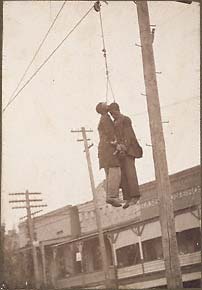 |
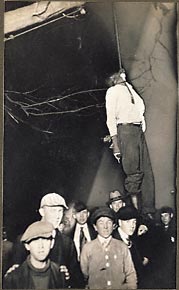 |
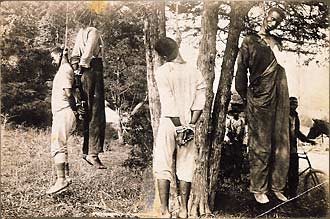
Note on body reads: "Let this be a warning to you niggers
to let white people alone or you will go the same way." |
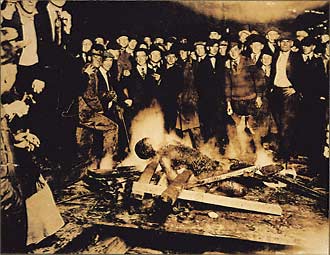 |
Early 20th century lynchings in America
For more information on these and other lynchings see:
http://www.musarium.com:16080/withoutsanctuary/
http://www.americanlynching.com/
When FDR came into office his primary goal was the passing of his New
Deal legislation. The New Deal represented a tremendous change in the
American system, and thus FDR was always walking a fine line in Congress
in terms of getting support for his measures. Because of this FDR tried
to distance himself from race issues as much as possible because, being
a Democrat, most of his fellow Democrats were from the South. At the
time the South was politically dominated by conservative Democrats, also
known as Dixiecrats. So in order for FDR to pass his New Deal
legislation he needed Democratic support; in order to keep his
Democratic support he could not be very progressive on race matters.
Roosevelt expressed personal sympathy with the cause of blacks in
America, but for the reasons mentioned above he never committed to any
progressive racial legislation. However, the First Lady, Eleanor
Roosevelt, was a vocal advocate of racial justice and she visited with
blacks and invited blacks to the White House, something that was very
progressive for the times.
While Roosevelt was in office anti-lynching bills were proposed. The
anti-lynching bills were quite divisive and Roosevelt tried to distance
himself from them. In speaking about the Wagner Bill (the anti-lynching
bill) FDR told Walter White of the NAACP: "I did not choose the
tools with which I must work. Had I been permitted to choose then I
would have selected quite different ones. But I've got to get
legislation passed by Congress to save America. The Southerners by
reason of the seniority rule in Congress are chairmen or occupy
strategic places on most of the Senate and House committees. If I come
out for the anti-lynching bill now, they will block every bill I ask
Congress to pass to keep America from collapsing. I just can't take that
risk."
While the Wagner bill was pending in Congress in 1934 lynching did
subside for a bit, but as soon as the bill failed to pass lynching
started up again.
In October of 1934 a particularly gruesome lynching took place in
Marianna Florida as is recounted here:
Not long after midnight on October 26, 'an armed mob of
approximately 100 men stormed the county jail at Brewton, Alabama,'
and seized Claude Neal, a black man accused of the murder of a white
women. According to an NAACP investigator, the mob took Neal back to
Florida, where the murder had been committed, and subjected him to
'the most brutal and savage torture imaginable, the greatest
possible humiliation and agony.' They sliced him with knives,
severed parts of his body, and made him eat his penis and testicles.
Then they branded him with red hot irons, choked him several times
with a rope, tied him to the back of a car, and dragged him to the
home of the dead woman, where a member of her family drove a butcher
knife into his heart. A crowd of thousands assembled; the body was
repeatedly trampled, and 'little children waiting with sharp sticks
drove their weapons deep into the flesh of the dead man.' The
mutilated body was hung on a tree in the courthouse square; hawkers
sold photographs for fifty cents apiece.
Source: Farwell to the Party of Lincoln:
Black Politics in the Age of FDR by Nancy J. Weiss
It was common practice for photographs of lynchings to be sold to the
pubic, and even postcards that could be sent through the mail, which is
why so many photos of lynchings exist today. It was also common for
lynchings to be large public events with hundreds or thousand of
participants. This was not a backwoods occurrence of a few deranged men,
this was a commonly accepted social practice in the regions where
lynchings took place, primarily the South. Children were also commonly
involved and children observers can be seen in many lynching
photographs.
Body mutilation was also common in lynchings, with one of the common
practices being the live castration of the victim. Lynchings were most
often directed against alleged criminals, however the first problem is
that there was seldom any trail, and often allegations against blacks
quickly sprang up as soon as any violent crime was committed with the
result being that "some" black man was going to get lynched. Often
who got lynched was based on a "hunch" by the vigilantes, and blacks
were often simply scapegoats for crimes committed by whites. Whites were
occasionally lynched as well. Group lynchings and family lynchings were
also not unheard of. Victims were also burned at the stake on occasion,
or burned alive while they hung.
Throughout FDR's administration Eleanor continued to support racially
liberal causes, despite the fact that FDR himself seldom gave public
support for them. This was a somewhat calculated measure because they
both supported progressive racial causes, however Roosevelt knew that in
the racial climate of the day his direct involvement in racial issues
would be political suicide for him, thus he and she took on a somewhat
detached public stance, she taking on the issues that FDR felt were too
radical for his own platform.
Eleanor received a lot of criticism for her actions however,
especially on race issues. Some familiar complaints were: "She goes
around telling Negroes they are as good as anyone else." "Wherever she
has spoken the Negroes always act like they are white folks."
Despite FDR's conscious attempts to distance himself from racial
issues it seemed that nothing was ever good enough for the American
public. FDR drew constant criticism on matters of race. In relation to
the New Deal's equal treatment of blacks and whites a man from Dearborn
Michigan (familiar place eh?) wrote that "any white man who worked
for the betterment of negroe [sic] races, the President included, was a
traitor."
FDR and Eleanor were often referred to as "nigger lovers". During the
1936 presidential campaign a popular anti-Roosevelt song was as follows:
"You kiss the niggers,
I'll kiss the Jews.
We'll stay in the White House
As long as we choose"
In letters to the White House people stated:
"Let [the Negro] stay in his place."
"Mr. President, we southern people don't believe in no such stuff
as social equality with the negroes as you are doing."
During the 1936 political conventions the Democrats began reaching
out to blacks for the first time. At a Democratic convention black
pastor Marshall L. Shepard gave the invocation, a first for such an
event, however immediately after the pastor spoke "Dixie" was sung
by the group. When the pastor took the podium Senator Ed Smith
from South Carolina walked out stating: "By God, he' as black as
melted midnight!" "Get out of my way. This mongrel meeting ain't no
place for a white man!" "I am not opposed to any Negro praying for me
but I don't want any blue-gummed, slew footed Senegambian praying for me
politically!" Smith later stated that "acceptance of the Negro
on terms of political equality humiliated the South."
Through all of this Roosevelt did little of substance directly for
blacks. Eleanor reached out to them socially, as did a few other
politicians, but no legislation of any substance was passed to protect
or promote blacks during the 1930s. Blacks began voting in large numbers
for FDR because he was at least not hostile to them (something that was
an accomplishment in the times), because Eleanor had established a good
public image towards blacks, and because the New Deal helped them in the
same way that it helped whites.
The perception that Roosevelt was favorable to blacks (because he
wasn't oppressing them) had a negative impact on him politically,
however the economic situation was such that people were voting
primarily with their pocketbooks, even if they were uncomfortable with
their views that Roosevelt was friendly to blacks. Despite the fact that
Roosevelt never supported any racially progressive laws, just the mere
fact that he wasn't taking action against blacks was bad enough for some
Americans, especially in the South.
The Rise of the Black Legion
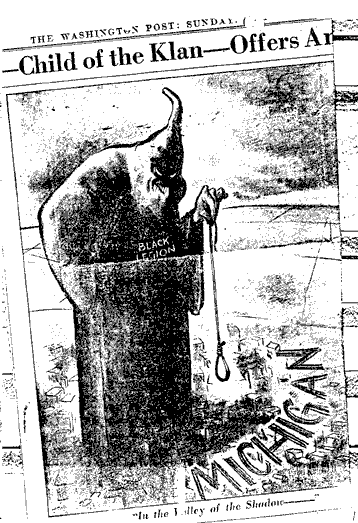 |
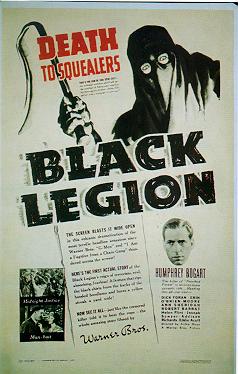 Poster for 1936 "based on a true story" movie about the Black
Legion
Poster for 1936 "based on a true story" movie about the Black
Legion |
As I said, after the demise of the Ku Klux Klan in the late 1920s due
to legal problems, the ideology of the Klan still lived on among the
American public. By the 1930s a new organization had formed out the
remains of the of KKK, but this new group, The Black Legion, was larger,
more aggressive, and estimated to have as many as 7 million members
nation wide.
Below is a collection of new paper articles on the Black Legion from
the 1930s:
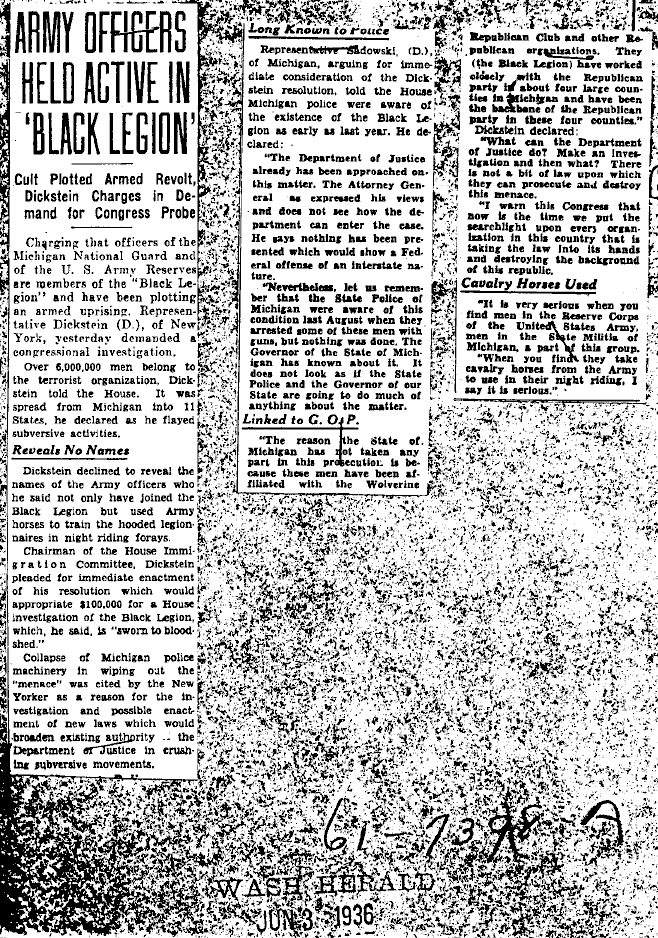
As stated above, the group primarily targeted Communists, blacks,
Jews, and Catholics in the name of God and protecting white Protestant
America. The group was also opposed to FDR and his policies and was
involved heavily with the Republican Party. The group was
political, large, and took serious action, including lynching people,
shooting murders, floggings, kidnappings, and general threats of
violence against people and groups that they opposed. The Black Legion
was also acting in accord with the interests of some corporations as
will be discussed below. They were involved in union busting and
threatening labor organizers. In addition to this there were
institutional members of the Black Legion, just as there had been
institutional members of the KKK. As discussed above, members of the
military and National Guard were of the Legion.
The Black Legion was the most violent expression of organized
opposition against FDR and his New Deal policies. The Black Legion
openly acknowledge that they considered the president a threat and
sought the overthrow of the government.
More on the Black Legion can be found in the Federal Freedom of Information Archives,
which states:
"This cult-type organization operated in the Midwest in the
1930's supposedly to protect the country from various forms of "isms".
Members wore black costumes with skull and crossbones insignia and were
allegedly responsible for numerous murders."
Supporters of the European Fascists
While FDR was busy bringing American capitalism under the control of
the State, many American capitalists began looking to blatantly Fascist
Italy and Germany, who were engaged in a large amount of spending, as
favorable regions to expand their capitalist empires. In addition, many
of America's wealthy elite were primarily concerned with Communism and
viewed the Fascist regimes as a bulwark against the spread of Communism.
Some of these people were simply businessmen doing business, but
others were more involved.
Professor William E. Dodd
William E. Dodd, the US Ambassador to
Germany, gave important insight into German and American economic
alliances. He wrote of the situation in general that:
"A clique of U.S. industrialists is hell-bent to bring a fascist
state to supplant our democratic government and is working closely with
the fascist regime in Germany and Italy. I have had plenty of
opportunity in my post in Berlin to witness how close some of our
American ruling families are to the Nazi regime. "
"Certain American industrialists had a great deal to do with
bringing fascist regimes into being in both Germany and Italy. They
extended aid to help Fascism occupy the seat of power, and they are
helping to keep it there."
- William E. Dodd, U.S. Ambassador to Germany, 1937
Some of the primary and more famous American companies and
individuals that were involved with the Fascist regimes of Europe are:
William Randolph Hearst, Joseph Kennedy (JFK's father), Charles
Lindbergh, John Rockefeller, Andrew Mellon (head of Alcoa, banker, and
Secretary of Treasury), DuPont, General Motors, Standard Oil (now
Exxon), Ford, ITT, Allen Dulles (later head of the CIA), Prescott Bush,
National City Bank, Coca-Cola, and General Electric.
It should be noted that businessmen from many countries, including
England and Australia, also worked with the Fascist regimes of Europe
prior to WWII. The Fascist governments were involved in a high level of
construction, production, and international business. All in all,
American corporate investments in Germany grew by almost 50% between
1929 and 1940, while declining in the rest of continental Europe.
I.G. Farben, a German company, was the largest chemical manufacturing
enterprise in the world during the early part of the 20th
century. As such, the company had many holdings in a variety of
countries, including America. The American holdings of I.G. Farben
included Bayer Co., General Aniline Works, BASF, Agfa Ansco, and
Winthrop Chemical Company.
I.G. Farben stamp showing corporate logo
I.G. Farben was critical in the development of the German economy and
war machine leading up to WWII. During this time I.G. Farben's
international holdings along with its international business contracts
with companies like Standard Oil, DuPont, Alcoa, and Dow Chemical were
crucial in supplying the Nazi regime with the materials needed for war,
as well as financial support.
Ford and GM supplied European Fascists with trucks and equipment, as
well as investing money in I.G. Farben plants. Standard Oil supplied the
fascists with fuel. US Steel and Alcoa supplied them with critically
needed metals. American banks gave them billion's of dollars worth of
loans. American banks and businesses continued to support the Fascist
regimes of Europe legally up until the day Germany declared war on
America and the activities were stopped under the Trading with the Enemy
Act. Despite this, some companies and individuals still maintained a
business relationship with the Third Reich.
The following is excerpted from a report printed by the United
States Senate Committee on the Judiciary in 1974:
The activities of General Motors, Ford and Chrysler prior to and
during World War II...are instructive. At that time, these three
firms dominated motor vehicle production in both the United States
and Germany. Due to its mass production capabilities, automobile
manufacturing is one of the most crucial industries with respect to
national defense. As a result, these firms retained the economic and
political power to affect the shape of governmental relations both
within and between these nations in a manner which maximized
corporate global profits. In short, they were private governments
unaccountable to the citizens of any country yet possessing
tremendous influence over the course of war and peace in the world.
The substantial contribution of these firms to the American war
effort in terms of tanks, aircraft components, and other military
equipment is widely acknowledged. Less well known are the
simultaneous contributions of their foreign subsidiaries to the Axis
Powers. In sum, they maximized profits by supplying both sides with
the materiel needed to conduct the war.
During the 1920's and 1930's, the Big Three automakers undertook an
extensive program of multinational expansion...By the mid-1930's,
these three American companies owned automotive subsidiaries
throughout Europe and the Far East; many of their largest facilities
were located in the politically sensitive nations of Germany,
Poland, Rumania, Austria, Hungary, Latvia, and Japan...Due to their
concentrated economic power over motor vehicle production in both
Allied and Axis territories, the Big Three inevitably became major
factors in the preparations and progress of the war. In Germany, for
example, General Motors and Ford became an integral part of the Nazi
war efforts. GM's plants in Germany built thousands of bomber and
jet fighter propulsion systems for the Luftwaffe at the same time
that its American plants produced aircraft engines for the U.S. Army
Air Corps....
Ford was also active in Nazi Germany's prewar preparations. In 1938,
for instance, it opened a truck assembly plant in Berlin whose "real
purpose," according to U.S. Army Intelligence, was producing "troop
transport-type" vehicles for the Wehrmacht. That year Ford's chief
executive received the Nazi German Eagle (first class)....
The outbreak of war in September 1939 resulted inevitably in the full
conversion by GM and Ford of their Axis plants to the production of
military aircraft and trucks.... On the ground, GM and Ford
subsidiaries built nearly 90 percent of the armored "mule" 3-ton
half-trucks and more than 70 percent of the Reich's medium and
heavy-duty trucks. These vehicles, according to American
intelligence reports, served as "the backbone of the German Army
transportation system."...
After the cessation of hostilities, GM and Ford demanded reparations
from the U.S. Government for wartime damages sustained by their Axis
facilities as a result of Allied bombing... Ford received a little
less than $1 million, primarily as a result of damages sustained by
its military truck complex at Cologne...
Due to their multinational dominance of motor vehicle production, GM
and Ford became principal suppliers for the forces of fascism as
well as for the forces of democracy. It may, of course, be argued
that participating in both sides of an international conflict, like
the common corporate practice of investing in both political parties
before an election, is an appropriate corporate activity. Had the
Nazis won, General Motors and Ford would have appeared impeccably
Nazi; as Hitler lost, these companies were able to re-emerge
impeccably American. In either case, the viability of these
corporations and the interests of their respective stockholders
would have been preserved.
In 1940 Graeme K. Howard, of General Motors, published America
and the New World Order, in which he advised that America give full
cooperation to the Nazi regime. In his book he blames FDR for causing
the war in Europe and goes on to say that the fascists should be
supported as the better alternative to the spread of Communism.
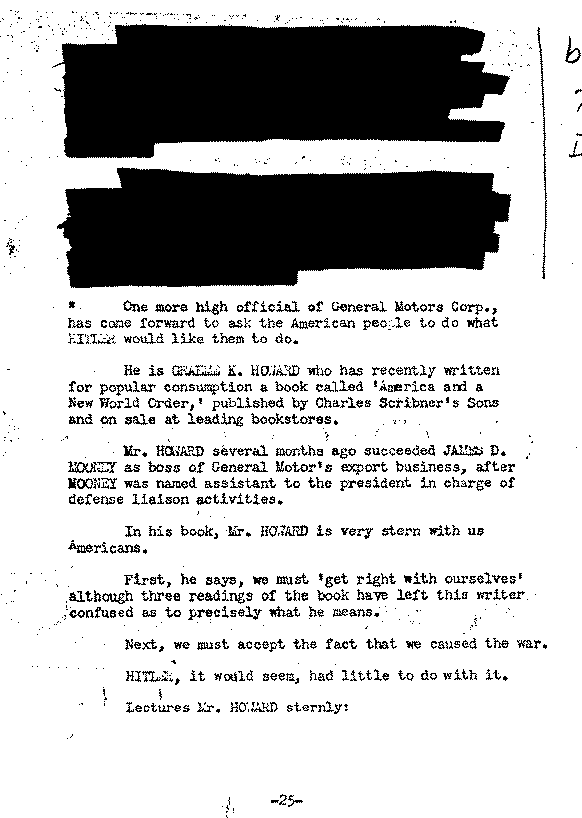
Ambassador Dodd also relayed important information about major
American publicist William Randolph Hearst's relationship with the
European fascists and how Heart's publications were influencing American
readers.
By the late 1930s a significant coalition of wealthy American
businessmen had formed opposition to FDR. Many believed that he was
getting too cozy with the Soviet Union and perceived his New Deal as
communist style legislation, which in fact it was not.
FDR did want to form peaceful relations with the Soviet Union
however, as he did with all nations. FDR's vision of the future was one
of peace among all nations, who would work together cooperatively. FDR
saw the fascists in Europe, especially Germany, as a threat to that
climate. Both Roosevelt and Churchill, while opposed to Communism, also
preferred opening relations with the Soviets in order to contain the
fascists.
So, while FDR was pursuing peace with the Soviet Union and a domestic
program of serious economic reform, powerful American businessmen
interpreted his actions as "Red" and formed coalitions against him and
began working hard on all fronts, political, economic, foreign and
domestic, to oppose FDR and his policies.
A 1935 letter to FDR from Dodd
relayed a conversation that Dodd had with Karl von Wiegand, a 25 years
principal correspondent of the International News Service in Central
Europe.
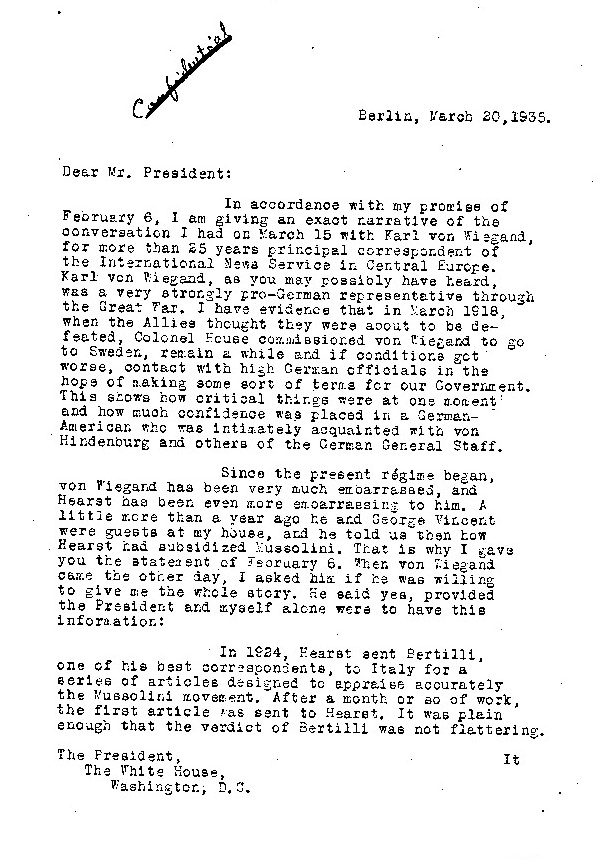
Dodd stated that:
Since the present regime began, von Wiegand has been very much
embarrassed, and Hearst has been even more embarrassing to him.
A little more than a year ago he and George Vincent were guests at
my house, and he told us then how Hearst had subsidized Mussolini.
Dodd then went on to relay information directly from von Wiegand:
...In 1924, Hearst sent Bertilli, one of his best correspondents,
to Italy for a series of articles designed to appraise accurately
the Mussolini movement. After a month or so of work, the first
article was sent to Hearst. It was plain enough that the verdict of
Bertilli was not flattering.
It had also been understood that Hearst had no sympathy with
dictatorial governments. Strangely enough, Bertilli was recalled and
all his work scrapped. Another strange thing, Gianini, President of
the Italian Bank System of California, an ardent supporter of
Mussolini, agreed to lend Hearst some millions of dollars, Hearst
being thought at that time to be in embarrassing financial
circumstances...
Hearst then sent me (von Wiegand) to Rome for an interview with
Mussolini, and asked me to engage him to write articles whenever he
chose for the Hearst press at $l a word. Mussolini was greatly
pleased and he wrote articles over a number of years, and I
delivered to him large checks from time to time. From that time on
Hearst was considered by his correspondents as an ally of
Mussolini...
In 1934 he (Hearst) came with a big party, including his mistress,
and spent the summer at Nauheim. Once more representatives of the
German Government visited him, and finally Rosenberg (editor of the
VOELKISCHER BEOBACHTER and representative of German foreign
propaganda work) made an engagement for him to see the Chancellor,
and he flew to Berlin one night in September. The next day he had an
interview of nearly an hour with the Chancellor, and he reported to
me that he was greatly impressed with the genius and friendliness of
Hitler...
A little later he asked me to negotiate a deal with Goebbels for
supplying the German Propaganda Ministry with all the Hearst news
service. I declined. Hearst then appointed Hillman, of London, to
work out the deal, and I went to London to continue my work for the
International News Service. Hillman arranged for the Propaganda
Ministry to have all continental Hearst information in Europe
delivered to its office at the same time it went to the Hearst press
over the world. For this service Hearst was to
receive $200,000 a year, and he at once began to bring pressure to
bear on his correspondents to give only friendly accounts of what
happened in Germany...
...I learned a little later that all my reports
from Germany went directly to Hearst and were re-edited so as to fit
the new program...
...he at the same time sent Dosch-Fleurot here
from Paris to administer the service in such a way that it would
always be friendly to the Hitler regime. However,
Dosch-Fleurot's attitude in the winter of 1934-35 began to change,
and now he is called home for discipline. I might add that other
representatives of the service in Germany have been dismissed, and
still others dislike to write one-sided reports...
In his closing Dodd stated:
You will see from von Wiegand's statements that what I told you about Hearst being an ally of Mussolini and
Hitler is correct.
This relationship between Hearst and the Nazis has even greater
implications than it first seems as well. Hearst's relationship with the
Nazis in 1934 is of critical importance in understanding a major element
of American anti-Communist propaganda. In 1934 Hearst published a number
of stories about the 1932-1933 famine in Ukraine. Nazi Germany had been
waging a major anti-Communist propaganda campaign as part of its agenda,
fascism being the "sworn enemy" or communism. In 1933 of course, Hitler
falsely blamed the Reichstag fire on Communists, which triggered the
beginning of the militarization of the German government and
establishment of concentration camps in Germany.
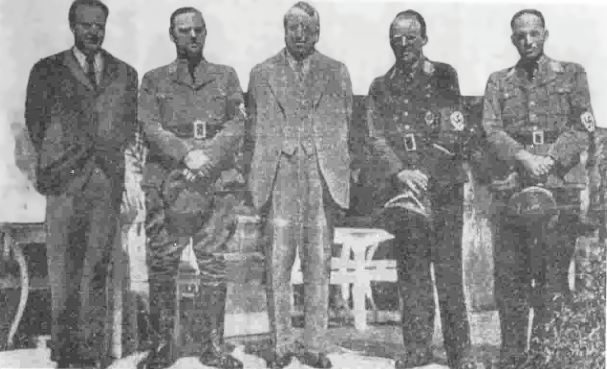
Hearst with Nazi officers
As part of this larger propaganda campaign the German Ministry of
Propaganda created a story about a Soviet program of genocide in
Ukraine. This was all part of the larger German plans to not only put
down Communist support in Germany, but justify later invasions to the
east under the banner of "liberation."
The Germans manufactured stories about the famine in Ukraine and used
false photographs to depict the famine conditions as worse than they
really were, including pictures from a 1920-22 famine in Russia during
the Russian Civil War and pictures of famine conditions during World War
I of regions that were not even Russian.
The Germans wanted to expand this propaganda campaign against the
USSR to potential rival states which it hoped to build support in, such
as the United States and Britain. This is where Hearst came in.
Hearst's role for the Nazis was to try and build Nazi sympathy in
America, which was to be achieved by both portraying Nazi Germany in a
good light, as well as portraying Germany's primary target, the Soviet
Union, and Communism in general, in an exaggeratedly negative light.
Hearst picked up the Ukraine famine story in 1934, about a year after
the famine actually took place. In a press like the Hearst Press
everything relied on "breaking news." Had Hearst had a real interest in
covering the Ukraine famine it would have been covered in 1932 and 1933
when it was taking place, however it was not covered in Hearst presses
until 1934, after he picked up the story for the Nazis.
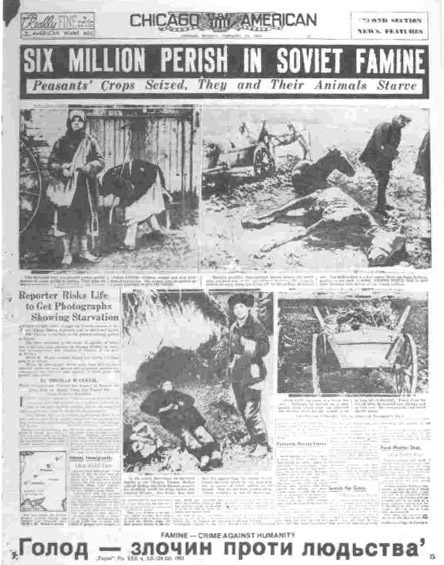
1935 Hearst publication showing pictures taken prior to 1930.
Notice claim that "reporter risked life to get photographs"
Hearst's Ukraine famine stories have proven to have had a huge impact
among Americans, and even today the majority of Americans believe that
there actually was a "Ukraine Holocaust." Common figures are that 6
million people died in Ukraine under Stalin's rule in what was an
intentional starving to death of these millions of people. This 6
million figure is in fact a pure fabrication of Nazi propaganda. The
idea that Ukrainians were intentionally starved to death is likewise a
product of Nazi propaganda, picked up by Hearst and spread to the United
States, where it was accepted at truth, and for the most part still is
today.
For more on the Ukrainian famine and the role of the Hearst Press in
creating the myth of a Ukrainian genocide see: Fraud, Famine and Fascism: The Ukrainian Genocide Myth from Hitler to Harvard
In 1938 George Seldes, famous American journalist, wrote of Hearst in Lords of the Press:
The year 1935 marked the height of the Hearst Red-baiting campaign
in the universities. It must be remarked here and now that there is
no Red teaching in the schools and colleges of the United States,
but the institutions of learning of our country still attempt to
give their students a liberal education. It is inconceivable that
they should do anything else. No school can supply an anti-liberal
education, or a Fascist education, as these terms are contradictory.
Liberalism and education are one, and all Hearst did was to call
liberal education "Red" education.
To this day the Hearst press is filled with Red-baiting articles
and attacks upon such notable Americans as Prof. Charles A. Beard,
Prof. George S. Counts, of Teachers College; Prof. E.A. Ross, of the
University of Wisconsin; Prof. Frederick L. Schuman, of Chicago.
Hearst reporters in numerous instances have been sent as students to
interview professors or to take courses for the purpose of writing
Red-baiting articles. When these reporters found nothing to write
about they falsified. In several cases they later confessed.
In the 1930s Heart Consolidated Publications was the largest
publishing business in the world, and his publications had a definite
impact on the views of Americans. It is obvious that Hearst was
attempting to influence Americans to be sympathetic to the European
fascist cause, and it is arguable that it his efforts were in fact
working.
In 1937 Fortune Magazine, a Hearst publication, stated that:
The good journalist must recognize in Fascism certain ancient
virtues of the race, whether or not they happen to be momentarily
fashionable in his own country. Among these are Discipline, Duty,
Courage, Glory, Sacrifice.
The Reader's Digest, another Hearst publication, reprinted and
article from The New Statesman, also a Hearst publication, that stated:
That Hitler's conquest of the hearts and minds of all classes of
Germans is now so complete that even if all his Brown Shirts and
Steel Helmets were to be disbanded, tomorrow he would still be
easily the strongest man in Germany, and on any appeal to the
electorate would be confirmed in power by a quite overwhelming
majority of votes.
Hitler is recognized by the whole of the political and official
intelligentsia as an exceedingly able man. As of the militarist
question: One may say with complete certainty that what Hitler said
in his Reichstag speech on May 17 was exactly what he meant and
accurately represents the policy that he will pursue.
I found no German who dreamed of the possibility of war, few who
did not hope that it might be prevented in the future altogether.
The truth is that the Nazi mind is concentrated on the internal
problems of Germany and does not want to be bothered by foreign
affairs for a long time to come.
Hitler has passed from the stage of party leader to being the
national prophet of an exceedingly serious people, and it would need
another prophet to replace him.
Below is a copy of a 1938 article published in Better Homes and
Gardens, a Hearst publication. The article paints a quaint portrait of
Hitler as a nice, humble, personable man of taste.
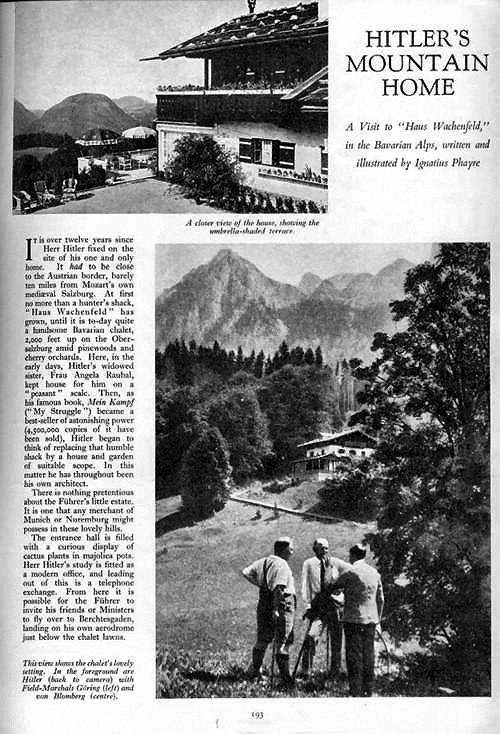
Another fact about Hearst is that Hearst originally backed FDR and
the New Deal, but again, in 1935 Hearst turned decidedly against FDR and
the New Deal, launching a media campaign against it calling it the "Raw
Deal".
In 1941, after the Nazis began their invasion of the Soviet Union,
President Roosevelt extended Lend-Lease aid to the Soviets. In response
to this Hearst presses attacked FDR's policies, as in the example below:
If we are fighting totalitarianism as a foul principle and oppressive
policy, why in the name of high heaven should we not desire to see
the two totalitarian powers exterminate each other and destroy not
only the principle but the practice of despotic government?
If we are citizens--or subjects--of a genuine democracy and if we
are devoted to the ideals of democracy, and honestly desirous of
preserving and perpetuating those ideals, why should we not desire
to see the enemies of democracy destroy each other?...
Is our free country piling up deficits, bleeding its citizens white
with confiscatory taxation, rushing headlong into national
bankruptcy, shoveling out our wealth abroad, and shipping our war
materials to alien nations to bolster up Bolshevism in Russia to
spread it over all of Europe, including Britain, and to breed it and
broadcast it in our own America?
We may not think that this is what we want to do, but this is
exactly what we are doing with our Bolshevist alliance, and no smoke
screen of fine phrases can obscure that outstanding fact.
No country which fights for Russia can claim to be honestly opposed
to tyranny, since Bolshevism is the basest and bloodiest tyranny
that has disgraced the supposed civilization of Europe since the
time of Ivan the Terrible.
No country can truthfully claim to be crusading for democracy and
the four freedoms when it is supporting a tyranny which is the most
evil enemy of democracy--a tyranny where all the four freedoms have
been brutally suppressed--a tyranny with no liberty, no opportunity,
no morality, and no God.
New York Journal-American, September 5, 1941.
The plot deepens though. There were some much more substantial
contributors to the Nazis, direct contributors to the Holocaust itself
and the German plans for "master race."
Perhaps one of the most egregious contributors to the Nazi cause was
IBM under the direction of Thomas J. Watson.
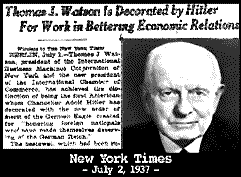
IBM knowingly helped to setup Nazi census databases through the use
of data sorting machines that enabled the Nazis to carry out the
Holocaust in a way that they would not have otherwise been able to.
Point blank, IBM increased the size and scope of the Holocaust, and did
it for profit. Not only this, but IBM leased the machines, which they
had developed especially for the Nazis, with the intention of taking
them back "once they were finished with them." Thomas Watson was
awarded a medal by Adolph Hitler for his role in assisting in the Nazi
regime, and Watson expressed, "the necessity of extending a
sympathetic understanding to the German people, and their leader Adolph
Hitler." He also expressed, "the highest esteem for
Hitler, his country, and his people."
Despite Watson's blatant support of the Nazi regime and IBM's
involvements in Germany, Watson still maintained a positive profile in
American society and among America's elite, even among members of the
Roosevelt White House. IBM was pioneering punch card and computing
technology, and the regime of Nazi Germany was their biggest client in
that field. The Nazi's were using IBM punch card tabulating technology
to administer their war effort, and to organize and administer the
Holocaust. In Germany IBM operated under its Germany subsidiary,
Deutsche Hollerith Maschinen Gesellschaft. The German subsidiary was no
rogue branch though, the Germany subsidiary operated with the
cooperation of IBM America and under the knowledge of Thomas Watson.
1934 poster reads: "See everything with Hollerith punchcards"
Below are excerpts from Harold J. Carter's 1944 report for the
Department of Justice, War Division, Economic Warfare Section:
"CONTROL IN BUSINESS MACHINES"
This is a story of a peculiar type of cartel. Generally speaking,
the cartel arrangements which have been heretofore considered deal
with instances wherein the cartel control stems from Germany, or one
of the other Axis countries, and into the United States for the
purpose of curtailing production of critical materials following a
deliberate plan of Nazi economic warfare. Previously a villain like
I.G. Farben or Siemens Halske has reached its tentacles into
American Industry and curtailed production through patents,
licensing agreements, and other types of control. This story deals
with an American firm which has deprived not only our own citizens
by limiting supply but also the citizenry of the world. Americans
and Germans alike have felt the pinching hand of Thomas J Watson and
International Business Machinery manifested through universal
limited production and international high prices. In this case, the
monopoly control originates in the United States and operates
throughout the world. And what Hitler has done to us through his
economic warfare, one of our own American corporations has also
done. In this "arsenal of democracy", which supplies materiel for
over half the warring world, limited production spells our worst
enemy. Hence IBM is in a class with the Nazis.
Further, we have a peculiar clash of interests. This [World War] is a
conflict of warilke nationalistic states, each having certain
interests. Yet we frequently find these interests clashing
diametrically with the opposing interests of international corporate
structures, more huge and powerful than nations. These corporate
entities are manned not by staffs of citizens of any nation, but by
citizens of the world looking solely to the corporate interest and
pledging loyalty thereto. We see revealed [in] this clash, this
dichotomy of culture between our nation and an international
corporation whose interests do not coincide...
Dr. Hollerith was employed by the U.S. Bureau of Census in 1880 where
it was necessary for him to spend much time in the routine of
addition and subtraction. As a timesaving device, he invented these
tabulating machines run by electric current for the use of the
Census Bureau. He sold his patents to the predecessor of
International Business Machines Company, who set up their legal
monopoly based on these patents. The patents have since expired but
so many additional patents were taken out by IBM on improvements and
refinements of the original Hollerith machines that the field has
been entirely weighted down and the legal monopoly extended. The
monopoly still exists because of the many patents taken out by IBM
on many small technical changes but all based upon the original
Hollerith patents. A question might well be raised as to whether the
patents belong to Dr. Hollerith or the U.S. Government in the first
place... Since Dr. Hollerith was an employee of a branch of our
government and since there was a definite connection between his
work of computing and his invention, the question might well be
raised as to whether the patents belonged to Dr. Hollerith and were
his to sell or to the U.S. Government at the time of their grant...
As to the fact that these monopolies [IBM and the ones IBM imposed on
Powers and Remington Rand in the U.S.] existed, there can be little
doubt. These companies deliberately conspired to limit production,
dictate price and restrain competition as much as possible. This
fact has been declared by the United States Supreme Court. We see a
monopoly inflicted on the people of the United States. We shall now
attempt to show the effect of this monopoly on the outside world,
the international cartel arrangement.
This is a story of circumstantial evidence. Practically no
documentation or direct evidence can be produced proving the
existence of the cartel. Yet one indirect source after the other
points to that ultimate conclusion and the indirect evidence is so
frequent as to be almost undeniable...
These international corporations have grown so large that very often
their interests and the national interests within which they are
supposedly contained do not coincide. The personnel of IBM, though
nominally citizens of the United States, is actually composed of
citizens of the world. Their loyalties to their corporation know no
national bounds. Mr. Thomas J. Watson, President of IBM, was one of
the leading figures in the international peace movement- not for
altruistic motives alone. IBM's far-flung empire was going much too
smoothly to be interrupted by war and Mr. Watson's goal is profit...
Certainly it can be said that his company is not an American company,
but an international company... The company has not only worked
hardship on the people of the U.S. but also people in Germany. When
the German section of the world monopoly grew too burdensome on the
German people, the Hitler Government apparently sought to
interfere... The entire world citizenry is hampered by an
international monster and the indirect evidence herein presented
seems to the writer conclusive enough to warrant an extensive search
into files of the companies mentioned so that direct evidence may be
obtained.
IBM, like hundreds of other major American companies, including Ford,
GM, Standard Oil, and Coke-a-Cola, was able to have its subsidiaries in
Axis territories classified as "American property," which meant that
this property was to be protected and not bombed or destroyed by the
military. In fact, after the war was over several companies, including
Ford and GM, sued for damages and won. They were paid from American tax
payer money for damage done to their property by the American military
in Germany, property which was being used against America.
Of this situation the British embassy wrote during the war: "It
is only too clear that where U.S. trade interests are involved, these
are being allowed to take precedence over 'hemispheric defense,' and...
over cooperation with us."
Source for information on IBM: IBM and the
Holocaust by Edwin Black
It goes beyond that though. Remember the American eugenics programs
that started at the turn of the century?
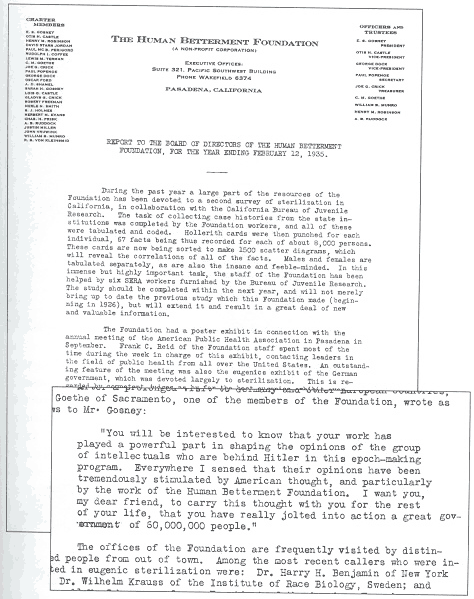
The above from War Against the Weak
The "German" quest for "Master Race", was in fact a product of
German cooperation with American racial supremacists. IBM's punch-card
system for census and categorization of citizens was a critical element
in the Nazi system for racial and genetic analysis of the population for
their large scale breeding program. The Nazi program was based on the
American eugenics programs, but was taking it to a new level. The plan
was ultimately "for the good" in the eyes of those perusing it; the
elimination of poverty, "stupidity", and genetic diseases was the
objective. One problem with these plans though, ignoring the obvious, is
that many of the traits that were targeted for "treatment" by the
breeding program, such as poverty and ignorance, are not caused by
heredity, they are socially created problems.
For more on this see War Against the Weak
Almost all of the major American supporters of the European Fascists
were advocates of peace and non-involvement on the part of America.
Thomas J. Watson of IBM was a major peace advocate during the 1930s and
early 40s, but one of the most vocal and active was famous American
pilot Charles Lindbergh.
Lindbergh began a tour of Europe in 1935, and in 1936 he attended the
Olympic games in Berlin as a guest of Hermann Georing. Lindbergh became
so impressed with Nazi society in 1936 that he strongly considered
moving to Berlin as he noted in his personal diary. Lindbergh stayed in
Germany for some time and inspected German military facilities, accessed
the German Luftwaffe, and attended parties hosted by the Nazis. In 1938
he was given the Service Cross of the German Eagle while attending a
dinner party in Berlin.
Lindbergh later founded the America First Committee in 1940,
after the outbreak of war in Europe.
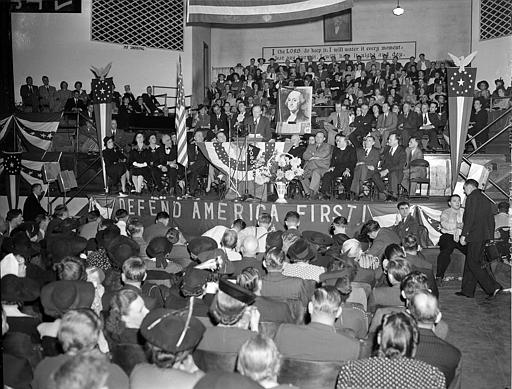
Lindbergh and the America First Committee opposed American
intervention in the war in Europe and pushed a media campaign strongly
opposed to the policies and rhetoric of the Roosevelt administration.
Lindbergh promoted the idea that that Germany, Britain, and France could
all get along and that it was actually Jews who were causing the
conflict, and he believed that the unification of Europe under Germany,
and even the possible alliance of America with Germany, was an essential
task if Western Civilization was to save itself from the "yellow hordes"
of Asia, particularly China. This was something that the Nazis advocated
as well and it is likely that Lindbergh's views on this were impacted by
his relations with the Germans who advocated such ideas. The
following is a recount of a conversation by Artur Silgailis, of the
Latvian Waffen SS, with Heinrich Himmler, where Himmler expresses what
is essentially the same view that Lindbergh also held on the issue of
the Nazi movement:
"He (Himmler) then singled out those nations which he regarded
as belonging to the German family of nations and they were: the
Germans, the Dutch, the Flemish, the Anglo-Saxons, the Scandinavians
and the Baltic people. 'To combine all of these nations into one big
family is the most important task at the present time' (Himmler
said). 'This unification has to take place on the principle of
equality and at that same time has to secure the identity of each
nation and its economical independence, of course, adjusting the
latter to the interests of the whole German living space. . . After
the unification of all the German nations into one family, this
family. . . has to take over the mission to include, in the family,
all the Roman nations whose living space is favored by nature with a
milder climate...I am convinced that after the unification, the
Roman nations will be able to persevere as the Germans...This
enlarged family of the White race will then have the mission to
include the Slavic nations into the family also because they too are
of the White race . . . it is only with such a unification of the
White race that the Western culture could be saved from the
Yellow race . . . At the present time, the Waffen-SS is leading in
this respect because its organization is based on the
principle of equality. The Waffen-SS comprises not only German,
Roman and Slavic, but even Islamic units and at the same time has
proven that every unit has maintained its national identity while
fighting in close togetherness ."
Lindbergh was also extremely anti-Communist and supported the Nazi
programs against Communism, as many people did all throughout the
world.
America First reached a membership of 800,000 people and hosted many
speeches and produced many publications as well as keeping its message
in the public press. After his death Lindbergh's private journal
revealed that he was very "active behind the scenes in generating
antiwar sentiment. The flier worked intimately with Robert R. McCormick,
the publisher of the Chicago Tribune; Robert Wood, board Chairman of
Sears, Roebuck; former president Herbert Hoover, Henry Ford, Senator
Harry F. Byrd of Virginia, Handford MacNider of the American Legion,
Senator Burton K. wheeler of Montana and John T. Flynn, the economist."
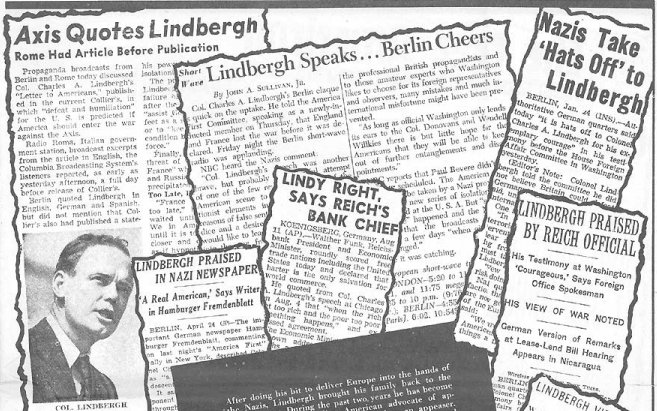
In his campaign to keep America out of the war in Europe Lindbergh
stated:
"If any one of these groups--the British, the Jewish, or the
administration--stops agitating for war, I believe there will be little
danger of our involvement."- September 11, 1941
However the Roosevelt administration did not stop agitating for war,
nor did the British or Jews. All of those groups did agitate for
American entry into the war in 1941 for what are now obviously some very
good reasons.
In the cartoon below the cover of the book held by FDR reads:
"The Story About the Destruction of Religion Throughout the
World."
The boy is replying:
"Gee that's awful: Now read the part about Uncle Joe killing the
fifty thousand Christians."
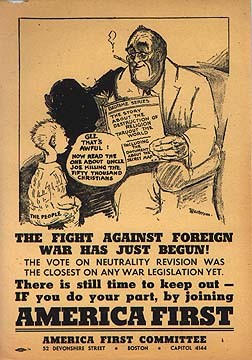
The poster is interesting for several reasons. One is that it
addresses the fact that Roosevelt conveyed the idea that the Fascists
were trying to destroy religion, and this was part of his campaign to
agitate the public to support going to war in Europe. In truth Roosevelt
was not being honest in his portrayal of that situation. Two, it
has the boy pointing out Russian religious oppression, which is meant to
be a stab at Roosevelt's courting of the Soviets as allies. The poster
paints Roosevelt as a hypocrite on this issue, which in fact he was. The
Roosevelt administration did overstate and misrepresent many aspects of
the German situation in order to influence public opinion.
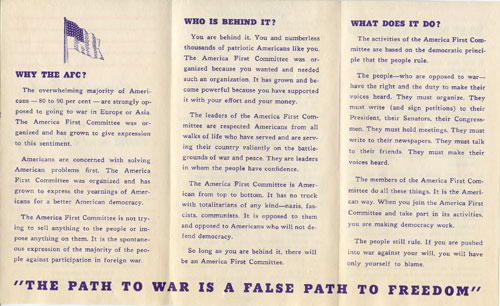
America First brochure
Unlike some of the others who opposed American entry into the war in
Europe, Lindbergh went farther and advocated total neutrality and
opposed American aid to Britain and France. Of course Lindbergh also
considered the Germans to have by far the most advanced and powerful
military in the world and so it was quite obvious that his position
amounted to German support.
In this political climate many American citizens opposed American
entry into war in Europe, either out of their pacifist ideologies, or
out of Nazi sympathy encouraged in part by anti-Roosevelt campaigns.
While racism was growing in Europe it was growing in America too,
including anti-Semitism. American society was very polarized and the
society itself was moving towards increasing intolerance as the tensions
in society increased.
In 1937 Gallup reported that a full 94% of Americans said that
America should "keep out" of European affairs. Roosevelt felt
strongly opposed to this position, but in order to maintain support he
publicly stated again and again, even during the 1940 presidential
campaign, that he would not send Americans to fight in a foreign war.
Despite these promises, Roosevelt was doing everything he could
behind the scenes to get America as involved as possible.
The Outbreak of War
With the bombing of Pearl Harbor, which FDR's policies helped to provoke,
America began taking on more and more qualities that were similar to its
own opponents. The American public had turned extremely hostile towards
Japanese Americans and there was a feeling that Japanese Americans, and
all other aliens, posed a security risk to the country.
Interestingly, many people inside the Roosevelt administration
disagreed with the Executive Order to place aliens and Japanese-American
citizens in internment camps, including
people like J. Edgar Hoover and Attorney General Francis Biddle.
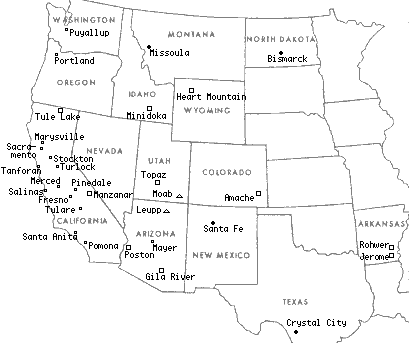
Map showing internment camp locations, which did include Italian and
German Americans, as well as Japanese
The arguments went back and fourth on both sides of the issue:
"For several weeks there have been increasing demands for
evacuation of all Japanese, aliens and citizens alike, from the West
Coast states. A great many West Coast people distrust the Japanese,
various special interests would welcome their removal from good farm
land and the elimination of their competition... My last advice from the
War Department is that there is no evidence of imminent attack and from
the F.B.I. that there is no evidence of planned sabotage." -
Francis Biddle
"The present procedure of keeping loyal American citizens in
concentration camps on the basis of race for longer than is absolutely
necessary is dangerous and repugnant to the principles of our
Government. It is also necessary to act now so that the agitation
against these citizens does not continue after the war" - Francis
Biddle
"My friends in the War Relocation Authority, like Secretary
Ickes, are deeply distressed over the effects of the entire evacuation
and relocation program upon the Japanese-Americans, particularly upon
the young citizen group. Persons in this group find themselves living in
an atmosphere for which their public school and democratic teachings
have not prepared them. It is hard for them to escape a conviction that
their plight is due more to racial discrimination, economic motivations,
and wartime prejudices than to any real necessity from the military
point of view for evacuation from the West Coast.
Life in a relocation center cannot possibly be pleasant. The
evacuees are surrounded by barbed wire fences under the eyes of armed
military police. They have suffered heavily in property losses; they
have lost their businesses and their means of support. The State
Legislatures, Members of the Congress, and local groups, by their
actions and statements bring home to them almost constantly that as a
people they are not really welcome anywhere. States in which they are
now located have enacted restrictive legislation forbidding permanent
resettlement, for example. The American Legion, many local groups, and
city councils have approved discriminatory resolutions, going so far in
some instances as to advocate confiscation of their property. Bills have
been introduced which would deprive them of citizenship...
Furthermore, in the opinion of the evacuees the Government may
not be excused for not having attempted to distinguish between the loyal
and the disloyal in carrying out the evacuation.
Under such circumstances it would be amazing if extreme
bitterness did not develop." - Milton Eisenhower
What is interesting about this is how it illuminates the cultural
issue, explaining that nativist and conservative groups like the
American Legion were supporters of the internment of the Japanese.
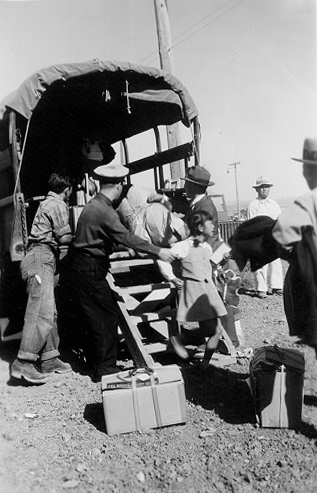
"The necessity for mass evacuation is based primarily upon public
and political pressure rather than on factual data. Public hysteria and
in some instances, the comments of the press and radio announcers, have
resulted in a tremendous amount of pressure being brought to bear on
Governor Olson and Earl Warren, Attorney General of the State, and on
the military authorities...
Local officials, press and citizens have started widespread
movement demanding complete evacuation of all Japanese, citizen and
alien alike." - J. Edgar Hoover
"The situation in California is not the same [as in Hawaii]. You
have no doubt become aware of the existence of active and powerful
minority groups in California whose main interest in the war seems to
take the form of a desire for permanent exclusion of all Japanese, loyal
or disloyal, citizen or alien, from the West Coast or, at least, from
California.... This means that considerations other than of mere
military necessity enter into any proposal for removal of the present
restrictions." - John McCloy Assistant Secretary of War
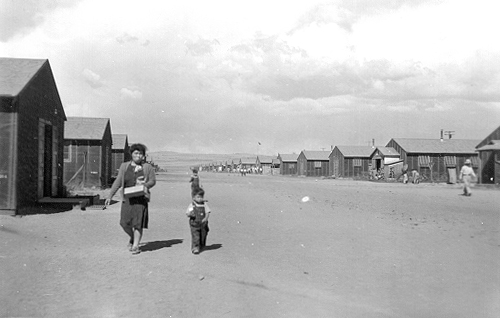
"[The Justice officials] said there is too much hysteria about
this thing; said these Western Congressmen are just nuts about it and
the people getting hysterical and there is no evidence whatsoever of any
reason for disturbing citizens, and the Department of Justice, Rowe
started it and Biddle finished it -- The Department of Justice will have
nothing whatsoever to do with any interference with citizens, whether
they are Japanese or not. They made me a little sore and I said, well
listen Mr. Biddle, do you mean to tell me that if the Army, the men on
the ground, determine it is a military necessity to move citizens, Jap
citizens, that you won't help me. He didn't give a direct answer, he
said the Department of Justice would be through if we interfered with
citizens and writ of habeas corpus, etc." - Marshal Allen W.
Gullion recalling a conversation between the War Department and Justice
Department.
"[Washington is] lax, tolerant, and soft toward the Japanese who
have violated American hospitality; Shinto Temples still operate;
propaganda outlets still disseminate propaganda material; and Japanese,
both alien and American citizens, still spy for the Japanese
government." - Texas Congressman Martin Dies
Martin Dies was a conservative Democrat and chairman of the House
Un-American Activities Committee. He was also a staunch
anti-Communist.
"I phoned the Attorney General's office and told them to stop
fucking around. I gave them twenty four hours notice that unless they
would issue a mass evacuation notice I would drag the whole matter out
on the floor of the House and of the Senate and give the bastards
everything we could with both barrels. I told them they had given us the
run around long enough... and that if they would not take immediate
action, we would clean the god damned office out in one sweep. I cussed
at the Attorney General and his staff himself just like I'm cussing to
you now and he knew damn well I meant business." - California
Congressman Leland Ford
"Once a Jap always a Jap. You cannot change him. You cannot make
a silk purse out of a sow's ear."
"The white man's civilization has come into conflict with
Japanese barbarism [and] one of them must be destroyed." -
Democratic Congressman John Rankin
"I'm for catching every Japanese in America, Alaska, and Hawaii,
now and putting them in concentration camps... Damn them! Let's get rid
of them now!" - Democratic Congressman John Rankin to Congress
December 1941
John Rankin was a conservative Democrat from Mississippi who was also
active in the House Un-American Activities Committee. His views were
shared by many Southern Politicians, such as Tennessee Senator Tom
Stewart and Congressmembers William F. Norrell (Arkansas), Jennings
Randolph (West Virginia), Schuyler O. Bland (Virginia), and Martin Dies
(Texas).
"Their racial characteristics are such that we cannot understand
or trust even the citizen Japanese." - Secretary of War Henry
Stimson
There is evidence that suggests that Roosevelt did eventually back
the measure to intern Japanese citizens because he was concerned about
the upcoming election and he knew that many Americans had a strong taste
for revenge after Pearl Harbor. In addition Roosevelt wanted to
concentrate on the war in Europe more than was popular among the public,
so it is suggested that he approved of interning the Japanese in order
to help satisfy American demands for revenge against the Japanese while
he shifted more effort towards Europe.
For more on internment during WWII see:
Documents and Photographs Related
to Japanese Relocation During World War II
During World War II many things happened in American society and
politics.
Even after the war started there was not overwhelming support for the
war in Europe. There were still fascist sympathizers and there were
still many Americans who felt that Communism was a bigger threat than
the Nazis. This contributed to the fact that 67% of the men who fought
in World War II had to be drafted.
Once drafted men were exposed to an intense propaganda regiment that
included the use of hate rhetoric, especially against the Japanese, and
that also promoted a number of distortions about Japanese and Nazi
culture.
This is not to say that these enemies didn't deserve every bit of
American hate, but nevertheless soldiers and citizens were not given
honest view of the situation. As the cliché goes, "truth is the first
casualty of war," and this was true on all sides. It cannot be
overstated that this was the largest mobilization effort in American
history for what was to be one of the most important wars in the history
of the world, during an extremely dire situation. In this situation, the
propaganda and hate rhetoric promoted by the White House can certainly
be justified. Once America entered the war, it was no less than a global
fight for survival, in which every advantage had to be maximized.
Nevertheless, many incorrect stereotypes and ideas about the Japanese
and Nazis were promoted, and then after winning the war nothing was
really done to correct those misconceptions, and in fact many of them
actually served to help promote the continuing agenda of American
leadership.
The posters of enemies harming women were more typical abroad in
military barracks and such. It was determined that images of the enemy
harming women evoked the strongest response and promoted the most hatred
among soldiers, who were often homesick and missed their wives, mothers,
or girlfriends.
Another common theme in American World War II propaganda was that of
describing the Nazis as anti-Christian or trying to destroy religion. As
was discussed in Fascism Part I, there is a margin
of truth to this, however Nazi society was highly religious and
Christianity was predominate among Germans. The impression given to
Americans was that the Germans, and Nazism, were anti-Religious when the
fact of the matter is the exact opposite.
There is much more to the role of religious propaganda in World War
II than first meets the eye though.
Because the United States was allied with an officially atheistic
country the message that the enemy was "anti-Christian" became all the
more important, and it was constantly pounded home in an effort to keep
America and its allies on the "moral side" of the war.
In 1942, during the midst of war, Congress officially recognized The
Pledge of Allegiance for the first time and entered it as part of the
U.S. Flag Code. Less than a year after its adoption however, the Supreme
Court ruled that it was unconstitutional to compel students to recite
the Pledge.
When the pledge was officially adopted the old salute was dropped,
because it resembled the fascist salute, and was replaced with the new
method of reciting the pledge with the hand over the heart.
Just prior to the end of the war FDR died and Vice President Harry
Truman took over. Truman did not have a lot of experience and was not
deeply involved in FDR's administration. In fact, Truman was not
Roosevelt's choice for Vice President, Roosevelt wanted his previous
Vice President, Henry Wallace, or failing that, James Byrnes, however
conservative Southern Democrats, who held the majority of power at the
Democratic conventions, wouldn't stand for Wallace and instead they
insisted on Harry Truman. Truman was chosen for FDR as his running mate
by the Democratic Party, against his wishes. Some of Truman's views
differed from those of FDR and because of his lack of experience, he
relied extensively on advice and support from other high ranking
officials, such as the Secretary of War.
Corporations and the Military-Industrial Complex
Throughout Roosevelt's administration the majority of businessmen
felt themselves at odds with the president. Though the New Deal did
provide government money to corporations for government funded works
projects, those bids went to the lowest bidders and were relatively few
in number compared to the larger number of businessmen who felt that the
New Deal policies had a negative impact on their businesses because of
things such as the government endorsement of unions in the 1935 National
Labor Relations Act. However, once serious preparation for the war
effort began a new alliance between government and business formed.
Those who were able to secure government contracts benefited greatly,
while others faced a difficult struggle.
Prior to World War II military contracts were made through sealed
bids, but with the war the system changed to negotiated bids, which
involved a more personal and subjective system for awarding bids, i.e.
the start of the "good ole boy" system.
Secretary of War Henry Stimson stated: "If you are going to try
to go to war, or to prepare for war, in a capitalistic country, you have
got to let business make money out of the process or business won't
work."
As proof of how influential and wide ranging the effects of the war
effort were for corporations, even Coke-a-Cola became part of the
"military-industrial complex."
During the first world war materials were rationed, and sugar was one
of those materials. The rationing of sugar significantly hurt
Coca-Cola's profits. During the depression of the 1930s Coke's major
competitor, Pepsi, was able to increase market share by adopting more
economical bottling practices, giving them a cheaper product.
Understanding the implications of sugar rationing Ben Oehlert, a
Washington lobbyist for Coca-Cola, promoted the need to secure a
government contract during war time. By getting war time contracts
Coca-Cola would able to avoid the rationing penalties that were placed
on other food makers. In order to get contracts it was said that
Coca-Cola could play an important role in the operation of the military,
by providing an energizing drink during pauses in action.
In 1942 sugar rationing went into effect and Coca-Cola was awarded an
exclusive contract to supply soft-drinks for the US military. Coca-Cola
was then able to completely dominate all competition because not only
did they have a huge contract, but they also had un-rationed access to
sugar. Pepsi nearly went bankrupt during WWII, while Coke flourished.
Sixty-four Coca-Cola bottling plants were built in Allied territory
on military bases, and the bottling plants were moved forward with the
progression of the military advances. Ironically, at the same time,
Coca-Cola's bottling plants in Nazi Germany were continuing production
as well, under the Fanta brand name, which was changed so as to
disassociate America with the drink. Coca-Cola, like so many other
companies, was making money off both sides of the war.
Coca-Cola played up its patriotic image through the war, both in
domestic advertisements, and also on military bases.
One military advertisement stated:
Stonewall Jackson taught us what the pause that refreshes really
means.... On the march he gave his men rations of sugar and at
intervals required them to lie down for a short rest. Thus he
marched troops farther and faster than any other general in the
field. Since his day all marching troops have been given a short
rest period out of every hour.
Stonewall Jackson was a Confederate General and Southern hero for his
opposition to the Union. Coca-Cola of course is an Atlanta based
company, but nevertheless, it is an additional point of interest that
Coke used a Confederate General as part of their "patriotic" advertising
campaigns, associating Coke with a military "tradition" of giving
soldiers rests for "sugar breaks." The basis of Coke's military contract
with the military was regimented and regular consumption of Coke by
soldiers as part of the moral and energy boosting program.
A domestic Coke ad read:
And no matter what anybody is doing to help (this doesn't go for
fighting men) nobody is doing his full share if he's not buying U.
S. War Bonds and War Stamps regularly. Are you buying them? Are you
buying your share in Victory and in the good American way of Life?
Of course, Coca-Cola was paid by the US Government out of money
raised by selling War Bonds. The promotion of buying War Bonds was in
effect a means of Coke promoting its own financial security. The more
money that the government raised for the war effort, the more money they
could afford to spend on Coca-Cola contracts.
After the war was over, the sugar rations stayed in place until 1947,
continuing to give Coke a major lead over competitors due to its insider
status, and Coke has remained very close to the White House ever since.
Another commodity industry that became heavily involved in the war
effort was the tobacco industry.
Coca-Cola though is of course not what people think about when they
think of the "military-industrial-complex."
The majority of the World War II production contracts went to large
corporations, such as General Motors, Ford, and Dupont, many of the same
companies that had been involved military production in World War I. The
rate of profit for these companies in World War II was much less than
during World War I, where rates of profit reached over 1,000%, but they
were still well above peace time profits, especially by Depression era
standards. Furthermore there was little or no risk once contracts were
established. General Motors was the leading contractor of World War II,
receiving about 8% of the total value awarded, despite the fact that
government officials knew that GM and other companies had been supplying
the fascists with materials as well.
Government contracts were awarded in a fairly concentrated manner.
Two thirds of the Research & Development contracts went to 68 companies.
During the war the US government became the largest investor in American
private business to the tune of $17 billion 1941 dollars. Again, this
can hardly be criticized, this was a war for national life and death,
and one of the most important events in all of human history.
Nevertheless, the business relations between certain private
corporations, indeed specific individuals in those corporations, and the
US government became very strong during this time and huge profits were
made at little risk for companies and businessmen, while American
citizens bought War Bonds and paid taxes to fund it and soldiers went
abroad to fight and die.
It was at this time the aircraft industry became the number one
industry in the nation, having previously not been a major industry at
all. To this day the aviation industry has one of the strongest
relationships with the federal government of any private industry.
While there was a dramatic increase in corporate-government relations
during the war, and while the companies involved did make handsome
profits with little risk, it also has to be remembered that there was
significant attention paid to the regulation of profits as well. In
World War I companies made huge profits from the war effort and there
was an enormous backlash against the government and industry for this,
thus during the Second World War close attention was paid to limiting
excessive profits.
Even President Dwight D. Eisenhower spoke about the significance of
the Military-Industrial complex when he left office in 1961,
Military-Industrial Complex Speech, Dwight D. Eisenhower, 1961:
Until the latest of our world conflicts, the United States had no
armaments industry. American makers of plowshares could, with time
and as required, make swords as well. But now we can no longer risk
emergency improvisation of national defense; we have been compelled
to create a permanent armaments industry of vast proportions. Added
to this, three and a half million men and women are directly engaged
in the defense establishment. We annually spend on military security
more than the net income of all United States corporations.
This conjunction of an immense military establishment and a large
arms industry is new in the American experience. The total influence
-- economic, political, even spiritual -- is felt in every city,
every State house, every office of the Federal government. We
recognize the imperative need for this development. Yet we must not
fail to comprehend its grave implications. Our toil, resources and
livelihood are all involved; so is the very structure of our
society.
In the councils of government, we must guard against the
acquisition of unwarranted influence, whether sought or unsought, by
the military-industrial complex. The potential for the disastrous
rise of misplaced power exists and will persist.
We must never let the weight of this combination endanger our
liberties or democratic processes. We should take nothing for
granted. Only an alert and knowledgeable citizenry can compel the
proper meshing of the huge industrial and military machinery of
defense with our peaceful methods and goals, so that security and
liberty may prosper together.
Akin to, and largely responsible for the sweeping changes in our
industrial-military posture, has been the technological revolution
during recent decades.
In this revolution, research has become central; it also becomes
more formalized, complex, and costly. A steadily increasing share is
conducted for, by, or at the direction of, the Federal government.
Today, the solitary inventor, tinkering in his shop, has been
overshadowed by task forces of scientists in laboratories and
testing fields. In the same fashion, the free university,
historically the fountainhead of free ideas and scientific
discovery, has experienced a revolution in the conduct of research.
Partly because of the huge costs involved, a government contract
becomes virtually a substitute for intellectual curiosity. For every
old blackboard there are now hundreds of new electronic computers.
The prospect of domination of the nation's scholars by Federal
employment, project allocations, and the power of money is ever
present and is gravely to be regarded.
American-Nazi Collaboration After the War
As the war was being rapped up in Europe America was quick to secure
Nazis scientists, spies, and officers who they knew were dedicated to
fighting Communism. Even Nazis who were known to have been war criminals
were aided by Americans so that they could avoid war crimes trials in
order to cooperate with American interests. In 1945 the Joint Chiefs of
Staff advised General Eisenhower to begin arresting and holding Nazi war
criminals, with the qualification that, "in your discretion you may
make such exceptions as you deem advisable for intelligence and other
military reasons."
This is one illustration of the fact that, not only were there
members of the military in the field that were immediately interested in
turning the war effort against the Soviet Union, but the view of the
Communists as the enemy, against which the most advanced "Communist
hunters" in the world, the Nazis, were reasonable to employ was held in
Washington DC as well. World War II was largely a war against Communism.
Both the fascists in Europe and the Japanese were fighting against
Communist forces and arguably the fight against Communism was one of the
primary objectives of the European fascists. The majority of Americans
were on the fascist's side of that issue when it really came down to it,
including many people in the FDR administration. The major war against
Communism started in 1941 when Germany invaded the Soviet Union and it
didn't end until 1991 when the Soviet Union collapsed. Germany and Japan
fought the first leg of that war, the baton was then passed to the
United States.
In 2000 the CIA was forced to begin releasing the names of Nazi and
Japanese war criminal that it had employed or worked with under the
Nazi War Crimes Disclosure Act,
signed into law by President Clinton. In accordance with the law the
names of over 400 war criminals were identified as having worked with or
for the Central Intelligence Agency.
More on this can be found here:
CIA Intends to Release Records on
Cold War Spymaster
Opening of CIA Records under Nazi War Crimes
Disclosure Act
"Name Files" released in response to the Nazi War
Crimes Disclosure Act and the Japanese Imperial Government Disclosure
Act
CIA
admits employing Nazis
In testimony before the Subcommittee on
Government Management Information and Technology of the House Committee
on Government Reform and Oversight in 1999 Elizabeth Holtzman
stated:
Over the years, there have been many indications that our own
government was working with Nazi war criminals. For example, a General
Accounting Office report issued in the 1970's pointed out that some
twenty Nazi war criminals had been employed by US government agencies
which knew the allegations against them. But the report did not disclose
the names of those Nazis, the work they did, why they were hired--and it
was not complete.
It was testimony like this that eventually led to the signing of the
Nazi War Crimes Disclosure Act.
After FDR died, and the American military machine had been
established, many of FDR's opponents flooded the political scene.
Prescott Bush, who had been implicated in financial dealings with the
Nazis became a Senator, Allen Dulles became head of the new CIA, and
conservatives who had developed ties with the Republicans through the
American Liberty League began their strong effort to promote a
Republican based anti-communist and anti-liberal agenda, which resulted
in a increase in Republican political power.
With the end of World War II American leadership immediately took a
position hostile to Russia and other Communist Party countries. Aid was
given to Chaing Kai Shek, leader of the Kuomintang, and American
soldiers are deployed to China in 1946 to fight against the Red Army,
which had been a major factor in helping American forces in the battle
for the Pacific. The top Kuomintang General, Tai Li, acknowledged during
the war that Heinrich Himmler was his role model.
When NASA was founded many of the initial and most important
scientists were Germans, former Nazi scientists. Werner von Braun
was of course the most famous of the ex-Nazi scientists and one of the
most important men in the American space program. Von Braun designed the
German V-2 rockets that were used against Britain, which were built by
thousands of enslaved Jews in a vast underground facility where people
typically only survived for a few weeks. Von Braun was in fact a member
of the SS. The NASA program was started as an anti-communist program as
part of the Cold War, and von Braun was a vocal promoter of America
anti-communist action.
From the Nazi War Crimes Disclosure act Report:
Between 1945 and 1955, 765 scientists, engineers, and technicians
were brought to the United States under [Operations] Overcast,
Paperclip, and similar programs. It has been estimated that at least
half, and perhaps as many as 80 percent, of the imported specialists
were former Nazi Party members. By the end of the mid-1980s three of
them had left the country for various reasons relating to their
wartime activities. One of them was Arthur Rudolph who had been a
V-2 project engineer and worked first for the Army and then NASA
developing the Saturn V rocket. Rudolph left the United States in
1984 and surrendered his U.S. citizenship following the Office of
Special Investigations' discovery of his role in the persecution of
slave laborers at an underground V-2 missile factory at the
Nordhausen Concentration Camp, where thousands of prisoners died.
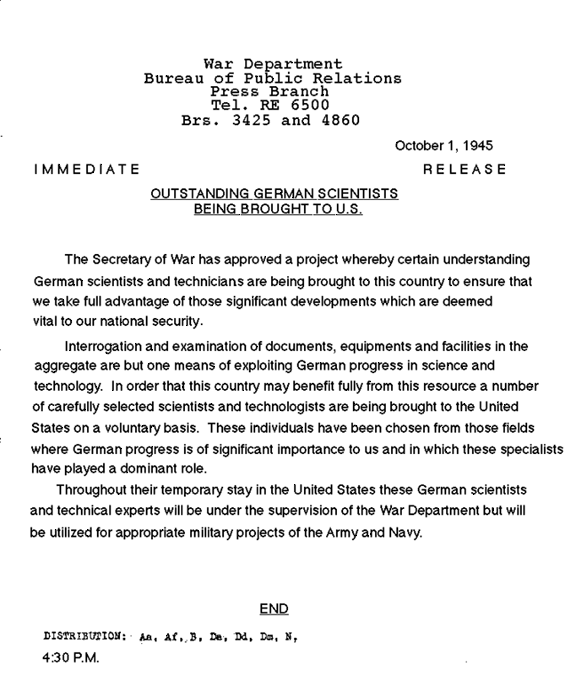
Many former Nazis were also put to work in the American chemical and biological weapons programs.
American leadership was actually very impressed with the Germans,
obviously in part because of the superior German technology such as
rocketry, jet technology, and chemical weapons technology. Americans
were also very impressed by the capabilities of German propaganda.
With the high influx of German personal into these very significant
programs, and in a position where the Germans were actually the superior
in terms of knowledge, many Americans who worked with these Germans
admired and respected them. The Germans, though having technically been
through "de-Nazification" programs, still held their same views about
the Soviets and the former Nazis, in part of out a desire to work, and
in part because they truly believed in the global Soviet threat,
advocated programs of strong Soviet opposition. They found plenty
of sympathetic ears in the American ranks, especially due to the fact
that many Americans were so impressed with the knowledge and
capabilities of these Germans.
Some of the suggestions made by the Germans were at first not taken
too seriously, but when North Korean invaded South Korea, and then again
when Sputnik was launched Americans began becoming even more sympathetic
to the German ideology of need for conflict with, and the destruction
of, the Soviet Union. There were plenty of strong anti-Communists before
the war, but their influence was mitigated by those who were on the
fence or seeking peace, but as the Soviet Union became stronger those
people on the fence fell more in line with the strong anti-Soviet
ideology and the influence of the German ideology increased.
The House Un-American Activities Committee
Audio Clip of members of the
House Un-American Activities Committee
When HUAC, the House Un-American Activities Committee, was
established by President Roosevelt in 1938 its primary purpose was to
investigate the activities of German and Italian fascist supporters in
the United States. Despite this, HUAC focused mainly on communism
and the activities of communists in America. The members of HUAC were
largely conservative Democrats. The chairman of HUAC was Martin Dies;
other members included John Rankin, John Wood, and future president
Richard Nixon.
Despite the fact that there were calls for HUAC to investigate the Ku
Klux Klan, Dies, Rankin, and Wood were all known sympathizers of the
KKK.
In 1937, while the formation of HUAC was in progress, a member of the
KKK sent a telegram to Martin Dies stating:
Every true American, and that includes every Klansman, is behind
you and your committee in its effort to turn the country back to the
honest, freedom-loving, God-fearing American to whom it belongs.
While a few investigations into the activities of overt Nazi
supporters did take place, attention quickly turned to communism.
Importantly, many Committee hearings were publicly broadcast. These
hearings become a major interest of the nation and were influential on
public opinion. It was in many ways a means to put communism on trial in
America, in an environment where the anti-communists were very much in
charge. Though there were of course those who voiced opposition to the
Committee, the majority of Americans were supportive of the Committee
throughout the bulk of its activities.
A favorite target of HUAC was labor unions. Though the Labor
Relations Act of 1935 gave government support to labor unions it also
brought new levels of government control over organized labor as well.
Labor unions were no longer separate and independent organizations of
men, but were now organizations under the direct influence of the
Federal Government. This resulted in major reforms of labor unions and
more investigations of their members.
The most significant anti-communist efforts of HUAC took place after
World War II, but even prior to the war the primary focus, even though
Nazi Germany was our official enemy, was on American communists.
It must be stated that even though the activities of HUAC did become
extreme, and should have been considered un-Constitutional in some
cases, the committee also engaged in valid investigation as well.
One of the major aspects of HUAC that brings much criticism is that
the focus of HUAC was in proving that individuals were members of the
Communist Party in America. The issue is that the Communist Party was a
perfectly legal political party. Many people joined the Communist Party
during the 1930s due to a real desire to work towards improving social
conditions in America. One of the strongest aspects that drew drew
individuals to the party at that time was the position of the Communist
Party on women's and minority rights.
At that time the Communist Party was the largest political party that
had the promotion of racial and gender equality as a part of its
platform. So, many people who were active in the party prior to World
War II were active in it largely for that reason, as is described by
party member Eugene Dennett, who was a member from 1931 to 1947.
"I was disturbed because there were no remains of the Party unit
I had led in Rainier Valley before joining the army. The people
who used to be active in it seemed to no longer have any ties to our
equal rights efforts for Negroes and women. Before I left for the
army, our Party unit had recruited about 150 members around the issues
of equal rights for women and the many minorities that had deep roots in
the Rainier Valley area. Our Party unit was inspired by the public
response to our efforts to stop discrimination against any minority."
The results of being called to testify before the Committee could be
extremely ruinous to a person's life, even if they themselves were never
a member of the party. Even if one was a member of the party and did
share many views of the party platform it still didn't necessarily
warrant to treatment given by the Committee. For example the biggest
achievement of the Washington State Communist Party was to draft
Washington state Initiative 141, which guaranteed seniors a minimum $40
income per month; a state Social Security program. The measure was
passed by popular vote.
Gary Costigan is an example of someone who came before the Committee
to testify against the Communist Party as a former member who still lost
his job and received ill treatment from the Committee, despite the fact
that he was naming names and testifying against communism.
Below is an excerpt from his 1948 testimony:
Q. The Communist Party has pursued a course of vilification and
persecution?
A. Well, all you have to do is to take a look at the "New World" [a
pro-communist newspaper published in Seattle]... to find out that I
am probably hated more than anyone in the Pacific Northwest by the
Communist Party. As a matter of fact, I see no particular reason. I
am perfectly willing to testify before this committee. I have
nothing I want to cover up. As a matter of fact, I haven't anything
to lose; that is, at least I haven't a job to lose, because your
headlines last week from these committee rooms, saw to the fact that
my job was taken too. So-
Q. You have lost your job since this-
A. Oh, yes,-
Q. -hearing began?
A. -I mean, some of the more flamboyant testimony last week helped
to do that.
Pete Seeger was a singer/songwriter who was a member of the Communist
Party. He is most famous for writing We Shall Overcome.
An excerpt of Seeger's testimony:
I feel that in my whole life I have never done anything of any
conspiratorial nature and I resent very much and very deeply the
implication of being called before this Committee that in some way
because my opinions may be different from yours, that I am any less
of an American than anyone else.
I am saying voluntarily that I have sung for almost every religious
group in the country, from Jewish and Catholic, and Presbyterian and
Holy Rollers and Revival Churches. I love my country very dearly,
and I greatly resent the implication that some of the places that I
have sung and some of the people that I have known, and some of my
opinions, whether they are religious or philosophical, make me less
of an American.
Seeger was eventually sentenced to 12 months in prison for contempt
because he refused to name names of people who he knew were associated
with the Communist Party.
Several professors were fired from their positions and prevented from
teaching through the efforts of HUAC.
One of the most widely publicized actions of HUAC was the sentencing
of "the Hollywood 10" and the blacklisting of 324 other Hollywood
workers, preventing them from being able to work in their profession.
The Hollywood 10 were sentenced for contempt for refusing to name names.
The actions of HUAC in strongly perusing members of the film industry
played a significant role in shaping film industry content during the
1950s.
In the 1950s, lead by Senator Joseph McCarthy, the committee went on
to allege that hundreds of federal employees were communist sympathizers
or in fact communist secret agents. These charges came after the 1950
conviction of Alger Hiss on charges of perjury during the HUAC
investigation of him. Alger Hiss was a high level State Department
official in the Roosevelt and Truman administrations. In 1948 Whittaker
Chambers, a former member of the Communist Party, testified before HUAC
and named Hiss as a communist sympathizer. Upon this testimony Hiss,
still a government official, asked to testify before the Committee to
defend himself against the the claims.
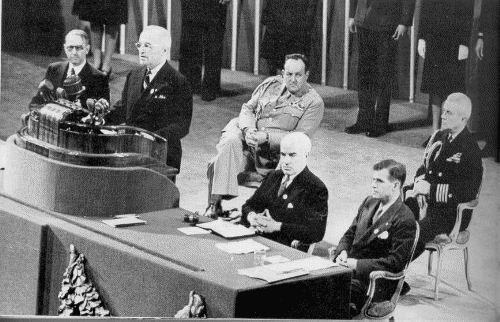
Hiss on lower right in 1948
During Hiss' examination by HUAC Richard Nixon aggressively went
after Hiss. Hiss then sued Chambers, who claimed to be a former friend
of his, for libel because of the impact that the HUAC investigation was
having on him.
After Hiss sued Cambers, Chambers lead Nixon to a set of documents
that he claimed he had gotten from Hiss back in 1938. These documents,
known as "the pumpkin papers" (because Chambers had stored the evidence
in a pumpkin) were critical in the prosecution of the Hiss case.
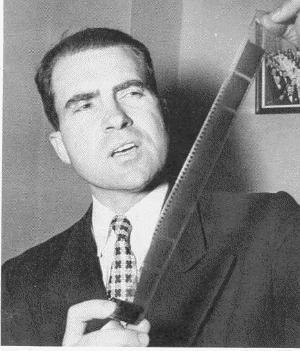
Richard Nixon holding up the "pumpkin papers" microfilm
Though the "papers" actually amounted to little in terms of actual
content, Nixon portrayed them in the press as "the most
confidential, highly secret , State Department documents," which he
stated were obtained for the purpose of sending them to the Soviet
Union.
Click to View footage of the Nixon Broadcast
When asked to hand over the documents to the Committee, Nixon
refused, but was later forced to by court order. After reviewing the
documents it was clear that they didn't represent "the most
confidential, highly secret, State Department documents," but they
did contain confidential government documents nonetheless.
Because of the statue of limitations, it was impossible to prosecute
Hiss on charges of espionage, but he was convicted on two counts of
perjury and sentenced to 3 years 8 months in jail. Hiss maintained his
innocence all his life; he died in 1996. There is still controversy
today as to whether or not Hiss actually was working with the Soviets. A
few things are known for certain, including the fact that several
aspects of Chambers testimony were definitely wrong, and while at the
Yalta Conference in 1945 Hiss took a strongly pro-American position and
presented opposition to some Soviet proposals.
After the Watergate scandal, the famous Nixon tapes revealed many
comments by Richard Nixon about
the Hiss case while he was in the White House, some 20 plus
years later:
"We won the Hiss case in the papers. We did. I had to
leak stuff all over the place. Because the Justice Department
would not prosecute it. Hoover didn't even cooperate. It was
won in the papers. We have to develop a program, a program for
leaking out information. We're destroying these people in the
papers."
Much more on the Hiss case can be found here:
The Alger
Hiss Story
Summary of Hiss Case
After the successful prosecution of the Hiss case, HUAC's
investigations into other government officials increased, primarily at
the direction of Joseph McCarthy, as was stated earlier.
McCarthy, a vocal Irish Catholic receiving support from the Church,
claimed that he knew of 205 "card carrying" Communists working in the
State Department, and that he intended to root them out. In a telegram
to President Truman, McCarthy indicated to the President that he was
going public with his claims about Communist infiltration of the
American government.
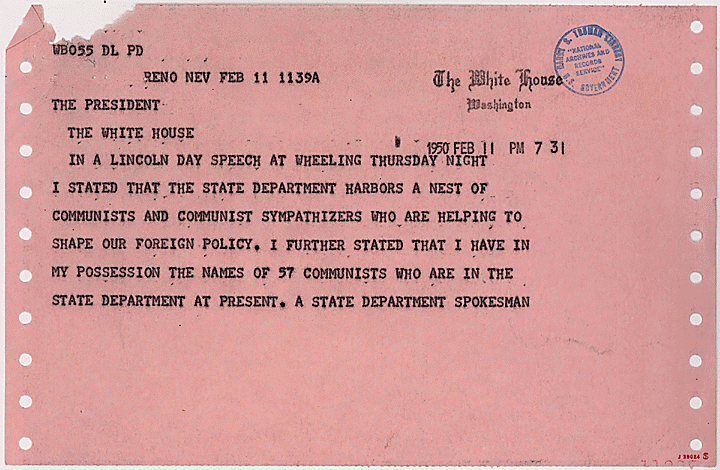
After publicly attacking a number of government officials,
McCarthy went on to bring allegations against the US military. It was
when he did this that he finally stepped on too many toes. Not only did
his institutional support come out from under him, but he lost the
support of the American public as well.
The point of understanding HUAC is neither to demonize it or defend
it, but rather to understand the impact that HUAC had on society.
Arguments can be made, especially if one is anti-communist, that the
actions of HUAC were justifiable. That's not really the issue in my
opinion. There is no need to pass judgment on HUAC either way to
understand its role in American history and shaping American politics
and political attitudes. Its also understood that by the 1950s many
members of HUAC, including men like Joseph McCarthy and Richard Nixon,
were using charges against government officials as a political tool to
try and discredit the political establishment and many members of the
Democratic Party who were politically connected to the Roosevelt and
Truman administrations in order to make way for conservative Republican
politicians.
For more on HUAC and its impact on America see:
Telegram from Senator Joseph McCarthy to President
Harry S. Truman
HUAC and Censorship Changes
The Cold War and Red Scare in
Washington State
House Un-American Activities Committee
American Society After the War
After World War II American society took on characteristics similar
in fashion, though not as dramatic, to the European fascist societies.
All of the same issues came up in America that had been critical in
Europe during the rise of fascism there. Despite the fact that many
Americans were still fond of FDR, the increase in conservative political
power after FDR was gone gave the country a strong conservative
environment and the growing anti-communist agenda, which was heavily
contributed to by HUAC, also contributed to this. The efforts of HUAC
also made many people suspicious of political figures associated with
the Roosevelt administration.
Just as in fascist Europe, gender roles became more pronounced with
men becoming "sole providers" and women staying at home. This is also
exactly what happened in Germany and Italy under fascism. In Germany a
woman's place was considered to be to with the, "Kinder, Kueche, and
Kirche," or, children, kitchen, and church.
Patriotism soared, of course in part due to the effects of the war,
this was only natural, but nevertheless its effects on society were the
same and it was taken advantage of by political leaders as well as
American corporations who were beginning to take advantage of the new
medium, television, to promote their products. Patriotism was used in
advertising, especially among companies like Coca-Cola, auto, and
cigarette companies, in ads such as the one below, which claims that
something "new" (muscles) was added to men returning from the war and a
new "more powerful punch" had also been added to the cigarettes.
Perhaps most importantly though, religious participation increased
dramatically after the war. This is typical of all wars, but in this
case there was more to it than just that.
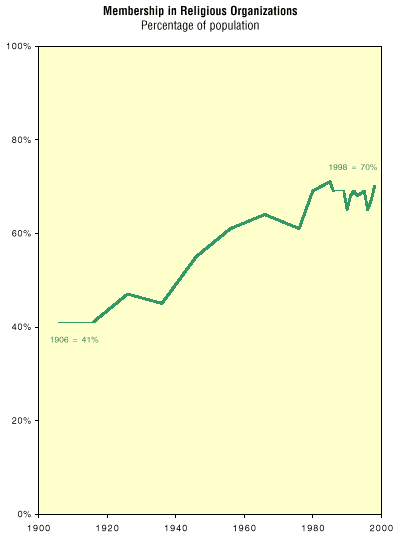
The American government began strongly promoting religion as part of
an overall strategy to distance American culture from Soviet culture,
which was the same thing that the Fascists did as well.
In addition to this however, the Communists and Nazis were painted
with the same brush by American leadership as both being anti-religious,
which was in fact not correct, as has already been discussed. The Nazis
were in fact extremely religious. Some members of Nazi leadership
opposed the power of the churches in Germany when the church interests
and State interests were in conflict, and some members of Nazi
leadership were anti-Christian in that they believed that Christianity
had its roots in Judaism and thus was "tainted" by "the Jews." However
Nazi Germany was, on the whole, a Christian society and it was an
extremely religious society where lack of faith was simply not
acceptable. Atheists were put into concentration camps in Nazi Germany
and in Fascist Italy Catholicism was the official State religion.
However, this was not made clear to the American public, it served a
better purpose to simply allow people to have misconceptions about Nazi
Germany and for American leadership create distance between American
culture and Nazi culture, so the misconceptions that were promoted
during the war about the Nazis were allowed to stand. Likewise religious
leaders were quick to condemn the fascists once the obviousness of their
horrors was apparent to all, and to point the finger at every other
source of blame rather than the roles of Christianity in those cultures
in contributing to anti-Semitism and nationalism.
FDR had created the economic tools of fascism. He organized
capitalism under the influence of the State for the purpose of bettering
society, and he was successful in doing that, and long after the war
that agenda was still being followed, the agenda of using the State to
direct the economy in ways that would benefit society. As much as we
take that for granted as a "good idea" that was part of the development
of Fascism during the 20th century, prior to that the idea
that the State should "direct" anything was considered a "no no" among
western democracies.
So, FDR created the economic tools of fascism, but it was not until
the 1950s that America would actually become a truly fascist country in
both the economic and social sense.
During the 1950s all aspects of life were brought in line with "the
interests of the State." Not nearly so strictly as in fascist Europe,
but the focus did shift to the State as a director of American society
like never before, and, just as in Europe, a conservative public
mentality encouraged this increased control and contributed to growing
social fascism as a means to quell dissent, not just as something that
was imposed by the State, but, like in Germany and Italy, as something
that the public majority itself participated in, and in fact, just as in
Italy and Germany, benefited from. The latent social conservative
tendencies inherent in American culture during the 1930s found
institutional support from leadership in America during the 1950s.
Nowhere is this more strongly evidenced than with the changes made to
the Pledge of Allegiance in 1954. The pledge was again
changed in 1954, during the McCarthy era. The change in 1954 was the
addition of the words "under God", so that the pledge then read:
"I pledge allegiance to the Flag of the United
States of America and to the Republic for which it stands, one
nation under God, indivisible, with liberty
and justice for all."
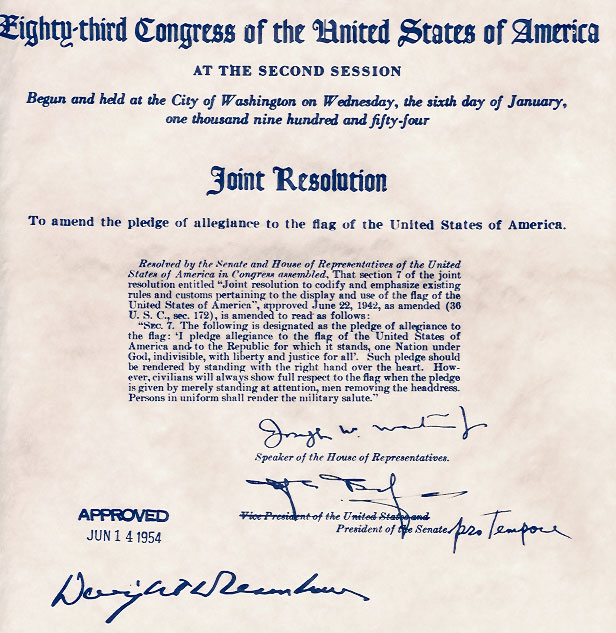
This last change was requested by the Knights of Columbus, a conservative Catholic
organization.
The account of how this change to the flag was made can be seen here:
How the words "UNDER GOD" came to be added
to the Pledge of Allegiance to the Flag
It is meaningful to note here that the Catholic Church was a major
factor in the spread of fascism in Europe. The history of the
relationship between fascism and the Vatican is controversial one, but
it cannot be denied that in both Germany and Italy the rise to power of
the fascists was aided by the Catholic Church. Why? Because the Catholic
Church was rapidly losing membership with the advancement of liberalism
and secularism in Europe. The fascists promised to promote the interests
of the Church if they were able to get into power. Mussolini made good
on his promise when he signed the Lateran Treatyin 1929,
giving increased powers to the Catholic Church, establishing Catholicism
as the official state religion of Italy, and ensuring that Catholicism
would be taught in public schools.
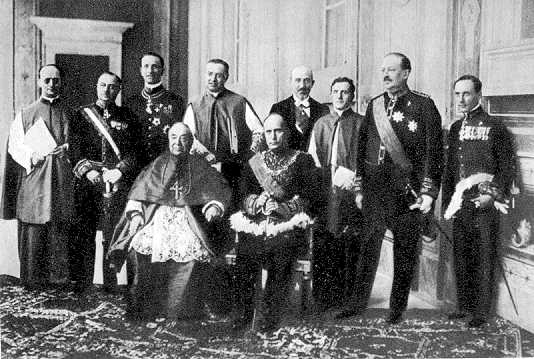
Cardinal Gasparri and Benito Mussolini seated after singing the
Lateran Treaty
In a 1937 Encyclical Letter titled On Atheistic Communism,
issued from Rome Italy, Pope Pius XI stated:
Duties of the Christian State Aid to the Church
73. Such is the positive task, embracing at once
theory and practice, which the Church undertakes in virtue of the
mission, confided to her by Christ, of constructing a Christian
society, and, in our own times, of resisting unto victory the
attacks of communism. It is the duty of the Christian state to
concur actively in this spiritual enterprise of the Church, aiding
her with the means at its command, which although they be external
devices, have nonetheless for their prime object the good of souls.
74. This means that all diligence should be
exercised by States to prevent within their territories the
ravages of an anti-God campaign which shakes society to its
very foundations. For there can be no authority on earth
unless the authority of the Divine Majesty be recognized; no oath
will bind which is not sworn in the Name of the Living God.
We repeat what We have said with frequent insistence in
the past, especially in Our Encyclical Caritate Christi:
"How can any contract be maintained, and what value can
any treaty have in which every guarantee of conscience is lacking?
And how can there be talk of guarantees of conscience when all faith
in God and all fear of God have vanished? Take
away this basis, and with it all moral law falls, and there is no
remedy left to stop the gradual but inevitable destruction of
peoples, families, the State, civilization itself." (Encycl.
Caritate Christi,May 3, 1932 [A. A. S., vol. XXIV, 1932, p.
190].)
Provision for the Common Good
75. It must likewise be the special care of the
State to create those material conditions of life without which an
orderly society cannot exist. The State must take every
measure necessary to supply employment, particularly for the heads
of families and for the young. To achieve this end demanded by
the pressing needs of the common welfare, the wealthy classes must
be induced to assume those burdens without which human society
cannot be saved nor they themselves remain secure. However,
measures taken by the State with this end in view ought to be of
such a nature that they will really affect those who actually
possess more than their share of capital resources, and who continue
to accumulate them to the grievous detriment of others.
Prudent and Sober Administration
76. The State itself, mindful of its responsibility
before God and society, should be a model of prudence and sobriety
in the administration of the commonwealth. Today more than
ever the acute world crisis demands that those who dispose of
immense funds, built up on the sweat and toil of millions, keep
constantly and singly in mind the common good. State
functionaries and all employees are obliged in conscience to perform
their duties faithfully and unselfishly, imitating the brilliant
example of distinguished men of the past and of our own day, who
with unremitting labor sacrificed their all for the good of their
country. In international trade-relations let all means be
sedulously employed for the removal of those artificial barriers to
economic life which are the effects of distrust and hatred.
All must remember that the peoples of the earth form but one family
in God.
Unrestricted Freedom for the Church
77. At the same time the State must allow the
Church full liberty to fulfill her divine and spiritual mission, and
this in itself will be an effectual contribution to the rescue of
nations from the dread torment of the present hour. Everywhere
today there is an anxious appeal to moral and spiritual forces; and
rightly so, for the evil we must combat is at its origin primarily
an evil of the spiritual order. From this polluted source the
monstrous emanations of the communistic system flow with satanic
logic. Now, the Catholic Church is undoubtedly preeminent
among the moral and religious forces of today. Therefore the
very good of humanity demands that her work be allowed to proceed
unhindered.
Encyclical Letters are letters by the Pope which are distributed to
every Bishop in the world and filtered down to the individual church
level to be read by every Priest. This is part of the globally
centralized Catholic system of administration. In fact, this particular
Encyclical Letter contributed to significant opposition to the
American alliance with the Soviet Union during World War II among
Catholics.
In 1943 author Joseph McCabe wrote in The Papacy in Politics Today:
...I invite him [the reader] to reflect on these facts, which must
be within his knowledge:
1. The Roman Church has remained throughout the war in
friendly relations with the three aggressive Powers--we shall see
that the occasional friction in Germany was a purely ecclesiastical
affair--and the Papacy has never condemned the crime of their
aggressions and the bestialities of their methods.
2. All Roman Catholic countries--Italy, Spain,
Portugal, Hungary, Eire, most of the South American Republics, and
now France and Belgium--are Fascist, and they rightly declare that
they have adopted Fascism in obedience to the Papal Encyclical
Quadragsimo Anno.
3. All non-Catholic States of Europe and America that
are still free are democratic, and the only great Powers fighting
for civilization are those in which Catholics are a relatively small
minority. Catholics form little more than one-tenth of the
population of the United States and less than one-twentieth of the
population of Great Britain.
4. In the democratic States that are fighting for
civilization the Catholic minorities have been the most obstructive
force, and their attitude was mainly based upon Papal declarations,
especially about Russia. All papers admitted that the Catholics were
"the core of the Isolationists" in America until Japan opened its
treacherous attack. Quebec, a Fascist State, has greatly
embarrassed, and still embarrasses, the Canadian Government, and the
Catholics of Australia under their bitter Irish leader, Archbishop
Mannix, have given serious trouble in that Dominion.
5. Whenever a country of mixed Catholics and
non-Catholics has been conquered by the Nazis it has, with the
cordial cooperation of the Vatican, either, like France and Belgium,
been put under a despotic Catholic minority or, as in
Czecho-Slovakia, Catholic provinces have been detached and converted
into Fascist Catholic States.
6. In short, the three great Powers which to-day
sustain at appalling cost the fight for civilization--a fight upon
which the Pope has not bestowed one word of human benediction--are
non-Catholics to the extent of more than ninety per cent. The Powers
(outside Asia) which would destroy civilization or which give
sympathy or active support to the criminals--Vichy France, Spain,
Portugal, Eire--are or claim to be solidly Catholic. Germany is at
least one-third Catholic.
The Catholic Church of course has little concern for the separation
of Church and State. The Catholic Church is itself the creation of the
Roman State and has for all time been the strongest opponent of
separation of Church and State. The history of Mexico is an excellent
testament to this, Mexico having struggled for centuries to break free
from Catholic government rule.
Pope Leo XIII stated:
It is quite unlawful to demand, defend, or to grant unconditional
freedom of thought, or speech, of writing or worship, as if these
were so many rights given by nature to man.
-Pope Leo XIII, "Great Encyclical Letters"
They [Catholics] must penetrate wherever possible in the
administration of civil affairs... all Catholics should do all in
their power to cause the constitution of states, and legislation to
be modeled on the principles of the true Church.
-Pope Leo XIII, "Encyclical of Leo XIII"
Hence follows the fatal theory of the need of separation between
Church and State.
-Pope Leo XIII, "Libertas"
The Catholic Church is the foundation of ties between Church and
State in Western Civilization. The Catholic Church has been the world
wide leader in movements to restore the role of the Church within the
State, which has often been advocated under the banner of fighting
communism.
This last change to the pledge is very symbolic of the finalization
of the fascist state in America. During the 1950s, as happened in Italy
and Germany, the barriers between Church, State, and Corporation had all
been broken.
In 1956 Congress changed the national motto from "E Pluribus Unum" to
"In God We Trust", and "So help me God" was added to federal oaths
(despite the fact that the Christian Bible clearly states
not to swear on God or any other person,
place, or thing when taking an oath. Matthew 5:33-37, James 5:12).
All of this is exactly the same type of thing that took place in
Fascist Europe, and just as in Europe these were changes that were not
forced upon people by the State, but they were in fact supported by the
people out of the increasingly conservative social climate.
Just as in Germany and Italy the increased religiosity and patriotism
also corresponded with increased intolerance and minorities were further
ostracized.
It would be wrong to conclude that all elements of fascism in
general, and particularly American fascism, are by definition negative
though. Aside from the war and horrible racial oppressions among the
European fascists, the European fascists did provide a variety of
benefits to their nations, such as increased employment, the
construction of the national autobahn (highways) in Germany, and a
strong focus on scientific research, though most of it was on weapons
technology.
Many of these same things took place in America, and people benefited
from these State programs. After the war President Eisenhower
commissioned the building of Federal highways, the G.I. Bill sent
thousands of men to college, the government poured money into scientific
research and large government contracts with businesses. The government
aided millions of American in buying their first homes, and so on and so
fourth. The biggest beneficiaries of American fascism during the early
years was the middle class.
Summary
The Enlightenment era of the 18th and 19th century created a whole
new world of ideas for mankind. The new ideologies that developed out of
The Enlightenment, combined with the sweeping changes ushered in by the
development of democracy, science, and industrialization, resulted in a
highly ideologically polarized world in the 20th century. All of these
changes challenged traditional world-views and institutions.
Laissez-faire capitalism had expanded rapidly in America during the late 19th
century, but laissez-faire capitalism reached a world-wide stage of
crisis in the early part of the 20th century, both moral and practical,
resulting in two primary outcomes: The rise of the socialist movement to
overthrow capitalism, and the development of fascism to use the State to
prop it up.
Fascism, though, embodied more than just that, because the once
revolutionary institution of capitalism had now become the potential
"victim" of the next revolution. Capitalism, once independent from the
State and aligned with liberalism, then became aligned with
elements of conservatism. The State and Capital together reached back into the Old
World, grasped onto the Church, and called on the name of God
Almighty to save them from revolution. This is fascism. The rejoining of
Church, State, and Commerce into a unified and mutually supportive
relationship for the maintenance of power.
The rise of fascism took a different, non-revolutionary, path in
America than it took in Europe. European fascism was certainly more
extreme and malignant, but it has to be repeated that the term "fascism"
has an unfairly negative connotation today because of its association
with the Axis powers. Describing the post Second World War American
State as fascist isn't an attempt to stigmatize it, but rather to
understand the qualities of the modern American State, for better or for
worse, and to understand the many different factors that contributed to
the establishment of the greatly more powerful American Federal
Government during World War II and to what ends that power would be
wielded in the second half of the 20th century.
|


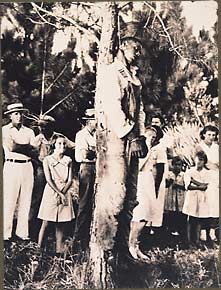
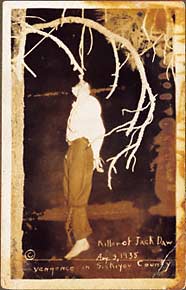
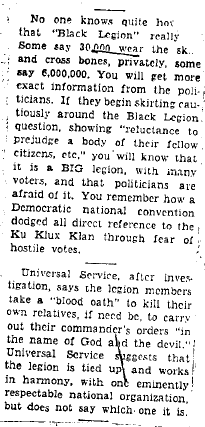
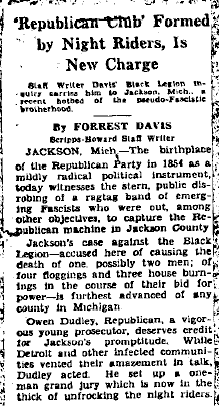
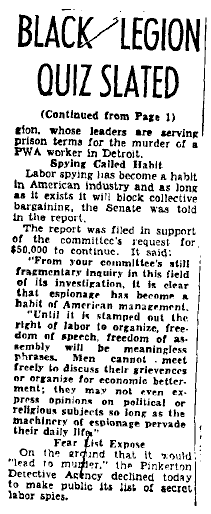
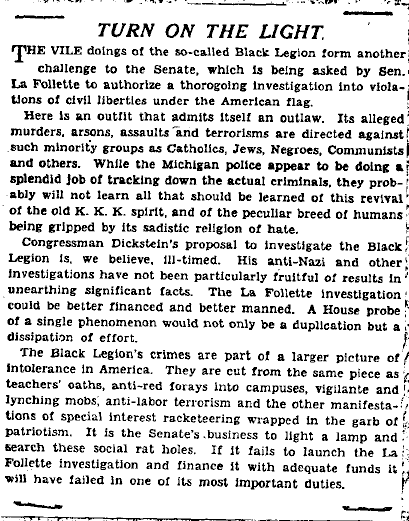
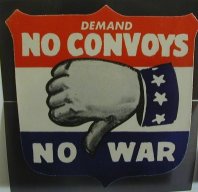
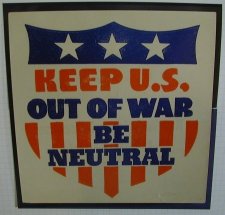
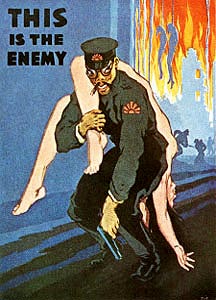
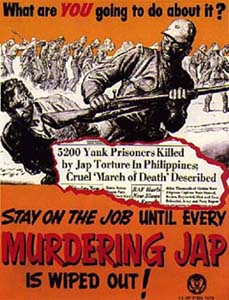
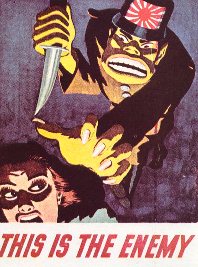
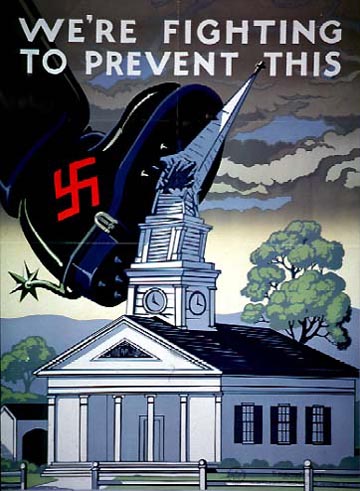
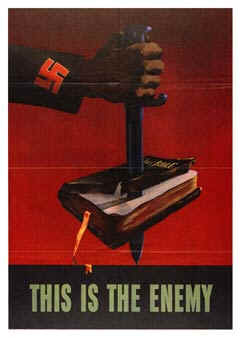
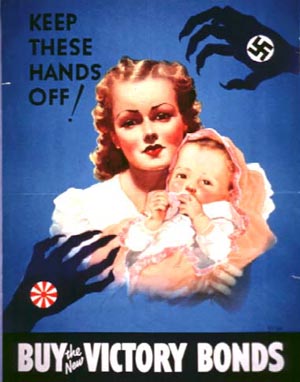
 views since 5/15/2004