|
A Historical Outline of Modern Religious Criticism
in Western Civilization
By
 - September 10, 2005
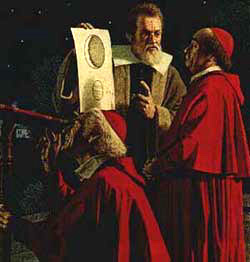
Galileo trying to convince the Pope of his views
The following is a generally chronological highlight of the major movements and
thinkers of religious criticism that have influenced modern Western Civilization. This is by no means a complete listing of
all of the important religious critics in Western Civilization, and the
focus is mainly on the major powers of Europe as well as the United States,
which is not to say that there have not been many other important religious
critics from around the world. The Protestant Reformation (1517-1555)
The Protestant movement ended the Catholic Church's long held monopoly on
religious and intellectual thought. The Protestant Reformation was a
movement of religious "protest" that started in Germany and spread
throughout Western Europe. The word Protestant has its original roots in
Latin and means "to bear witness", but the word "protest" in the English
language today comes from the Protestant movement, because it was a movement
of opposition to authority.
The Reformation was marked by religious wars that raged across Europe,
with the execution and torture of many people for heresy. The majority of
people killed for heresy actually considered themselves Christians and
believed in God - their views on God were just slightly different than
accepted dogma or even from other religious protestors. Indeed many
Protestants killed other Protestants for holding different beliefs.
During the Protestant reformation the idea that the Bible was the literal
and complete word of God became widespread. This was done because the
Catholic Church claimed that the clergy were required to interpret the
Bible, which tied all belief and salvation to the Church. The Protestants
were looking for a way to remove themselves from dependence on the Church,
so they claimed that the Bible itself was all that was needed to know and
understand God, eliminating the need for priestly intervention between the
individual and God. Claiming that the Bible was the literal word of God
resulted in much stronger scrutiny of the Bible and set the stage for
further criticism of Christianity based on analysis of Biblical texts.
Following the Reformation personal religious interpretations grew and the
variety of religious ideas increased.
The Renaissance (1500-~1650s)
During the Renaissance period scientific ideas slowly
took root and challenged religious beliefs. This was the period in which
Copernicus and Galileo taught that the Earth revolved around the Sun, which
contradicted the view espoused by the Catholic Church. This was also a
period of great advance in mathematics, philosophy, human anatomy, and the
arts, but there was still a significant danger of persecution, imprisonment,
and death for heresy.
Advances during the Renaissance were heavily influenced by classical
Greek and Roman art and literature.
Andreas Vesalius (1514-1564)
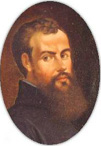 Andreas Vesalius
is considered the father of modern human anatomy and is one of the major
contributors to modern science. He published
the first complete textbook on human anatomy in 1546, On the Workings of
the Human Body. Vesalius was from Belgium, but traveled throughout Western
Europe. Vesalius took pains not to make needlessly controversial statements
due to his fear of the Inquisition. His religious criticism was a criticism
by action, because he knowingly violated Church law by dissecting human
corpses. Though he tried as much as he could to avoid controversy while practicing
his study of the human body, charges of atheism and heresy were brought
against on more than one occasion. He did finally face the Inquisition and
was sentenced to make a pilgrimage to Jerusalem to prove his faith. He died
during a shipwreck on his return journey. Andreas Vesalius
is considered the father of modern human anatomy and is one of the major
contributors to modern science. He published
the first complete textbook on human anatomy in 1546, On the Workings of
the Human Body. Vesalius was from Belgium, but traveled throughout Western
Europe. Vesalius took pains not to make needlessly controversial statements
due to his fear of the Inquisition. His religious criticism was a criticism
by action, because he knowingly violated Church law by dissecting human
corpses. Though he tried as much as he could to avoid controversy while practicing
his study of the human body, charges of atheism and heresy were brought
against on more than one occasion. He did finally face the Inquisition and
was sentenced to make a pilgrimage to Jerusalem to prove his faith. He died
during a shipwreck on his return journey.
Vesalius’ publications on anatomy contradicted the
accepted teachings of his day. This is largely because human anatomy in
Christian civilization up to that time was not based on the study of the
human body, it was based on a combination of animal anatomy and
theology. For example, it was believed that there was a special bone within
the human body that housed the soul, and this bone was needed for bodily
resurrection after the last judgment. This is one reason that convicted
heretics were burned and why Christians opposed cremation. It was believed
that this bone and the “body” were needed for the body to ascend to heaven
after the Final Judgment. Vesalius also documented that men and women have
the same number of ribs, which contradicted the Church teaching that men had
one less rib because one of Adam’s ribs had been used by God to create Eve.
After his death permission to dissect human cadavers
for study slowly began to gain acceptance, though an aversion to the
practice has persisted among many Christians to this day. Even still there
are many Christians who oppose the donation of human bodies to science.
Giordano Bruno (1548-1600)
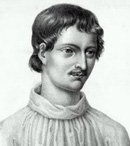 Giordano Bruno, from Italy, was one of the most radical
cosmologists of the Renaissance. Bruno was not a mathematician, like most
other astronomers, but he took Copernican astronomical theory farther than
any others of his time. Giordano Bruno, from Italy, was one of the most radical
cosmologists of the Renaissance. Bruno was not a mathematician, like most
other astronomers, but he took Copernican astronomical theory farther than
any others of his time.
Copernicus’ heliocentric theory stated that the Earth
revolved around the Sun, which contradicted the Christian view that the
Earth was the center of the universe, around which everything else revolved.
Bruno went further and stated that space and time are both infinite,
contradicting Christian beliefs in Creation and Final Judgment. He also
stated that the Sun is a star, and that all of the other stars in the
universe are the centers of their own solar systems, each having their own planets. This deeply upset religious authorities by
contradicting the Christian belief that the Earth and humans are central to
the universe and uniquely special.
He was arrested for heresy in 1592 and imprisoned for
six years prior to his Inquisition hearing. During his trial Bruno refused
to accept Church doctrine regarding the nature of Jesus and he refused to
recant his views of the universe. Thus he was sentenced to death.
In 1600 Giordano Bruno was taken to a public square in
Rome, with his tongue in a vice, and he was burned to death.
Galileo Galilei (1564-1642)
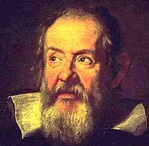 Galileo is perhaps the most famous and important
scientific figure of the Renaissance. Galileo is not only famous for his
scientific discoveries, but also for his conflict with the Catholic Church
and the effect he had on theology. Galileo is most well known for his
support of Copernicus' theory that the Earth revolves around the Sun. Galileo is perhaps the most famous and important
scientific figure of the Renaissance. Galileo is not only famous for his
scientific discoveries, but also for his conflict with the Catholic Church
and the effect he had on theology. Galileo is most well known for his
support of Copernicus' theory that the Earth revolves around the Sun.
The Copernican heliocentric theory was published in 1543, before Galileo was born. The Copernican
theory was strongly opposed and viewed as heresy by the Church. Prior to
Galileo there was little supporting evidence for the theory. Copernicus’
work was based heavily on mathematics and general observations. Others, such
as Giordano Bruno, expanded the theory philosophically, but it was Galileo
that provided the strong supporting evidence needed to confirm the theory
with scientific observation. In fact, Galileo’s work to support the
Copernican theory really was the beginning of modern science. It was Galileo
that pioneered the use of precise measurable observations with a large
volume of recorded data that could be independently analyzed as well as records of experiments and observations that could be verified by others.
While Galileo made many contributions to science,
mathematics, technology, and philosophy, he was also a critic of religion
itself, though only indirectly because he still lived in a time when one
could be tortured and burned alive for heresy. Throughout his life Galileo
was censured by the Church. In 1616 Galileo was subject to the Inquisition.
The judgment of this Inquisition banned Galileo from teaching the Copernican
theory.
“The first proposition, that the sun is the centre
and does not revolve about the earth, is foolish, absurd, false in
theology, and heretical, because expressly contrary to Holy Scripture…
[and]… the second proposition, that the earth is not the centre but
revolves about the sun, is absurd, false in philosophy, and, from a
theological point of view at least, opposed to the true faith.”
- Judgment of the Inquisition of Galileo Galilei,
1616
“[Galileo Galilei is commanded] in the name of His
Holiness the Pope and the whole Congregation of the Holy Office, to
relinquish altogether the opinion that the sun is the centre of the
world and immovable, and that the earth moves, nor henceforth to hold,
teach, or defend it in any way whatsoever, verbally or in writing.”
- Cardinal Bellarmin decree to Galileo Galilei,
1616
His most famous work of religious “criticism” is Dialogue Concerning the Two Chief World Systems, published in 1632.
Galileo was given permission by the Pope to write and publish Dialog
based on the premise that he give the position held by the Church equal
weight as the Copernican position and that the book draw no concrete
conclusion.
Dialog presents both sides of the debate, as Galileo was given
permission by the Church to do, but unlike what he promised the Pope, Dialog does present the Copernican theory as
correct and the Church’s view as incorrect. To add insult to injury the
character in Dialog who argues the position of the Church is
portrayed as a simpleton who isn't very logical or knowledgeable.
For this the book was banned and Galileo was subjected again to the Inquisition, during
which he finally recanted his views in order to save himself from death. He
was ultimately sentenced to house arrest, under which he lived out the rest of his
days.
“Father Lecazre declared ‘it casts suspicion on the
doctrine of the incarnation.’ Others declared, ‘It upsets the whole
basis of theology. If the earth is a planet, and only one among several
planets, it can not be that any such great things have been done
specially for it as the Christian doctrine teaches. If there are other
planets, since God makes nothing in vain, they must be inhabited; but
how can their inhabitants be descended from Adam? How can they trace
back their origin to Noah's ark? How can they have been redeemed by the
Saviour?’ Nor was this argument confined to the theologians of the Roman
Church; Melanchthon, Protestant as he was, had already used it in his
attacks on Copernicus and his school.”
- A History of the Warfare of Science with Theology
in Christendom, Andrew Dickenson White, 1898
“The opinion of the earth's motion is of all
heresies the most abominable, the most pernicious, the most scandalous;
the immovability of the earth is thrice sacred; argument against the
immortality of the soul, the existence of God, and the incarnation,
should be tolerated sooner than an argument to prove that the earth
moves.”
- Declaration of Father Melchior Inchofer, 1631
"We say, pronounce, sentence and declare that you, Galileo, by reason
of these things which have been detailed in the trial and which you have
confessed already, have rendered yourself according to this Holy Office
vehemently suspect of heresy, namely of having held and believed a
doctrine that is false and contrary to the divine and Holy Scripture:
namely that Sun is the centre of the world and does not move from east
to west, and that one may hold and defend as probable an opinion after
it has been declared and defined contrary to Holy Scripture.
Consequently, you have incurred all the censures and penalties enjoined
and promulgated by the sacred Canons and all particular and general laws
against such delinquents. We are willing to absolve you from them
provided that first, with a sincere heart and unfeigned faith, in our
presence you abjure, curse and detest the said errors and heresies, and
every other error and heresy contrary to the Catholic and Apostolic
Church in the manner and form we will prescribe to you. Furthermore, so
that this grievous and pernicious error and transgression of yours may
not go altogether unpunished, and so that you will be more cautious in
future, and an example for others to abstain from delinquencies of this
sort, we order that the book Dialogue of Galileo Galilei be prohibited
by public edict. We condemn you to formal imprisonment in this Holy
Office at our pleasure. As a salutary penance we impose on you to recite
the seven penitential psalms once a week for the next three years. And
we reserve to ourselves the power of moderating, commuting, or taking
off, the whole or part of the said penalties and penances. This we say,
pronounce, sentence, declare, order and reserve by this or any other
better manner or form that we reasonably can or shall think of. So we
the undersigned Cardinals pronounce:
F. Cardinal of Ascoli
B. Cardinal Gessi
G. Cardinal Bentivoglio
F. Cardinal Verospi
Fr. D. Cardinal of Cremona
M. Cardinal Ginetti
Fr. Ant. s Cardinal of. S. Onofrio"
- Condemnation of Galileo Galilei, 1632
Baron Edward Herbert (1582-1648)
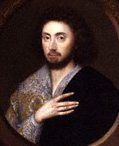 Edward Herbert is considered the first British Deist,
however all of his theological works were written in Latin and thus didn’t
have an enormous impact in England initially. He was well known by scholars who also studied Latin
however, and his works were translated into other
languages, such as French. Edward Herbert is considered the first British Deist,
however all of his theological works were written in Latin and thus didn’t
have an enormous impact in England initially. He was well known by scholars who also studied Latin
however, and his works were translated into other
languages, such as French.
Herbert was highly critical of Christianity and of the
idea of revealed truth, which put him in conflict with the religious
establishment, though his nobility and military service provided him an
adequate degree of protection. He also denied the divinity of Jesus and the
validity of miracles. His “rationalist” approach to theology was influential
on men such as Thomas Hobbes and Thomas Paine.
Herbert intended to develop a religion based on
rational principles. He studied the known religions of the time and came up
with five basic principles that he believed all religions had in common.
These principles are:
- There is a God
- God ought to be worshipped
- Virtue and Piety are the essential components of
any religion
- Vice is expiated through some form of repentance
- There are rewards and punishments after death
Lucilio Vanini (1585-1618)
Lucilio Vanini was an Italian philosopher and critic of
Christianity. Vanini studied theology and became an ordained priest. He
went on to travel Europe promoting freedom of thought, rationalism,
opposition to dogma, and opposition to the Catholic Church. After traveling
Europe he returned to Italy, but was forced to flee for his life to avoid
the Inquisition and charges of atheism.
In an attempt to clear his name and satisfy the
authorities he published a book of opposition to atheism in 1615 that
ostensibly affirmed his belief in God. This was the first book he had ever
published. Once his name was cleared by this book, however, he published
another book in 1616 that made it clear the first book was a parody of
religious belief and was not really reflective of his true views. The book
was banned.
In 1618 Vanini was arrested and charged with atheism. He refused to recant
and was sentenced to death. His tongue was cut out, he was hanged to death,
and then his body was burned to ashes, as was customary with all heretics.
The Enlightenment (1650-1790)
The Age of Enlightenment was
marked by a period of scientific advance, especially in the areas of physics
and mathematics. It was accompanied by deep philosophical advances as well.
Sir Isaac Newton’s work in physics and the laws of nature contributed
greatly to The Enlightenment, though Newton himself was a deeply religious
man. Enlightenment philosophy, both religious and anti-religious, held that
the world was observable and knowable. For men like Newton this meant that
it was possible to understand the laws of nature created by God; for others
it meant that there were explanations for the world without God.
In all cases, however, The
Enlightenment was a period of belief in human rationality and the power of education to advance the
interests of humanity. Criticism of dogma and the
Bible became widespread among educated members of society, even among those
that believed in God. Challenges to established institutions such as the
Church and the State grew during this period, resulting in the advancement
of democracy, free trade and science.
The end of The Enlightenment is generally marked by the French
Revolution, the rise of Industrial Capitalism in England, and developments in
German art and philosophy, among other trends.
Benedicto Spinoza (1632-1677)
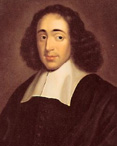 Spinoza was born in Amsterdam to a family of Portuguese Jews who had fled
there to escape the Portuguese Inquisition. He is considered a
major Enlightenment philosopher and a major contributor to the ideas of liberalism,
democracy, and religious tolerance. Spinoza was excommunicated from his
synagogue for challenging orthodoxy. He is considered the father of modern
Biblical criticism and a major contributor to Pantheism, which holds a view
of God as the physical universe. Spinoza was born in Amsterdam to a family of Portuguese Jews who had fled
there to escape the Portuguese Inquisition. He is considered a
major Enlightenment philosopher and a major contributor to the ideas of liberalism,
democracy, and religious tolerance. Spinoza was excommunicated from his
synagogue for challenging orthodoxy. He is considered the father of modern
Biblical criticism and a major contributor to Pantheism, which holds a view
of God as the physical universe.
Many of Spinoza's views are very familiar today, indeed his social views
essentially form the basis of all modern liberal democratic ideology. Both his
religious views and his views on government were highly controversial in his
day however, and thus he lived a reclusive life and published most of his
works anonymously in order avoid persecution. He arranged to have his last
work, The Ethics, published after his death.
Spinoza's views on religion and God did change over time. Clearly he
professed a more traditional (though still controversial) view of God in his
earlier works, but in The Ethics he put forward his most Pantheistic
view of God as nature.
Major works of Spinoza:
- On the Improvement of the Understanding (1662)
- Principles of Cartesian Philosophy (1663)
- A Theologico-Political Treatise (1670)
- The Ethics (1677)
"(1) If men's minds were as easily controlled as their tongues, every
king would sit safely on his throne, and government by compulsion would
cease; for every subject would shape his life according to the
intentions of his rulers, and would esteem a thing true or false, good
or evil, just or unjust, in obedience to their dictates. (2) However, we
have shown already (Chapter XVII.) that no man's mind can possibly lie
wholly at the disposition of another, for no one can willingly transfer
his natural right of free reason and judgment, or be compelled so to do.
(3) For this reason government which attempts to control minds is
accounted tyrannical, and it is considered an abuse of sovereignty and a
usurpation of the rights of subjects, to seek to prescribe what shall be
accepted as true, or rejected as false, or what opinions should actuate
men in their worship of God. (4) All these questions fall within a man's
natural right, which he cannot abdicate even with his own consent.
...
However unlimited, therefore, the power of a sovereign may be,
however implicitly it is trusted as the exponent of law and religion, it
can never prevent men from forming judgments according to their
intellect, or being influenced by any given emotion.
...
(14) Since, therefore, no one can abdicate his freedom of judgment
and feeling; since every man is by indefeasible natural right the master
of his own thoughts, it follows that men thinking in diverse and
contradictory fashions, cannot, without disastrous results, be compelled
to speak only according to the dictates of the supreme power. (15) Not
even the most experienced, to say nothing of the multitude, know how to
keep silence. (16) Men's common failing is to confide their plans to
others, though there be need for secrecy, so that a government would be
most harsh which deprived the individual of his freedom of saying and
teaching what he thought; and would be moderate if such freedom were
granted. (17) Still we cannot deny that authority may be as much injured
by words as by actions; hence, although the freedom we are discussing
cannot be entirely denied to subjects, its unlimited concession would be
most baneful; we must, therefore, now inquire, how far such freedom can
and ought to be conceded without danger to the peace of the state, or
the power of the rulers; and this, as I said at the beginning of Chapter
XVI., is my principal object. (18) It follows, plainly, from the
explanation given above, of the foundations of a state, that the
ultimate aim of government is not to rule, or restrain, by fear, nor to
exact obedience, but contrariwise, to free every man from fear, that he
may live in all possible security; in other words, to strengthen his
natural right to exist and work - without injury to himself or others.
(19) No, the object of government is not to change men from rational
beings into beasts or puppets, but to enable them to develope their
minds and bodies in security, and to employ their reason unshackled;
neither showing hatred, anger, or deceit, nor watched with the eyes of
jealousy and injustice. (20) In fact, the true aim of government is
liberty.
...
If we hold to the principle that a man's loyalty to the state should
be judged, like his loyalty to God, from his actions only - namely, from
his charity towards his neighbours; we cannot doubt that the best
government will allow freedom of philosophical speculation no less than
of belief. (38) I confess that from such freedom inconveniences may
sometimes arise, but what question was ever settled so wisely that no
abuses could possibly spring therefrom? (39) He who seeks to regulate
everything by law, is more likely to arouse vices than to reform them.
(40) It is best to grant what cannot be abolished, even though it be in
itself harmful. (41) How many evils spring from luxury, envy, avarice,
drunkenness, and the like, yet these are tolerated - vices as they are -
because they cannot be prevented by legal enactments. (42) How much
more then should free thought be granted, seeing that it is in itself a
virtue and that it cannot be crushed! (43) Besides the evil results can
easily be checked, as I will show, by the secular authorities, not to
mention that such freedom is absolutely necessary for progress in
science and the liberal arts: for no man follows such pursuits to
advantage unless his judgment be entirely free and unhampered.
...
(58) If formal assent is not to be esteemed above conviction, and if
governments are to retain a firm hold of authority and not be compelled
to yield to agitators, it is imperative that freedom of judgment should
be granted, so that men may live together in harmony, however diverse,
or even openly contradictory their opinions may be. (59) We cannot
doubt that such is the best system of government and open to the fewest
objections, since it is the one most in harmony with human nature. (60)
In a democracy (the most natural form of government, as we have shown in
Chapter XVI.) everyone submits to the control of authority over his
actions, but not over his judgment and reason; that is, seeing that all
cannot think alike, the voice of the majority has the force of law,
subject to repeal if circumstances bring about a change of opinion. (61)
In proportion as the power of free judgment is withheld we depart from
the natural condition of mankind, and consequently the government
becomes more tyrannical.
...
(64) The city of Amsterdam reaps the fruit of this freedom in its own
great prosperity and in the admiration of all other people. (65) For in
this most flourishing state, and most splendid city, men of every nation
and religion live together in the greatest harmony, and ask no questions
before trusting their goods to a fellow- citizen, save whether he be
rich or poor, and whether he generally acts honestly, or the reverse.
(66) His religion and sect is considered of no importance: for it has no
effect before the judges in gaining or losing a cause, and there is no
sect so despised that its followers, provided that they harm no one, pay
every man his due, and live uprightly, are deprived of the protection of
the magisterial authority.
...
(76) Lastly, that not only may such liberty be granted without
prejudice to the public peace, to loyalty, and to the rights of rulers,
but that it is even necessary for their preservation. (77) For when
people try to take it away, and bring to trial, not only the acts which
alone are capable of offending, but also the opinions of mankind, they
only succeed in surrounding their victims with an appearance of
martyrdom, and raise feelings of pity and revenge rather than of terror.
(78) Uprightness and good faith are thus corrupted, flatterers and
traitors are encouraged, and sectarians triumph, inasmuch as concessions
have been made to their animosity, and they have gained the state
sanction for the doctrines of which they are the interpreters. (79)
Hence they arrogate to themselves the state authority and rights, and do
not scruple to assert that they have been directly chosen by God, and
that their laws are Divine, whereas the laws of the state are human, and
should therefore yield obedience to the laws of God - in other words, to
their own laws. (80) Everyone must see that this is not a state of
affairs conducive to public welfare."
- A Theologico-Political Treatise: Chapter 20
"VI. By God (Deus) I understand a being absolutely infinite, that is,
a substance consisting of infinite attributes, each of which expresses
eternal and infinite essence."
- The Ethics: First Part
"Thus an infant thinks that it freely seeks milk, an angry child
thinks that it freely desires vengeance, or a timid child thinks it
freely chooses flight. Again, a drunken man thinks that he speaks by the
free decision of the mind those things which, were he sober, he would
keep to himself. Thus a madman, a talkative woman, a child, and people
of such kind, think they speak by the free decision of the mind, when,
in truth, they cannot put a stop to the impulse to talk. So experience
teaches as clearly as reason that men think themselves free on account
of this alone, that they are conscious of their actions and ignorant of
the causes of them; and moreover that the decisions of the mind are
nothing save their appetites, which are various according to various
dispositions of the body. For each one manages everything according to
his emotion, and thus those who are assailed by conflicting emotions
know not what they want: those who are assailed by none are easily
driven to one or the other. Now all these things clearly show that the
decision of the mind, and the appetite and the determination of the
body, are simultaneous in nature, or rather one and the same thing,
which when considered under the attribute of thought and explained
through the same we call a decision (decretum), and when considered
under the attribute of extension and deduced from the laws of motion and
rest we call a determination (determinatio), which will appear more
clearly from what will be said on the subject."
- The Ethics: Third Part
"We see thus that men have been wont to call things of nature perfect
or imperfect from prejudice rather than from a true knowledge, for we
showed in the appendix of the first part that nature does not act with
an end in view: for that eternal and infinite being we call God or
nature acts by the same necessity as that by which it exists, for we
showed that it acts from the same necessity of its nature as that by
which it exists (see Prop. 16, Part I.).
Therefore the reason or cause why God or nature acts and why it
exists is one and the same; therefore, as God exists with no end in
view, he does not act with any end in view, but has no principle or
purpose either in existing or acting. A cause, then, that is called
'final' is nothing save human appetite itself in so far as it is
considered as the principle or primary cause of something."
- The Ethics: Fourth Part
English Empiricism
Empiricism is the view that
all knowledge must come from experience, i.e. that there is no such thing as
knowledge a priori. It is from British Empiricism that we later get
the term “agnostic”. Gnosticism refers to an early Christian sect that
believed in “divine knowledge”, or knowledge without experience – that
people could “just know facts”.
Empiricism has its original
roots among the Greeks, but it was in England that empiricism first made its
rebirth in Western Civilization. The Empirical ideology of England formed
the basis of the scientific method.
Thomas Hobbes (1588-1679)
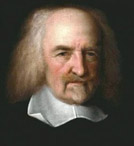 Thomas Hobbes is one of the
early English empirical philosophers. Though Hobbes wrote several works, the
bulk of his views are incorporated into his most well known work, Leviathan, or the Matter, Form and Power of a Commonwealth, Ecclesiastical
and Civil, published in 1651. While Hobbes was not an atheist, in fact
he very much believed in God, the relatively materialist and
anti-supernatural nature of his work made him an enemy of the religious
establishment. When Leviathan was published Hobbes became the most
controversial figure in England. Thomas Hobbes is one of the
early English empirical philosophers. Though Hobbes wrote several works, the
bulk of his views are incorporated into his most well known work, Leviathan, or the Matter, Form and Power of a Commonwealth, Ecclesiastical
and Civil, published in 1651. While Hobbes was not an atheist, in fact
he very much believed in God, the relatively materialist and
anti-supernatural nature of his work made him an enemy of the religious
establishment. When Leviathan was published Hobbes became the most
controversial figure in England.
In Leviathan Hobbes
laid out his view of the world, upon which he based his views on government.
Hobbes concluded that individuals are motivated by self-interest to come
together to form social groups in order to protect themselves from the risk
of violent death by other individuals or nature, and that therefore the main
function of government is to protect the people, but not to interfere with
people in any way unless protecting them from the harm of others. Hobbes
believed that in order for government to perform its duty properly it had to
be all powerful and beyond question. Hobbes has been heavily criticized for
this because of the implicit problems of ensuring that an all powerful
government would remain just.
“The original of them all is
that which we call sense, (for there is no conception in a man's mind which
hath not at first, totally or by parts, been begotten upon the organs of
sense). The rest are derived from that original.
…
The cause of sense is the external body, or
object, which presseth the organ proper to each sense, either immediately,
as in the taste and touch; or mediately, as in seeing, hearing, and
smelling: which pressure, by the mediation of nerves and other strings and
membranes of the body, continued inwards to the brain and heart, causeth
there a resistance, or counter-pressure, or endeavour of the heart to
deliver itself: which endeavour, because outward, seemeth to be some matter
without.”
- Leviathan : Of Sense
“But evil men, under pretext that God can do
anything, are so bold as to say anything when it serves their turn, though
they think it untrue; it is the part of a wise man to believe them no
further than right reason makes that which they say appear credible. If this
superstitious fear of spirits were taken away, and with it prognostics from
dreams, false prophecies, and many other things depending thereon, by which
crafty ambitious persons abuse the simple people, men would be would be much
more fitted than they are for civil obedience.
And this ought to be the work
of the schools, but they rather nourish such doctrine.”
- Leviathan : Of Imagination
“Nevertheless, it is not
prudence that distinguisheth man from beast. There be beasts that at a year
old observe more and pursue that which is for their good more prudently than
a child can do at ten.”
- Leviathan : Of the
Consequence or Train of Imaginations
“The second cause of absurd
assertions, I ascribe to the giving of names of bodies to accidents; or of
accidents to bodies; as they do that say, faith is infused, or inspired;
when nothing can be poured, or breathed into anything, but body; and that
extension is body; that phantasms are spirits, etc.”
- Leviathan : Of Reason and
Science
John Locke (1632-1704)
 John Locke is considered an
important empiricist philosopher in part because of his influence on the
founding principles of the United States of America. It
was John Locke who made the most successful and well-known refutation of
King James’ Divine Right of Kings doctrine. John Locke is considered an
important empiricist philosopher in part because of his influence on the
founding principles of the United States of America. It
was John Locke who made the most successful and well-known refutation of
King James’ Divine Right of Kings doctrine.
Like Hobbes, John Locke based
his views of government and society on his fundamental understanding of
reality and humanity. Unlike Hobbes, however, Locke advocated government by
the consent of the governed.
Locke was trained as a
physician, but never went into medical practice. He became involved in
politics and had to flee to Amsterdam out of fear for his life.
He later returned to England
where he published his major writings.
Locke’s major empirical work
is An Essay Concerning Human Understanding, published in 1689.
In Human Understanding
Locke made the argument that people are not born with innate knowledge or
ideas, and that everything that people know comes from our experiences. This
was an argument against the idea that a human soul possessed knowledge of
universal truth.
Locke argued that people are
not born with any universal set of ideas at all, but that agreement comes
from the common observation of the same material reality.
“2. General assent the great
argument. - There is nothing more commonly taken for granted, than that
there are certain principles, both speculative and practical (for they speak
of both), universally agreed upon by all mankind; which therefore; they
argue, must needs be constant impressions which the souls of men receive in
their first beings, and which they bring into the world with them, as
necessarily and really as they do any of their inherent faculties.
3. Universal consent proves
nothing innate. - This argument, drawn from universal consent, has this
misfortune in it, that if it were true in matter of fact that there were
certain truths wherein all mankind agreed, it would not prove them innate,
if there can be any other way shown, how men may come to that universal
agreement in the things they do consent in; which I presume may be done.
…
5. Not on the mind naturally, imprinted,
because not known to children, idiots, etc. - For, first, it is
evident, that all children and idiots have not the least apprehension or
thought of them; and the want of that is enough to destroy that universal
assent, which must needs be the necessary concomitant of all innate truths:
it seeming to me near a contradiction to say, that there are truths
imprinted on the soul which it perceives or understands not; imprinting, if
it signify anything, being nothing else but the making certain truths to be
perceived.”
- Human Understanding : No
Innate Principles in the Mind
“2. All ideas come from sensation or reflection. - Let us then
suppose the mind to be, as we say, white paper (tabula rasa), void of all characters without any ideas; how comes it to be
furnished? Whence comes it by that vast store, which the busy and boundless
fancy of man has painted on it with an almost endless variety? Whence has it
all the materials of reason and knowledge? To this I answer, in one word,
From experience: in that all our knowledge is founded, and from that it
ultimately derives itself.
…
3. The object of sensation one source of ideas.
- First. Our senses, conversant about particular sensible objects, do convey
into the mind several distinct perceptions of things, according to those
various ways wherein those objects do affect them; and thus we come by those
ideas we have of yellow, white, heat, cold, soft, hard, bitter, sweet, and
all those which we call sensible qualities; which when I say the senses
convey into the mind, I mean, they from external objects convey into the
mind what produces there those perceptions. This great source of most of the
ideas we have., depending wholly upon our senses, and derived by them to the
understanding, I call, "sensation."
…
7. Men are differently
furnished with these according to the different objects they converse with.
- Men then come to be furnished with fewer or more simple ideas from
without, according as the objects they converse with afford greater or less
variety; and from the operations of their minds within, according as they
more or less reflect on them.”
- Human Understanding : Of
Ideas in General, and Their Original
David Hume (1711-1776)
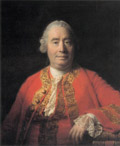 Hume is the most atheistic of the early empiricists. Unlike Hobbes
and Locke, Hume didn’t make room for God in his views. Because of this,
however, Hume had to be very cautious and often wrote under pseudonyms or
used veiled references. Hume is the most atheistic of the early empiricists. Unlike Hobbes
and Locke, Hume didn’t make room for God in his views. Because of this,
however, Hume had to be very cautious and often wrote under pseudonyms or
used veiled references.
Hume argued philosophically
against the idea that the universe was designed by an intelligent creator.
He also developed an early theory of natural selection to explain the
development of the universe and all life before Charles Darwin was even born.
Hume argued that the idea of
free will was a logical impossibility because free will would deny the role
of cause and effect, making all actions random, but if you account for cause
and effect then you are back to determinism. He further argued that if you
can’t hold people accountable for their actions because of determinism, then
you also can’t hold them accountable via the concept of free will either -
that would mean holding people responsible for randomness. Therefore Hume
argued in favor of a punishment/reward approach to laws. People are not
responsible for their actions either way, under the view of free will or
determinism. Hume took the deterministic view, that people’s behaviors are
all reactions to external stimuli, so these stimuli should be used to reward
behavior that we deem positive or punish that which we deem negative as a
way to guide behavior in the way that we want.
Hume argued that people are
hard-wired to approve of actions that are beneficial to their social group
and oppose those actions that are detrimental to their social group.
Hume viewed people very much
the same as all other animals - as governed largely by instinct.
Some of Hume’s most important
works are as follows:
- A Treatise of Human Nature:
Being an Attempt to introduce the experimental Method of Reasoning into
Moral Subjects. (1739–40)
- An Enquiry Concerning Human
Understanding (1748)
- Dialogues Concerning
Natural Religion (posthumous)
“Our evidence, then, for the
truth of the Christian religion is less than the evidence for the truth of
our senses; because, even in the first authors of our religion, it was no
greater; and it is evident it must diminish in passing from them to their
disciples; nor can any one rest such confidence in their testimony, as in
the immediate object of his senses. But a weaker evidence can never destroy
a stronger; and therefore, were the doctrine of the real presence ever so
clearly revealed in scripture, it were directly contrary to the rules of
just reasoning to give our assent to it…
Nothing is so convenient as a
decisive argument of this kind, which must at least silence the most
arrogant bigotry and superstition, and free us from their impertinent
solicitations.
…
I am the better pleased with
the method of reasoning here delivered, as I think it may serve to confound
those dangerous friends or disguised enemies to the Christian Religion, who
have undertaken to defend it by the principles of human reason. Our most
holy religion is founded on Faith, not on reason; and it is a sure method of
exposing it to put it to such a trial as it is, by no means, fitted to
endure. To make this more evident, let us examine those miracles, related in
scripture; and not to lose ourselves in too wide a field, let us confine
ourselves to such as we find in the Pentateuch, which we shall examine,
according to the principles of these pretended Christians, not as the word
or testimony of God himself, but as the production of a mere human writer
and historian. Here then we are first to consider a book, presented to us by
a barbarous and ignorant people, written in an age when they were still more
barbarous, and in all probability long after the facts which it relates,
corroborated by no concurring testimony, and resembling those fabulous
accounts, which every nation gives of its origin. Upon reading this book, we
find it full of prodigies and miracles. It gives an account of a state of
the world and of human nature entirely different from the present: Of our
fall from that state: Of the age of man, extended to near a thousand years:
Of the destruction of the world by a deluge: Of the arbitrary choice of one
people, as the favourites of heaven; and that people the countrymen of the
author: Of their deliverance from bondage by prodigies the most astonishing
imaginable: I desire any one to lay his hand upon his heart, and after a
serious consideration declare, whether he thinks that the falsehood of such
a book, supported by such a testimony, would be more extraordinary and
miraculous than all the miracles it relates; which is, however, necessary to
make it be received, according to the measures of probability above
established.
What we have said of miracles
may be applied, without any variation, to prophecies; and indeed, all
prophecies are real miracles, and as such only, can be admitted as proofs of
any revelation. If it did not exceed the capacity of human nature to
foretell future events, it would be absurd to employ any prophecy as an
argument for a divine mission or authority from heaven. So that, upon the
whole, we may conclude, that the Christian Religion not only was at first
attended with miracles, but even at this day cannot be believed by any
reasonable person without one. Mere reason is insufficient to convince us of
its veracity: And whoever is moved by Faith to assent to it, is conscious of
a continued miracle in his own person, which subverts all the principles of
his understanding, and gives him a determination to believe what is most
contrary to custom and experience.”
- An Enquiry Concerning Human
Understanding : Of Miracles.
“But though animals learn many
parts of their knowledge from observation, there are also many parts of it,
which they derive from the original hand of nature; which much exceed the
share of capacity they possess on ordinary occasions; and in which they
improve, little or nothing, by the longest practice and experience. These we
denominate Instincts, and are so apt to admire as something very
extraordinary, and inexplicable by all the disquisitions of human
understanding. But our wonder will, perhaps, cease or diminish, when we
consider, that the experimental reasoning itself, which we possess in common
with beasts, and on which the whole conduct of life depends, is nothing but
a species of instinct or mechanical power, that acts in us unknown to
ourselves; and in its chief operations, is not directed by any such
relations or comparisons of ideas, as are the proper objects of our
intellectual faculties. Though the instinct be different, yet still it is an
instinct, which teaches a man to avoid the fire; as much as that, which
teaches a bird, with such exactness, the art of incubation, and the whole
economy and order of its nursery.”
- An Enquiry Concerning Human
Understanding : Of the Reason of Animals
“First, when we analyze our
thoughts or ideas however compounded or sublime, we always find that they
resolve themselves into such simple ideas as were copied from a precedent
feeling or sentiment. Even those ideas, which, at first view, seem the most
wide of this origin, are found, upon a nearer scrutiny, to be derived from
it. The idea of God, as meaning an infinitely intelligent, wise, and good
Being, arises from reflecting on the operations of our own mind, and
augmenting, without limit, those qualities of goodness and wisdom. We may
prosecute this enquiry to what length we please; where we shall always find,
that every idea which we examine is copied from a similar impression.”
- An Enquiry Concerning Human
Understanding : Of the Origin of Ideas
In Dialogues Concerning
Natural Religion, quoted below, Hume laid out arguments for
and against the intelligent design of the universe in dialog format. Hume’s
argument, some 250 years old, is remarkably relevant today. The characters
in his dialog are as follows:
- CLEANTHES: The philosopher
- PHILO: The skeptic
- DEMEA: The orthodox theologian
“[PHILO:] Now, according to this method
of reasoning, DEMEA, it follows, (and is, indeed, tacitly allowed by
CLEANTHES himself,) that order, arrangement, or the adjustment of final
causes, is not of itself any proof of design; but only so far as it has been
experienced to proceed from that principle. For aught we can know a priori,
matter may contain the source or spring of order originally within itself,
as well as mind does; and there is no more difficulty in conceiving, that
the several elements, from an internal unknown cause, may fall into the most
exquisite arrangement, than to conceive that their ideas, in the great
universal mind, from a like internal unknown cause, fall into that
arrangement. The equal possibility of both these suppositions is allowed.
But, by experience, we find, (according to CLEANTHES), that there is a
difference between them. Throw several
pieces of steel together, without shape or form; they will never arrange
themselves so as to compose a watch. Stone, and mortar, and wood, without an
architect, never erect a house. But the ideas in a human mind, we see, by an
unknown, inexplicable economy, arrange themselves so as to form the plan of
a watch or house. Experience, therefore, proves, that there is an original
principle of order in mind, not in matter. From similar effects we infer
similar causes. The adjustment of means to ends is alike in the universe, as
in a machine of human contrivance. The causes, therefore, must be
resembling.
…
[CLEANTHES:] Consider, anatomise the eye;
survey its structure and contrivance; and tell me, from your own feeling, if
the idea of a contriver does not immediately flow in upon you with a force
like that of sensation. The most obvious conclusion, surely, is in favour of
design; and it requires time, reflection, and study, to summon up those
frivolous, though abstruse objections, which can support Infidelity. Who can
behold the male and female of each species, the correspondence of their
parts and instincts, their passions, and whole course of life before and
after generation, but must be sensible, that the propagation of the species
is intended by Nature? Millions and millions of such instances present
themselves through every part of the universe; and no language can convey a
more intelligible irresistible meaning, than the curious adjustment of final
causes. To what degree, therefore, of blind dogmatism must one have
attained, to reject such natural and such convincing arguments?
…
[PHILO:] In either case, a chaos
ensues; till finite, though innumerable revolutions produce at last some
forms, whose parts and organs are so adjusted as to support the forms amidst
a continued succession of matter.
Suppose (for we shall
endeavour to vary the expression), that matter were thrown into any
position, by a blind, unguided force; it is evident that this first position
must, in all probability, be the most confused and most disorderly
imaginable, without any resemblance to those works of human contrivance,
which, along with a symmetry of parts, discover an adjustment of means to
ends, and a tendency to self-preservation. If the actuating force cease
after this operation, matter must remain for ever in disorder, and continue
an immense chaos, without any proportion or activity. But suppose that the
actuating force, whatever it be, still continues in matter, this first
position will immediately give place to a second, which will likewise in all
probability be as disorderly as the first, and so on through many
successions of changes and revolutions. No particular order or position ever
continues a moment unaltered. The original force, still remaining in
activity, gives a perpetual restlessness to matter. Every possible situation
is produced, and instantly destroyed. If a glimpse or dawn of order appears
for a moment,it is instantly hurried away,
and confounded, by that never-ceasing force which actuates every part of
matter.
Thus the universe goes on for
many ages in a continued succession of chaos and disorder. But is it not
possible that it may settle at last, so as not to lose its motion and active
force (for that we have supposed inherent in it), yet so as to preserve an
uniformity of appearance, amidst the continual motion and fluctuation of its
parts? This we find to be the case with the universe at present. Every
individual is perpetually changing, and every part of every individual; and
yet the whole remains, in appearance, the same. May we not hope for such a
position, or rather be assured of it, from the eternal revolutions of
unguided matter; and may not this account for all the appearing wisdom and
contrivance which is in the universe? Let us contemplate the subject a
little, and we shall find, that this adjustment, if attained by matter of a
seeming stability in the forms, with a real and perpetual revolution or
motion of parts, affords a plausible, if not a true solution of the
difficulty.
It is in vain, therefore, to
insist upon the uses of the parts in animals or vegetables, and their
curious adjustment to each other. I would fain know, how an animal could
subsist, unless its parts were so adjusted? Do we not find, that it
immediately perishes whenever this adjustment ceases, and that its matter
corrupting tries some new form? It happens indeed, that the parts of the
world are so well adjusted, that some regular form immediately lays claim to
this corrupted matter: and if it were not so, could the world subsist? Must
it not dissolve as well as the animal, and pass through new positions and
situations, till in great, but finite succession, it falls at last into the
present or some such order?
…
[PHILO:] All religious systems, it is
confessed, are subject to great and insuperable difficulties. Each disputant
triumphs in his turn; while he carries on an offensive war, and exposes the
absurdities, barbarities, and pernicious tenets of his antagonist. But all
of them, on the whole, prepare a complete triumph for the Sceptic; who tells
them, that no system ought ever to be embraced with regard to such subjects:
For this plain reason, that no absurdity ought ever to be assented to with
regard to any subject. A total suspense of judgement is here our only
reasonable resource. And if every attack, as is commonly observed, and no
defence, among Theologians, is successful; how complete must be his victory,
who remains always, with all mankind, on the offensive, and has himself no
fixed station or abiding city, which he is ever, on any occasion, obliged to
defend?”
- Dialogues Concerning Natural
Religion
Adam Smith (1723-1790)
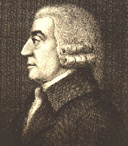 Adam
Smith, while not an atheist or outspoken religious critic, published a work
on law and society, The Theory of Moral Sentiments (1759),
which
was not based on established church doctrine. In Moral Sentiments
Smith made the argument that individuals' actions towards others are often
guided by our ability to sympathies with others and that we engage in seemingly
altruistic actions out of self-interest because by helping others we can
strengthen the society that we live in, which protects our own best
interests. This view was instrumental to Smith's later economic theories. Adam
Smith, while not an atheist or outspoken religious critic, published a work
on law and society, The Theory of Moral Sentiments (1759),
which
was not based on established church doctrine. In Moral Sentiments
Smith made the argument that individuals' actions towards others are often
guided by our ability to sympathies with others and that we engage in seemingly
altruistic actions out of self-interest because by helping others we can
strengthen the society that we live in, which protects our own best
interests. This view was instrumental to Smith's later economic theories.
Smith's most famous book, however, is Inquiry into the Nature and Causes of the Wealth of
Nations, published in 1776, which took a completely materialist view of
the economy. Smith didn’t attribute any aspect of economic prosperity to
God or faith, as had been the tradition up to that time. Instead Smith
documented and analyzed the material basis of economic principles. For this
reason Adam Smith is considered the father of modern economics, because he
approached economics as a science.
"'Does it suit the greatness of God,' says the eloquent and
philosophical bishop of Clermont, with that passionate and exaggerating
force of imagination, which seems sometimes to exceed the bounds of
decorum; 'does it suit the greatness of God, to leave the world which he
has created in so universal a disorder? To see the wicked prevail almost
always over the just; the innocent dethroned by the usurper; the father
become the victim of the ambition of an unnatural son; the husband
expiring under the stroke of a barbarous and faithless wife? From the
height of his greatness ought God to behold those melancholy events as a
fantastical amusement, without taking any share in them? Because he is
great, should he be weak, or unjust, or barbarous? Because men are
little, ought they to be allowed either to be dissolute without
punishment, or virtuous without reward? O God! if this is the character
of your Supreme Being; if it is you whom we adore under such dreadful
ideas; I can no longer acknowledge you for my father, for my protector,
for the comforter of my sorrow, the support of my weakness, the rewarder
of my fidelity. You would then be no more than an indolent and
fantastical tyrant, who sacrifices mankind to his insolent vanity, and
who has brought them out of nothing, only to make them serve for the
sport of his leisure and of his caprice.'
When the general rules which determine the merit and demerit of
actions, come thus to be regarded as the laws of an All-powerful Being,
who watches over our conduct, and who, in a life to come, will reward
the observance, and punish the breach of them; they necessarily acquire
a new sacredness from this consideration. That our regard to the will of
the Deity ought to be the supreme rule of our conduct, can be doubted of
by nobody who believes his existence. The very thought of disobedience
appears to involve in it the most shocking impropriety. How vain, how
absurd would it be for man, either to oppose or to neglect the commands
that were laid upon him by Infinite Wisdom, and Infinite Power! How
unnatural, how impiously ungrateful not to reverence the precepts that
were prescribed to him by the infinite goodness of his Creator, even
though no punishment was to follow their violation. The sense of
propriety too is here well supported by the strongest motives of
self-interest. The idea that, however we may escape the observation of
man, or be placed above the reach of human punishment, yet we are always
acting under the eye, and exposed to the punishment of God, the great
avenger of injustice, is a motive capable of restraining the most
headstrong passions, with those at least who, by constant reflection,
have rendered it familiar to them.
It is in this manner that religion enforces the natural sense of
duty: and hence it is, that mankind are generally disposed to place
great confidence in the probity of those who seem deeply impressed with
religious sentiments. Such persons, they imagine, act under an
additional tie, besides those which regulate the conduct of other men.
...
In treating of the principles of morals there are two questions to be
considered. First, wherein does virtue consist? Or what is the tone of
temper, and tenour of conduct, which constitutes the excellent and
praise-worthy character, the character which is the natural object of
esteem, honour, and approbation? And, secondly, by what power or faculty
in the mind is it, that this character, whatever it be, is recommended
to us? Or in other words, how and by what means does it come to pass,
that the mind prefers one tenour of conduct to another, denominates the
one right and the other wrong; considers the one as the object of
approbation, honour, and reward, and the other of blame, censure, and
punishment?
We examine the first question when we consider whether virtue
consists in benevolence, as Dr. Hutcheson imagines; or in acting
suitably to the different relations we stand in, as Dr. Clarke supposes;
or in the wise and prudent pursuit of our own real and solid happiness,
as has been the opinion of others.
We examine the second question, when we consider, whether the
virtuous character, whatever it consists in, be recommended to us by
self-love, which makes us perceive that this character, both in
ourselves and others, tends most to promote our own private interest; or
by reason, which points out to us the difference between one character
and another, in the same manner as it does that between truth and
falsehood; or by a peculiar power of perception, called a moral sense,
which this virtuous character gratifies and pleases, as the contrary
disgusts and displeases it; or last of all, by some other principle in
human nature, such as a modification of sympathy, or the like."
- The Theory of Moral Sentiments
Matthew Turner (?-1788)
Known as the “first British
atheist”, Turner was the first Englishman to openly declare his own atheism in a published
work in England. He was definitely not the first self-described British atheist however,
because in his letter he presented a reply from an atheist friend of his
whom he said had convinced him of the atheist view. There are also records
of the expression of atheism in England prior to this as well, just not
in published works, and no doubt many people held the view and never
expressed it in writing.
It was in Answer to Dr.
Priestley's Letters to a Philosophical Unbeliever that Turner declared his
own atheism. The letter was first publicly published in England in 1782.
“…you meant your Letters to be
perused by thinking men in general, Believers and Unbelievers, to confirm
the former in their creed, and to convert the latter from their error. You
shall speedily know the effect they have had in both ways. For myself I must
inform you that I was brought up a Believer from my infancy… when I began
freely to think I proceeded boldly to doubt; your Letters gave me the cause
for thinking, and my scepticism was exchanged for conviction; not entirely
by the perusal of your Letters; for I do not think they would quite have
made me an Atheist, but by attention to
that answer from my friend, which I have his permission to subjoin.
…
With me and with my friend the
comparison holds by way of contrast, for we are so proud in our singularity
of being atheists that we will hardly open our lips in company, when the
question is started for fear of making converts, and so lessening our own
enjoyment by a numerous division of our privilege with others.
…
But as to the question whether
there is such an existent Being as an atheist, to put that out of all manner
of doubt, I do declare upon my honour that I am one.
…
When my friend returned me
your Letters, addressing me with a grave face he said, "I hope, if you have
any doubts, these Letters will have as good effect upon you as they have had
upon me."
My countenance brightened up
and I replied, "You are then, my friend, convinced ?" "Yes, he said, I am
convinced; that is, I am most thoroughly convinced there is no such thing as
a God." Behold then, if we are to be believed, two atheists instead of one.”
The rest of the letter went on
to give Matthew’s friend’s refutation of the existence of God. The
postscript of the letter reads:
“Had you thought it impossible
for man to hold different sentiments respecting Natural religion and the
proof of the existence of a God than you do, the Letters to a Philosophical
Unbeliever would not have appeared, much less would you have invited an
answer by promising a reply to every objection. Differing from you in
sentiment I am the man who enter with you in the lists; but I find myself
upon consultation with my friends under more difficulties than you were, and
more to stand in need of courage in taking up the glove, than you needed to
have in throwing it down. For this dispute is not like others in philosophy,
where the vanquished can only dread ridicule, contempt and disappointment;
here, whether victor or vanquished, your opponent has to dread, beside
ecclesiastical censure, the scourges, chains and pillories of the courts of
Law.”
French Materialism
French Materialism was highly
influenced by Sir Isaac Newton’s work on mathematics and the laws of nature.
France, at the time, had the leading schools of mathematics and engineering,
and this was reflected in French philosophy as well. French Materialism was
led mainly by liberal French aristocrats who opposed the Catholic Church.
Encyclopedia, or Reasoned Dictionary of the
Sciences, Arts, and Crafts – 1751 to 1772
Encyclopedia
contained the works of many prominent French Enlightenment thinkers. The
work, an effort to combat superstition and religious dogma with scientific
facts and principles, was officially banned when it was published. Many of the contributors were atheists, though not all were.
Julien Offray de La Mettrie
(1709-1751)
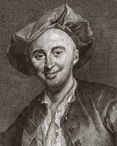 La Mettrie was the first
major Materialist writer of the Enlightenment. Virtually all of his writings
were banned and he had to constantly move around Europe to avoid
persecution. He eventually ended up as a physician in the court of Frederick
the Great. La Mettrie's major philosophical breakthrough came while he was
very ill and he concluded that thought was affected by the physical organs
and physical effects on the brain. This was extremely controversial so his
books were banned and he had to leave Paris to seek refuge. La Mettrie
believed that atheism was the only way to ensure happiness in the world, and
that the problems of the world were created by theology and the deceptions
and wars that accompany it. Le Mettrie's concept of the soul can basically
be seen as consciousness, for he discusses the soul as if he were discussing
what we call consciousness and he believed that the soul ended when life
ended. La Mettrie was the first
major Materialist writer of the Enlightenment. Virtually all of his writings
were banned and he had to constantly move around Europe to avoid
persecution. He eventually ended up as a physician in the court of Frederick
the Great. La Mettrie's major philosophical breakthrough came while he was
very ill and he concluded that thought was affected by the physical organs
and physical effects on the brain. This was extremely controversial so his
books were banned and he had to leave Paris to seek refuge. La Mettrie
believed that atheism was the only way to ensure happiness in the world, and
that the problems of the world were created by theology and the deceptions
and wars that accompany it. Le Mettrie's concept of the soul can basically
be seen as consciousness, for he discusses the soul as if he were discussing
what we call consciousness and he believed that the soul ended when life
ended.
La Mettrie viewed humans and animals as fundamentally the same and believed
that man and animals had the same common origin. Being far ahead of his
time, La Mettrie believed that it would be possible, as we now know, to
teach apes to speak using sign-language.
His most famous and controversial book is Man a Machine, published in
1748. This book was so controversial that even other atheists and
materialists advocated that the book be banned.
"It is not enough for a wise man to study nature and truth; he should
dare state truth for the benefit of the few who are willing and able to
think. As for the rest, who are voluntarily slaves of prejudice, they
can no more attain truth, than frogs can fly.
...
Man is so complicated a machine that it is impossible to get a clear
idea of the machine beforehand, and hence impossible to define it. For
this reason, all the investigations have been vain, which the greatest
philosophers have made à priori, that is to to say, in so far as they
use, as it were, the wings of the spirit. Thus it is only à posteriori
or by trying to disentangle the soul from the organs of the body, so to
speak, that one can reach the highest probability concerning man's own
nature, even though one can not discover with certainty what his nature
is.
...
But the better to show this dependence, in its completeness and its
causes, let us here make use of comparative anatomy; let us lay bare the
organs of man and of animals. How can human nature be known, if we may
not derive any light from an exact comparison of the structure of man
and of animals?
In general, the form and the structure of the brains of quadrupeds
are almost the same as those of the brain of man; the same shape, the
same arrangement everywhere, with this essential difference, that of all
the animals man is the one whose brain is largest, and, in proportion to
its mass, more convoluted than the brain of any other animal; then come
the monkey, the beaver, the elephant, the dog, the fox, the cat. These
animals are most like man, for among them, too, one notes the same
progressive analogy in relation to the corpus callosum in which Lancisi
- anticipating the late M. de la Peyronie - established the seat of the
soul. The latter, however, illustrated the theory by innumerable
experiments. Next after all the quadrupeds, birds have the largest
brains. Fish have large heads, but these are void of sense, like the
heads of many men. Fish have no corpus callosum, and very little brain,
while insects entirely lack brain.
...
Among animals, some learn to speak and sing; they remember tunes, and
strike the notes as exactly as a musician. Others, for instance the ape,
show more intelligence, and yet cannot learn music. What is the reason
for this, except some defect in the organs of speech? But is this defect
so essential to the structure that it could never be remedied? In a
word, would it be absolutely impossible to teach the ape a language? I
do not think so.
I should choose a large ape in preference to any other, until by some
good fortune another kind should be discovered, more like us, for
nothing prevents there being such a one in regions unknown to us. The
ape resembles us so strongly that naturalists have called it 'wild
man' or 'man of the woods.' I should take it in the condition of the
pupils of Amman, that is to say, I should not want it to be too young or
too old; for apes that are brought to Europe are usually too old. I
would choose the one with the most intelligent face, and the one which,
in a thousand little ways, best lived up to its look of intelligence.
Finally not considering myself worthy to be his master, I should put him
in the school of that excellent teacher whom I have just named, or with
another teacher equally skillful, if there is one.
You know by Amman's work, and by all those who have interpreted his
method, all the wonders he has been able to accomplish for those born
deaf. In their eyes he discovered ears, as he himself explained, and in
how short a time! In short he taught them to hear, speak, read, and
write. I grant that a deaf person's eyes see more clearly and are keener
than if he were not deaf, for the loss of one member or sense can
increase the strength or acuteness of another, but apes see and hear,
they understand what they hear and see, and grasp so perfectly the signs
that are made to them, that I doubt not that they would surpass the
pupils of Amman in any other game or exercise.
...
The transition from animals to man is not violent, as true
philosophers will admit. What was man before the invention of words and
the knowledge of language? An animal of his own species with much less
instinct than the others. In those days, he did not consider himself
king over the other animals, nor was he distinguished from the ape, and
from the rest, except as the ape itself differs from the other animals,
i.e., by a more intelligent face. Reduced to the bare intuitive
knowledge of the Leibnizians he saw only shapes and colors, without
being able to distinguish between them: the same, old as young, child at
all ages, he lisped out his sensations and his needs, as a dog that is
hungry or tired of sleeping, asks for something to eat, or for a walk.
Words, languages, laws, sciences, and the fine arts have come, and by
them finally the rough diamond of our mind has been polished. Man has
been trained in the same way as animals. He has become an author, as
they have become beasts of burden. A geometrician has learned to perform
the most difficult demonstrations and calculations, as a monkey has
learned to take his little hat off and on, and to mount his tame dog.
All has been accomplished through signs, every species has learned what
it could understand, and in this way men have acquired symbolic
knowledge, still so called by our German philosophers.
Nothing, as any one can see, is so simple as the mechanism of our
education. Everything may be reduced to sounds or words that pass from
the mouth of one through the ears of another into his brain. At the same
moment, he perceives through his eyes the shape of the bodies of which
these words are the arbitrary signs.
But who was the first to speak? Who was the first teacher of the
human race? Who invented the means of utilizing the plasticity of our
organism? I cannot answer: the names of these first splendid geniuses
have been lost in the night of time. But art is the child of nature, so
nature must have long preceded it.
...
To be a machine, to feel, to think, to know how to distinguish good
from bad, as well as blue from yellow, in a word, to be born with an
intelligence and a sure moral instinct, and to be but an animal, are
therefore characters which are no more contradictory, than to be an ape
or a parrot and to be able to give oneself pleasure. ... I
believe that thought is so little incompatible with organized matter,
that it seems to be one of its properties on a par with electricity, the
faculty of motion, impenetrability, extension, etc."
- Man a Machine
Claude Helvétius
(1715-1771)
 Helvetius was a philosopher and poet, whose
books were mostly banned and frequently burned. The publicity generated by
opposition to his works resulted in widespread attention to them however,
and they were published in many languages throughout Europe, where they were
also banned and burned. Helvetius was a philosopher and poet, whose
books were mostly banned and frequently burned. The publicity generated by
opposition to his works resulted in widespread attention to them however,
and they were published in many languages throughout Europe, where they were
also banned and burned.
Helvetius believed, like John Locke, that people are born with "blank
minds", and that the major differences between people were the result of
education and environment. For this reason he was a strong promoter of
education and culture.
His two most famous works are Essays on the Mind (1758) and A
Treatise on Man; his Intellectual Faculties and his Education (1772)
His basic views consisted of the ideas that:
- All faculties may be reduced to physical
sensation, even memory, comparison, and judgment.
- Our only difference from the lower animals lies
in our external organization.
- Self-interest, founded on the love of pleasure and the fear of pain,
is the sole spring of judgment, action, and affection.
- We have no liberty of choice between good and evil.
- There is no such thing as absolute right. Ideas
of justice and injustice change according to conditions
Jean Le Rond d'Alembert
(1717-1783)
 D’Alembert was a scientist, mathematician and
philosopher who contributed to wave theory and several other areas of
physics and mathematics. As a known atheist he was buried in an unmarked
grave. D’Alembert didn’t directly address theology, but he contributed
significantly to materialist philosophy and science, choosing to focus on
science and to mostly ignore issues of religion altogether. Religion may
simply have been unimportant to him, or he may have avoided publishing
religious criticisms so as not to interfere with his career. D’Alembert was a scientist, mathematician and
philosopher who contributed to wave theory and several other areas of
physics and mathematics. As a known atheist he was buried in an unmarked
grave. D’Alembert didn’t directly address theology, but he contributed
significantly to materialist philosophy and science, choosing to focus on
science and to mostly ignore issues of religion altogether. Religion may
simply have been unimportant to him, or he may have avoided publishing
religious criticisms so as not to interfere with his career.
He was a well known and highly regarded professional. He was admitted to the
French Academy of Science, published many works, and was praised by
Frederick the Great. D'Alembert also wrote the introduction to the Encyclopedia and contributed mathematical articles.
Denis Diderot (1713-1784)
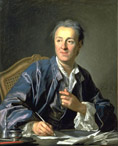 Diderot was a major French Enlightenment author
who wrote many popular fiction and non-fiction works, including dramas.
Diderot was also the editor-in-chief of the Encyclopedia. Diderot was
the largest contributor to the Encyclopedia, contributing over
1,000 articles to it during his lifetime. Diderot was a major French Enlightenment author
who wrote many popular fiction and non-fiction works, including dramas.
Diderot was also the editor-in-chief of the Encyclopedia. Diderot was
the largest contributor to the Encyclopedia, contributing over
1,000 articles to it during his lifetime.
Diderot also contributed to the most strongly
atheistic book published up to that time, The System of Nature.
Diderot was a major and vocal proponent of freedom of speech and
democracy, as well as an opponent of slavery and Christianity. He faced
serious challenges because of his outspoken opposition to the political
authorities, but he was well received in Russia by Catherine the Great, who
met with him personally and bought his library from him, but allowed him to
keep it throughout his lifetime. His library was transferred to Russia after
his death.
"The good of the people must be the great purpose of government. By
the laws of nature and of reason, the governors are invested with power
to that end. And the greatest good of the people is liberty. It is to
the state what health is to the individual."
- Encyclopédie article on Government
"Reason is to the philosopher what grace is to the Christian...
Other men walk in darkness; the philosopher, who has the same passions,
acts only after reflection; he walks through the night, but it is
preceded by a torch. The philosopher forms his principles on an infinity
of particular observations. He does not confuse truth with plausibility;
he takes for truth what is true, for forgery what is false, for doubtful
what is doubtful, and probable what is probable. The philosophical
spirit is thus a spirit of observation and accuracy."
- Encyclopédie article on Philosophy
"If exclusive privileges were not granted, and if the financial
system would not tend to concentrate wealth, there would be few great
fortunes and no quick wealth. When the means of growing rich is divided
between a greater number of citizens, wealth will also be more evenly
distributed; extreme poverty and extreme wealth would be also rare."
- Encyclopédie article on Wealth
Baron d'Holbach (1723-1789)
 Baron d’Holbach may be considered the first
true modern atheist, meaning that he personally declared that God does not
exist and advocated that position. D’Holbach wrote several influential and extremely high
quality works that are just as relevant today as the day they were written.
D’Holbach’s books were generally banned and often burned. They had to be
published outside of France, most often in Amsterdam, where many
Enlightenment works were first published. D’Holbach held nothing back; he
criticized French Imperialism and abuse of power among all nations. He also
strongly attacked the Catholic Church and religion in general, but not with
mere criticism, he went further and explained the entirety of the universe
from a material basis and proposed a system of atheistic morality. Baron d’Holbach may be considered the first
true modern atheist, meaning that he personally declared that God does not
exist and advocated that position. D’Holbach wrote several influential and extremely high
quality works that are just as relevant today as the day they were written.
D’Holbach’s books were generally banned and often burned. They had to be
published outside of France, most often in Amsterdam, where many
Enlightenment works were first published. D’Holbach held nothing back; he
criticized French Imperialism and abuse of power among all nations. He also
strongly attacked the Catholic Church and religion in general, but not with
mere criticism, he went further and explained the entirety of the universe
from a material basis and proposed a system of atheistic morality.
Fundamentally his views are still consistent
with our present-day scientific understanding of reality.
Two of his major works are Christianity
Unveiled (1761) and The System of Nature (1770).
Christianity Unveiled
discusses the history of the Christian religion and the many flaws
in Christian beliefs and doctrines. The work declared that Christianity and
all religions were antithetical to humanity and impeded the
advancement of mankind.
The System of Nature was the first book to openly proclaim atheism in Western
Civilization since the time of the ancient Greeks. The System of Nature has stood the
test of time remarkably. The work is based on philosophical materialism,
declaring that there is no soul and that the mind is a product of the
physical brain only. Most impressively, d’Holbach described the process of
biological evolution years before the theory was formally proposed by
Charles Darwin.
“To
expose superstition, the ignorance and credulity on which it is based, and
to ameliorate the condition of the human race, is the ardent desire of every
philanthropic mind.
Mankind are
unhappy, in proportion as they are deluded by imaginary systems of theology.
Taught to attach much importance to belief in religious doctrines, and to
mere forms and ceremonies of religious worship, the slightest disagreement
among theological dogmatists is oftentimes sufficient to inflame their
minds, already excited by bigotry, and to lead them to anathematize and
destroy each other without pity, mercy, or remorse.
The
various theological systems in which mankind have been misled to have faith,
are but fables and falsehoods imposed by visionaries and fanatics
on the ignorant, the weak, and the credulous, as historical truths; and for
unbelief of which, millions have perished at the stake, or pined in gloomy
dungeons: and such will ever be the case, until the mists of superstition,
and the influence of priestcraft, are exposed by the light of knowledge and
the power of truth.”
- From 1868 Advertisement for the first English Translation
“The
source of man’s unhappiness is his ignorance of Nature. The pertinacity with
which he clings to blind opinions imbibed in his infancy, which interweave
themselves with his existence, the consequent prejudice that warps his mind,
that prevents its expansion, that renders him the slave of fiction, appears
to doom him to continual error. He resembles a child destitute of
experience, full of idle notions: a dangerous leaven mixes itself with all
his knowledge: it is of necessity obscure, it is vacillating and false: — He
takes the tone of his ideas on the authority of others, who are themselves
in error, or else have an interest in deceiving him.”
- The
System of Nature : Preface
"Men will always deceive themselves by abandoning experience to
follow imaginary systems. Man is the work of Nature: he exists in
Nature: he is submitted to her laws: he cannot deliver himself from
them; nor can he step beyond them even in thought. It is in vain his
mind would spring forward beyond the visible world, an imperious
necessity always compels his return. For a being formed by Nature, and
circumscribed by her laws, there exists nothing beyond the great whole
of which he forms a part, of which he experiences the influence. The
beings which he pictures to himself as above nature, or distinguished
from her, are always chimeras formed after that which he has already
seen, but of which it is impossible he should ever form any correct
idea, either as to the place they occupy, or of their manner of acting."
- The
System of Nature : Chapter 1: Of Nature
“Let us
now apply the general laws we have scrutinized, to those beings of nature
who interest us the most. Let us see in what man differs from the other
beings by which he is surrounded. Let us examine if he has not certain
points in conformity with them, that oblige him, not withstanding the
different properties they respectively possess, to act in certain respects
according to the universal laws to which every thing is submitted. Finally,
let us inquire if the ideas he has formed of himself in meditating on his
own peculiar mode of existence, be chimerical, or founded in reason.
…
Has man
always been what he now is, or has he, before he arrived at the state in
which we see him, been obliged to pass under an infinity of successive
developments? … Matter is eternal, and necessary, but its forms are
evanescent and contingent. It may be asked of man, is he any thing more than
matter combined, of which the form varies every instant?
…
[S]ome reflections seem to favour the supposition, and to render more probable
the hypothesis that man is a production formed in the course of time; who is
peculiar to the globe he inhabits, and the result of the peculiar laws by
which it is directed; who, consequently, can only date his formation as
coeval with that of his planet.”
- The
System of Nature : Chapter 6: Of Man — Of his Distinction into Moral and
Physical - Of his
Origin.
“All
children are atheists - they have no idea of God.”
- Good
Sense, 1772
Marquis de Condorcet
(1743-1794)
 Condorcet was a highly influential political
figure, and can be considered one of the fathers of classic liberalism.
Condocet was a scientist and mathematician who was elected to the French
Royal Academy of Sciences in 1769. He became a world-renowned scientist and
worked with men such as Benjamin Franklin. He later became known for his
strong advocacy of human rights. Condorcet was a highly influential political
figure, and can be considered one of the fathers of classic liberalism.
Condocet was a scientist and mathematician who was elected to the French
Royal Academy of Sciences in 1769. He became a world-renowned scientist and
worked with men such as Benjamin Franklin. He later became known for his
strong advocacy of human rights.
Condorcet promoted a liberal
free-market economy, free and equal public education, constitutional
justice, and equal rights for women and people of all races. He was
especially known for his promotion of women’s rights and racial equality.
He was also influential to the
foundation of the United States of America and was highly supportive of the
effort. He was known personally by several of the Founders. Thomas Jefferson
mentioned him among other French atheists when discussing the virtue of
atheists:
“If we did a good act merely
from the love of God and a belief that it is pleasing to Him, whence arises
the morality of the Atheist? It is idle to say, as some do, that no such
thing exists. We have the same evidence of the fact as of most of those we
act on, to wit: their own affirmations, and their reasonings in support of
them. I have observed, indeed, generally, that while in Protestant countries
the defections from the Platonic Christianity of the priests is to Deism, in
Catholic countries they are to Atheism. Diderot, D'Alembert, D'Holbach,
Condorcet, are known to have been among the most virtuous of men. Their
virtue, then, must have had some other foundation than love of God.”
- Thomas Jefferson: in letter to Thomas Law, June 13, 1814
Condorcet went on to play important roles in
the French Revolution and post-Revolution administration. Marquis de Condorcet is now
among the officially honored heroes of France.
American Revolutionaries
Deism and religious liberalism
were common among American Founders and prominent revolutionaries.
Many Founders who did consider themselves Christians, or who spoke
favorably of Christianity, took a highly philosophical view of Christianity
and maintained a scientific outlook. They also didn’t fail to criticize many
Christian practices and the mentality of devout Christians.
George Washington,
John Adams, Thomas Jefferson, Benjamin Franklin and
James Madison are arguably good examples such men.
None of these men, except Benjamin Franklin, explicitly
declared themselves Deists, and all spoke favorably of Christian philosophy,
however these men did not put religion or Christianity beyond question, and
their views were founded much more strongly in naturalism. They have often
been considered Deists based on their views. They also rarely attended
church services, and did not belong to any denomination. Some of the
founders never attended church past childhood, with the exception of special
occasions such as funerals, etc.
One thing that is important to note is that when any of these Founders
mentioned God in public or in their writings, they did so in terms that were
commonly known to be Deistic at the time, such as "Creator", "Almighty
Judge", "God of Nature", "Nature's God", "Author of Every Good", etc. These
are all terms that were widely recognized as Deistic during the 1700s and
early 1800s. In contrast, when Christians mentioned God or their faith they
typically used terms such as "the Lord", "God", "Jesus Christ", "our Savior", or any
combination of these, such as "the Lord God Jesus Christ".
Thomas Jefferson, while still
calling himself a Christian, was highly critical of the Bible and declared
that he did not believe in any of the supernatural claims about Jesus or any
other religion. Jefferson wrote that he believed that Jesus himself was a
deistic philosopher, not the literal son of God.
Of the founders, Jefferson and Adams held strongly materialist worldviews and denounced all
forms of supernaturalism. The God of Jefferson and Adams, as well as other
Founders, was a God that created the laws of nature but did not
actively intervene in the world. Jefferson was more critical of
Christianity than Adams, but both were critical, yet both also saw value in
the philosophy of the religion as well.
“Well aware that:
I. the opinions and belief of
men depend not on their own will, but follow involuntarily the evidence
proposed to their minds;
II. that Almighty God hath
created the mind free, and manifested his supreme will that free it shall
remain by making it altogether insusceptible of restraint;
…
VI. that our civil rights have
no dependance on our religious opinions, any more than our opinions in
physics or geometry; that therefore the proscribing any citizen as unworthy
the public confidence by laying upon him an incapacity of being called to
offices of trust and emolument, unless he profess or renounce this or that
religious opinion, is depriving him injuriously of those privileges and
advantages to which, in common with his fellow citizens, he has a natural
right;”
- Thomas Jefferson – A Bill
for Establishing Religious Freedom, 1777
"Nature has constituted utility to man the standard and test of
virtue. Men living in different countries, under different
circumstances, different habits and regimens, may have different
utilities; the same act, therefore, may be useful and consequently
virtuous in one country which is injurious and vicious in another
differently circumstanced."
-Thomas Jefferson to Thomas Law, 1814
“[W]here get we the ten
commandments? The book indeed gives them to us verbatim, but where did it
get them? For itself tells us they were written by the finger of God on
tables of stone, which were destroyed by Moses; it specifies those on the
second set of tables in different form and substance, but still without
saying how the others were recovered. But the whole history of these books
is so defective and doubtful, that it seems vain to attempt minute inquiry
into it; and such tricks have been played with their text, and with the
texts of other books relating to them, that we have a right from that cause
to entertain much doubt what parts of them are genuine.”
- Thomas Jefferson – Letter to
John Adams, 1814
"The immaculate conception of Jesus, his deification, the creation of
the world by him, his miraculous powers, his resurrection and visible
ascension, his corporeal presence in the Eucharist, the Trinity;
original sin, atonement, regeneration, election, orders of Hierarchy,
etc. [were all] invented by ultra-Christian sects,
unauthorized by a single word ever uttered by him."
- Thomas Jefferson – Letter to
William Short, 1819
“It is not to be understood that I am with him (Jesus Christ) in all
his doctrines. I am a Materialist; he takes the side of Spiritualism; he
preaches the efficacy of repentance toward forgiveness of sin; I require
a counterpoise of good works to redeem it.”
- Thomas Jefferson – Letter to
William Short, 1820
“The truth is, that the
greatest enemies of the doctrine of Jesus are those, calling themselves the
expositors of them, who have perverted them to the structure of a system of
fancy absolutely incomprehensible, and without any foundation in his genuine
words. And the day will come when the mystical generation of Jesus, by the
Supreme Being as his father, in the womb of a virgin, will be classed with
the fable of the generation of Minerva in the brain of Jupiter. But we may
hope that the dawn of reason and freedom of thought in these United States
will do away with this artificial scaffolding and restore to us the
primitive and genuine doctrines of this most venerated Reformer of human
errors.”
- Thomas Jefferson – Letter to
John Adams, 1824
“One other of these laws
deserves particular notice. In private, every family were free to worship
the gods in their own way; and in public, though certain forms were
required, yet there was not any penalty annexed to the omission of them, as
the punishment of offences in this matter was left to the offended god.
This, probably, was the source of that wise and humane toleration which does
so much honour to the Romans, and reflects disgrace on almost every
Christian nation.”
- John Adams: A Defense of
the Constitutions of Government of the United States of America (1787-88)
“The United States of America
have exhibited, perhaps, the first example of governments erected on the
simple principles of nature; and if men are now sufficiently enlightened to
disabuse themselves of artifice, imposture, hypocrisy, and superstition,
they will consider this event as an era in their history. Although the
detail of the formation of the American governments is at present little
known or regarded either in Europe or in America, it may hereafter become an
object of curiosity. It will never be pretended that any persons employed in
that service had interviews with the gods, or were in any degree under the
influence of Heaven, more than those at work upon ships or houses, or
laboring in merchandise or agriculture; it will forever be acknowledged that
these governments were contrived merely by the use of reason and the senses.
…
Unembarrassed by attachments
to noble families, hereditary lines and successions, or any considerations
of royal blood, even the pious mystery of holy oil had no more influence
than that other of holy water: the people universally were too enlightened
to be imposed on by artifice; and their leaders, or more properly followers,
were men of too much honour to attempt it. Thirteen governments thus founded
on the natural authority of the people alone, without a pretence of miracle
or mystery, which are destined to spread over the northern part of that
whole quarter of the globe, are a great point gained in favour of the rights
of mankind. The experiment is made, and has completely succeeded: it can no
longer be called in question, whether authority in magistrates, and
obedience of citizens, can be grounded on reason, morality, and the
Christian religion, without the monkery of priests, or the knavery of
politicians.”
- John Adams: A Defense of
the Constitutions of Government of the United States of America (1787-88)
The quote above in an
excellent example of Adams’ relationship with religion. He regarded
Christian values as good, yet he was not a religious man. He did not believe
in the priesthood, in miracles, in the supernatural, nor in the perfection
of the Bible. Like Jefferson, he viewed the Bible as a highly flawed text
that had been tampered with and manipulated by priests over the centuries so
as to add all manner of supernatural events to it.
The most well known
American revolutionaries who actually did declare themselves Deists, and
wrote on the topic of religious criticism, were Benjamin Franklin, Ethan Allan and Thomas
Paine.
Benjamin Franklin (1706-1790)
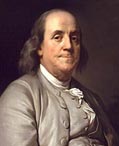 Benjamin
Franklin was the oldest of the primary Founders. He is also the only Founder
to have signed all three of America's founding documents: The Declaration
of Independence, The Treaty of Paris, and The Constitution. Benjamin
Franklin was the oldest of the primary Founders. He is also the only Founder
to have signed all three of America's founding documents: The Declaration
of Independence, The Treaty of Paris, and The Constitution.
Franklin's formal education lasted through age ten, after which he became
a printing apprentice under his older brother. He engaged in a variety of
businesses and trades during his lifetime including printer, journalist,
publisher, author, statesman, scientist, librarian, diplomat, inventor and
United States Postmaster General.
In 1727 Franklin founded a small intellectual club called Junto where
members discussed current events, science and philosophy. Junto later gave
rise to the American Philosophical Society, which was founded in 1743. The
American Philosophical Society, founded by members of Junto, was the first
scientific society in the American colonies. Franklin served as first
secretary of the organization and later served as its president.
Franklin went on to become the most well known scientist of the American
colonies. His most significant scientific contributions were in the fields
of electricity and meteorology, both of which he pioneered. Franklin
proposed the first experiment to prove that lightening is electricity. The
experiment was first conducted by a Frenchman based on Franklin's
publication, but Franklin conducted the second experiment days later
(unaware that someone else had already conducted it).
In 1751 Franklin co-founded the first hospital in the American colonies,
Pennsylvania Hospital.
Franklin had numerous political achievements and played a critical role
in the American Revolution. He was key in enlisting the help of the French
in the American Revolution. He was also considered one of the most important
members of the Constitutional Convention. The only individual more widely
associated with the American Revolution than Franklin was George Washington.
Throughout his life, since his teenage years, Franklin was a Deist.
Franklin's views on religion were more conventional than those of his friend
Thomas Paine, but he was nevertheless critical of the institution. Despite
this he did propose the use of a daily prayer during the Constitutional
Convention, which did not go over well with the assembly - most men thinking
that a prayer was inappropriate. Only three of the men at the convention
supported the measure.
"...I procur'd Xenophon's Memorable Things of Socrates, wherein there
are many instances of the same method. I was charm'd with it, adopted
it, dropt my abrupt contradiction and positive argumentation, and put on
the humble inquirer and doubter. And being then, from reading
Shaftesbury and Collins, become a real doubter in many points of our
religious doctrine, I found this method safest for myself and very
embarrassing to those against whom I used it; therefore I took a delight
in it, practis'd it continually, and grew very artful and expert in
drawing people, even of superior knowledge, into concessions, the
consequences of which they did not foresee, entangling them in
difficulties out of which they could not extricate themselves, and so
obtaining victories that neither myself nor my cause always deserved. I
continu'd this method some few years, but gradually left it, retaining
only the habit of expressing myself in terms of modest diffidence; never
using, when I advanced any thing that may possibly be disputed, the
words certainly, undoubtedly, or any others that give the air of
positiveness to an opinion;"
"...I was rather inclin'd to leave Boston when I reflected that I had
already made myself a little obnoxious to the governing party, and, from
the arbitrary proceedings of the Assembly in my brother's case, it was
likely I might, if I stay'd, soon bring myself into scrapes; and
farther, that my indiscrete disputations about religion began to make me
pointed at with horror by good people as an infidel or atheist."
"I had been religiously educated as a Presbyterian; and tho' some of
the dogmas of that persuasion, such as the eternal decrees of God,
election, reprobation, etc., appeared to me unintelligible, others
doubtful, and I early absented myself from the public assemblies of the
sect, Sunday being my studying day, I never was without some religious
principles. I never doubted, for instance, the existence of the Deity;
that he made the world, and govern'd it by his Providence; that the most
acceptable service of God was the doing good to man; that our souls are
immortal; and that all crime will be punished, and virtue rewarded,
either here or hereafter."
"My parents had early given me religious impressions, and brought me
through my childhood piously in the Dissenting [Protestant] way. But I
was scarce fifteen, when, after doubting by turns of several points, as
I found them disputed in the different books I read, I began to doubt of
Revelation itself. Some books against Deism fell into my hands; they
were said to be the substance of sermons preached at Boyle's Lectures.
It happened that they wrought an effect on me quite contrary to what was
intended by them; for the arguments of the Deists, which were quoted to
be refuted, appeared to me much stronger than the refutations; in short,
I soon became a thorough Deist."
- The Autobiography of Benjamin Franklin
"Here is my creed. I believe in one God, creator of the universe.
That he governs it by his Providence. That he ought to be worshiped.
That the most acceptable service we render to him is doing good to his
other children. That the soul of man is immortal, and will be treated
with justice in another life respecting its conduct in this. These I
take to be the fundamental principles of all sound religion, and I
regard them as you do in whatever sect I meet with them.
As to Jesus of Nazareth, my opinion of whom you particularly desire,
I think the system of morals, and his religion, as he left them to us,
the best the world ever saw, or is likely to see; but I apprehend it has
received various corrupting changes, and I have, with most of the
present dissenters in England, some doubts as to his divinity; tho' it
is a question I do not dogmatize upon, having never studied it, and
think it needless to busy myself with it now, when I expect soon an
opportunity of knowing the truth with less trouble."
- Benjamin Franklin in letter to Ezra Stiles; March
9,1790
Ethan Allen (1738-1789)
 Allan was a rough and rowdy colonist who became
a fervent supporter of the revolutionary war and leader of the Green
Mountain Boys. He was taken prisoner early in
the Revolutionary War, but returned to political life in Vermont after being released from
capture. Allan was a rough and rowdy colonist who became
a fervent supporter of the revolutionary war and leader of the Green
Mountain Boys. He was taken prisoner early in
the Revolutionary War, but returned to political life in Vermont after being released from
capture.
Perhaps more important than his
participation in the Revolution, however, was his writing of one of the most
significant early documents of American freethought, Reason: The Only
Oracle of Man, in 1784, shortly before he died.
Allan believed that the
universe was created by God, but beyond that there was little that could be
known about the nature of God except what could be learned through the study
of the natural world through science.
“In the circle of my
acquaintance, (which has not been small,) I have generally been denominated
a Deist, the reality of which I never disputed, being conscious I am no
Christian, except mere infant baptism make me one;”
“The desire of knowledge has engaged the
attention of the wise and curious among mankind in all ages which has been
productive of extending the arts and sciences far and wide in the several
quarters of the globe, and excited the contemplative to explore nature's
laws in a gradual series of improvement, until philosophy, astronomy,
geography, and history, with many other branches of science, have arrived to
a great degree of perfection.”
“An unjust composition never fails to contain error and falsehood. Therefore an unjust connection of ideas is not derived from nature, but from the imperfect composition of man. Misconnection of ideas is the same as misjudging, and has no positive existence, being merely a creature of the imagination; but nature and truth are real and uniform; and the rational mind by reasoning, discerns the uniformity, and is thereby enabled to make a just composition of ideas, which will stand the test of truth. But the fantastical illuminations of the credulous and superstitious part of mankind, proceed from weakness, and as far as they take place in the world subvert the religion of REASON, NATURE and TRUTH.”
- Reason: The Only Oracle of
Man
Thomas Paine (1737-1809)
 Thomas Paine is America’s most
well known Deist. He came to America in 1774 at the invitation of
Benjamin Franklin, where he quickly made a name for himself as a writer.
Throughout his life, however, he refused to take profits from the sale of
his books. He could easily have become one of the wealthiest men in America
by the profits from his books alone, but instead he remained poor by his own
choice, and gave what money he did get to charity or put it towards his
various causes. Thomas Paine is America’s most
well known Deist. He came to America in 1774 at the invitation of
Benjamin Franklin, where he quickly made a name for himself as a writer.
Throughout his life, however, he refused to take profits from the sale of
his books. He could easily have become one of the wealthiest men in America
by the profits from his books alone, but instead he remained poor by his own
choice, and gave what money he did get to charity or put it towards his
various causes.
When Paine published Common
Sense in January 1776 it quickly became a best seller and ignited the
desire for revolution among the colonists. Paine was indeed the first person
to use the term “United States of America”. Thomas Paine quickly became the
most well known author in the Western world, with a reputation that
stretched back to Europe, where he was largely hated in his home country of
England, of course because Common Sense was anti-British.
Paine continued to write
important inspirational pieces throughout the Revolutionary War that were
widely read by American patriots.
After the war Paine became
Secretary of Foreign Affairs. Soon after, however, he developed the idea for
a single-span iron bridge, the first of its kind. He then traveled to
France, to the Institute of Math and Science, in order to have his invention
analyzed and to acquire a patent. While in France the French Revolution
erupted and Paine was then stuck. He became involved in the Revolution and
then was thrown in jail, where he began writing his most important theological work,
The Age of Reason, in 1794. Ironically, it was Thomas Paine’s
opposition to the atheist movement in the French Revolution that landed him in jail. He
sent his manuscript back to America to be published, for he feared that he
would be executed, and indeed he was scheduled to be executed but escaped
death by a stroke of luck and was eventually saved by James Madison, after
which he returned to America.
In The Age of Reason
Thomas Pain delivered a thorough criticism of Christianity and the Bible.
Paine denounced the Bible as a negative influence on mankind that
perpetuated irrationality and barbarism. Paine discussed many contradictions
in the Bible and explained the mystical elements of the story of Jesus as
pagan mythology reheated.
Paine did state that he
believed in God, but said that it is impossible to claim any knowledge of
God other than what can be determined by the laws of nature, and that he
viewed God merely as whatever created the universe.
The major works of Paine:
- Common Sense (1776)
- The American Crisis (1774-1779)
- The Rights of Man (1779-1792)
- The Age of Reason
(1794-1796)
“I do not believe in the creed professed by the
Jewish church, by the Roman church, by the Greek church, by the Turkish
church, by the Protestant church, nor by any church that I know of. My own
mind is my own church.
All national institutions of churches, whether
Jewish, Christian or Turkish, appear to me no other than human inventions,
set up to terrify and enslave mankind, and monopolize power and profit.”
“It is, however, not difficult
to account for the credit that was given to the story of Jesus Christ being
the Son of God. He was born when the heathen mythology had still some
fashion and repute in the world, and that mythology had prepared the people
for the belief of such a story. Almost all the extraordinary men that lived
under the heathen mythology were reputed to be the sons of some of their
gods. It was not a new thing at that time to believe a man to have been celestially begotten; the
intercourse of gods with women was then a matter of familiar opinion. Their
Jupiter, according to their accounts, had cohabited with hundreds; the story
therefore had nothing in it either new,
wonderful, or obscene; it was conformable to the opinions that then
prevailed among the people called Gentiles, or mythologists, and it was
those people only that believed it. The Jews, who had kept strictly to the
belief of one God, and no more, and who had always rejected the heathen
mythology, never credited the story.
It is curious to observe how
the theory of what is called the Christian Church, sprung out of the tail of
the heathen mythology. A direct incorporation took place in the first
instance, by making the reputed founder to be celestially begotten. The
trinity of gods that then followed was no other than a reduction of the
former plurality, which was about twenty or thirty thousand. The statue of
Mary succeeded the statue of Diana of Ephesus. The deification of heroes
changed into the canonization of saints. The Mythologists had gods for
everything; the Christian mythologists had saints for everything. The church
became as crowded with the one, as the pantheon had been with the other; and Rome was
the place of both. The Christian theory is little else than the idolatry of
the ancient mythologists, accommodated to the purposes of power and revenue;
and it yet remains to reason and philosophy to abolish the amphibious
fraud.”
“The opinions I have advanced… are the effect
of the most clear and long-established conviction that the Bible and the
Testament are impositions upon the world, that the fall of man, the account
of Jesus Christ being the Son of God, and of his dying to appease the wrath
of God, and of salvation by that strange means, are all fabulous inventions,
dishonorable to the wisdom and power of the Almighty; that the only true
religion is Deism, by which I then meant, and mean now, the belief of one
God, and an imitation of his moral character, or the practice of what are
called moral virtues—and that it was upon this only (so far as religion is
concerned) that I rested all my hopes of happiness hereafter.”
- The Age of Reason
German Atheism
“Germany” (Greater Deutschland, including all Germanic
speaking peoples) is a place of great importance to the history of atheism
and religious criticism. The invention of the Guttenberg printing press in
“Germany” made Germany a leader in early social movements of opposition to
the Church based on philosophical and factual principles because of the
ability to mass produce and spread literature.
This is perhaps why the Protestant Reformation began in
Germany. From that time on criticism of religion and Christianity has been
deeply rooted in German culture.
German philosophy of the 19th century marked the end of the
Enlightenment and a move towards the modern era.
Arthur Schopenhauer (1788-1860)
 Schopenhauer is the
first prominent German atheist philosopher. Schopenhauer was a man ahead of
his time and, partially due to his personal disposition, he wasn’t highly recognized
during his lifetime. Schopenhauer published and lectured during the time of
one of Germany’s most famous philosophers: Hegel. Hegel’s philosophy was not
atheistic and was much more popular, which confounded Schopenhauer. Schopenhauer is the
first prominent German atheist philosopher. Schopenhauer was a man ahead of
his time and, partially due to his personal disposition, he wasn’t highly recognized
during his lifetime. Schopenhauer published and lectured during the time of
one of Germany’s most famous philosophers: Hegel. Hegel’s philosophy was not
atheistic and was much more popular, which confounded Schopenhauer.
Over time, however, Schopenhauer has been regarded with
great esteem. He was a prolific author and believed in truth beyond anything
else. He stuck to his principles and wrote books even if they
didn’t sell. He was also independently wealthy due to an inheritance so he
didn’t need to worry about making money, which obviously helped.
Schopenhauer is important to the roots of
Existentialism and Nihilism. He viewed all life as ultimately meaningless.
He stated that the will to live is the only driving force of life, and that
this will to live itself is meaningless - its only point being to perpetuate
itself. He did, however, believe in the ability to develop a moral compass
without religion, which he related back to the will. What is most remarkable
about Schopenhauer is that his views existed before Darwin's theory of
evolution, though his views clearly foreshadowed evolutionary theory .
His most famous work is a series of books titled The
World as Will and Representation. The first volume was published in
1818.
Schopenhauer wasn’t aggressively opposed to religion;
he was sympathetic to it because he saw it as an illusion that helped people
through a meaningless life. Schopenhauer in some ways lamented the "death of
religion", but believed that it was important to develop a system of morality
without a belief in God.
“All truth passes through three stages. First, it is
ridiculed. Second, it is violently opposed. Third, it is accepted as being
self-evident.”
- Arthur Schopenhauer
“The chief objection I have to Pantheism is that it
says nothing. To call the world God is not to explain it; it is only to
enrich our language with a superfluous synonym for the word world.”
- A Few Words On Pantheism
“In the Christian system the devil is a personage of
the greatest importance. God is described as absolutely good, wise and
powerful; and unless he were counterbalanced by the devil, it would be
impossible to see where the innumerable and measureless evils, which
predominate in the world, come from, if there were no devil to account for
them. And since the Rationalists [Rationalist Christians who claim that God
created the laws of nature and deny ongoing supernatural interaction from
heaven and hell] have done away with the devil, the damage inflicted on the
other side has gone on growing, and is becoming more and more palpable; as
might have been foreseen, and was foreseen, by the orthodox. The fact is,
you cannot take away one pillar from a building without endangering the rest
of it. And this confirms the view, which has been established on other
grounds, that Jehovah is a transformation of Ormuzd, and Satan of the
Ahriman who must be taken in connection with him.
…
Christianity has this peculiar disadvantage, that,
unlike other religions, it is not a pure system of doctrine: its chief and
essential feature is that it is a history, a series of events, a collection
of facts, a statement of the actions and sufferings of individuals: it is
this history which constitutes dogma, and belief in it is salvation… The
historical constitution of Christianity makes the Chinese laugh at
missionaries as story-tellers.
I may mention here another fundamental error of
Christianity, an error which cannot be explained away, and the mischievous
consequences of which are obvious every day: I mean the unnatural
distinction Christianity makes between man and the animal world to which he
really belongs. It sets up man as all-important, and looks upon animals as
merely things. Brahmanism and Buddhism, on the other hand, true to the
facts, recognize in a positive way that man is related generally to the
whole of nature, and specially and principally to animal nature; and in
their systems man is always represented by the theory of metempsychosis and
otherwise, as closely connected with the animal world. The important part
played by animals all through Buddhism and Brahmanism, compared with the
total disregard of them in Judaism and Christianity, puts an end to any
question as to which system is nearer perfection, however much we in Europe
may have become accustomed to the absurdity of the claim. Christianity
contains, in fact, a great and essential imperfection in limiting its
precepts to man, and in refusing rights to the entire animal world… look at
the revolting ruffianism with which our Christian public treats its animals;
killing them for no object at all, and laughing over it, or mutilating or
torturing them: even its horses, who form its most direct means of
livelihood, are strained to the utmost in their old age, and the last
strength worked out of their poor bones until they succumb at last under the
whip. One might say with truth, Mankind are the devils of the earth, and the
animals the souls they torment.”
- Religion : Psychological Observation – The Christian
System
Ludwig von Feuerbach (1804–1872)
 Feuerbach was mostly an
outcast of the intellectual establishment because he was both non-religious
and his methods were also not scientific, therefore he was accepted by
neither branch of thought. He also did not consider himself an atheist as
such, but he didn’t believe in God either. He did have success in writing
books however. Feuerbach was mostly an
outcast of the intellectual establishment because he was both non-religious
and his methods were also not scientific, therefore he was accepted by
neither branch of thought. He also did not consider himself an atheist as
such, but he didn’t believe in God either. He did have success in writing
books however.
His most famous and important book is Essence of
Christianity. Perhaps the most important impact of this book was its
influence on Karl Marx.
Unlike many of the anti-religious thinkers up to that
time, who opposed religion outright and saw little or nothing positive in
religion, Feuerbach viewed religion and God as expressions of the hopes of
man. Feuerbach also discussed how religious values are the product of the
material needs of the people when the values were originally enshrined in
dogma. Feuerbach opened to door to seeing religion as a window into the
human mind and also into the material past.
Basically, Feuerbach performed a psychological analysis
on Western society based on the religious beliefs of Christian society.
“We have shown that the substance and object of religion is
altogether human; we have shown that divine wisdom is human wisdom; that
the secret of theology is anthropology; that the absolute mind is the
so-called finite subjective mind. But religion is not conscious that its
elements are human; on the contrary, it places itself in opposition to
the human, or at least it does not admit that its elements are human.
The necessary turning-point of history is therefore the open confession,
that the consciousness of God is nothing else than the consciousness of
the species;
…
Man thanks God for those benefits which have been rendered to him even
at the cost of sacrifice by his fellow-man. The Gratitude which he expresses
to his benefactor is only ostensible: it is paid, not to him, but to God. He
is thankful, grateful to God, but unthankful to man.
Thus is the moral sentiment subverted into religion! Thus does man
sacrifice man to God!
…
Think, therefore, with every morsel of bread which
relieves thee from the pain of hunger, with every draught of wine which
cheers thy heart, of the God who confers these beneficent gifts upon thee, —
think of man!”
- Essence of Christianity
Bruno Bauer
(1809-1882)
 Bruno Bauer was a member of the Young Hegelians, and
heavily influenced Karl Marx. Bauer was deeply atheistic and highly critical
of Christianity. He was perhaps the first major writer to attack the
historical validity of Christianity and Jesus. Bruno Bauer was a member of the Young Hegelians, and
heavily influenced Karl Marx. Bauer was deeply atheistic and highly critical
of Christianity. He was perhaps the first major writer to attack the
historical validity of Christianity and Jesus.
Bauer used archival material and historical study to
trace the roots of Christianity. He was the first major author to publicly
write that none of the Gospels were written until well after the time that
Jesus was claimed to have lived and that the Gospel of Mark was the
original Gospel, upon which all of the other Gospels were based. Bauer
concluded that the entirety of the New Testament was fiction based on
fiction, with zero basis in fact at all.
Bauer was also a materialist philosopher and he predicted a crisis in Western Civilization brought on by the exhaustion
of philosophy as a means of answering questions and by the spread of liberalism
and “materialism” (in the economic sense) in ways that would fragment
society.
Unfortunately it is hard to find English
translations of his works.
His important works on Christianity are as follows:
- Religion of the Old Testament (1838)
- Critique of
the Gospel of John(1840)
- Critique of the Synoptic
Gospels (1840- 42)
- Christianity Revealed (1843).
“The sight of nature fascinates, the family tie has a
sweet enchantment and patriotism gives the religious spirit a fiery devotion
to the powers that it reveres. The chains that the human spirit bore in the
service of these religions were decked with flowers and man brought himself
as a victim to the religious powers festooned in an admirably decorative
way. His very chains helped to deceive him about the harshness of his
service.”
- Bruno Bauer
"But in Christianity, by contrast, the freedom of the
children of God was also freedom from all important worldly interests, from
all art and science, etc."
- Bruno Bauer
Karl Marx (1818-1883)
 Karl Marx is perhaps
the most famous of the German atheistic philosophers. Marx’s view of
religion was highly influenced by Feuerbach and Bauer, as mentioned above. Karl Marx is perhaps
the most famous of the German atheistic philosophers. Marx’s view of
religion was highly influenced by Feuerbach and Bauer, as mentioned above.
Marx was actually favorable to much of “Christian
philosophy”. Karl Marx came from a Jewish family that had converted to
Protestantism in order to avoid discrimination. Marx actually criticized
aspects of Judaism and viewed elements of Christianity as better than
Judaism. In particular Marx highly criticized the Jewish belief in a Chosen
People and the tribalism of the ancient Jews as well as what he viewed as
the continued exclusivity of present day Jews. He viewed Christian
universalism as an advancement over the older Jewish concept of a tribal
god. Marx compared the early Christian movement to the Socialist
movement and saw early Christianity as an anti-imperialist movement against the
Roman Empire.
Marx also developed a highly positive outlook based on
humanism and the belief that mankind could overcome nature to make the world
a better place. Marx’s humanism made his philosophy very attractive compared
to that of other atheists such as the Existentialists and Nihilists of his
day.
Marx was, of course, most well known for his views on
economics. Marx concluded that all of human society is based on material
economic conditions – that our values, morals, social patterns and
institutions are all based on the relationship of the members of society to
the means of production. Because of this, Marx concluded that religion could
never be abolished by education and anti-religious instruction alone, but
that in order for religion to be abolished the economic basis of society
that gives rise to religious belief would have to be abolished as well.
Marx believed that religion could only be abolished
when man realized that he had control over the world of man, and that in
order to do this man would have to take conscious and planned control of
the economy. The ultimate goal of economic planning and Communism,
therefore, was the abolition of religious belief.
In the pattern of other German thinkers Marx declared,
“philosophers have only interpreted the world, in various ways; the point
however is to change it.”
"The profane existence of error is discredited after
its heavenly oratio pro aris et focis has been disproved. Man, who looked
for a superhuman being in the fantastic reality of heaven and found nothing
there but the reflection of himself, will no longer be disposed to find but
the semblance of himself, only an inhuman being, where he seeks and must
seek his true reality.
The basis of
irreligious criticism is: Man makes religion, religion does not make man.
Religion is the self-consciousness and self-esteem of man who has either not
yet found himself or has already lost himself again. But man is no abstract
being encamped outside the world. Man is the world of man, the state,
society. This state, this society, produce religion, an inverted
world-consciousness, because they are an inverted world. Religion is the
general theory of that world, its encyclopaedic compendium, its logic in a
popular form, its spiritualistic point d'honneur, its enthusiasm, its moral
sanction, its solemn complement, its universal source of consolation and
justification. It is the fantastic realization of the human essence because
the human essence has no true reality. The struggle against religion is
therefore indirectly a fight against the world of which religion is the
spiritual aroma.
Religious distress is at the same time the expression
of real distress and also the protest against real distress. Religion is the
sigh of the oppressed creature, the heart of a heartless world, just as it
is the spirit of spiritless conditions. It is the opium of the people.
To abolish religion as the illusory happiness of the
people is to demand their real happiness. The demand to give up illusions
about the existing state of affairs is the demand to give up a state of
affairs which needs illusions. The criticism of religion is therefore in
embryo the criticism of the vale of tears, the halo of which is religion.
Criticism has torn up the imaginary flowers from the
chain not so that man shall wear the unadorned, bleak chain but so that he
will shake off the chain and pluck the living flower. The criticism of
religion disillusions man to make him think and act and shape his reality
like a man who has been disillusioned and has come to reason, so that he
will revolve round himself and therefore round his true sun. Religion is
only the illusory sun which revolves round man as long as he does not
revolve round himself.
The task of history, therefore, once the world beyond
the truth has disappeared, is to establish the truth of this world. The
immediate task of philosophy, which is at the service of history, once the
holy form of human self-estrangement has been unmasked, is to unmask
self-estrangement in its unholy forms. Thus the criticism of heaven turns
into the criticism of the earth, the criticism of religion into the
criticism of law and the criticism of theology into the criticism of
politics...
The weapon of criticism cannot, of course, replace
criticism by weapons, material force must be overthrown by material force;
but theory also becomes a material force as soon as it has gripped the
masses. Theory is capable of gripping the masses as soon as it demonstrates
ad hominem, and it demonstrates ad hominem as soon as it becomes radical. To
be radical is to grasp the root of the matter. But for man the root is man
himself. The evident proof of the radicalism of German theory, and hence of
its practical energy, is that it proceeds from a resolute positive abolition
of religion. The criticism of religion ends with the teaching that man is
the highest being for man, hence with the categorical imperative to
overthrow all relations in which man is a debased, enslaved forsaken,
despicable being;"
- Contribution To The Critique Of Hegel's Philosophy Of
Right, 1844
Friedrich Nietzsche (1844-1900)
 Nietzsche is a
controversial philosopher who has often been misinterpreted and taken out of
context. One of the main controversies surrounding Nietzsche is his concept
of the “Will to Power”, a concept made even more famous by fascists who
later used the phrase. Nietzsche is a
controversial philosopher who has often been misinterpreted and taken out of
context. One of the main controversies surrounding Nietzsche is his concept
of the “Will to Power”, a concept made even more famous by fascists who
later used the phrase.
Nietzsche’s most well
known anti-religious book, mostly because of its title, is The
Antichrist.
Nietzsche has been
called everything from a fascist and authoritarian to a humanist and
romantic.
He was extremely
anti-Christian and also self-absorbed. He sought to find human values that
transcended religion and faith. His concept of “the will to power” was
influential on the later Ayn Rand.
One of his most well
known statements is “God is Dead”, meaning that the system of values based
on belief in an absolute truth is dead. Nietzsche, however, didn’t approve
of this, for he believed in absolute truth - the absolute truth of
materialism and physical reality. Nietzsche saw Christianity as inevitably
leading to materialism. His argument was that Christianity embraced the idea
of absolute truth and once the idea of absolute truth had been accepted he
concluded that the quest for absolute truth could only lead to materialism
and a scientific worldview.
"God is dead. God
remains dead. And we have killed him. How shall we, murderers of all
murderers, console ourselves? That which was the holiest and mightiest of
all that the world has yet possessed has bled to death under our knives. Who
will wipe this blood off us? With what water could we purify ourselves? What
festivals of atonement, what sacred games shall we need to invent? Is not
the greatness of this deed too great for us? Must we not ourselves become
gods simply to be worthy of it?"
- Nietzsche, Thus
Spoke Zarathustra
The Golden Age of Freethought (1870-1917)
The Golden Age of Freethought is generally recognized
to have lasted from the end of the American Civil War until the end of World
War I. With the beginning of World War I many governments, including the
United States, passed laws against free speech and/or began regulating
speech more closely. Arguably, however, it was not World War I
that brought an end to the Golden Age of Freethought, but rather it was the
Bolshevik Revolution, which elevated anti-religious ideas to a new level of
threat against the established social order.
Religious criticism in the Freethought era is
distinguished from the earlier Enlightenment era by being much less academic
and much more popular - it’s when religious criticism moved out of the ranks
of the elite and into the mainstream. This occurred during the period of
major social and economic change around the world that was brought on by
capitalism, democracy, travel and science. Throughout the Golden Age of Freethought
there was a growing sense of internationalism and a brotherhood of all
mankind. During this time many people were learning about religions from all
over the world, especially Asia and the tribal cultures of Africa,
Polynesia, and South America.
All of this led to many people questioning their
traditional religious beliefs and resulted in an explosion of mysticism, new
religious cults, and also a large increase in atheism and secularism.
Elizur Wright (1804-1885)
Elizur Wright was an abolitionist, conservationist,
social reformer, self-described atheist and philosophical materialist.
Wright was a Professor of Mathematics, and secretary of the American
Anti-Slavery Society.
He became commissioner of life insurance for the state
of Massachusetts and worked to reform the insurance industry into a
credible industry based on scientific risk analysis that could actually
work, as opposed to a fly by night industry where insurers often took
people’s money and then went bankrupt or skipped town.
"Christianity is itself a total failure... so far as it
is a plan of saving souls for a future life without saving souls and bodies
for this."
– Elizur Wright 1847
Charles Darwin (1809-1882)
 Darwin is, of course, the famous author of the
scientific theory of evolution based on natural selection. This theory was
put forward by Darwin in his most famous book, The Origin of Species,
in 1859. It was in a later book however, The Descent of Man and Selection
in Relation to Sex (1871), that Darwin made the statement that man was not
created by God. Darwin is, of course, the famous author of the
scientific theory of evolution based on natural selection. This theory was
put forward by Darwin in his most famous book, The Origin of Species,
in 1859. It was in a later book however, The Descent of Man and Selection
in Relation to Sex (1871), that Darwin made the statement that man was not
created by God.
Darwin was a prolific publisher but, more importantly, he also put a tremendous amount of work into research.
Darwin was born into a Christian
family and he attended a theological university with the intent of becoming
a clergyman. Darwin’s education in biology consisted of the teaching that
the universe and all life was designed by God, and he learned all of the
arguments in favor of this position.
Darwin himself was a believer,
but he wrote that during his time on the HMS Beagle he began to
doubt the validity of the Bible.
Darwin struggled with
his religious views throughout his life. He moved gradually from a belief in complete design to
a belief in divinely inspired evolution, to outright belief in a purely
material process that required no divine creation or intervention. His
change in belief was a product of his observation of the natural world and
it was a change in belief that he was not at all comfortable with, but he
was unable to ignore the facts that he saw with his own eyes.
By the time of his death Darwin
had declared himself an agnostic.
“Whilst on board the Beagle
(October 1836-January 1839) I was quite orthodox, and I remember being
heartily laughed at by several of the officers (though themselves orthodox)
for quoting the Bible as an unanswerable authority on some point of
morality. I suppose it was the novelty of the argument that amused them. But
I had gradually come, by this time, to see that the Old Testament; from its
manifestly false history of the world, with the Tower of Babel, the rainbow
as a sign, etc., etc., and from its attributing to God the feelings of a
revengeful tyrant, was no more to be trusted than the sacred books of the
Hindoos, or the beliefs of any barbarian.”
- The Autobiography of Charles
Darwin
"With respect to the theological view of the question:
This is always painful to me. I am bewildered. I had no intention to write
atheistically, but I own that I cannot see as plainly as others do, and as I
should wish to do, evidence of design and beneficence on all sides of us.
There seems to me too much misery in the world. I cannot persuade myself
that a beneficent and omnipotent God would have designedly created the
Ichneumonidae with the express intention of their feeding within the living
bodies of caterpillars or that a cat should play with mice... On the other
hand, I cannot anyhow be contented to view this wonderful universe, and
especially the nature of man, and to conclude that everything is the result
of brute force. I am inclined to look at everything as resulting from
designed laws, with the details, whether good or bad, left to the working
out of what we may call chance."
- The Origin of Species
"Belief in God- Religion: There is no evidence that man
was aboriginally endowed with the ennobling belief in the existence of an
Omnipotent God. On the contrary there is ample evidence, derived not from
hasty travelers, but from men who have long resided with savages, that
numerous races have existed, and still exist, who have no idea of one or
more gods, and who have no words in their languages to express such an idea.
The question is of course wholly distinct from that higher one, whether
there exists a Creator and Ruler of the universe; and this has been answered
in the affirmative by some of the highest intellects that have ever
existed."
- The Descent of Man
"The belief in God has often been advanced as not only
the greatest, but the most complete of all the distinctions between man and
the lower animals. It is however impossible, as we have seen, to maintain
that this belief is innate or instinctive in man. On the other hand a belief
in all-pervading spiritual agencies seems to be universal; and apparently
follows from a considerable advance in man's reason, and from a still
greater advance in his faculties of imagination, curiosity and wonder. I am
aware that the assumed instinctive belief in God has been used by many
persons as an argument for His existence. But this is a rash argument, as we
should thus be compelled to believe in the existence of many cruel and
malignant spirits, only a little more powerful than man; for the belief in
them is far more general than in a beneficent Deity. The idea of a universal
and beneficent Creator does not seem to arise in the mind of man, until he
has been elevated by long-continued culture."
- The Descent of Man
"He who is not content to look, like a savage, at the
phenomena of nature as disconnected, cannot any longer believe that man is
the work of a separate act of creation."
- The Descent of Man
Elizabeth Cady Stanton (1815-1902)
 By
the time of her death Stanton was a self described agnostic and a leading woman’s rights activist. She
opposed organized religion and all superstition in general. By
the time of her death Stanton was a self described agnostic and a leading woman’s rights activist. She
opposed organized religion and all superstition in general.
Stanton was the most well known female religious critic of her time. The
only other American more famous than her for religious criticism was Robert Ingersoll. She was a member of the American Anti-Slavery Society and a
co-founder of the National Woman Suffrage Association.
Susan B. Anthony and Stanton also founded a weekly periodical called The Revolution, in which they published political articles. Unlike
Anthony, however, Stanton was married and raised seven children.
Stanton's most famous, and controversial, publication was The Woman's
Bible, published in 1895. The book was written by Stanton and a
committee of other women.
"Though we have passed beyond the Inquisition, the stake, the rack
and the thumb screw, yet those who dare publicly question the popular
theology, are as effectually persecuted to day, as ever. Though in
different ways, from the coarse, brutal modes of the past, we have more
refined methods of torturing the spirit rather than the flesh. Go into
any community, and if there is a person or family who does not belong to
some one of the leading sects, who expresses doubts as to the truth of
any of the dogmas, traditions, and superstitions of the popular theology
and you will invariably find such a person or family, ignored,
ostracized, slandered, unless by great wealth, and genius they conquer
by power, the positions denied them by right."
- Dare To Question (speech), 1870s
"The Bible teaches that woman brought sin and death into the world,
that she precipitated the fall of the race, that she was arraigned
before the judgment seat of Heaven, tried, condemned and sentenced.
Marriage for her was to be a condition of bondage, maternity a period of
suffering and anguish, and in silence and subjection, she was to play
the role of a dependent on man's bounty for all her material wants, and
for all the information she might desire on the vital questions of the
hour, she was commanded to ask her husband at home. Here is the Bible
position of woman briefly summed up.
Those who have the divine insight to translate, transpose and
transfigure this mournful object of pity into an exalted, dignified
personage, worthy of our worship as the mother of the race, are to be
congratulated as having a share of the occult mystic power of the
eastern Mahatmas.
...
The only points in which I differ from all ecclesiastical teaching is
that I do not believe that any man ever saw or talked with God, I do not
believe that God inspired the Mosaic code, or told the historians what
they say he did about woman, for all the religions on the face of the
earth degrade her, and so long as woman accepts the position that they
assign her, her emancipation is impossible."
- The Woman's Bible: Introduction
“The Bible and the Church have been the greatest
stumbling blocks in the way of women's emancipation.”
- Free Thought Magazine, 1896
“When women understand that governments and religions
are human inventions; that bibles, prayer-books, catechisms, and encyclical
letters are all emanations from the brain of man, they will no longer be
oppressed by the injunctions that come to them with the divine authority of
"thus saith the Lord."”
- Elizabeth Cady Stanton, quoted from Thomas S. Vernon
"I can say that the happiest period of my life has been
since I emerged from the shadows of superstitions of the old theologies,
relieved from all gloomy apprehensions of the future, satisfied that as my
labors and capacities were limited to this sphere of action, I was
responsible for nothing beyond my horizon, as I could neither understand nor
change the condition of the unknown world. Giving ourselves, then, no
trouble about the future, let us make the most of the present, and fill up
our lives with earnest work here."
- The Pleasures of Age, 1901
Susan B. Anthony (1820-1906)
 Susan B. Anthony
is America's most famous woman's rights advocate. She was born into an
unorthodox Quaker family, but disavowed the Quaker faith shortly after she
left home. She attended a Unitarian church for some time, but then left that as well.
She did struggle with her religious faith throughout her life but by the
time of her death she stated that she did not believe in immortality. Susan B. Anthony
is America's most famous woman's rights advocate. She was born into an
unorthodox Quaker family, but disavowed the Quaker faith shortly after she
left home. She attended a Unitarian church for some time, but then left that as well.
She did struggle with her religious faith throughout her life but by the
time of her death she stated that she did not believe in immortality.
Like Stanton, Anthony viewed Christianity and the Bible as the major
institutions that were holding women back and depriving women of rights.
Unlike Stanton, however, she focused on gaining women's rights as a higher
priority than attacking religion.
Anthony tried at all times to build the largest coalitions possible for the
women's suffrage movement. She worked
with church groups because it was the best way to organize and get mass
support for woman’s suffrage. Arguably this was a key to her success,
because it was among the religious community that she faced the strongest
opposition, but by working with church organizations she was able to break
down some of the strongest barriers against women's rights. Nevertheless,
she did not live to see women granted the right to vote.
"You say 'women must be emancipated from their superstitions before
enfranchisement will be of any benefit,' and I say just the reverse,
that women must be enfranchised before they can be emancipated from
their superstitions. Women would be no more superstitious today than
men, if they had been men's political and business equals and gone
outside the four walls of home and the four of the church into the great
world, and come in contact with and discussed men and measures on the
plane of this mundane sphere, instead of living in the air with Jesus
and the angels. So you will have to keep pegging away, saying, 'Get rid
of religious bigotry and then get political rights;' while I shall keep
pegging away, saying, 'Get political rights first and religious bigotry
will melt like dew before the morning sun;' and each will continue still
to believe in and defend the other."
- Susan B. Anthony to Elizabeth Cady Stanton
"To them this government has no just powers derived
from the consent of the governed. To them this government is not a
democracy. It is not a republic. It is an odious aristocracy; a hateful
oligarchy of sex; the most hateful aristocracy ever established on the face
of the globe; an oligarchy of wealth, where the rich govern the poor.
An oligarchy of learning, where the educated govern the
ignorant, or even an oligarchy of race, where the Saxon rules the African,
might be endured; but this oligarchy of sex, which makes father, brothers,
husband, sons, the oligarchs over the mother and sisters, the wife and
daughters, of every household - which ordains all men sovereigns, all women
subjects, carries dissension, discord, and rebellion into every home of the
nation."
- 1872 letter in reaction to arrest for casting a vote
"My religious superstitions gave place to rational
ideas based on scientific facts and ... as I looked at everything from a new
standpoint, I grew more and more happy."
- Susan B. Anthony
“We have come now to another turning-point and, if it is necessary, I
will fight forty years more to make our platform free for the Christian
to stand upon whether she be a Catholic and counts her beads, or a
Protestant of the straightest orthodox creed, just as I have fought for
the rights of the infidels the last forty years. These are the
principles I want you to maintain, that our platform may be kept as
broad as the universe, that upon it may stand the representatives of all
creeds—Jew or Christian, Protestant or Catholic, Gentile or Mormon,
pagan or atheist.”
- Susan B. Anthony, 1886
“What you should say to outsiders is that a Christian
has neither more nor less rights in our Association than an atheist. When
our platform becomes too narrow for people of all creeds and of no creeds, I
myself shall not stand upon it.”
- Susan B. Anthony
Thomas Henry Huxley (1825-1895)
 Huxley was a major defender of Darwin’s theory of
evolution. He also coined the term agnostic, and labeled himself as such. He
supposedly suggested the term agnostic at a meeting of the Metaphysical
Society in 1869. Huxley was a major defender of Darwin’s theory of
evolution. He also coined the term agnostic, and labeled himself as such. He
supposedly suggested the term agnostic at a meeting of the Metaphysical
Society in 1869.
Huxley was a popular biologist who contributed to the
sciences and also helped to bring the sciences to the public. He was, perhaps,
the “Carl Sagan” of his day.
Despite these things, Huxley still promoted the
teaching of the Bible in public schools. He held very conflicted views on
irreligiosity. He expressed disdain for atheists, yet knew that he didn’t
believe in God either. This is perhaps why he came up with the term
agnostic.
“I neither affirm nor deny the immortality of man. I
see no reason for believing it, but, on the other hand, I have no means of
disproving it. I have no a priori objections to the doctrine. No man who has
to deal daily and hourly with nature can trouble himself about a priori
difficulties. Give me such evidence as would justify me in believing in
anything else, and I will believe that. Why should I not? It is not half so
wonderful as the conservation of force or the indestructibility of matter”
- letter to Charles Kingsley, 1860
“I have never had the least sympathy with the a priori
reasons against orthodoxy, and I have by nature and disposition the greatest
possible antipathy to all the atheistic and infidel school. Nevertheless I
know that I am, in spite of myself, exactly what the Christian would call,
and, so far as I can see, is justified in calling, atheist and infidel.”
- letter to Charles Kingsley, 1863
"When I reached intellectual maturity, and began to ask
myself whether I was an atheist, a theist or a pantheist, a materialist or
an idealist, a Christian or a freethinker, I found that the more I learned
and reflected, the less ready was the answer. The one thing on which most of
these good people were agreed was the one thing in which I differed from
them. They were quite sure they had attained a certain ' gnosis '—had more
or less successfully, solved the problem of existence; while I was quite
sure that I had not, and had a pretty strong conviction that the problem was
insoluble.
This was my situation when I had the good fortune to
find a place among the members of that remarkable confraternity of
antagonists, the Metaphysical Society. Every variety of philosophical and
theological opinion was represented there; most of my colleagues were
"-ists" of one sort or another; and I, the man without a rag of a belief to
coyer himself with, could not fail to have some of the uneasy feelings which
must have beset the historical fox when, after leaving the trap in which his
tail remained, he presented himself to his normally elongated companions. So
I took thought, and invented what I conceived to be the appropriate title of
'agnostic.' It came into my head as suggestively antithetic to the 'gnostic'
of Church history, who professed to know so much about the very things of
which I was ignorant. To my great satisfaction the term took."
- Thomas Huxley
Charles Bradlaugh (1833-1891)
 Bradlaugh was an openly proclaimed British atheist who
ran for political office in England and won repeatedly. He was widely
popular with the public, yet extremely opposed by the British establishment. Bradlaugh was an openly proclaimed British atheist who
ran for political office in England and won repeatedly. He was widely
popular with the public, yet extremely opposed by the British establishment.
He is still among the most well known atheists in
England.
Bradlaugh co-founded the National Secular Society in
1866. He was repeatedly charged with blasphemy, sedition, and obscenity and
was sentenced to jail on more than one occasion.
Bradlaugh was elected to Parliament in 1880, but
requested to affirm instead of taking the Oath of Allegiance. The request
was rejected and he was kicked out of Parlament, so his seat became open, at
which point new elections were held and he was elected again. This went on
three more times, and each time he was reelected. He had later agreed to take the
Oath of Allegiance but he was still denied with each election, until finally
in 1886 he was allowed to take his seat after taking the Oath of Allegiance.
In 1888 he drafted the Oaths Act, which
allowed government officials to take office through affirmation.
Bradlaugh’s major writings:
- Doubts In Dialogue (1884)
- A Few Words About the Devil (1864 or earlier)
- Humanity's Gain From Unbelief (1889 & 1929)
- A Plea For Atheism (1864)
- What Did Jesus Teach? (1860 or earlier)
- Who Was Jesus Christ? (1860)
“Atheism, properly understood, is no mere disbelief; is
in no wise a cold, barren negative; it is, on the contrary, a hearty,
fruitful affirmation of all truth, and involves the positive assertion of
action of highest humanity.
Let Atheism be fairly examined, and neither condemned
-- its defence unheard -- on the 'ex parte' slanders of some of the
professional preachers of fashionable orthodoxy, whose courage is bold
enough while the pulpit protects the sermon, but whose valour becomes
tempered with discretion when a free platform is afforded and discussion
claimed; nor misjudged because it has been the custom to regard Atheism as
so unpopular as to render its advocacy impolitic. The best policy against
all prejudice is to firmly advocate the truth. The Atheist does not say
"There is no God," but he says: "I know not what you mean by God; I am
without idea of God; the word 'God' is to me a sound conveying no clear or
distinct affirmation. I do not deny God, because I cannot deny that of which
I have no conception, and the conception of which by its affirmer, is so
imperfect that he is unable to define it to me. If, however, 'God' is
defined to mean an existence other than the existence of which I am a mode,
then I deny 'God,' and affirm that it is impossible such 'God' can be. That
is, I affirm one existence, and deny that there can be more than one." The
Pantheist also affirms one existence, and denies that there can be more than
one but the distinction between the Pantheist and the Atheist is, that the
Pantheist affirms infinite attributes for existence, while the Atheist
maintains that attributes are the characteristics of mode -- i.e., the
diversities enabling the conditioning in thought.”
- A Plea for Atheism, 1864
Colonel Robert Green Ingersoll (1833-1899)
 A Colonel in the Civil War on the side of the Union, Robert Ingersoll was
nicknamed “The Great Agnostic”. Ingersoll became an influential American leader
after the war who promoted equality and civil liberties. A Colonel in the Civil War on the side of the Union, Robert Ingersoll was
nicknamed “The Great Agnostic”. Ingersoll became an influential American leader
after the war who promoted equality and civil liberties.
Ingersoll is perhaps the most successful freethinker in
American history and was known worldwide. He campaigned for the Republican
Party (following the Civil War when the Republican Party was the progressive
party) as an open agnostic, and more importantly he
made a living later in life touring the country giving anti-religious
speeches. At the height of his popularity he earned over a million dollars a
year on his speaking tours, regularly selling-out stadiums and auditoriums
of thousands of people.
He wrote few actual books; instead most of his writings
are actually his prepared speeches, and because of this his writings are
highly readable and dynamic. He was considered one of the greatest orators
of the late 1800s.
"When I became convinced that the Universe is natural -
that all the ghosts and gods are myths, there entered into my brain, into my
soul, into every drop of my blood, the sense, the feeling, the joy of
freedom. For the first time, I was free. I stood erect and fearlessly,
joyously, faced all worlds.
And then my heart was filled with gratitude, with
thankfulness, and went out in love to all the heroes, the thinkers who gave
their lives for the liberty of hand and brain. And then I vowed to grasp the
torch that they had held, and hold it high, that light might conquer
darkness still."
- Why I am an Agnostic (speech),
1890
“Churches are becoming political
organizations.... It probably will not be long until the churches will
divide as sharply upon political, as upon theological questions; and when
that day comes, if there are not liberals enough to hold the balance of
power, this Government will be destroyed. The liberty of man is not safe in
the hands of any church. Wherever the Bible and sword are in partnership,
man is a slave. All laws for the purpose of making man worship God, are born
of the same spirit that kindled the fires of the auto da fe [burning of
heretics], and lovingly built the dungeons of the Inquisition.”
- Some Mistakes of Moses
(speech), 1879
Ambrose Bierce (1842-1914)
 Bierce was a Union soldier in the Civil War. He had a
distinguished military career and fought in many battles including the
battle of Girard Hill, during which he bravely rescued a comrade while under
fire, for which he was recognized in several newspaper articles. (The US
military did not commonly give medals until World War I) Bierce was a Union soldier in the Civil War. He had a
distinguished military career and fought in many battles including the
battle of Girard Hill, during which he bravely rescued a comrade while under
fire, for which he was recognized in several newspaper articles. (The US
military did not commonly give medals until World War I)
After the Civil War Bierce became one of the most well
known journalists of the West Coast. As a journalist he was a well-respected
critic of popular culture and politics.
He also wrote several books, which are now considered
to be among the best of the 19th century. Bierce’s writings on
the Civil War have been collected into a volume titled Ambrose Bierce’s
Civil War, perhaps the most, graphic, realistic, and
humanistic account of the Civil War.
His most well known atheistic work is The Devil’s
Dictionary, a satirical collection of definitions.
From The Devil’s Dictionary:
"CHRISTIAN: One who follows the teachings of Christ in
so far as they are not inconsistent with a life of sin."
“FAITH: Belief without evidence in what is told by one
who speaks without knowledge, of things without parallel.”
”RELIGION: A daughter of Hope and Fear, explaining to Ignorance the nature
of the Unknowable.”
”OCEAN: A body of water occupying about two thirds of a world made for man-
who has no gills.”
”SAINT: A dead sinner revised and edited.”
“WAR: God's way of teaching Americans geography.”
Thomas Edison (1847-1931)
 Edison is, of course, one of America’s most famous
inventors. Edison was also a freethought advocate and spoke his mind on
matters of religion. He was not an atheist as such - his religious views are
hard to describe. He could be called a deist, but even this may go too far. Edison was a fervent admirer of Thomas Paine. He wrote
an essay on Paine, The Philosophy of Thomas Paine, and spoke
frequently of him. He called Paine’s The Age of Reason the best book he
had ever read on the subject of religion. He also said that that he
considered Robert Ingersoll “the perfect man”. Edison is, of course, one of America’s most famous
inventors. Edison was also a freethought advocate and spoke his mind on
matters of religion. He was not an atheist as such - his religious views are
hard to describe. He could be called a deist, but even this may go too far. Edison was a fervent admirer of Thomas Paine. He wrote
an essay on Paine, The Philosophy of Thomas Paine, and spoke
frequently of him. He called Paine’s The Age of Reason the best book he
had ever read on the subject of religion. He also said that that he
considered Robert Ingersoll “the perfect man”.
“I have never seen the slightest scientific proof of
the religious theories of heaven and hell, of future life for individuals,
or of a personal God.”
- Columbian Magazine
“I cannot believe in the immortality of the soul....
No, all this talk of an existence for us, as individuals, beyond the grave
is wrong. It is born of our tenacity of life -- our desire to go on living
-- our dread of coming to an end.”
- The New York Times (October 2, 1910)
“I do not believe in the God of the theologians; but
that there is a Supreme Intelligence I do not doubt.”
- Thomas Edison, quoted from Thomas S. Vernon
“My mind is incapable of conceiving such a thing as a
soul. I may be in error, and man may have a soul; but I simply do not
believe it.”
- Do We Live Again?
“I do not believe that any type of religion should ever
be introduced into the public schools of the United States.”
- Do We Live Again?
“The great trouble is that the preachers get the
children from six to seven years of age and then it is almost impossible to
do anything with them.”
- Thomas Edison, quoted by Joseph Lewis from a personal conversation
Henry Stephens Salt (1851-1939)
Salt is the founder of the Humanitarian League. He was an influential reformer,
vegetarian, advocate of animal rights, a school teacher and author over 40
books.
“…when I say I shall die, as I have lived, rationalist,
socialist, pacifist, and humanitarian, I must make my meaning clear. I
wholly disbelieve in the present established religion; but I have a very
firm religious faith of my own - a Creed of Kinship I call it - a
belief that in years yet to come there will be a recognition of brotherhood
between man and man, nation and nation, human and subhuman, which will
transform a state of semi-savagery, as we have it, into one of civilization,
when there will be no such barbarity of warfare, or the robbery of the poor
by the rich, or the ill-usage of the lower animals by mankind.”
–
Self-authored statement read at his funeral in 1939
Joseph McCabe (1867-1955)
 Joseph McCabe was an extremely prolific atheist writer.
He entered the Franciscan Order of Monks as a young man because he thought
it was a noble way of life. After twelve years as a monk in training and a
monk he left the Church in 1897. Following that he wrote a well-received
book titled Twelve Years in a Monastery in 1897. The book was highly
critical of the Catholic Church and monastery life. He exposed many unknown
aspects of monk life and discussed his coming to grips with his lack of
faith while living in the monastery. It was, in fact, his study of religion
and his exposure to monk life that led him to atheism. Joseph McCabe was an extremely prolific atheist writer.
He entered the Franciscan Order of Monks as a young man because he thought
it was a noble way of life. After twelve years as a monk in training and a
monk he left the Church in 1897. Following that he wrote a well-received
book titled Twelve Years in a Monastery in 1897. The book was highly
critical of the Catholic Church and monastery life. He exposed many unknown
aspects of monk life and discussed his coming to grips with his lack of
faith while living in the monastery. It was, in fact, his study of religion
and his exposure to monk life that led him to atheism.
In 1899 he helped found the Rationalist Press
Association. McCabe went on to write over 100 books on a variety of topics,
virtually all of them important. McCabe covered historical and contemporary
issues. He wrote about the history of the Catholic Church, the history of religions
in general, the history of atheism, evolutionary theory, morality, politics,
philosophy, science and technology, etc.
“Unquestionably there was in the mind of practically
all men an imperious sense of moral law. Men might defy it, but they did not
deny it. And it did not come from revelation, since it was just as strong
amongst civilized peoples beyond the range of Christianity, or before the
Christian Era. It was a great reality, and it had to be explained.
But until the idea of evolution arose again, there was
no possibility of explaining it, at least fully. Some of the Greeks and the
Deists could see how closely this law was related to the social interests of
man. Justice, truthfulness, and self-control are obviously desirable social
qualities. But there were parts of the law, like sexual purity, that seemed
to have no social significance; and it was not at all clear how even the law
of justice, however useful it was, came into existence. So the law was taken
as a great fact, existing in the scheme of things apart from man, and
"intued" by him through a special faculty which he called his "conscience."
The entire situation was changed when the truth of
evolution was proved.
…
Evolution has made all this mysticism superfluous; and
it is the only explanation of moral law in which you can put any confidence,
because it is the only theory which takes into account all the facts of the
moral life.
…
The philosophers do not even explain, or candidly
confront, all the facts of the moral life of civilized people. One of the
most striking features of normal moral ideas is that the approval or censure
of an act is overwhelmingly proportionate to the social value or social
injury of the act. Wherever religion or superstition has perverted the
conscience, you get very extraordinary notions of sin: amongst the different
castes of Hindus, for instance, and amongst savages. You get mortally
serious rules about washing, sneezing, coughing, excreting, wearing hats,
and so on. But in proportion as men rise toward a rational order -- an order
prescribed by rational consideration only, not by blind subservience to
tradition -- the ideas of the moral and immoral come to coincide more and
more with human and social interests.
Why is justice the fundamental and essential moral law?
It is a vital regulation of social life. Why is murder the greatest crime?
It is the gravest social delinquency. And so on. It would be a remarkable
coincidence if this mystic law of the philosophers and the theologians,
existing before man existed, and surviving when he disappears, just happened
to agree so well with the social interests of the observers of the law
themselves!
…
But all this will become clearer. For the moment I am
only pressing the social nature of moral law because it is essential to the
evolutionary theory of it.
…
But the man who studies morality in the light of
evolution is not troubled by these verbal contradictions. They are just what
he expects to find. Ask three travelers to a certain region whether the
natives have government, shops, churches, or art. One will say "no," one
"yes," and the third "a sort of government," etc. We more advanced peoples
attach meanings to our words which do not apply to the corresponding culture
of the natives. It is entirely in harmony with evolution. In Australia the
highest authorities on the natives have assured me that they have "no
religion and no morals"; and they have then assured me that the natives have
an elaborate belief in spirits, especially the spirits of certain remote and
very powerful ancestors, and a relatively high code of character.
It is religion and morals in the making. It is from
first to last, a massive testimony to evolution. Everything in the world
testifies to it. Everything in the world is illumined by it.
Hence we cannot expect to put our finger on a point in
the history of the race and say: Here religion begins, there morality
begins. They rise gradually, with a long dawn.
…
Let us take the Golden Rule in its proper and more or
less practical form: Act toward others as you would have them act toward
you. It is a most admirable principle. It puts the Utilitarian theory of
morality in a nutshell. It is so obvious a rule of social life that one is
not surprised that few ever said it. It is not profound. It is common sense.
If you do not want lies told you, don't tell them. If you want just,
honorable, kindly, brotherly treatment from Cyrus P. Shorthouse or James F.
Longshanks, try to get it by reciprocity.
Rather a good word, is it not, reciprocity? Well the
famous and Agnostic Chinese moralist Confucius gave that as the Golden Rule
six hundred years before Christ was born, and nearly two hundred years
before the Old Testament, as we have it, was written!
…
Moral-law is social law. We have the whole story of its
evolution before us. We have studied tribes without moral ideas, tribes with
a dull glimmer of moral sentiment, and tribes with a moral code in every
stage of development. We have put these tribes in the strict order of their
degree of culture -- as is, unfortunately, very rarely done -- and this
corresponds to the various chronological stages in the evolution of
humanity.
- The Human Origin of Morals, 1926
Margaret Sanger (1879-1966)
 Margaret Sanger is the author of the famous slogan
“No
Gods, No Masters”. Sanger was a woman’s rights activist and the founder of
Planned Parenthood, a point that still draws much criticism today. Sanger’s
first publication was a newsletter titled "The Woman Rebel" in the
early 1900s. She was a self-described atheist and feminist who had a way of
regularly finding controversy. She was arrested many times under laws
against the dissemination of obscene material and material related to birth
control. Margaret Sanger is the author of the famous slogan
“No
Gods, No Masters”. Sanger was a woman’s rights activist and the founder of
Planned Parenthood, a point that still draws much criticism today. Sanger’s
first publication was a newsletter titled "The Woman Rebel" in the
early 1900s. She was a self-described atheist and feminist who had a way of
regularly finding controversy. She was arrested many times under laws
against the dissemination of obscene material and material related to birth
control.
Sanger was active in the Socialist Party and often
blamed capitalism for the ills of society. She eventually married an oil
tycoon, however, and used the resources provided her to gain influence and
launch birth control programs around the world, especially in third-world
countries.
Sanger was named by TIME magazine as one of the 100
most important people of the 20th century.
Although many modern opponents of Sanger identify her
with Nazism and eugenics, she opposed the practice of eugenics and was an
extreme opponent of fascism.
"Eugenists imply or insist that a woman's first duty is
to the state; we contend that her duty to herself is her first duty to the
state. We maintain that a woman possessing an adequate knowledge of her
reproductive functions is the best judge of the time and conditions under
which her child should be brought into the world. We further maintain that
it is her right, regardless of all other considerations, to determine
whether she shall bear children or not, and how many children she shall bear
if she chooses to become a mother."
- The Birth Control Review, 1919
“Marriage, which is a personal agreement between a man
and a woman, should be no concern of the State or of the Church. Never have
either of these institutions interested themselves in the happiness or
health of the individual. Never have they concerned themselves that children
be born in healthy and clean surroundings, which might insure their highest
development. The Church has been and is anxious only if a child be trained
Catholic, Baptist, Methodist and so forth. The State and the Church are
concerned only in maintaining and perpetuating themselves even to the
detriment and sacrifice of the human race. In the willingness to accept
without protest or question the indignities imposed through the barbarities
of the Law, together with the stupid superstitions of the Church, can be
traced a great proportion of the world’s misery.
That there exists in all Nature an attraction which
takes place between particles of bodies and unites to form a chemical
compound is not doubted. This same attraction exists in men and women and
will, unconsciously perhaps, cause them to seek a mate just as other
organisms do.
Priests and marriage laws have no power or control over
this attraction nor can they make desirable a union where this attraction
does not exist.
Marriage laws abrogate the freedom of woman by
enforcing upon her a continuous sexual slavery and a compulsory motherhood.
Marriage laws have been dictated and dominated by the
Church always and ever upon the unquestionable grounds of the wisdom of the
Bible.”
- The Woman Rebel. No Gods No Masters, 1914
William James Sidis (1898-1944)
 Sidis is claimed to be the most intelligent man who
ever lived. He was the child of first generation Russian Jews escaping the
pogroms of the Czars. He professed his atheism at age 6. He passed the MIT
entrance exam at age 8, wrote books on anatomy and astronomy by age 8,
mastered higher math by age 11, learned over 100 languages, lectured on 4
dimensional bodies at age 11 at Harvard, and was famous for being able to
determine what day of the week any date in the future would fall on off the
top of his head. His IQ was estimated to be between 250 and 300, though
these numbers become meaningless at a certain point. Sidis is claimed to be the most intelligent man who
ever lived. He was the child of first generation Russian Jews escaping the
pogroms of the Czars. He professed his atheism at age 6. He passed the MIT
entrance exam at age 8, wrote books on anatomy and astronomy by age 8,
mastered higher math by age 11, learned over 100 languages, lectured on 4
dimensional bodies at age 11 at Harvard, and was famous for being able to
determine what day of the week any date in the future would fall on off the
top of his head. His IQ was estimated to be between 250 and 300, though
these numbers become meaningless at a certain point.
Sidis was a prolific writer, but was attacked by the
media relentlessly, essentially told that he was wrong about everything.
This was partly because he himself attacked the media and other
intellectuals. After going broke through stock market investments he had to
work, which did not go well due to constant harassment and the refusal of
others to accept his views.
While Sidis was an atheist, he was not really a part of the freethought movement in America.
20th Century Communism
Communism has proven to be one of the most contentious
issues for atheists. With the success of the Bolshevik Revolution in 1917
the Communist movement began a series of “successes” in backwards and
oppressed feudal societies. While Karl Marx intended Communism to take hold
in advanced industrialized countries, groups waving the banner of Communism
took power in pre-industrial countries like Russia, China, Korea, Vietnam
and Cuba. All of these Communist regimes were officially atheist and were
antagonistic towards religion. The Soviet Union produced millions of copies of anti-religious books in
dozens of different languages that it distributed around the world for free.
Rosa Luxemburg (1870-1919)
 Rosa was a Polish born Jew who became the leader of the
Communist Party of Germany. She was captured and tortured to death in 1919
after a failed Communist Party uprising that she opposed. Rosa was a Polish born Jew who became the leader of the
Communist Party of Germany. She was captured and tortured to death in 1919
after a failed Communist Party uprising that she opposed.
Rosa was a staunch internationalist and viewed the
Socialist struggle as superior to all national struggles. Because of this
she did not support the right to self-determination of any socialist nation,
which was a point of conflict with Lenin after the Bolshevik Revolution.
Rosa wrote periodicals and published writings all over
Europe. Luxemburg extended Marxist thought and accounted for problems left
unsolved by Marx as well as pointing out errors in some of Marx’s
conclusions. She nevertheless remained true to core Marxist principles. For
example, Luxemburg showed that the 20th century would be a
century of struggle over third-world resources and that the vast untapped
supply of third-world resources would allow capitalism to expand for a much
longer time than Marx had believed.
Luxemburg was also a staunch critic of the Bolshevik
Revolution and warned that it was leading to dictatorship. Some of her most
famous quotes are listed below:
"Freedom only for the members of the government, only
for the members of the Party — though they are quite numerous — is no
freedom at all. Freedom is always the freedom of dissenters. The essence of
political freedom depends not on the fanatics of 'justice', but rather on
all the invigorating, beneficial, and detergent effects of dissenters. If
'freedom' becomes 'privilege', the workings of political freedom are
broken."
"Marxism is a revolutionary worldview that must always
struggle for new revelations. Marxism must abhor nothing so much as the
possibility that it becomes congealed in its current form. It is at its best
when butting heads in self-criticism, and in historical thunder and
lightning, it retains its strength."
“The current mass struggle for women's political rights
is only an expression and a part of the proletariat's general struggle for
liberation. In this lies its strength and its future. Because of the female
proletariat, general, equal, direct suffrage for women would immensely
advance and intensify the proletarian class struggle.”
Vladimir Lenin (1870-1924)
 Lenin was the most prominent member of the Bolshevik
Party. He, along with the other party members, was an atheist. Lenin was
known for always having an open door to the public and working tirelessly to
try to make the grand Soviet experiment work. Lenin was the most prominent member of the Bolshevik
Party. He, along with the other party members, was an atheist. Lenin was
known for always having an open door to the public and working tirelessly to
try to make the grand Soviet experiment work.
Lenin wrote volumes of works, and did much to restate
and clarify many of Marx’s points. Marx was known for being hard to read,
but Lenin made Marx more accessible and condensed his important points into
a system of ideology.
Lenin created what is known as “Marxism” today. When most people speak of “Marxism” the ideology, they are usually
speaking of Marxism-Leninism. There is ongoing debate about the degree to
which Lenin altered Marx’s views in his own works – whether Leninism is a
clarification of Marx or a “corruption” of Marx.
Lenin defended and promoted Marxism as a fundamental
worldview, based on philosophical materialism, and saw Marxism as the pinnacle of the
Enlightenment - as the final product of the process of English, German and
French philosophy.
Lenin, however, was opposed to many of the qualities that came out of the Communist movement after his death in 1924, such as the
“cult of the individual” (the leader), dictatorship, and religious oppression. Though Lenin
was an atheist and felt that atheism should be promoted, he was also opposed
to restricting freedom of religion. Because of this religious freedom was
specifically protected in the Constitution of the Soviet Union that was
drafted in 1918 under Lenin’s leadership.
“13. For the purpose of securing to the workers’ real
freedom of conscience, the church is to be separated from the state and the
school from the church, and the right of religious and anti-religous
propaganda is accorded to every citizen.”
- Constitution of the U.S.S.R., 1918
“The Marxian doctrine is omnipotent because it is true.
It is complete and harmonious, and provides men with an integral worldview,
which is irreconcilable with any form of superstition, reaction, or defense
of bourgeois oppression. It is the legitimate successor of the best that was
created by humanity in the nineteenth century in the shape of German
philosophy, English political economy and French Socialism.
On these three sources of Marxism, which are at the
same time its component parts, we shall dwell briefly.
The philosophy of Marxism is materialism. Throughout
the modern history of Europe, and especially at the end of the eighteenth
century in France, which was the scene of a decisive battle against every
kind of medieval rubbish, against feudalism in institutions and ideas,
materialism has proved to be the only philosophy that is consistent, true to
all the teachings of natural science and hostile to superstition, bigotry,
etc. The enemies of democracy therefore tried in every way to “refute,”
undermine and defame materialism, and advocated various forms of
philosophical idealism, which always, in one way or another, amounts to an
advocacy or support of religion.”
- Three Sources & Three Component Parts of Marxism,
1913
“Our Program is based entirely on the scientific, and
moreover the materialist, world-outlook. An explanation of our Program,
therefore, necessarily includes an explanation of the true historical and
economic roots of the religious fog. Our message necessarily includes the
message of atheism; the publication of the appropriate scientific
literature, which the autocratic feudal government has hitherto strictly
forbidden and persecuted, must now form one of the fields of our Party work.
We shall now probably have to follow the advice Engels once gave to the
German Socialists: to translate and widely disseminate the literature of the
eighteenth-century French Enlighteners and atheists.
But under no circumstances ought we to fall into the
error of posing the religious question in an abstract, idealistic fashion,
as an "intellectual" question unconnected with the class struggle, as is not
infrequently done by the radical-democrats from among the bourgeoisie. It
would be stupid to think that, in a society based on the endless oppression
and coarsening of the working masses, religious prejudices could be
dispelled by purely educational methods. It would be bourgeois
narrow-mindedness to forget that the yoke of religion that weighs upon
mankind is merely a product and reflection of the economic yoke within
society. No number of pamphlets and no amount of preaching can enlighten the
proletariat, if it is not enlightened by its own struggle against the dark
forces of capitalism.
Unity in this really revolutionary struggle of the
oppressed class for the creation of a paradise on earth is more important to
us than unity of proletarian opinion on paradise in heaven.
That is the reason why we do not and should not set
forth our atheism in our Program; that is why we do not and should not
prohibit proletarians who still retain vestiges of their old prejudices from
associating themselves with our Party. We shall always preach the scientific
world-outlook, and it is essential for us to combat the inconsistency of
various "Christians". But that does not mean in the least that the religious
question ought to be advanced to first place, where it does not belong at
all; nor does it mean that we should allow the forces of the really
revolutionary economic and political struggle to be split up on account of
third-rate opinions or senseless ideas, rapidly losing all political
importance, rapidly being swept out as rubbish by the very course of
economic development.”
– Socialism and Religion, 1905
Mao Zedong (1893-1976)
 Mao Zedong grew up in a China that was dominated by
foreign powers, namely British, French, and American. He lived through the
Boxer Rebellion as a child, when the Western Powers invaded China and killed
millions of mostly defenseless Chinese. This, no doubt, heavily influenced
Mao’s strongly anti-Western views, along with the views of many other
Chinese. Mao Zedong grew up in a China that was dominated by
foreign powers, namely British, French, and American. He lived through the
Boxer Rebellion as a child, when the Western Powers invaded China and killed
millions of mostly defenseless Chinese. This, no doubt, heavily influenced
Mao’s strongly anti-Western views, along with the views of many other
Chinese.
Mao came to power as a guerilla military leader during the
Chinese Civil War that waged prior to, during, and after World War II. During World War II the
Red Army, under Mao’s leadership, was the most effective fighting force
against the Japanese and also the greatest aid to the American military.
The Red Army had much more support than the other
Chinese factions, including the old Warlords and the Kuomintang army of
Chiang Kai-shek.
After the defeat of Chiang Kai-shek, Mao unified China
and expelled all foreign powers. Mao’s leadership is highly controversial,
both for its failures and for his Cult of Personality, which he personally
promoted.
Mao was an atheist and promoted the spread of atheism.
Some repressions against religion did take place under Mao, but this was
never a major focus of the Chinese Communist Party, partly because organized religion was not a
major influence in China in the first place. Mao did believe in religious
tolerance and did not support the outright banning of religion.
While there are wide ranging claims about deaths under
Mao’s leadership, the death rate in China was little different under Mao
than what it had been over the century prior to his leadership. Indeed the
Kuomintang and Warlords executed more people than the Communists did.
Mao believed that China had no choice but to pursue a
program of independent socialism because he believed that the established
capitalist powers would never allow China to compete in a global capitalist
market. For this reason Mao pushed for an “accelerated advance straight to
socialism,” despite this being contrary to the Marxist economic view that
socialism had to be built upon a capitalist foundation.
Many economic errors were committed by Mao, but
nevertheless his legacy is regarded in China as mostly good. Many in China
call Mao’s leadership “70% right.”
|
|
Prior to Mao |
By Mao’s death |
|
Literacy Rate |
~20% |
~90% |
|
Life Expectancy |
~35 years |
~70 years |
|
Population of China |
~400 million |
~700 million |
Some of Mao’s statements regarding atheism are listed
below:
“Indeed this is true, our system does deprive all
counter-revolutionaries of freedom of speech and allows this freedom only
among the people. We allow opinions to be varied among the people, that is,
there is freedom to criticize, to express different views and to advocate
theism or atheism (i.e., materialism). In any society and at any time, there
are always two kinds of people and views, the advanced and the backward,
that exist as opposites struggling with each other, with the advanced views
invariably prevailing over the backward ones; it is neither possible nor
right to have "uniformity of public opinion". Society can progress only if
what is advanced is given full play and prevails over what is backward. But
in an era in which classes and class struggle still exist both at home and
abroad, the working class and the masses who have seized state power must
suppress the resistance to the revolution put up by all
counter-revolutionary classes, groups and individuals, thwart their
activities aimed at restoration and prohibit them from exploiting freedom of
speech for counter-revolutionary purposes.”
- In Refutation of Uniformity of Public Opinion, 1955
“In the final analysis, this is also true of the
imperialist and capitalist systems, which are bound to be replaced in the
end by the socialist system. The same applies to ideology, idealism will be
replaced by materialism and theism by atheism.”
- A Dialectical Approach to Inner Party Unity, 1957
The Backlash
By the mid 20th century there was a
significant backlash against atheism and the Communist movement. This
opposition was strongly led by the Catholic Church and other conservative
organizations. By combining opposition to both religion and capitalism
together into one movement Communism led to the formation of many powerful
coalitions against it and all ideas associated with it. Likewise, once the
Russians had adopted a Communist platform many nationalist elements formed in
opposition to perceived Russian and Communist aggression. This led to nationalized opposition
to all ideas associated with Communism, including
atheism.
Significant opposition to “Godless Communism” developed
in America after the Bolshevik Revolution of 1917.
Ever since the Bolshevik Revolution, being an atheist in
America has been associated with being a traitor and Communist sympathizer.
Atheists were seen as people who were likely to want to overthrow the
government and collaborate with the Soviet Union. Not only did all of the
traditional opposition to atheism still apply, but these new prejudices
against atheists became prominent as well.
The Fascist movement of Europe, however, was the
strongest movement of opposition to Communism and atheism leading up to
World War II
“Fascism transcends democracy and liberalism; its
regenerative action is based on granite foundations: the idea of hierarchy,
of the participation of the whole population in the life of the State,
social justice in the equitable distribution of rights and duties, the
infusion of public life with moral principles, the affirmation of religious
values, the prestige of the family, the ethical interpretation of the ideas
of order, authority and liberty. In the light of this transcendence Europe
will be able to find its way to enter a new phase of History.”
- Asvero Gravelli
In 1929 Benito Mussolini signed the Lateran Treaty with Pope
Pius XI. This established Catholicism as the official religion of Italy,
gave the Pope increased political powers, gave papal sovereignty to Vatican
City, ensured that the Catholic religion would be taught in all public
schools, compensated the Pope with $90 million for the loss of papal
property since 1870, and cemented broad Catholic support for Mussolini.
Cardinal Gasparri and
Benito Mussolini seated after singing the Lateran Treaty in 1929
Adolph Hitler came to power with the support of the
conservatives and anti-Communists of Germany. Both Mussolini and Hitler put
an end to the separation of Church and State that had been recently
established in
their countries. They both returned to the teaching of religion in school,
school prayer, and adopted highly religious public platforms.
Hitler with Reich Bishop Muller and Abbot Schachleitner
"We were convinced that the people needs and requires
this faith. We have therefore undertaken the fight against the atheistic
movement, and that not merely with a few theoretical declarations: we have
stamped it out."
-Adolph Hitler, 1933 Berlin Speech
"The Government, being resolved to undertake the
political and moral purification of our public life, is creating and
securing the conditions necessary for a really profound revival of religious
life.
The advantages of a personal and political nature that
might arise from compromising with atheistic organizations would not
outweigh the consequences which would become apparent in the destruction of
general moral basic values. The national Government regards the two
Christian confessions as the weightiest factors for the maintenance of our
nationality. It will respect the agreements concluded between it and the
federal States. Their rights are not to be infringed. But the Government
hopes and expects that the work on the national and moral regeneration of
our nation which it has made its task will, on the other hand, be treated
with the same respect.”
- Adolph Hitler, 1933 Reichstag
speech
“Such a conception of life makes Fascism the complete
opposite of that doctrine, the base of so-called scientific and Marxian
Socialism, the materialist conception of history; according to which the
history of human civilization can be explained simply through the conflict
of interests among the various social groups and by the change and
development in the means and instruments of production. That the changes in
the economic field—new discoveries of raw materials, new methods of working
them and the inventions of science—have their importance no one can deny;
but that these factors are sufficient to explain the history of humanity
excluding all others is an absurd delusion. Fascism, now and always,
believes in holiness and in heroism; that is to say, in actions influenced
by no economic motive, direct or indirect. And if we deny the economic
conception of history, according to which men are no more than puppets
carried to and fro by the waves of chance, while the real directing forces
are quite out of their control, it follows that the existence of an
unchangeable and unchanging class-war is also denied—the natural progeny of
the economic conception of history. And above all Fascism denies that
class-war can be the preponderant force in the transformation of society.”
- Mussolini, 1935 Essay on Fascism
"Life comes from God and returns to God. All life and
all races follow God's ordinances. No people and no race can ignore them. We
want the German youth to again recognize the religious nature of life. They
must realize that God wants the individual as well as the whole people, and
that they lose contact with life when they lose contact with God! God and
nation are the two foundations of the life of the individual and the
community. We want no shallow and superficial piety, rather a deep faith
that God guides the world, that he controls it, and a consciousness of the
relationship between God and each individual, and between God and the lives
of the people and the fatherland. The National Socialist [Nazi] state will promote
such a deeply religious educational system. We want parents to support and
strengthen this by honesty and by good example."
- Educational Principles of the New Germany; What
Schools and Parents Need to Know About the Goals of National Socialist
Education, 1937
Video of Hitler invoking God in Triumph of the Will
Post War Atheism
Shortly after World War II the United States underwent
a period of extreme anti-Communism, verging on the same degree of
anti-Communism as that of the European Fascists that America had recently
defeated. During this period atheism was viewed with increased suspicion, and
being a known atheist posed significant problems for university professors
and teachers.
The view of atheists as anti-American traitors became
even stronger during the height of the Red Scare of the 1940s and 1950s.
Likewise, problems in so-called Communist States, such as the Soviet Union and China,
were seen as validation of the immorality and inferiority of atheists.
Problems in Communist countries, however, were often exaggerated and were
not viewed in the light of historical conditions. For example China had a
history of massive famines that stretched back hundreds of years, but
famines that occurred under Mao were seen as atrocities committed by
“godless communists”, and none of the Communist nations had any history of
democracy, but instead had historically been ruled by tyrannical leaders. In all of
these countries the Communist governments were more democratic than the
previous rulers, even if they were less democratic than other Western
nations.
It was during this time that the United States federal
government adopted many religious elements. During the 1950s the national
motto was changed from “E Pluribus Unum” to “In God We Trust”, God was
introduced into federal oaths, “In God We Trust” was added to all currency,
and “under God” was added to the Pledge of Allegiance.
After the 1940s atheists spoke up less about their
atheism and religious criticism in America went “in the closet.”
During the 1960s Post-Modernist idealism and New Age religious beliefs
began to grow in American society and in American universities.
Post-Modernism and New Age spiritualism introduced new types of opposition
to atheism and religious criticism. Post-Modernists deny the existence of an
objective reality, effectively undermining the scientific basis of religious
criticism. New Age religious views introduced an array of pseudo-scientific,
anti-scientific, and spiritualistic worldviews that became so overwhelming
and fractious that all of these many different beliefs became impractical to
effectively refute, due to the never ending avalanche of contradictory and
shifting beliefs that left no stable target for religious critics to
address. This trend has continued from the 1960s through to present day.
Nevertheless, there are several notable atheists and
religious critics of the Post War period in America.
Albert Einstein (1879-1955)
 Einstein immigrated to America from Austria prior to
World War II, because as a Jew he was both a target of persecution and he
wanted to contribute to Fascist opposition. Einstein was a member of many
Communist organizations, and the United States government was highly
suspicious of him. Because of this the FBI spied on Einstein
throughout his entire life in America. Nevertheless, he was seen as
an important asset for national security due to his knowledge and
capabilities. Einstein immigrated to America from Austria prior to
World War II, because as a Jew he was both a target of persecution and he
wanted to contribute to Fascist opposition. Einstein was a member of many
Communist organizations, and the United States government was highly
suspicious of him. Because of this the FBI spied on Einstein
throughout his entire life in America. Nevertheless, he was seen as
an important asset for national security due to his knowledge and
capabilities.
Einstein’s view on God is somewhat complex, making it
easy for people to misrepresent his views. When asked, Einstein said that he
believed in “God”, but he viewed the physical universe as God. Many religious leaders repeatedly tried to
portray Einstein as a believer in God or to get Einstein to make public
professions of belief because of his iconic role as a leading scientist.
Einstein was greatly annoyed by this and expressed anger at it on several
occasions. Likewise his views on religion were often misrepresented in the
media.
Einstein actually wrote prolifically on matters of
religion and politics, but his writings on these matters are little known by the
public because they were in opposition to mainstream views. This was
especially true after World War II, when Einstein was heavily censored.
"It was, of course, a lie what you read about my
religious convictions, a lie which is being systematically repeated. I do
not believe in a personal God and I have never denied this but have
expressed it clearly. If something is in me which can be called religious
then it is the unbounded admiration for the structure of the world so far as
our science can reveal it."
- The Human Side, 1954
“It seems to me that the idea of a personal God is an
anthropological concept which I cannot take seriously. I also cannot imagine
some will or goal outside the human sphere.... Science has been charged with
undermining morality, but the charge is unjust. A man's ethical behavior
should be based effectually on sympathy, education, and social ties and
needs; no religious basis is necessary. Man would indeed be in a poor way if
he had to be restrained by fear of punishment and hope of reward after
death.”
- "Religion and Science," New York Times Magazine, 1930
“The minority, the ruling class at present, has the
schools and press, usually the Church as well, under its thumb. This enables
it to organize and sway the emotions of the masses, and make its tool of
them.”
- letter to Sigmund Freud, 1932
“If it is one of the goals of religions to liberate
mankind as far as possible from the bondage of egocentric cravings, desires,
and fears, scientific reasoning can aid religion in another sense. Although
it is true that it is the goal of science to discover rules which permit the
association and foretelling of facts, this is not its only aim. It also
seeks to reduce the connections discovered to the smallest possible number
of mutually independent conceptual elements. It is in this striving after
the rational unification of the manifold that it encounters its greatest
successes, even though it is precisely this attempt which causes it to run
the greatest risk of falling a prey to illusion. But whoever has undergone
the intense experience of successful advances made in this domain, is moved
by the profound reverence for the rationality made manifest in existence. By
way of the understanding he achieves a far-reaching emancipation from the
shackles of personal hopes and desires, and thereby attains that humble
attitude of mind toward the grandeur of reason, incarnate in existence, and
which, in its profoundest depths, is inaccessible to man. This attitude,
however, appears to me to be religious in the highest sense of the word. And
so it seems to me that science not only purifies the religious impulse of
the dross of its anthropomorphism but also contributes to a religious
spiritualization of our understanding of life.”
- Science, Philosophy, and Religion, A Symposium, 1941
“I cannot imagine a God who rewards and punishes the
objects of his creation, whose purposes are modeled after our own -- a God,
in short, who is but a reflection of human frailty. Neither can I believe
that the individual survives the death of his body, although feeble souls
harbor such thoughts through fear or ridiculous egotisms.”
- Quoted in his own obituary in New York Times, 1955
Culbert Olson (1876-1962)
 Olson is the only openly atheist politician to have
ever been elected to office in America. Olsen was elected senator to the state
legislature of Utah in 1916. In 1934 he was elected senator of California.
He was elected governor of California in 1939 and served until 1943. After
his time as governor he became involved in the secularist movement. Olson
served as the president of United Secularists of America from 1957 to 1962. Olson is the only openly atheist politician to have
ever been elected to office in America. Olsen was elected senator to the state
legislature of Utah in 1916. In 1934 he was elected senator of California.
He was elected governor of California in 1939 and served until 1943. After
his time as governor he became involved in the secularist movement. Olson
served as the president of United Secularists of America from 1957 to 1962.
Olson was born into a Mormon family in Utah, but he
never accepted the faith, being a non-believer from his youth.
“I was born in a small country town. The entire
community belonged to one religion and church, which controlled the
educational, cultural and civic affairs of the community. Any apostate was
looked upon as having fallen by the wayside by the influence of the "Devil."
It may be that I was naturally a skeptic, for, notwithstanding the religious
influence of my early youth, I did not join in the emotion that other
children seemed to enjoy in their emotional response to the passionate
sermons of the church teachers who told of revelation from God and the
appearance of an angel to the prophet, seer, revelator and founder of the
church. Reason forced me to conclude that the founder was a bold, ambitious
imposter whose revelations did not make sense. My conclusion was not reached
easily because of my desire to conform with the religion of my Mother whom I
dearly loved — the kindest, he kindest, most humane and self-sacrificing
person I have ever known.
…
Well, it was a Mormon school and the principal in his sermons to the
children would arouse emotionalism and the children would become so
emotional that they would declare they saw angels. Of course I did not
see any angels and therefore did not join in the emotionalism stirred up
by the preacher. I was called into the principal's office by him. He
said that he noticed that I didn't participate in the spirit of the
occasion. I told him that I didn't see angels and I didn't believe that
the other children did
…
I had felt so much alone in my disbeliefs. I didn't
believe in any of the religions and I had come to the point where I didn't
believe in the existence of a God. When I heard Ingersoll's bold and
reasonable address, I felt that I wasn't quite alone and there must be many
others who were disbelievers too.
…
I just told the member of the Supreme Court [of
California] who came to swear me in as governor that there was no use to ask
me to say "So help me God" because God couldn't help me at all, and that
there isn't any such person, and I will have to just say "I will affirm."
…
Secularism is defined as follows: "Supreme or exclusive attention to
the affairs of this life; specifically an ethical system founded on
natural morality which seeks the development of the physical, moral, and
intellectual nature of man to the highest possible point as the
immediate duty apart from theism or religion and choosing as the method
of procedure the promotion of human improvement by material means."
…
I don't see how anybody can read the Bible and believe
it's the word of God, or believe that it is anything but a barbarous story
of a barbaric people who were so ignorant that they lived terrible lives.
The Bible itself is the most obscene book that was ever published.”
- from interview with Paul Coats, 1961
Ayn Rand (1905-1982)
 Rand was born in Russia shortly before the Bolshevik
Revolution and she reached her teen years in the Soviet Union during the
height of the Civil War. She left the Soviet Union in 1926, never to return.
Once in America she changed her name to Ayn Rand, both because she didn’t
want her name making it back to Russia, and also because she was Jewish and
was seeking a career in Hollywood during a time of American anti-Semitism. Rand was born in Russia shortly before the Bolshevik
Revolution and she reached her teen years in the Soviet Union during the
height of the Civil War. She left the Soviet Union in 1926, never to return.
Once in America she changed her name to Ayn Rand, both because she didn’t
want her name making it back to Russia, and also because she was Jewish and
was seeking a career in Hollywood during a time of American anti-Semitism.
Rand deeply hated the Communists and despised Marxism.
She developed her own non peer-reviewed philosophy called Objectivism, which
she promoted largely through fiction novels. She was highly supportive of
capitalism and was deeply drawn to the wealthy and powerful. Ayn Rand’s
philosophy and views basically legitimized economic disparity and championed
individual heroes who were able to amass power to themselves.
In her most popular work, Atlas Shrugged, she
made this statement about her philosophy:
"My philosophy, in essence, is the concept of man as a
heroic being, with his own happiness as the moral purpose of his life, with
productive achievement as his noblest activity, and reason as his only
absolute."
Rand, an atheist, was strongly anti-religious and
anti-charity. She could arguably be called one of the last and most
popularly accepted Social Darwinists. She made statements such as “the
so-called Robber Barons should be considered heroes.”
During the Red Scare Ayn Rand testified against
Americans before the House Un-American Activities Committee and claimed that
certain American-made media that portrayed positive aspects of Soviet
life was exaggerated propaganda that was dangerous to the country. She also
felt that the HUAAC hearings were “futile” because they didn’t go far
enough.
Rand was the consummate social climber and constantly
sought the attention of the rich and powerful. Her atheism was tolerated
more than most during the post war era because she was such a staunch
supporter of capitalism and the wealthy establishment.
Ayn Rand has had a significant influence on American
libertarianism and American corporate culture, but her philosophy is almost unknown outside of the United
States and is not regarded as important among philosophical scholars.
Nevertheless, her impact on American culture has not been insignificant.
“Do you believe in God, Andrei?
No.
Neither do I. But that's a favorite question of
mine. An upside-down question, you know.
What do you mean?
Well, if I asked people whether they believed in
life, they'd never understand what I meant. It's a bad question. It can mean
so much that it really means nothing. So I ask them if they believe in God.
And if they say they do -- then, I know they don't believe in life.
Why?
Because, you see, God -- whatever anyone chooses
to call God -- is one's highest conception of the highest possible. And
whoever places his highest conception above his own possibility thinks very
little of himself and his life. It's a rare gift, you know, to feel
reverence for your own life and to want the best, the greatest, the highest
possible, here, now, for your very own.”
- We the Living, 1936
“The Founding Fathers were neither passive,
death-worshiping mystics nor mindless, power-seeking looters; as a political
group, they were a phenomenon unprecedented in history: they were thinkers
who were also men of action. They had rejected the soul-body dichotomy, with
its two corollaries: the impotence of man's mind and the damnation of this
earth; they had rejected the doctrine of suffering as man's metaphysical
fate, they proclaimed man's right to the pursuit of happiness and were
determined to establish on earth the conditions required for man's proper
existence, by the "unaided" power of their intellect.”
- For the New Intellectual, 1961
"God... a being whose only definition is that he is
beyond man's power to conceive."
- The Objectivist, 1966
Sidney Hook (1902-1989)
 Sidney Hook was an atheist, activist, university
teacher, and humanist from the 1930s through the 1950s who later became one of
America’s leading Cold War ideologues. In 1933 Hook wrote Towards an
Understanding of Karl Marx, which contrasted the reality of the Soviet
Union with the ideals of Karl Marx. At this point Hook was a well known
American Trotskyite who had personal contact with former Red Army leader
Leon Trotsky. In the 1950s he turned extremely anti-Communist and advocated
the expulsion of Marxist teachers from universities. He later became a
senior research fellow at the Hoover Institute and a leading Cold Warrior. Sidney Hook was an atheist, activist, university
teacher, and humanist from the 1930s through the 1950s who later became one of
America’s leading Cold War ideologues. In 1933 Hook wrote Towards an
Understanding of Karl Marx, which contrasted the reality of the Soviet
Union with the ideals of Karl Marx. At this point Hook was a well known
American Trotskyite who had personal contact with former Red Army leader
Leon Trotsky. In the 1950s he turned extremely anti-Communist and advocated
the expulsion of Marxist teachers from universities. He later became a
senior research fellow at the Hoover Institute and a leading Cold Warrior.
In all he had over 1,000 publications to his name and
was awarded the Presidential Medal of Freedom by Ronald Reagan in 1985. This was largely
based on his anti-Soviet activities.
After his change from Marxist to extreme anti-Marxist,
Hook became one of the ideological founders of American neo-conservatism.
Many of the other neo-conservatives, including members of the current Bush
administration, are known to have at least been atheists at some time. Their
current views on religion are well guarded however.
"It still remains true that as a set of cognitive
beliefs about the existence of God in any recognizable sense continuous with
the great systems of the past, religious doctrines constitute a speculative
hypothesis of an extremely low order of probability."
- The Partisan Review, 1950
“Since what one Court can do, another can undo, in the
long run it seems to me that those who wish to keep religion out of the
public life of a free society should look primarily to the educational
processes of democracy itself rather than to the decrees of the Court to
extend the secular position.”
- Sydney Hook, 1967
John Lennon (1940-1980)
 John Lennon was one of the most influential musicians
and popular figures of the 20th century. Lennon, while a highly
spiritual person, was an atheist. Lennon constantly challenged authority and
was able to make a fortune doing it. Lennon was a leading popular figure during the
turbulent and questioning times of the 1960s. In addition to his musical
career Lennon was a prominent anti-war protestor, advocate of woman’s
rights, and opponent of racism. John Lennon was one of the most influential musicians
and popular figures of the 20th century. Lennon, while a highly
spiritual person, was an atheist. Lennon constantly challenged authority and
was able to make a fortune doing it. Lennon was a leading popular figure during the
turbulent and questioning times of the 1960s. In addition to his musical
career Lennon was a prominent anti-war protestor, advocate of woman’s
rights, and opponent of racism.
“Christianity will go. It will vanish and shrink. I
needn't argue about that; I'm right and I will be proved right. We're more
popular than Jesus now; I don't know which will go first-rock 'n' roll or
Christianity. Jesus was all right but his disciples were thick and ordinary.
It's them twisting it that ruins it for me.”
- interview in The Evening Standard, 1966
"God is a Concept by which
we measure our pain
I'll say it again
God is a Concept by which
we measure our pain
I don't believe in magic
I don't believe in I-ching
I don't believe in Bible
I don't believe in Tarot
I don't believe in Hitler
I don't believe in Jesus
I don't believe in Kennedy
I don't believe in Buddha
I don't believe in Mantra
I don't believe in Gita
I don't believe in Yoga
I don't believe in Kings
I don't believe in Elvis
I don't believe in Zimmerman
I don't believe in Beatles
I just believe in me...and that's reality
The dream is over
What can I say?
the Dream is Over
Yesterday
I was the Dreamweaver
But now I'm reborn
I was the Walrus
But now I'm John
and so dear friends
you'll just have to carry on
The Dream is over"
- God, 1970
"I told you before, stay away from my door
don't give me that brother, brother, brother, brother
No! I found Out!
Now that I showed you just what I've been through
Don't take nobody's word what you can do
There ain't no Jesus don't come from the sky
now that I found out I know I can cry
I found out!
Some of you sitting there with your cock in your hand
Don't get you nowhere don't make you a man
I heard something about my ma and my pa
They didn't want me so they made me a star
I found out!
Old Hare Krishna ain't got nothing on you
just keep you crazy with nothing to do
keep you occupied with with pie in the sky
There ain't no guru who can see through your eyes
I found out!
I seen the junkies I've been through it all
I've seen religons from Jesus to Paul
don't let them fool you with dope and cocaine
can't do you no harm to feel your own pain
I found out!”
- I Found Out, 1970
Imagine there's no heaven,
It's easy if you try,
No hell below us,
Above us only sky,
Imagine all the people
living for today...
Imagine there's no countries,
It isn’t hard to do,
Nothing to kill or die for,
No religion too,
Imagine all the people
living life in peace...
Imagine no possessions,
I wonder if you can,
No need for greed or hunger,
A brotherhood of man,
Imagine all the people
Sharing all the world...
You may say I’m a dreamer,
but I’m not the only one,
I hope some day you'll join us,
And the world will live as one.”
- Imagine, 1971
Madalyn Murray O’Hair (1919-1995)
 Ms. O’Hair gained notoriety in 1960 when she began her lawsuit against the
Baltimore School District to put an end to prayer in public schools. In 1963 she
won her case when the Supreme Courted voted 8 to 1 in her favor. O’Hair then
became known as “the most hated woman in America.” Ms. O’Hair gained notoriety in 1960 when she began her lawsuit against the
Baltimore School District to put an end to prayer in public schools. In 1963 she
won her case when the Supreme Courted voted 8 to 1 in her favor. O’Hair then
became known as “the most hated woman in America.”
O’Hair went on to found American Atheists, now one of America’s most prominent
atheist organizations. She was an outspoken activist, which was a very
controversial issue among many atheists and religious critics. Some
non-believers thought that her approach was too direct and that she did more
harm than good. Madalyn was murdered in 1995 under highly unusual circumstances.
“But people ... don't even know what atheism is. It's
not a negation of anything. You don't have to negate what no one can prove
exists. No, atheism is a very positive affirmation of man's ability to think
for himself, to do for himself, to find answers to his own problems. I'm
thrilled to feel that I can rely on myself totally and absolutely; that my
children are being brought up so that when they meet a problem they can't
cop out by foisting it off on God. Madalyn Murray's going to solve her own
problems, and nobody's going to intervene. It's about time the world got up
off its knees and looked at itself in the mirror and said: "Well, we are
men. Let's start acting like it."
…
I was shamed into it by my son, Bill, who came to me in
1960 -- he was 14 then -- and said: "Mother, you've been professing that
you're an atheist for a long time now. Well, I don't believe in God either,
but every day in school I'm forced to say prayers, and I feel like a
hypocrite. Why should I be compelled to betray my beliefs?" I couldn't
answer him. He quoted the old parable to me: "It is not by their words, but
by their deeds that ye shall know them" -- pointing out that if I was a true
atheist, I would not permit the public schools of America to force him to
read the Bible and say prayers against his will. He was right. Words
divorced from action supporting them are meaningless and hypocritical. So we
began the suit. And finally we won it. I knew it wasn't going to make me the
most popular woman in Baltimore, but I sure as hell didn't anticipate the
tidal wave of virulent, vindictive, murderous hatred that thundered down on
top of me and my family in its wake.
…
The neighborhood children, of course, were forbidden by
their parents to play with my little boy, Garth, so I finally got him a
little kitten to play with. A couple of weeks later we found it on the porch
with its neck wrung.
…
Here goes: "You should be shot!" ... "Why don't you go
peddle your slop in Russia?" ... "YOU WICKID ANAMAL" ... "I will KILL you!"
... "Commie, Commie, Commie!" ... "Somebody is going to put a bullet through
your fat ass, you scum, you masculine Lesbian bitch!" ... "You will be
killed before too long. Or maybe your pretty little baby boy. The
queer-looking bastard. You are a bitch and your son is a bastard" ... "Slut!
Slut! Slut! Bitch slut from the Devil!" That'll give you the general idea.
Oh -- just one more; I love this one: "May Jesus, who you so vigorously
deny, change you into a Paul."”
- interview in Playboy, 1965
“Actually, I don't like Atheists very much -- at least
most of them -- because they are not motivated to move into the community
and attempt to correct the injustices which are everywhere apparent against
them.”
-Radio Address #151
Gene Roddenberry (1921-1991)
 Gene Roddenberry, the writer of
Star Trek, was
an atheist and self-described humanist. Gene Roddenberry, the writer of
Star Trek, was
an atheist and self-described humanist.
Gene’s mother was a devout Southern Baptist and Gene
went to church regularly with his family, although his father did not
attend. As a child he quickly realized that the views of his church weren’t
rational and he rejected religious belief.
Roddenberry became an Air force pilot during World War
II, during which he flew many bombing missions. He was awarded the
Flying Cross and the Air Medal during his service.
Gene incorporated his humanist vision of the world into
his Star Trek series in a way that presented many humanist concepts
to a broad audience.
“I listened to the sermon, and I remember complete
astonishment because what they were talking about were things that were just
crazy. It was communion time, where you eat this wafer and are supposed to
be eating the body of Christ and drinking his blood. My first impression
was, "This is a bunch of cannibals they’ve put me down among!" For some
time, I puzzled over this and puzzled over why they were saying these
things, because the connection between what they were saying and reality was
very tenuous. How the hell did Jesus become something to be eaten?
I guess from that time it was clear to me that religion
was largely nonsense — largely magical, superstitious things. In my own teen
life, I just couldn’t see any point in adopting something based on magic,
which was obviously phony and superstitious.”
- interview The Humanist, 1991
"I condemn false prophets, I condemn the effort to take
away the power of rational decision, to drain people of their free will--and
a hell of a lot of money in the bargain. Religions vary in their degree of
idiocy, but I reject them all. For most people, religion is nothing more
than a substitute for a malfunctioning brain."
"We must question the story logic of having an all-knowing all-powerful God,
who creates faulty Humans, and then blames them for his own mistakes."
– Gene Roddenberry
Carl Sagan (1934-1996)
 Carl Sagan was an astronomer and scientist who
contributed significantly to America’s space program. A child of secular
Jews, Sagan was comfortable with a scientific viewpoint from his youth. Carl Sagan was an astronomer and scientist who
contributed significantly to America’s space program. A child of secular
Jews, Sagan was comfortable with a scientific viewpoint from his youth.
Sagan was a vocal advocate of science and cosmology,
who worked to popularize a scientific view of the universe and an interest
in outer space. His most well known work is the television series Cosmos,
which played on PBS. Sagan also became a social critic and advocate for
human responsibility in the use of technology, especially related to the
military and environmental issues. Later in life Sagan became increasingly
outspoken against religion, nationalism, and conservatism.
Sagan’s major philosophical/ideological books:
- The Dragons of Eden: Speculations on the Evolution
of Human Intelligence, 1989
- Shadows of Forgotten Ancestors: A Search for Who We
Are, 1993
- Pale Blue Dot: A Vision of the Human Future in
Space, 1997
- The Demon-Haunted World: Science as a Candle in the
Dark, 1997
- Billions & Billions: Thoughts on Life and Death at
the Brink of the Millennium, 1998
“The suppression of uncomfortable ideas may be common
in religion or in politics, but it is not the path to knowledge, and there's
no place for it in the endeavor of science. We do not know beforehand where
fundamental insights will arise from about our mysterious and lovely solar
system. The history of our study of our solar system shows us clearly that
accepted and conventional ideas are often wrong, and that fundamental
insights can arise from the most unexpected sources.”
- Cosmos television series
“We wish to find the truth, no matter where it lies.
But to find the truth we need imagination and skepticism both. We will not
be afraid to speculate, but we will be careful to distinguish speculation
from fact.”
- Cosmos television series
“Modern science has been a voyage into the unknown,
with a lesson in humility waiting at every stop. Many passengers would
rather have stayed home.”
- Pale Blue Dot
“If you want to save your child from polio, you can
pray or you can inoculate.”
- The Demon-Haunted World
“If some good evidence for life after death were
announced, I'd be eager to examine it; but it would have to be real
scientific data, not mere anecdote.... Better the hard truth, I say, than
the comforting fantasy.”
- The Demon-Haunted World
“If we can't think for ourselves, if we're unwilling to
question authority, then we're just putty in the hands of those in power.
But if the citizens are educated and form their own opinions, then those in
power work for us. In every country, we should be teaching our children the
scientific method and the reasons for a Bill of Rights. With it comes a
certain decency, humility and community spirit. In the demon-haunted world
that we inhabit by virtue of being human, this may be all that stands
between us and the enveloping darkness.”
- The Demon-Haunted World
“I would love to believe that when I die I will live
again, that some thinking, feeling, remembering part of me will continue.
But as much as I want to believe that, and despite the ancient and worldwide
cultural traditions that assert an afterlife, I know of nothing to suggest
that it is more than wishful thinking.”
- The Demon Haunted World
“Think of how many religions attempt to validate
themselves with prophecy. Think of how many people rely on these prophecies,
however vague, however unfulfilled, to support or prop up their beliefs. Yet
has there ever been a religion with the prophetic accuracy and reliability
of science? ... No other human institution comes close.”
- The Demon-Haunted World
“In Italy, the Inquisition was condemning people to
death until the end of the eighteenth century, and inquisitional torture was
not abolished in the Catholic Church until 1816. The last bastion of support
for the reality of witchcraft and the necessity of punishment has been the
Christian churches.”
- The Demon-Haunted World
Richard Dawkins (1941-N/A)
 Richard Dawkins is one of the most well known atheists
and religious critics in the English-speaking world today. Dawkins was born
in Africa and raised in England. He was brought up in a non-religious family
with a scientific background. Richard Dawkins is one of the most well known atheists
and religious critics in the English-speaking world today. Dawkins was born
in Africa and raised in England. He was brought up in a non-religious family
with a scientific background.
Dawkins has received numerous awards and recognitions.
He is an Associate of the National Secular Society, vice-president of the
British Humanist Association, and is a Senior Editor of Free Inquiry
magazine. He has appeared on television programs and in several
documentaries.
Books by Richard Dawkins:
- The Selfish Gene, 1976
- The Extended Phenotype, 1982
- The Blind Watchmaker, 1986
- River Out Of Eden, 1995
- Climbing Mount Improbable, 1997
- Unweaving the Rainbow, 1998
- A Devil's Chaplain, 2003
- The Ancestor's Tale: A Pilgrimage to the Dawn of
Life, 2004
“Faith is powerful enough to immunize people against
all appeals to pity, to forgiveness, to decent human feelings. It even
immunizes them against fear, if they honestly believe that a martyr's death
will send them straight to heaven.”
- The Selfish Gene
“An atheist before Darwin could have said, following
Hume: "I have no explanation for complex biological design. All I know is
that God isn't a good explanation, so we must wait and hope that somebody
comes up with a better one." I can't help feeling that such a position,
though logically sound, would have left one feeling pretty unsatisfied, and
that although atheism might have been logically tenable before Darwin,
Darwin made it possible to be an intellectually fulfilled atheist.”
- The Blind Watchmaker
“The total amount of suffering per year in the natural
world is beyond all decent contemplation. During the minute that it takes me
to compose this sentence, thousands of animals are being eaten alive, many
others are running for their lives, whimpering with fear, others are slowly
being devoured from within by rasping parasites, thousands of all kinds are
dying of starvation, thirst, and disease. It must be so. If there ever is a
time of plenty, this very fact will automatically lead to an increase in the
population until the natural state of starvation and misery is restored. In
a universe of electrons and selfish genes, blind physical forces and genetic
replication, some people are going to get hurt, other people are going to
get lucky, and you won't find any rhyme or reason in it, nor any justice.
The universe that we observe has precisely the properties we should expect
if there is, at bottom, no design, no purpose, no evil, no good, nothing but
pitiless indifference.”
- River Out of Eden: A Darwinian View of Life
“Textbooks describe DNA as a blueprint for a
body. It's better seen as a recipe for making a body, because it is
irreversible. But today I want to present it as something different again,
and even more intriguing. The DNA in you is a coded description of ancient
worlds in which your ancestors lived. DNA is the wisdom out of the old days,
and I mean very old days indeed.
...
What changes is the long programs that natural
selection has written using those 64 basic words. The messages that have
come down to us are the ones that have survived millions, in some cases
hundreds of millions, of generations. For every successful message that has
reached the present, countless failures have fallen away like the chippings
on a sculptor's floor. That's what Darwinian natural selection means. We are
the descendants of a tiny élite of successful ancestors. Our DNA has proved
itself successful, because it is here. Geological time has carved and
sculpted our DNA to survive down to the present.”
- "Science, Delusion and the Appetite for Wonder" (1996)
“Each week The X-Files poses a mystery and offers two
rival kinds of explanation, the rational theory and the paranormal theory.
And, week after week, the rational explanation loses. But it is only
fiction, a bit of fun, why get so hot under the collar?
Imagine a crime series in which, every week, there is a
white suspect and a black suspect. And every week, lo and behold, the black
one turns out to have done it. Unpardonable, of course. And my point is that
you could not defend it by saying: "But it's only fiction, only
entertainment".”
- "Science, Delusion and the Appetite for Wonder"
(1996)
“Society bends over backward to be accommodating to
religious sensibilities but not to other kinds of sensibilities. If I say
something offensive to religious people, I'll be universally censured,
including by many atheists. But if I say something insulting about Democrats
or Republicans or the Green Party, one is allowed to get away with that.
Hiding behind the smoke screen of untouchability is something religions have
been allowed to get away with for too long.”
- "Confessions of a Lonely Atheist," New York Times
Magazine, 2001
“Over the centuries, we've moved on from Scripture to
accumulate precepts of ethical, legal and moral philosophy. We've evolved a
liberal consensus of what we regard as underpinnings of decent society, such
as the idea that we don't approve of slavery or discrimination on the
grounds of race or sex, that we respect free speech and the rights of the
individual. All of these things that have become second nature to our morals
today owe very little to religion, and mostly have been won in opposition to
the teeth of religion.”
- "Confessions of a Lonely Atheist," New York Times
Magazine, 2001
“If death is final, a rational agent can be expected to
value his life highly and be reluctant to risk it. This makes the world a
safer place, just as a plane is safer if its hijacker wants to survive. At
the other extreme, if a significant number of people convince themselves, or
are convinced by their priests, that a martyr's death is equivalent to
pressing the hyperspace button and zooming through a wormhole to another
universe, it can make the world a very dangerous place. Especially if they
also believe that that other universe is a paradisiacal escape from the
tribulations of the real world. Top it off with sincerely believed, if
ludicrous and degrading to women, sexual promises, and is it any wonder that
naïve and frustrated young men are clamoring to be selected for suicide
missions?”
- "Religion's Misguided Missiles" (September 15, 2001)
“Many of us saw religion as harmless nonsense. Beliefs
might lack all supporting evidence but, we thought, if people needed a
crutch for consolation, where's the harm? September 11th changed all that.
Revealed faith is not harmless nonsense, it can be lethally dangerous
nonsense. Dangerous because it gives people unshakeable confidence in their
own righteousness. Dangerous because it gives them false courage to kill
themselves, which automatically removes normal barriers to killing others.
Dangerous because it teaches enmity to others labeled only by a difference
of inherited tradition. And dangerous because we have all bought into a
weird respect, which uniquely protects religion from normal criticism. Let's
now stop being so damned respectful!”
- "Religion's Misguided Missiles" (September 15, 2001)
“To fill a world with... religions of the Abrahamic
kind, is like littering the streets with loaded guns. Do not be surprised if
they are used.”
- "Religion's Misguided Missiles" (September 15, 2001)
“Perhaps the best of the available euphemisms for
atheist is nontheist. It lacks the connotation of positive conviction that
there is definitely no god, and it could therefore easily be embraced by
Teapot or Tooth Fairy Agnostics. It is less familiar than atheist and lacks
its phobic connotations. Yet, unlike a completely new coining, its meaning
is clear. If we want a euphemism at all, nontheist is probably the best.
The alternative which I favor is to renounce all
euphemisms and grasp the nettle of the word atheism itself, precisely
because it is a taboo word carrying frissons of hysterical phobia. Critical
mass may be harder to achieve than with some non-confrontational euphemism,
but if we did achieve it with the dread word atheist, the political impact
would be all the greater.”
- following a list of excerpts from hate mail sent to
the editor of Freethought Today, 2002
“My last vestige of "hands off religion" respect
disappeared in the smoke and choking dust of September 11th 2001, followed
by the "National Day of Prayer," when prelates and pastors did their
tremulous Martin Luther King impersonations and urged people of mutually
incompatible faiths to hold hands, united in homage to the very force that
caused the problem in the first place.”
- The Devil's Chaplain
“It is fashionable to wax apocalyptic about the threat
to humanity posed by the AIDS virus, "mad cow" disease, and many others, but
I think a case can be made that faith is one of the world's great evils,
comparable to the smallpox virus but harder to eradicate.”
- The Humanist
Julia Sweeney (1961-N/A)
 Julia
Sweeny became famous as the androgynies character Pat on Saturday Night
Live. Julia had a typical Catholic American upbringing. She attended
Catholic school as a child and teenager, but was not extremely devout. Like
many people, she accepted the idea of God at face value without much thought
about it. Julia
Sweeny became famous as the androgynies character Pat on Saturday Night
Live. Julia had a typical Catholic American upbringing. She attended
Catholic school as a child and teenager, but was not extremely devout. Like
many people, she accepted the idea of God at face value without much thought
about it.
During her late 30s she entered a challenging time in her life, so she
turned to God and the Church for guidance. When she began Bible study
classes her belief in the sacredness of the book was challenged and she felt
it was incomprehensible that the Bible would actually be the divine word of
an all powerful and loving God. This led Julia to reexamine her faith and
ask herself hard questions about life.
Since that time she has become an atheist and an activist, who has put
together very compelling productions about losing her faith. Her first
production was God Said "HA!", which she began performing on stage in
1996. Her second production was Letting Go Of God, which she began
performing in 2004. Both of these stage productions have also been produced
for audio and DVD. Julia Sweeney's humorous and personal approach to
discussing her atheism has made her a relatively well received and powerful
speaker on the subject of atheism and faith.
"Well, the most surprising thing overall is that anyone takes it [the
Bible] seriously at all. Even if you were, say, Margaret Mead looking at
Catholic Christian culture in America and you said all these people
believe this thing -- every week they go and hear quotes from this book,
and everything in this book is so sacred to these people -- I, as the
Margaret Mead character looking at this, would be stupendously shocked
that it was so contradictory and so obviously the result of a historic
tribe trying to make sense of an unpredictable environment with limited
scientific knowledge and a need for culture and cohesion. It isn't that
there aren't wonderful parts to the Bible, but it's just shocking to me
that anyone spends their time defending it as anything more than a
culturally special book. In terms of really taking it seriously as the
word of God, I can't."
...
It was a long process. I just became a stronger agnostic, and then I
started to realize that everyone who was saying they were agnostic
really hadn't thought about it that much. Still, I went with agnosticism
for a long, long time because I just hated to say I was an atheist --
being an atheist seemed so rigid. But the more I became comfortable with
the word, and the more I read, it started to stick.
...
After I stopped believing in God, I realized it was completely up to
me to create my own meaning and my purpose was my own. God didn't care
if I was working at the gas station my whole life or writing great
novels. It didn't really matter in the universe what I did, but it
mattered to me.
- interview for SFGate.com (San Francisco Gateway)
2005
Atheism and Religious Criticism Today
Atheism and religion have
progressed around the world in different ways based on the political and
economic climates of the different regions. In Western Europe atheism has
become more widespread since World War II largely on its own merits, based
on open scientific and educational advance. In Eastern Europe atheism has
also spread since World War II due to
both education and the suppression of religion by Communist regimes.
Nevertheless, the Eastern European nations are still generally more
religious than the Western European nations.
In Asia atheism is a complex
issue because formal religions with a belief in a single supreme creator god
never really existed. The primary Japanese religion was Shinto, which held
that the emperor was a god, and this view has now been completely rejected
in Japan, leaving Shinto a mostly ceremonial religion. Almost all Japanese
are technically atheists, although many are religious in the sense that they
still follow Shinto as cultural practice.
In China religion as Westerners
know it never had a major following. Asian belief systems are more
philosophical and also incorporate many mystical supernatural beliefs, which
amount mostly to superstition, but there is little organized religious
belief in “God” in Chinese history or in China today, yet many Chinese still
consider themselves religious. This is generally the
case with much of Asia, but in places such as the
Philippines Christianity has become popular due to missionary work and colonialism.
In others areas of Asia, such as
Indonesia, Islam has become very dominant and there is very little atheism
among the people.
In India atheism is uncommon,
although atheism has been tolerated in India for thousands of years and
India is an extremely religiously diverse place with many conflicting
religions.
In the Middle East atheism is
rare and faces the strongest opposition. Most of the countries in the Middle
East are formal theocracies or have very strong support of Islam by the
State. Nevertheless, there are atheists in the Middle East. Atheism in the
Middle East has been heavily associated with the Communist movement since
World War II, and continues to be today. The war in Afghanistan during the
1980s was between atheistic Afghani Marxists and Islamic fundamentalists.
The Soviet Union backed the Marxist Afghanis and the United States supported the
Islamic Jihad of the fundamentalists, arguably leading to development of
Al-Queda and the wave of Islamic terrorism that overtook the Middle East
after the end of the Afghan civil war.
In Africa atheism is rare among
the native populations. Some of the traditional religious beliefs persist in
Africa, and there are many superstitious beliefs that persist even among
Christian and Muslims. Christianity and Islam are becoming widely adopted
there.
In South America atheism is not
unheard of and is often associated with various socialist movements that
have persisted in that region since World War II. The Majority of South
America remains Catholic however. The president of Brazil from 1995 to 2000,
Fernando Henrique Cardoso, was a publicly acknowledged atheist.
In The United States of America the rate of atheism is
the lowest of any major industrialized country. The United States is the
most religious country in the world outside of Third World countries.
Atheism is even more prevalent in Israel than it is in America.
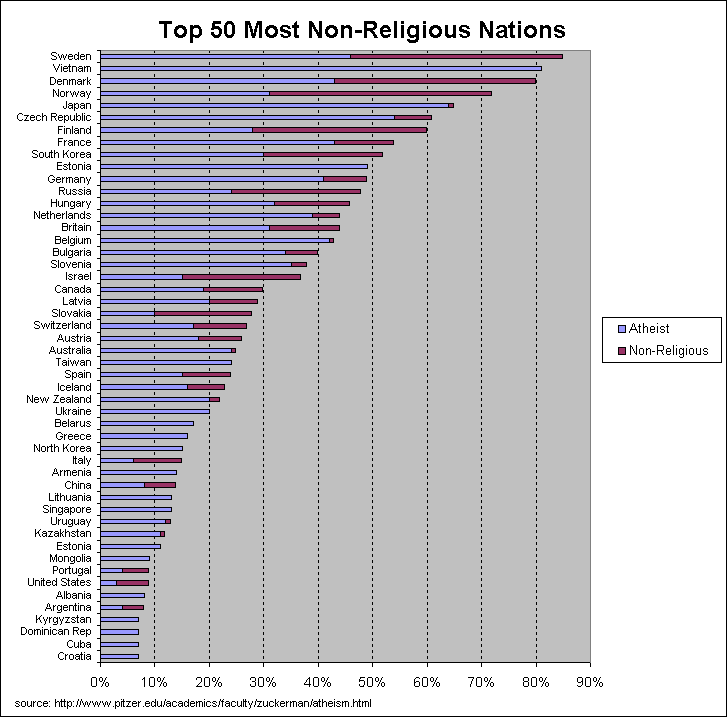
Attitudes towards atheism in the US have been heavily
impacted by the Cold War. Since America and the Soviet Union were the two
major superpower rivals after World War II, opposition to atheism became
deeply rooted in American society and associated with patriotism in ways
that did not take place anywhere else in the world.
Very few young atheists in America today understand the
impact of the Cold War on religious attitudes in America.
While secular public education in America has been
upheld since World War II, due to much effort by secular advocates,
religious criticism has not been incorporated into public education. What we
have in America today is a silence on the subject of religion. Education in
America has avoided, and continues to avoid, taking any position on religion
or criticism of religion. This has led to a very watered down teaching of
history and science in attempts to reduce conflict with the wide variety of
religious beliefs that exist in America. It is impossible to teach history and science without
teaching the fallacies of religious beliefs however, and this is one of the
elements that continues to undermine the education system of America.
Due to the unique anti-atheistic environment that has been
present in America since the beginning of the Cold War, most atheists have remained in the closet
and have had very little contact with other atheists and with atheistic
ideas outside of their own personal ideas. Indeed many American atheists
have been hostile to other atheists due to social conditioning. Many
non-religious people in America today still do not like the term atheist and
often speak in opposition to atheists, supporting religion as a social
institution. Recent polls show that atheists are the most hated major group
of people in America today.
Since no positive atheistic role models are discussed
in public or made known through general education or public media in
America, one of the biggest challenges that atheists and religious critics face in
America today is coming into contact with other like minded people,
identifying positive role models, and learning about atheistic worldviews.
|