|
Jesus Myth - The Case Against
Historical Christ
By
 - January 03, 2007
The majority of people in the world today assume or believe that Jesus
Christ was at the very least a real person. Perhaps he wasn't really "the
Messiah", perhaps he was not "The Son of God", and perhaps he didn't
actually perform miracles and rise from the dead, but he really was a great
moral teacher who traveled around Galilee with followers and got arrested by
the Jews
and crucified by the Romans right?
Not likely. In fact, a close examination of the evidence shows that the
best explanation for the story of "Jesus Christ" is what we call
"mythology". The case that I will be outlining here is that there never was
any "Jesus Christ" nor any meaningful real life basis for the story of "Jesus
Christ". Like many other religious figures, "Jesus Christ" began as a
theological concept, was later used as a character in allegorical stories,
and was then historicized as someone whom people believed really
existed. The belief in a literal "human" Jesus most likely emerged as
eucharist rituals and theology developed around the concept of the "flesh"
and "blood" of Christ and these concepts merged with allegorical narratives
about the figure.
What is the basis for the claim that "Jesus never existed"?
Actually, there are many important facts that support this
conclusion. First let's look at an outline of some of the major points in
this case:
- The Gospel of Mark was the first story of Jesus that
was written, and all others are dependent on it
- The Gospel of Mark shows clear signs of being
written as an allegorical fiction
- Virtually every detail of the life of Jesus comes from
"Old Testament" scriptures
- Some of the details of the life of Jesus are based on
mistranslations of the Hebrew scriptures
- Jesus' crucifixion on Passover defies historical
believability, yet makes perfect sense metaphorically
- The Gospels make many claims that are contradicted by
the historical record
- The earliest writings about Jesus, from Paul and
others, contain no details of his life
- Many statements in the letters of Paul only make sense
if Paul does not view Jesus Christ as a historical person
- There is not one single writing from or about Jesus
during his supposed lifetime
- Philo, a prolific Jewish writer who lived from 20 BCE to
50 CE, wrote extensively
about the political and theological movements throughout the
Mediterranean, and his views foreshadowed Christian theology, yet he
never once wrote anything about Jesus. Not only this, but he actually
wrote about political conflicts between the Jews and Pontius Pilate in
Judea
- All of the non-Christian references to Jesus can be
shown to have either been introduced later by Christian scribes or were
originally based on Christian claims
- There is no evidence of any knowledge of a tomb of
Jesus (empty or occupied) prior to the Gospel stories
- There were many conflicting beliefs about who Jesus
Christ was in the 1st, 2nd, and 3rd centuries, including beliefs that he
had never existed on earth "in the flesh"
- The Catholics made purely theological arguments as to
why Jesus Christ had to have existed "in the flesh"
None of these points are meant to stand on their own, but
collectively they provide a very strong argument against the story of
Jesus Christ being based on a real person.
It is important to note that we have one, and only one, source of
information about the life of Jesus and that is the Christian Gospels.
The Gospels are the sole source of information about this figure;
everything that we "know" about "him" depends on these sources.
There are two basic views of the Biblical Jesus as a real person
today, the religious Christian view and the secular historical view. The
religious Christian view takes the Gospels as accurate and reliable
accounts of the life of Jesus, including all of the miracles. The
religious Christian view demands that Jesus Christ was a popular and
well known figure in the region, who drew crowds of thousands of people
and performed great miracles, who was such a revolutionary figure that
the Jewish priesthood was compelled to have him arrested and put to
death in dramatic fashion before hundreds or thousands of witnesses.
The secular historical view, which may also be held by some
Christians, takes the Gospels as exaggerated accounts of the life
of a real Jesus. The secular historical view basically starts with the
Gospels and then removes the fantastic or "supernatural" claims in the
Gospels and accepts what is left as history. The secular historical view
tends to minimize the role of Jesus in the region, stating instead that
he was barely noticed by others. Secular historians who believe that
Jesus existed rely on the Gospels as essentially historical, but
inflated, accounts of his life.
But are the Gospels reliable historical accounts?
The origin of the Gospels has always been unknown. At no point has anyone
(that we know of) really known who wrote any of the Gospels, when they were written, or even where
they were written. Each of the Gospels could have been written anywhere from
Egypt to Rome, and the estimated dates for their writing range from around
50 CE at the earliest estimates to about 150 CE at the latest, with a minority of
people proposing dates into the 4th century.
The traditional explanation for the origin of the Gospels has been that
they were each written independently by people who were either disciples of
Jesus or who received their information from disciples of Jesus. This is
called the apostolistic tradition, and according to the apostolistic
tradition a Gospel could only be considered "authentic" if it had a direct
lineage to an apostle, thus the names assigned to each of the Gospels were
given in order to help establish their authenticity.
It has not always been believed, however, that each of the Gospels is an
eyewitness account. Indeed, the Gospel of Luke explicitly states that it is
compiled from the research of the author.
The earliest account for the origin of some of the Gospels comes
to us from the early church leader Papias, from about 130 CE:
Mark being the interpreter of Peter, whatsoever he recorded he wrote
with great accuracy, but not, however, in the order in which it was
spoken or done by our Lord, for he neither heard nor followed our Lord,
but, as before said, was in company with Peter, who gave him such
instruction as was necessary, but not to give a history of our Lord’s
discourses. Wherefore Mark has not erred in any thing, by writing some
things as lie has recorded them; for lie was carefully attentive to one
thing, not to pass by any thing that he heard, or to state any thing
falsely in these accounts. ... Matthew composed his history in the
Hebrew dialect, and every one translated it as he was able.
-
Papias, 130 CE
Here Papias states that the Gospel called Mark was written by someone
named Mark, and that Mark recorded his Gospel from the apostle Peter. He
then goes on to state that the Gospel called Matthew was written by someone
named Matthew who wrote his Gospel in "the Hebrew dialect", which would have
been Aramaic. We'll go ahead and
look at one more early explanation for the origin of the Gospels and then
analyze these statements.
Around 175 CE the early church leader Irenaeus expounded upon the
information of Papias when he gave an account of the origin of each of the
four Gospels that later became canon.
Matthew also issued a written Gospel among the Hebrews in their own
dialect, while Peter and Paul were preaching at Rome, and laying the
foundations of the Church. After their departure, Mark, the disciple and
interpreter of Peter, did also hand down to us in writing what had been
preached by Peter. Luke also, the companion of Paul, recorded in a book
the Gospel preached by him. Afterwards, John, the disciple of the Lord,
who also had leaned upon His breast, did himself publish a Gospel during
his residence at Ephesus in Asia.
-
Irenaeus; Against Heresies, 175 CE
Here Irenaeus basically repeats the statement of Papias, most likely
getting his information from Papias, and then adds a statement about the
Gospel called Luke and the Gospel called John. There are several problems
with what Papias and Irenaeus state, but first let's see what they are
saying and why they are saying it.
Early Christian theologians believed the Gospel of Matthew to be the first
Gospel that was written, and, by many accounts, the most important (of
course there was disagreement among them, as there was on all doctrinal
issues). The reason that Matthew was viewed by many as the earliest Gospel
and the most important was because it contained the virgin birth story and
the lineage to David, and the Gospel of Luke was self-described as not an
eyewitness account, so it could not have been the first. Some people claimed
that they had seen the original copy of Matthew, and that it was in Aramaic,
but the real motivation behind this story of being written "in the language
of the Hebrews" was an effort to establish its primacy and authority. It
makes sense that an account would be written in the same language that Jesus
spoke to his followers, yet all of the Gospels were written in Greek, so
this idea of an original Hebrew or Aramaic Gospel had a lot of draw to it.
Jesus was presumed to have spoken in Aramaic because the Gospels "quote him"
as saying things in Aramaic, such as his last words in the crucifixion
scenes.
Mark was said to have been a second-hand account which was out of order
because events in the Gospel of Mark are the same as in the Gospel of
Matthew, but in a different order, and Mark does not contain the virgin
birth story so it was seen as less valuable, thus, to resolve the
contradiction between the order of events in Mark and Matthew, the idea that
Mark was a second-hand account gained favor. The attribution of Peter as the
source of information for Mark comes from the fact that in order to be
viewed as legitimate the Gospel had to be tied back to an apostle, and the
Gospel of Mark seemed to come from Rome due to linguistic reasons, where the
"apostle Peter" supposedly preached, as well as the fact that Peter was the
most highly esteemed apostle, so Peter was proposed as Mark's source of
information.
The Gospel of Luke was obviously not a first-hand account, but the author
of Luke is also thought to be the author of the Acts of the Apostles, in
which there are several "we" passages that refer to Paul, thus the
conclusion was that the author of Luke was in the company of Paul and got
his information from Paul.
The Gospel of John states, "Peter turned and saw that the
disciple whom Jesus loved was following them...This is the disciple who is
testifying to these things and has written them, and we know that his
testimony is true," from which from which Irenaeus and others believed
that the author of the Gospel was the disciple John son of Zebedee, the
"Beloved Disciple".
There are several problems with all of these explanations however.
Scholars are now certain that the Gospel called Mark was
actually the first Gospel that was written, for reasons which will be
explained. The idea that Mark got his information from "Peter" does not make
sense because the apostle Peter is poorly portrayed in the Gospel of Mark.
In Mark's Gospel Peter is portrayed as a fool who doesn't understand the
message of Jesus, and thus him being Mark's authoritative source is unlikely
at best.
The Gospel of Matthew cannot have been originally written
in any language but Greek, because the Gospel of Matthew is copied from the
Gospel of Mark (or some version of the Gospel of Mark), which was written in
Greek. We will explore this shortly, but the word-for-word similarities
between Matthew and Mark are so strong that Matthew had to have been copied
directly from either the current version of Mark or a similar earlier
version of Mark or from a third source common between the two, but at any
rate, Matthew is clearly dependent on Markan text. The biggest change that
the author of Matthew made to the Gospel of Mark was the addition of the
virgin birth story.
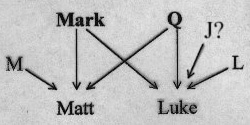
The author of Luke also shares a large quantity of text
with both Mark and Matthew, showing that much of Luke is copied from these
sources in some fashion. (The dominant theory now is that Matthew and Luke
both independently use Mark and a document called "Q") It also would not
make sense that Luke got his information from Paul, because Paul plainly
stated in his letters that he never saw Jesus, other than through visions.
Paul was definitely not a witness to anything in the Gospel stories, which
is clear in his own writings. Luke may also be dependent on the writings of
the Jewish historian Josephus.
The Gospel of John seems to have been the latest of the
Gospels that was written, putting it out of range for having been written by
anyone living during the supposed time of Jesus and the supposed signatory
passage is really a third party statement, not a self-description, in
addition to the fact that Chapter 21, in which it exists, was almost
certainly added by a later hand, not the same person who wrote the bulk of
the Gospel. On top of this the Gospel of John, unlike the synoptic Gospels
of Mark and Matthew, is written by someone whose first language appears to
have been Greek. The Gospel also does not seem to have been written by a
Jew, as it frequently referrers to "the Jews" as another group of people and
in a demeaning way. The dialog of Jesus presented in John is also more
complex than the synoptic Gospels and written in such a way that it would
not make sense for it to be a Greek interpretation of speeches given in
Aramaic or Hebrew, based on the use of things like Greek alliteration. In
other words, John uses eloquent Greek prose for the speeches of Jesus. If he
were simply giving a literal Greek translation of speeches given in a
different language, this wouldn't be the case. All of these things lead to
the conclusion that John was most likely written by a native Greek speaking
non-Jew after the other Gospels had been written and is most likely
influenced by one or more of the synoptic Gospels itself. The Gospel
certainly does not appear to have been written by an uneducated fisherman
from Galilee, which is who John the disciple is portrayed as in Gospel
stories.
Why do we say that Mark was written first and the others were copied from
it? This has to do with what is called the "synoptic problem". Basically, so
much of the text of Mark, Matthew, and Luke is shared word-for-word that the
only explanation can be that there has been extensive copying between the
texts. An example of this is shown below:
Mark 11:
28 "By what authority are you doing these things?" they asked. "And who
gave you authority to do this?"
29 Jesus replied, "I will ask you one question. Answer me, and I will
tell you by what authority I am doing these things. 30 John's baptism—was
it from heaven, or from men? Tell me!"
31 They discussed it among themselves and said, "If we say, 'From
heaven,' he will ask, 'Then why didn't you believe him?' 32But if we
say, 'From men'...." (They feared the people, for everyone held that
John really was a prophet.)
Matthew 21:
"By what authority are you doing these things?" they asked. "And who
gave you this authority?"
24 Jesus replied, "I will also ask you one question. If you answer me, I
will tell you by what authority I am doing these things. 25 John's
baptism—where did it come from? Was it from heaven, or from men?"
They discussed it among themselves and said, "If we say, 'From heaven,'
he will ask, 'Then why didn't you believe him?' 26 But if we say, 'From
men'—we are afraid of the people, for they all hold that John was a
prophet."
Luke 20:
2 "Tell us by what authority you are doing these things," they said. "Who
gave you this authority?"
3 He replied, "I will also ask you a question. Tell me, 4 John's
baptism—was it from heaven, or from men?"
5 They discussed it among themselves and said, "If we say, 'From heaven,'
he will ask, 'Why didn't you believe him?' 6 But if we say, 'From men,'
all the people will stone us, because they are persuaded that John was a
prophet."
These types of similarities are
prevalent throughout these three works.
While the Gospel called John is different from the synoptics and does not
share the same type of word-for-word copying with the others, it does share
many specific elements and references that indicate the author of John had
read at least one of the other synoptics. One example of this can be
seen in the crucifixion scene, shown below:
John 19:
23 When the soldiers crucified Jesus, they took his clothes, dividing
them into four shares, one for each of them, with the undergarment
remaining. This garment was seamless, woven in one piece from top to
bottom.
24 "Let's not tear it," they said to one another. "Let's decide by lot
who will get it."
This happened that the scripture might be fulfilled which said, "They
divided my garments among them
and cast lots for my clothing." So this is what the soldiers did.
Here the author of John is explicitly drawing a reference
to Psalm 22, which is implicitly referenced in Mark and Matthew. John builds
on the passage and creates a narrative around it in order to justify the
passage, which is a typical trait of John. Whereas the writers of Mark and
Matthew often just quoted or paraphrased passages from the "Old Testament",
the writer of John builds scenarios that he then relates back to those same
passages. The thing is that John ends up referencing many of the same
passages that Mark and Matthew reference, the author just does it in a
different way. But many of these passages are obscure, such as the casting
of lots for clothing, and thus indicate that the author of John is working
from one or more of the synoptic narratives.
Of the four Gospels, obviously one of them had to come
first, and one of the reasons that Mark is considered the first of the four
is indeed the fact that it is the shortest and least detailed. The author of
Mark is evidently unaware of any virgin birth story, making no mention
whatsoever of it, and the birth stories in Matthew and Luke are both
completely different from one another, while they both contain the core of
Mark.
It is almost universally accepted by New Testament
scholars today that Mark was the first of the narrative Gospels that was
written, and that Matthew and Luke are copied from it in some fashion,
however this position has only been adopted within the last 200 years. For
the majority of time Christians have believed that Matthew was written
first, hence the reason that it is the first book in the New Testament. Not
only this, but Christians believed that each of the Gospels was written
independently.
Why would "Matthew" and "Luke" copy from Mark, and why do
we have four different Gospels, each of which share many points but also
contradict each other in critical ways? Because the Gospels after Mark were
actually written in opposition to one another. The three other Gospels all
build on the story of Mark, but they introduce theological differences. The
authors of the other Gospels wrote their versions because of theological
differences or enhancements that they wished to introduce to the story. For
example, many of the changes made by the authors of Matthew and Luke deal
with making Mark's account more compatible with the virgin birth story,
since Mark contains story elements which infer that Jesus is the naturally
born son of Joseph and Mary.
Far from being four separate eyewitness accounts that
just happen to slightly disagree with each other, these four Gospels are a
product of theological disagreements among the early Christian community.
The writers of these Gospels obviously could not have known that these works
would later be compiled together into a single book side by side. The fact
that this was done is actually quite ironic, since the writers of these
Gospels evidently viewed other Gospels as flawed, hence the reason that they
created new versions.
The fact that all three of the other narrative Gospels in
the Bible are based directly or indirectly on the Gospel of Mark
demonstrates the lack of other narrative information about Jesus. The Gospel
of Mark became the root of the other Gospels because it was the only writing
that provided narrative details about Jesus. The additions that the authors
of Matthew and Luke made to the Gospel of Mark are primarily just the virgin
birth narratives and some additional post-resurrection narratives.
There is also language that is shared between the Gospels
of Matthew and Luke which is not in the Gospel of Mark. The most well known
proposed explanation for this is the "Q" document theory, which purposes
that there was some other source document which both the authors of Matthew
and Luke used, but was not used by the author of Mark. An equally valid
explanation is that both Matthew and Luke are simply based on an expanded
version of Mark, or that what we call the Gospel of Mark is a shortened
version of the original, which the authors of Matthew and Luke used.
The Gospel of John adds a few additional narrative
elements to the synoptic template, but the Gospel of John is a much later
Gospel, probably written some 40 to 50 years after the Gospel of Mark. The
additional elements in John are basically a gnostic theology element and a
"miraculous signs" element, both of which appear to be inventions of the
author himself. Some scholars propose that the "miraculous signs" narrative
in the Gospel of John is derived from yet another source, but it actually
seems to be a narrative element designed by the author as a polemic against
the Jews. The "miraculous signs" narrative in John shows Jesus doing many
"miraculous signs", but then at the end says that even after all of this the
Jews still didn't believe that he was the Son of God. Thus, this narrative
advances one of the agendas of the Gospel of John, which is portraying the
Jews as unreasonable betrayers of Christ.
The parallels between the four Gospels can be seen here:
Four Gospels Parallel
More on the Synoptic Problem can be seen here:
The Synoptic Problem (Catholic Resources)
The fact that the Gospel of Mark is the first narrative story of the life
of Jesus that was written, and the three other stories about the life of
Jesus are dependent on it either directly or indirectly, makes the Gospel of
Mark the lynchpin of the entire Jesus story. Understanding Mark is the key
to understanding the whole story of Jesus.
Most scholars today agree that the Gospel of Mark was written either
during or after the destruction of Judea by the Romans, which occurred
around 70 CE. The most widely accepted dates for the writing of Mark range
from between 66 CE to 100 CE, with a fringe of scholars claiming times
outside of this range on both sides.
The period in which the Gospel of Mark was written is well known among
scholars of ancient literature as an era of allegorical writing. Allegory is
defined as follows:
Allegory is a form of extended metaphor, in which objects, persons,
and actions in a narrative, are equated with the meanings that lie
outside the narrative itself. The underlying meaning has moral, social,
religious, or political significance, and characters are often
personifications of abstract ideas as charity, greed, or envy.
http://www.tnellen.com/cybereng/lit_terms/allegory.html
In essence, an allegory is a symbolic narrative. Allegorical writing was
prominent in the Greek speaking world from about the 5th century BCE onward,
but there was a particular revival of allegorical writing in the 1st
century CE among both Jews and Neo-Platonic Greeks and Romans. Indeed the
Jewish writer Philo wrote about symbolic and allegorical interpretation
of the Hebrew scriptures shortly before Paul began writing his first letters
about Jesus.
Let's take a look at the beginning of the story of Mark, just to get an
idea of how this story reads.
The beginning of the good news of Jesus Christ, the Son of God.
As it is written in the prophet Isaiah, ‘See, I am sending my
messenger ahead of you, who will prepare your way; the voice of one
crying out in the wilderness: “Prepare the way of the Lord, make his
paths straight” ’,John the baptizer appeared in the wilderness,
proclaiming a baptism of repentance for the forgiveness of sins. And
people from the whole Judean countryside and all the people of Jerusalem
were going out to him, and were baptized by him in the river Jordan,
confessing their sins. Now John was clothed with camel’s hair, with a
leather belt around his waist, and he ate locusts and wild honey. He
proclaimed, ‘The one who is more powerful than I is coming after me; I
am not worthy to stoop down and untie the thong of his sandals. I have
baptized you with water; but he will baptize you with the Holy Spirit.’
In those days Jesus came from Nazareth of Galilee and was baptized by
John in the Jordan. And just as he was coming up out of the water, he
saw the heavens torn apart and the Spirit descending like a dove on him.
And a voice came from heaven, ‘You are my Son, the Beloved; with you I
am well pleased.’
And the Spirit immediately drove him out into the wilderness. He was
in the wilderness for forty days, tempted by Satan; and he was with the
wild beasts; and the angels waited on him.
Now after John was arrested, Jesus came to Galilee, proclaiming the
good news of God, and saying, ‘The time is fulfilled, and the kingdom of
God has come near; repent, and believe in the good news.’
As Jesus passed along the Sea of Galilee, he saw Simon and his
brother Andrew casting a net into the lake—for they were fishermen. And
Jesus said to them, ‘Follow me and I will make you fishers of men.’ And
immediately they left their nets and followed him. As he went a little
farther, he saw James son of Zebedee and his brother John, who were in
their boat mending the nets. Immediately he called them; and they left
their father Zebedee in the boat with the hired men, and followed him.
Note here that the phrase "the Son of God" in the first line was probably
a later addition to this Gospel, because it is not present in some of the
earliest copies that we have, but this is not of critical importance. Just
from an initial reading one should be able to see that this is written in a
narrative fashion and makes no claim to being a historical account. The
Gospel isn't written like other histories of its time, but it is written
like other allegorical stories of its time. To get a sense of this we can
compare the Gospel of Mark to other historical accounts, by both Jews and
Romans, that were written around the same time.
Historical works typically had a table of contents, the authors of the
works identified themselves, and they were written in a formal style. We can
begin with The Wars of the Jews, by Josephus.
WHEREAS the war which the Jews made with the Romans hath been the
greatest of all those, not only that have been in our times, but, in a
manner, of those that ever were heard of; both of those wherein cities
have fought against cities, or nations against nations; while some men
who were not concerned in the affairs themselves have gotten together
vain and contradictory stories by hearsay, and have written them down
after a sophistical manner; and while those that were there present have
given false accounts of things, and this either out of a humor of
flattery to the Romans, or of hatred towards the Jews; and while their
writings contain sometimes accusations, and sometimes encomiums, but no
where the accurate truth of the facts; I have proposed to myself, for
the sake of such as live under the government of the Romans, to
translate those books into the Greek tongue, which I formerly composed
in the language of our country, and sent to the Upper Barbarians;
Joseph, the son of Matthias, by birth a Hebrew, a priest also, and one
who at first fought against the Romans myself, and was forced to be
present at what was done afterwards, [am the author of this work].
Now at the time when this great concussion of affairs happened, the
affairs of the Romans were themselves in great disorder. Those Jews also
who were for innovations, then arose when the times were disturbed; they
were also in a flourishing condition for strength and riches, insomuch
that the affairs of the East were then exceeding tumultuous, while some
hoped for gain, and others were afraid of loss in such troubles; for the
Jews hoped that all of their nation which were beyond Euphrates would
have raised an insurrection together with them.
-
Josephus; The Wars of the Jews, 70 CE
This is the preface to Josephus' account of the war between the
Jews and the Romans that lasted from 66 to 70 CE, resulting in the
destruction of Judea. As you can see, this reads like a work of history.
This was also written at pretty much the same time that the Gospel of Mark
was probably written.
We can also look at History of Rome, written by the Roman
historian Livy around 30 BCE:
To begin with, it is generally admitted that after the capture of
Troy, whilst the rest of the Trojans were massacred, against two of
them--Aeneas and Antenor--the Achivi refused to exercise the rights of
war, partly owing to old ties of hospitality, and partly because these
men had always been in favour of making peace and surrendering Helen.
Their subsequent fortunes were different. Antenor sailed into the
furthest part of the Adriatic, accompanied by a number of Enetians who
had been driven from Paphlagonia by a revolution and after losing their
king Pylaemenes before Troy were looking for a settlement and a leader.
The combined force of Enetians and Trojans defeated the Euganei, who
dwelt between the sea and the Alps and occupied their land. The place
where they disembarked was called Troy, and the name was extended to the
surrounding district; the whole nation were called Veneti. Similar
misfortunes led to Aeneas becoming a wanderer but the Fates were
preparing a higher destiny for him. He first visited Macedonia, then was
carried down to Sicily in quest of a settlement; from Sicily he directed
his course to the Laurentian territory. Here, too, the name of Troy is
found, and here the Trojans disembarked, and as their almost infinite
wanderings had left them nothing but their arms and their ships, they
began to plunder the neighbourhood. The Aborigines, who occupied the
country, with their king Latinus at their head came hastily together
from the city and the country districts to repel the inroads of the
strangers by force of arms.
From this point there is a twofold tradition. According to the one,
Latinus was defeated in battle, and made peace with Aeneas, and
subsequently a family alliance. According to the other, whilst the two
armies were standing ready to engage and waiting for the signal, Latinus
advanced in front of his lines and invited the leader of the strangers
to a conference.
-
Livy; History of Rome, 30 BCE
Whether these things are actually true or not is debatable, but there is
no debate about the fact that Livy was writing a history that he believed to
be factual and straight forward, not metaphorical or allegorical.
We can also look at the works of Tacitus, which were written shortly
after the Gospel of Mark was probably written.
I BEGIN my work with the time when Servius Galba was consul for the
second time with Titus Vinius for his colleague. Of the former period,
the 820 years dating from the founding of the city, many authors have
treated; and while they had to record the transactions of the Roman
people, they wrote with equal eloquence and freedom. After the conflict
at Actium, and when it became essential to peace, that all power should
be centered in one man, these great intellects passed away. Then too the
truthfulness of history was impaired in many ways; at first, through
men's ignorance of public affairs, which were now wholly strange to
them, then, through their passion for flattery, or, on the other hand,
their hatred of their masters. And so between the enmity of the one and
the servility of the other, neither had any regard for posterity. But
while we instinctively shrink from a writer's adulation, we lend a ready
ear to detraction and spite, because flattery involves the shameful
imputation of servility, whereas malignity wears the false appearance of
honesty. I myself knew nothing of Galba, of Otho, or of Vitellius,
either from benefits or from injuries. I would not deny that my
elevation was begun by Vespasian, augmented by Titus, and still further
advanced by Domitian; but those who profess inviolable truthfulness must
speak of all without partiality and without hatred. I have reserved as
an employment for my old age, should my life be long enough, a subject
at once more fruitful and less anxious in the reign of the Divine Nerva
and the empire of Trajan, enjoying the rare happiness of times, when we
may think what we please, and express what we think.
I am entering on the history of a period rich in disasters, frightful
in its wars, torn by civil strife, and even in peace full of horrors.
Four emperors perished by the sword. There were three civil wars; there
were more with foreign enemies; there were often wars that had both
characters at once.
-
Tacitus; The Histories, 109 CE
As you can see, there was definitely such a thing as formal history at the
time that the Gospels were written, and the Gospel of Mark, upon which all
of the others are based, does not read at all like a formal history, it
reads like an allegorical story. Mark develops characters and has a plot,
with scenes, suspense, and a climax. One of the interesting subplots in Mark
deals with John the Baptist. The beginning of Mark 1 is as follows:
As it is written in the prophet Isaiah, ‘See, I am sending my
messenger ahead of you, who will prepare your way; the voice of one
crying out in the wilderness: “Prepare the way of the Lord, make his
paths straight” ’,John the baptizer appeared in the wilderness,
proclaiming a baptism of repentance for the forgiveness of sins. And
people from the whole Judean countryside and all the people of Jerusalem
were going out to him, and were baptized by him in the river Jordan,
confessing their sins. Now John was clothed with camel’s hair, with a
leather belt around his waist, and he ate locusts and wild honey. He
proclaimed, ‘The one who is more powerful than I is coming after me; I
am not worthy to stoop down and untie the thong of his sandals. I have
baptized you with water; but he will baptize you with the Holy Spirit.’
The section in bold is a paraphrase of 2 Kings 1:8, which reads,
"They replied, 'He was a man with a garment of hair and with a leather belt
around his waist.' The king said, 'That was Elijah the Tishbite." The
author of Mark doesn't indicate that he is referencing the Hebrew scriptures
here, but he uses a scripture that identifies Elijah. Later in the story
(Mark 9), the disciples ask Jesus about the teaching that Elijah would come
before the "Son of Man", as shown below:
As they were coming down the mountain, he ordered them to tell no one
about what they had seen, until after the Son of Man had risen from the
dead. So they kept the matter to themselves, questioning what this
rising from the dead could mean. Then they asked him, ‘Why do the
scribes say that Elijah must come first?’ He said to them, ‘Elijah is
indeed coming first to restore all things. How then is it written about
the Son of Man, that he is to go through many sufferings and be treated
with contempt? But I tell you that Elijah has come, and they did
to him whatever they pleased, as it is written about him.’
Here the author of Mark tells the reader that Elijah has already come,
but he doesn't explain what that means. The reader has to figure out that
John the Baptist is Elijah, which can only be done by making the connection
between Mark 1:6 and 2 Kings 1:8. Obviously these types of twists and
riddles are written into the text on purpose for literary and mystical value, this isn't
how someone would write a historical work.
If Mark is an allegorical story, then what is Mark about, why did the
author write it, and why is it about someone called Jesus Christ?
These are not easy questions to answer, and they probably cannot be
answered definitively at this point, but reasonable options can be proposed.
The Gospel of Mark appears to have been written in response to
the conflict between the Jews and the Romans that resulted in the
destruction of Judea in 70 CE. It may have been written
during the war between the Jews and Romans, or shortly thereafter. The main
thrust of the story is that the Judean Jews brought destruction upon
themselves. This is not at all unusual, indeed this was a common opinion
among both Jews and non-Jews and was also expressed, though in a different
way, by the Jewish writer Josephus. Indeed many Jews blamed themselves for
their plight and for the destruction of their state by the Romans. This
self-blaming of the Jews follows a clear tradition in Jewish culture and
literature and is expressed repeatedly throughout the Hebrew scriptures.
This is because the Jews were often dominated by foreign rulers. Jewish
scriptures and literature saw the plights of the Jews as being a result of
their inability to properly please their god. For this reason, Jewish
literature prior to the writing of the Gospels was often pessimistic and full
of self-admonishments and stories of suffering. One of the many
examples of this is Psalm 74, which was supposedly written some time around
900 BCE.
1 Why have you rejected us forever, O God? Why does your anger
smolder against the sheep of your pasture?
2 Remember the people you purchased of old, the tribe of your
inheritance, whom you redeemed— Mount Zion, where you dwelt.
3 Turn your steps toward these everlasting ruins, all this destruction
the enemy has brought on the sanctuary.
4 Your foes roared in the place where you met with us; they set up their
standards as signs.
5 They behaved like men wielding axes to cut through a thicket of trees.
6 They smashed all the carved paneling with their axes and hatchets.
7 They burned your sanctuary to the ground; they defiled the dwelling
place of your Name.
...
- Psalm 74; Asaph
As you can see, it would be easy to call this a prophesy for the
destruction of Judea in 70 CE, but the fact is that it isn't, its just a
song that was written during some other time when the Israelites were
suffering the occupation of another conquering civilization. The author of the song
wasn't trying to predict events or think about the future, he was writing
about experiences that they were having at that moment. Here is another
example, Psalm 2, supposedly written around 1000 BCE by David:
1 Why do the nations conspire and the peoples plot in vain?
2 The kings of the earth take their stand and the rulers gather together
against the LORD and against his anointed one.
3 "Let us break their chains," they say, "and throw off their fetters."
4 The One enthroned in heaven laughs; the Lord scoffs at them.
5 Then he rebukes them in his anger and terrifies them in his wrath,
saying,
6 "I have installed my King on Zion, my holy hill."
7 I will proclaim the decree of the LORD : He said to me, "You are my
Son ; today I have become your Father.
...
- Psalm 2; David
Here we see another song that when taken out of context could easily be
turned into a supposed prophesy for Jesus, but the reality is that this is
just an old song, it's not a prophesy for anything. It should also be noted
that "anointed one" in this song, and in most of the pre-Christian Jewish
contexts, simply meant king. The anointed one was the king.
Another compelling story in the Hebrew scriptures, that in many ways
foreshadows the story of the crucifixion of Jesus, is the story of the
martyrdom of the seven brothers in 2 Maccabees, which was written some time
between the 1st century BCE and the 1st century CE. The account in 2
Maccabees is likely exaggerated and is used to make theological points and
encourage martyrdom. It
describes how a mother and her seven children are tortured to death during
the reign of the Greek ruler Antiochus.
2 Maccabees 7:
It happened also that seven brothers and their mother were arrested
and were being compelled by the king, under torture with whips and
thongs, to partake of unlawful swine’s flesh. One of them, acting as
their spokesman, said, ‘What do you intend to ask and learn from us? For
we are ready to die rather than transgress the laws of our ancestors.’
The king fell into a rage, and gave orders to have pans and cauldrons
heated. These were heated immediately, and he commanded that the tongue
of their spokesman be cut out and that they scalp him and cut off his
hands and feet, while the rest of the brothers and the mother looked on.
When he was utterly helpless, the king ordered them to take him to the
fire, still breathing, and to fry him in a pan. The smoke from the pan
spread widely, but the brothers and their mother encouraged one another
to die nobly, saying, ‘The Lord God is watching over us and in truth has
compassion on us, as Moses declared in his song that bore witness
against the people to their faces, when he said, “And he will have
compassion on his slaves.” ’
After the first brother had died in this way, they brought forward
the second for their sport. They tore off the skin of his head with the
hair, and asked him, ‘Will you eat rather than have your body punished
limb by limb?’ He replied in the language of his ancestors and said to
them, ‘No.’ Therefore he in turn underwent tortures as the first brother
had done. And when he was at his last breath, he said, ‘You accursed
wretch, you dismiss us from this present life, but the King of the
universe will raise us up to an everlasting renewal of life, because we
have died for his laws.’
After him, the third was the victim of their sport. When it was
demanded, he quickly put out his tongue and courageously stretched forth
his hands, and said nobly, ‘I got these from Heaven, and because of his
laws I disdain them, and from him I hope to get them back again.’ As a
result the king himself and those with him were astonished at the young
man’s spirit, for he regarded his sufferings as nothing.
After he too had died, they maltreated and tortured the fourth in the
same way. When he was near death, he said, ‘One cannot but choose to die
at the hands of mortals and to cherish the hope God gives of being
raised again by him. But for you there will be no resurrection to life!’
Next they brought forward the fifth and maltreated him. But he looked
at the king, and said, ‘Because you have authority among mortals, though
you also are mortal, you do what you please. But do not think that God
has forsaken our people. Keep on, and see how his mighty power will
torture you and your descendants!’
After him they brought forward the sixth. And when he was about to
die, he said, ‘Do not deceive yourself in vain. For we are
suffering these things on our own account, because of our sins against
our own God. Therefore astounding things have happened. But do
not think that you will go unpunished for having tried to fight against
God!’
The mother was especially admirable and worthy of honorable memory.
Although she saw her seven sons perish within a single day, she bore it
with good courage because of her hope in the Lord. She encouraged each
of them in the language of their ancestors. Filled with a noble spirit,
she reinforced her woman’s reasoning with a man’s courage, and said to
them, ‘I do not know how you came into being in my womb. It was not I
who gave you life and breath, nor I who set in order the elements within
each of you. Therefore the Creator of the world, who shaped the
beginning of humankind and devised the origin of all things, will in his
mercy give life and breath back to you again, since you now forget
yourselves for the sake of his laws.’
...
While she was still speaking, the young man said, ‘What are you
waiting for? I will not obey the king’s command, but I obey the command
of the law that was given to our ancestors through Moses. But you, who
have contrived all sorts of evil against the Hebrews, will certainly not
escape the hands of God. For we are suffering because of our own
sins. And if our living Lord is angry for a little while, to
rebuke and discipline us, he will again be reconciled with his own
slaves. But you, unholy wretch, you most defiled of all mortals, do not
be elated in vain and puffed up by uncertain hopes, when you raise your
hand against the children of heaven. You have not yet escaped the
judgment of the almighty, all-seeing God. For our brothers after
enduring a brief suffering have drunk of ever-flowing life, under God’s
covenant; but you, by the judgment of God, will receive just punishment
for your arrogance. I, like my brothers, give up body and life for the
laws of our ancestors, appealing to God to show mercy soon to our nation
and by trials and plagues to make you confess that he alone is God,
and
through me and my brothers to bring to an end the wrath of the Almighty
that has justly fallen on our whole nation.’
The king fell into a rage, and handled him worse than the others,
being exasperated at his scorn. So he died in his integrity, putting his
whole trust in the Lord.
Last of all, the mother died, after her sons.
4 Maccabees, written after 2 Maccabees and by a different author,
comments on the seven martyrs in 2 Maccabees and states that their sacrifice
was a "ransom for the sin of our nation."
4 Maccabees 17:
If it were possible for us to paint the history of your religion as
an artist might, would not those who first beheld it have shuddered as
they saw the mother of the seven children enduring their varied tortures
to death for the sake of religion? ... [T]hey having become, as it were,
a ransom for the sin of our nation. And through the blood of those
devout ones and their death as an atoning sacrifice, divine Providence
preserved Israel that previously had been mistreated.
The point is that there are many stories and psalms in the Hebrew Bible
and other pieces of Jewish literature that talk about suffering,
destruction, being rejected by God, "anointed ones" (messiahs), sons of God, redemptive sacrifices, etc.
Some of these suffering and "Son of God" stories are the basis for the Jesus
Christ figure or are the tradition out of which the Jesus Christ figure
emerged.
As Jews continuously faced problems and setbacks they asked themselves
"why", and their answer was often that bad things happen to them because
they failed to properly worship their god and hold his commandments. The
Gospel of Mark just builds on this tradition, writing a story about a savior
who is unrecognized by the Jews and eventually killed by them. There are
many Jewish stories where a certain faction of Jews are blamed for bringing
destruction on Jews as a whole. In the story
of Mark the killing of Jesus serves an allegorical role. "Mark" presents the
killing of Jesus as the reason for the destruction of Judea. The author of
Mark is writing
either during the war or shortly after it, and basically the rejection of
Jesus by the Jews is symbolic of the failure of the Jews to keep the favor
of their god, resulting in the destruction brought upon them by the Romans. This
type of mentality was really typical of Jewish culture and nothing new,
surprising, or unique, though it may have seemed new and unique to many
non-Jews.
Why is "Jesus Christ" a character in "Mark's" story? It's impossible to say
for sure, but the author of Mark may have been a member of a diaspora Jewish
community that taught about "Jesus Christ", perhaps along the lines of the
Pauline tradition. The concept of "Jesus Christ" as a crucified savior did
come before the writing of the Gospel of Mark, and the Gospel of Mark does
correspond to the idea of Jesus as a crucified savior figure, so the author
of Mark was
influenced by some pre-existing tradition, but there was probably no
biographical information about Jesus before Mark (for reasons we will
discuss). The author of Mark probably made all of the biographical information up himself
based on the existing "Old Testament" scriptures.
It is quite likely that the Gospel of Mark is primarily a story that
reflects the personal views of the author. As we will explore in the next
section, the Gospels, especially the Gospel of Mark, are based heavily on
the Hebrew scriptures. It is significant that the very first scriptural
reference in the Gospel of Mark refers to a passage in the Hebrew scriptures
that talks about the destruction of Israel.
Mark 1:
1 The beginning of the gospel about Jesus Christ[, the Son of God.]
2 It is written in Isaiah the prophet:
"I will send my messenger ahead of you,
who will prepare your way"—
3"a voice of one calling in the desert,
'Prepare the way for the Lord,
make straight paths for him.'"
4 And so John came, baptizing in the desert region and preaching a
baptism of repentance for the forgiveness of sins.
Mark 1:2 refers to Malachi 3:1. The entire book of Malachi is about God's
destruction of Israel because he is angry at them.
Malachi 2
"And now this admonition is for you, O priests. 2 If you do not listen,
and if you do not set your heart to honor my name," says the LORD
Almighty, "I will send a curse upon you, and I will curse your
blessings. Yes, I have already cursed them, because you have not set
your heart to honor me.
3 "Because of you I will rebuke your descendants ; I will spread on
your faces the offal from your festival sacrifices, and you will be
carried off with it. 4 And you will know that I have sent you this
admonition so that my covenant with Levi may continue," says the LORD
Almighty. 5 "My covenant was with him, a covenant of life and peace, and
I gave them to him; this called for reverence and he revered me and
stood in awe of my name. 6 True instruction was in his mouth and nothing
false was found on his lips. He walked with me in peace and uprightness,
and turned many from sin.
7 "For the lips of a priest ought to preserve knowledge, and from his
mouth men should seek instruction—because he is the messenger of the
LORD Almighty. 8 But you have turned from the way and by your teaching
have caused many to stumble; you have violated the covenant with Levi,"
says the LORD Almighty. 9 "So I have caused you to be despised and
humiliated before all the people, because you have not followed my ways
but have shown partiality in matters of the law."
10 Have we not all one Father? Did not one God create us? Why do we
profane the covenant of our fathers by breaking faith with one another?
11 Judah has broken faith. A detestable thing has been committed in
Israel and in Jerusalem: Judah has desecrated the sanctuary the LORD
loves, by marrying the daughter of a foreign god. 12 As for the man who
does this, whoever he may be, may the LORD cut him off from the tents of
Jacob [d] —even though he brings offerings to the LORD Almighty.
13 Another thing you do: You flood the LORD's altar with tears. You
weep and wail because he no longer pays attention to your offerings or
accepts them with pleasure from your hands. 14 You ask, "Why?" It is
because the LORD is acting as the witness between you and the wife of
your youth, because you have broken faith with her, though she is your
partner, the wife of your marriage covenant.
15 Has not the LORD made them one? In flesh and spirit they are his.
And why one? Because he was seeking godly offspring. So guard yourself
in your spirit, and do not break faith with the wife of your youth.
16 "I hate divorce," says the LORD God of Israel, "and I hate a man's
covering himself with violence as well as with his garment," says the
LORD Almighty.
So guard yourself in your spirit, and do not break faith.
17 You have wearied the LORD with your words.
"How have we wearied him?" you ask.
By saying, "All who do evil are good in the eyes of the LORD, and he is
pleased with them" or "Where is the God of justice?"
Malachi 3:
1 "See, I will send my messenger, who will prepare the way
before me. Then suddenly the Lord you are seeking will come to
his temple; the messenger of the covenant, whom you desire, will come,"
says the LORD Almighty.
2 But who can endure the day of his coming? Who can stand when he
appears?
The entire book of Malachi serves as a backdrop for the Gospel of Mark,
and we can see with the very first literary reference that is made by the
author of Mark, that this is a story talking about the destruction of Israel
and the failure of Israel to heed the messenger of God. In Malachi this is
Levi, in the Gospel of Mark this is Jesus.
These types of references and themes persist throughout the entire Gospel
of Mark. Another example from the beginning of Mark is the calling of the
fishermen, which has a quite different meaning when you know the underlying
subtext of the passage.
Mark 1:
14 After John was put in prison, Jesus went into Galilee, proclaiming
the good news of God. 15 "The time has come," he said. "The kingdom of
God is near. Repent and believe the good news!"
16 As Jesus walked beside the Sea of Galilee, he saw Simon and his
brother Andrew casting a net into the lake, for they were fishermen.
17 "Come, follow me," Jesus said, "and I will make you fishers
of men." 18 At once they left their nets and followed him.
This refers to a passage in Jeremiah 16, which is again talking about the
destruction of Israel.
Jeremiah 16:
5 For this is what the LORD says: "Do not enter a house where there is a
funeral meal; do not go to mourn or show sympathy, because I have
withdrawn my blessing, my love and my pity from this people," declares
the LORD. 6 "Both high and low will die in this land. They will not be
buried or mourned, and no one will cut himself or shave his head for
them. 7 No one will offer food to comfort those who mourn for the
dead—not even for a father or a mother—nor will anyone give them a drink
to console them.
8 "And do not enter a house where there is feasting and sit down to
eat and drink. 9 For this is what the LORD Almighty, the God of Israel,
says: Before your eyes and in your days I will bring an end to the
sounds of joy and gladness and to the voices of bride and bridegroom in
this place.
10 "When you tell these people all this and they ask you, 'Why has
the LORD decreed such a great disaster against us? What wrong have we
done? What sin have we committed against the LORD our God?' 11 then say
to them, 'It is because your fathers forsook me,' declares the LORD,
'and followed other gods and served and worshiped them. They forsook me
and did not keep my law. 12 But you have behaved more wickedly than your
fathers. See how each of you is following the stubbornness of his evil
heart instead of obeying me. 13 So I will throw you out of this land
into a land neither you nor your fathers have known, and there you will
serve other gods day and night, for I will show you no favor.'
14 "However, the days are coming," declares the LORD, "when men will
no longer say, 'As surely as the LORD lives, who brought the Israelites
up out of Egypt,' 15 but they will say, 'As surely as the LORD lives,
who brought the Israelites up out of the land of the north and out of
all the countries where he had banished them.' For I will restore them
to the land I gave their forefathers.
16 "But now I will send for many fishermen," declares the
LORD, "and they will catch them. After that I will send for many
hunters, and they will hunt them down on every mountain and hill and
from the crevices of the rocks. 17 My eyes are on all their
ways; they are not hidden from me, nor is their sin concealed from my
eyes. 18 I will repay them double for their wickedness and their sin,
because they have defiled my land with the lifeless forms of their vile
images and have filled my inheritance with their detestable idols."
This is an interestingly subversive reference, like many in the Gospel of
Mark. What seems like a good proclamation of happiness, refers to a text of
butchery and destruction. This is the only instance in the Old Testament of
fishermen catching people, and is surely the inspiration of Mark 1:17.
One of the augments that has often been used to claim that the Gospels
reflect authentic history is the recognition that, especially in the Gospel
of Mark, the disciples are poorly portrayed. The argument states that the
Gospels must be telling the truth because they present such an unflattering
picture of the disciples, that anyone who was fabricating the story would
have presented them in a better light. But this presumes that the author of
Mark, who set the tone for all the other Gospels, was writing history and
writing something that was intended to be a foundational document for the
beginning of a new religion about Jesus, and that he would have wanted to
portray the disciples well. Indeed this is not the case. The author of Mark
was writing an allegorical story that intentionally portrayed the Jews and
the disciples as failures, the purpose of which was to explain why Judea was
utterly destroyed. The Gospel of Mark is a story about failure, destruction,
and despair. This is critical to understand for the entire Gospel. This is
why the author of Mark has Jesus die on the cross, quoting from Psalm 22,
saying "My God, My God, why have you forsaken me?"
The original ending of
Mark indicates that after Jesus had risen nothing happened. There are
actually four different endings to Mark, but scholars agree that the ending
most likely to be original is the shortest one, that ends with the women who
had found the empty tomb being afraid and saying nothing. This would
indicate that the author of Mark is saying that they had dropped the ball,
and this symbolizes a further failure of the Jews, presumably responsible
for their woes.
Mark 16:
When the sabbath was over, Mary Magdalene, and Mary the mother of
James, and Salome bought spices, so that they might go and anoint him.
And very early on the first day of the week, when the sun had risen,
they went to the tomb. They had been saying to one another, ‘Who will
roll away the stone for us from the entrance to the tomb?’ When they
looked up, they saw that the stone, which was very large, had already
been rolled back. As they entered the tomb, they saw a young man,
dressed in a white robe, sitting on the right side; and they were
alarmed. But he said to them, ‘Do not be alarmed; you are looking for
Jesus of Nazareth, who was crucified. He has been raised; he is not
here. Look, there is the place they laid him. But go, tell his disciples
and Peter that he is going ahead of you to Galilee; there you will see
him, just as he told you.’ So they went out and fled from the tomb, for
terror and amazement had seized them; and they said nothing to anyone,
for they were afraid.
Throughout the Gospel of Mark the author sets up scenes
where Jews are wrong and fail, but Gentiles are good and become blessed. We
see this in several places, but one of the most notable is the scene were
Jesus rebukes Peter and tells the crowd that those who will come after him
must take up their cross and follow him.
Mark 8:
31 He then began to teach them that the Son of Man must suffer many
things and be rejected by the elders, chief priests and teachers of the
law, and that he must be killed and after three days rise again. 32 He
spoke plainly about this, and Peter took him aside and began to rebuke
him.
33 But when Jesus turned and looked at his disciples, he rebuked
Peter. "Get behind me, Satan!" he said. "You do not have in mind the
things of God, but the things of men."
34 Then he called the crowd to him along with his disciples and said:
"If anyone would come after me, he must deny himself and take up
his cross and follow me.
This scene is a foreshadowing of the events leading up to
the crucifixion, where the author has someone named Simon carry Jesus'
cross. Peter's original name was Simon, but throughout the Gospel of Mark
Peter constantly does the wrong things, and eventually denies Jesus. In the
end, it is a different Simon who carries his cross.
Mark 15:
20 And when they had mocked him, they took off the purple robe and put
his own clothes on him. Then they led him out to crucify him.
21 A certain man from Cyrene, Simon, the father of Alexander and
Rufus, was passing by on his way in from the country, and they forced
him to carry the cross.
Cyrene was a Gentile city and Alexander and Rufus are
Gentile names. Cyrene is also noted in Acts to have been the location of the
first "Gentile church". This was all likely said by the author of Mark in
order to clearly establish that this person was not a Jew, but rather a
Gentile who just happened to be passing through. This Simon, or the sons
mentioned, may also have been a real known figure in the Cyrene Christian
community, whom Mark placed within the narrative.
This again is just a clear building of the symbolism in
the story, showing the failures of the Jews, especially the so-called
disciples, while putting Gentiles in positive roles.
The
Gospel of Mark is indeed a polemic story, and it's not entirely clear if it
was written by a self-critical Jew or by an anti-Jewish non-Jew, but I tend
to think that it was written by a self-critical Jew. The anti-Jewish
attitude of the Gospel of Mark reverberates throughout all of the canonical
Gospels, which are directly or indirectly based on it, and have contributed
to so many generations of Jewish persecution by Christians.
The Gospel of Mark makes
sense as allegory, but it does not make sense as literally true history, and
due to the style that it is written in, as well as the fact that the author
was obviously aware of the fact that he was basing the events of his story
on scriptural references, as we shall explore next, it is almost certain
that the author himself wrote the story as allegory, with no intention that
it be taken as literal history. The Gospel of Mark does not proclaim itself
to be history, nor does it proclaim itself to be divinely inspired, nor does
it proclaim itself to be an authoritative religious document. The Gospel of
Mark is an unsigned allegorical commentary on the destruction of Judea, and
makes no pretense of being anything other than that. It was other people who
claimed it to be something more.
Many people ask, "If Jesus didn't exist, then where did these stories
come from?" "How would these stories emerge if someone did not in-fact
inspire them?"
Pretty much every detail of the life of Jesus as presented in the
Gospels relates back to some prior Hebrew scripture, mostly from the
scriptures that we now call the Old Testament, though some elements of the
Gospels appear to be based on other non-scriptural works as well. The
life of Jesus is a story that was created by combining elements from
many other Hebrew stories to create a pseudo-proto-typical savior figure.
Christians have traditionally used the parallels between the story of
Jesus and the Hebrew scriptures to claim that Jesus fulfilled many
prophecies from the "Old Testament", but there are several
problems with this claim.
First of all, even if every
parallel between the story of Jesus and the Hebrew scriptures related
back to a genuine prophecy there would still be nothing to show that the
authors of the Gospels didn't simply base their stories on the
prophesies. They would have known exactly what to write in order to
"fulfill" the prophecies and we have nothing independent of
the Gospels to attest to any of
this.
Secondly, many of the parallels between the story of Jesus and the
Hebrew scriptures don't relate back to prophecies, they simply relate
back to other stories about different people, or simply to songs and
poems.
Thirdly, as we will discuss later, some of the key elements of the
Jesus story are based on mistranslations of the Hebrew scriptures,
showing clearly that the authors of the Gospels were basing their
accounts of Jesus on other texts and that there is no way to call those
accounts "prophesy fulfillment".
Lastly, I call the Jesus Christ character of the Gospels a "pseudo-proto-typical
savior" because the story of Jesus is definitely based on the Hebrew
scriptures, but it is based on a misunderstanding of them.
There are three basic ways in which the Gospels relate back to the
Hebrew scriptures: Where the author explicitly references the
scriptures, where the author uses scriptures for underlying themes, and
where the author quotes or paraphrases scriptures without indicating
that they have done so.
Let us give these three types of references designations:
- Type 1 (T1) : Author explicitly references Hebrew scriptures
- Type 2 (T2) : Author uses Hebrew scriptures for underlying theme
- Type 3 (T3) : Author quotes or paraphrases Hebrew scripture
without indicating they have done so (implicit reference)
Now let's look at examples for each of these types of
references:
Type 1:
John 12:
12 The next day the great crowd that had come to the festival
heard that Jesus was coming to Jerusalem. 13 So they took
branches of palm trees and went out to meet him, shouting, ‘Hosanna!
Blessed is the one who comes in the name of the Lord—
the King of Israel!’
14 Jesus found a young donkey and sat on it; as it is
written: 15 ‘Do not be afraid, daughter of Zion.
Look, your king is coming,
sitting on a donkey’s colt!’
16 His disciples did not understand these things at first;
but when Jesus was glorified, then they remembered that these
things had been written of him and had been done to him.
This passage in John refers to Zechariah 9, which discusses the
judgment of the enemies of Israel and the coming of a warrior who
will lead the Israelites against their enemies:
Zechariah 9:
9 Rejoice greatly, O daughter Zion!
Shout aloud, O daughter Jerusalem!
Lo, your king comes to you;
triumphant and victorious is he,
humble and riding on a donkey,
on a colt, the foal of a donkey.
10 I will cut off the chariot from Ephraim
and the warhorse from Jerusalem;
and the battle-bow shall be cut off,
and he shall command peace to the nations;
his dominion shall be from sea to sea,
and from the River to the ends of the earth.
Type 2:
Isaiah 53 is known as the passage of the "Suffering Servant". The passage
actually starts in Isaiah 52 with lamentations about the occupation of Israel by
foreign rulers and the selling of Jews into slavery. Isaiah 53 is seen as an
underlying theme for the entire story of Jesus Christ.
Isaiah 53:
Who has believed what we have heard?
And to whom has the arm of the Lord been revealed?
For he grew up before him like a young plant,
and like a root out of dry ground;
he had no form or majesty that we should look at him,
nothing in his appearance that we should desire him.
He was despised and rejected by others;
a man of suffering and acquainted with infirmity;
and as one from whom others hide their faces
he was despised, and we held him of no account.
Surely he has borne our infirmities
and carried our diseases;
yet we accounted him stricken,
struck down by God, and afflicted.
But he was wounded for our transgressions,
crushed for our iniquities;
upon him was the punishment that made us whole,
and by his bruises we are healed.
All we like sheep have gone astray;
we have all turned to our own way,
and the Lord has laid on him
the iniquity of us all.
He was oppressed, and he was afflicted,
yet he did not open his mouth;
like a lamb that is led to the slaughter,
and like a sheep that before its shearers is silent,
so he did not open his mouth.
By a perversion of justice he was taken away.
Who could have imagined his future?
For he was cut off from the land of the living,
stricken for the transgression of my people.
They made his grave with the wicked
and his tomb with the rich,
although he had done no violence,
and there was no deceit in his mouth.
Yet it was the will of the Lord to crush him with pain.
When you make his life an offering for sin,
he shall see his offspring, and shall prolong his days;
through him the will of the Lord shall prosper.
Out of his anguish he shall see light;
he shall find satisfaction through his knowledge.
The righteous one, my servant, shall make many righteous,
and he shall bear their iniquities.
Therefore I will allot him a portion with the great,
and he shall divide the spoil with the strong;
because he poured out himself to death,
and was numbered with the transgressors;
yet he bore the sin of many,
and made intercession for the transgressors.
Type 3:
The crucifixion scene in the Gospels of Mark and Matthew (Matthew's is
copied from Mark with some minor additions) is based on Psalm 22. Psalm 69
and Isaiah 50 are also referenced, and Matthew adds on an allusion to Ezekiel 37 as well
as some other references.
| New Testament |
Old Testament |
Matthew 27:
30 They spit on him, and took the staff and struck him on the
head again and again. 31 After they had mocked him,
they took off the robe and put his own clothes on him. Then
they led him away to crucify him.32 As they were going out, they met a man from Cyrene,
named Simon, and they forced him to carry the cross. 33 They
came to a place called Golgotha (which means The Place of
the Skull). 34 There they offered Jesus wine to drink, mixed
with gall; but after tasting it, he refused to drink it.
35 When they had crucified him, they divided up his
clothes by casting lots. 36 And sitting down, they kept
watch over him there. 37 Above his head they placed the
written charge against him: THIS IS JESUS, THE KING OF THE
JEWS. 38 Two robbers were crucified with him, one on his
right and one on his left. 39 Those who passed by hurled
insults at him, shaking their heads 40 and saying, "You
who are going to destroy the temple and build it in three
days, save yourself! Come down from the cross, if you are
the Son of God!"
41 In the same way the chief priests, the teachers of
the law and the elders mocked him. 42 "He saved others,"
they said, "but he can't save himself! He's the King of
Israel! Let him come down now from the cross, and we will
believe in him. 43 He trusts in God. Let God rescue him
now if he wants him, for he said, 'I am the Son of
God.' " 44 In the same way the robbers who were crucified
with him also heaped insults on him.
45 From the sixth hour* until the ninth hour darkness came
over all the land. 46 About the ninth hour Jesus cried out in
a loud voice, "Eloi, Eloi, lama sabachthani?"—which means,
"My God, my God, why have you forsaken me?"
47 When some of those standing there heard this, they
said, "He's calling Elijah.
48 Immediately one of them ran and got a sponge. He
filled it with wine vinegar, put it on a stick, and offered
it to Jesus to drink. 49 The rest said, "Now leave him
alone. Let's see if Elijah comes to save him."
50 And when Jesus had cried out again in a loud voice, he
gave up his spirit.
51 At that moment the curtain of the temple was torn in
two from top to bottom. The earth shook and the rocks split.
52 The tombs broke open and the bodies of many holy
people who had died were raised to life. 53 They came out of
the tombs, and after Jesus' resurrection they went into the
holy city and appeared to many people. * The
sixth hour is noon |
Isaiah 50:
6 I offered my back to those who beat me, my cheeks to those
who pulled out my beard; I did not hide my face from
mocking and spitting.Amos 2:
11 I also raised up prophets from among your sons and
Nazirites from among your young men. Is this not true,
people of Israel?' declares the LORD. 12 'But you
made the Nazirites drink wine and commanded the prophets not
to prophesy.
Psalm 22:
1 My God, my God, why have you forsaken me?
Why are you so far from saving me,
so far from the words of my groaning?
...
7 All who see me mock me;
they hurl insults, shaking their heads:
8 "He trusts in the LORD;
let the LORD rescue him.
Let him deliver him,
since he delights in him."
...
16 Dogs have surrounded me;
a band of evil men has encircled me,
they have pierced my hands and my feet.
17 I can count all my bones;
people stare and gloat over me.
18 They divide my garments among them
and cast lots for my clothing.
Psalm 69:
Insults have broken my heart, so that I am in despair.
I looked for pity, but there was none;
and for comforters, but I found none. They gave me poison for food,
and for my thirst they gave me vinegar to drink.
Amos 8:
8 "Will not the land tremble for this, and
all who live in it mourn? ... 9 "In that day,"
declares the Sovereign LORD, "I will make the sun go down at
noon and darken the earth in broad daylight.
Ezekiel 37:
12 Therefore prophesy and
say to them: 'This is what the Sovereign LORD says: O my
people, I am going to open your graves and bring you up from
them; I will bring you back to the land of Israel. 13 Then
you, my people, will know that I am the LORD, when I open
your graves and bring you up from them. 14 I will put
my Spirit in you and you will live, and I will settle you in
your own land. Then you will know that I the LORD have
spoken, and I have done it, declares the LORD.' " |
The crucifixion scenes in Matthew and Mark do not openly indicate that
they are based on other scriptures, but the details of the scenes are
nevertheless drawn directly from the older scriptures.
Psalms 22 and 69 are not prophecies at all, they are lamentation songs,
and thus the similarities between the psalms and the Gospel stories could
not be called "prophesy fulfillment" under any circumstance. In addition,
the phrase "they have pierced my hands and my feet" is a
mistranslation, and is not a part of the Hebrew text, but is a later
variant of a Greek translation of the text.
Now, when it comes to the question of whether the crucifixion accounts of
Mark and Matthew are historical, the fact that the scenes are clearly
inspired by Isaiah 53, and parts of them are directly copied from Psalm 22,
Psalm 69, Ezekiel 37, etc. means that the authors are not
writing from either their own witnessing of the event or from a secondary
telling of the account, they are writing from the scriptures. Their source
for the story is the older scriptures - well, Mark's source is the older
scriptures, and Matthew's source is Mark, plus his own additional
references.
Clearly the story of the crucifixion of Jesus doesn't require a real
event for its inspiration, all of the ideas needed to inspire the story
already existed in the scriptures.
The thing is, the entire story of Jesus follows this pattern. Pretty
much every detail of the life of Jesus comes from the existing literature
from before his supposed time. To get an idea of the extent to which this is
the case we can look at one of the Gospels and identify the scriptural
basis for the events in the story of Jesus. A lot of these references are
the same across all the Gospels, so I will just use the Gospel of Matthew
here because it contains the most events and much of it is identical to Mark.
Here is an outline of the story of Jesus, based on the outline provided
by the New International Version (NIV) Bible, with references to the
passages in what we call the Old Testament that serve as the basis for the
elements of the story as told by the author of Matthew. I use T1, T2, and T3
to designate the type of reference that is used. I won't present every quote
due to length, but I will present some of the key quotes. I am also leaving
out all of the parables because I am concerned here with the supposed events
of the life of Jesus, i.e. the plot of the story:
Birth of Jesus:
T1: Matthew 1:2 - Isaiah 7:14 (based on Greek mistranslation):
"Then Isaiah said, 'Hear now, you house of David! Is it not enough to
try the patience of men? Will you try the patience of my God also? 14
Therefore the Lord himself will give you a sign: The virgin will be with
child and will give birth to a son, and will call him Immanuel.' "(Note:
This is a mistranslation that will be addressed in the next section.)
T2: Matthew 1 - Isaiah 9:6:
"For to us a child is born, to us a son is given, and the government
will be on his shoulders. And he will be called Wonderful Counselor, Mighty
God, Everlasting Father, Prince of Peace."
Born in Bethlehem:
T1: Matthew 2:5 - Micah 5:2:
"But you, Bethlehem Ephrathah, though you are small among the clans of
Judah, out of you will come for me one who will be ruler over Israel, whose
origins are from of old, from ancient times. "
Escape to Egypt:
T1: Matthew 2:15 - Hosea 11:1:
"When Israel was a child, I loved him, and out of Egypt I called my son."
Massacre of the Innocents:
T1: Matthew 2:17 - Jeremiah 31:15
T2: Matthew 2:16 - Exodus 1:22
"Then Pharaoh gave this order to all his people: "Every boy that is born to
the Hebrews you must throw into the Nile, but let every girl live.""
The Return to Nazareth:
T1: Matthew 2:23 - Judges 13:5:
"because you will conceive and give birth to a son. No razor may be
used on his head, because the boy is to be a Nazirite, set apart to God from
birth, and he will begin the deliverance of Israel from the hands of the
Philistines." (Note: Jesus was called a Nazorean in the gospels because he
supposedly lived in a place called Nazareth, but this refers to Samson being
from a Nazirite sect. The author himself made the reference however)
John the Baptist Prepares the Way:
T1: Matthew 3:3 - Isaiah 40:3:
"A voice of one calling: 'In the desert prepare the way for the LORD
;make straight in the wilderness a highway for our God."
T3: Matthew 3:4 - 2 Kings 2:8:
"They replied, 'He was a man with a garment of hair and with a leather
belt around his waist.' The king said, 'That was Elijah the Tishbite.'"
(Note: Matthew 3:4 says: "John's clothes were made of camel's hair, and he had a
leather belt around his waist." Later in the story Jesus indicates that John
was Elijah.)
The Temptation of Jesus:
T1: Matthew 4:6 - Psalm 91:11,12
T1: Matthew 4:7 - Deuteronomy 6:16
T1: Matthew 4:10 - Deuteronomy 6:13
Jesus Begins to Preach in Galilee:
T1: Matthew 4:12 - Isaiah 9:1:
"Nevertheless, there will be no more gloom for those who were in distress.
In the past he humbled the land of Zebulun and the land of Naphtali, but in
the future he will honor Galilee of the Gentiles, by the way of the sea,
along the Jordan"
Jesus Heals the Sick:
T2: Matthew 4:23 - Isaiah 53
Sermon on the Mount:
T2: Matthew 5-7 - Exodus 19...:
(Note: The Sermon on the Mount {which is only in the Gospel of Matthew}
refers to how only Moses was allowed up the mountain in Exodus, but Jesus
brings everyone up the mountain. Jesus then gives new interpretations of the
Commandments and Laws {from Exodus 20...})
Jesus Heals Many:
T2: Matthew 8 - Isaiah 53
Jesus Calms the Storm:
T2: Matthew 8:27 - Psalm 107 28-29:
"Then they cried to the Lord in their trouble, and he brought them out from
their distress; he made the storm be still, and the waves of the sea were
hushed."
Jesus Heals a Paralytic:
T2: Matthew 9:6 - Isaiah 53
T2: Matthew 9:6 - Isaiah 35:5-6:
"Then the eyes of the blind shall be opened, and the ears of the deaf
unstopped; then the lame shall leap like a deer, and the tongue of the
speechless sing for joy."
Jesus Consorts with Sinners:
T1: Matthew 9:12 - Hosea 6:6:
"For I desire mercy, not sacrifice, and acknowledgment of God rather
than burnt offerings."
A Dead Girl and a Sick Woman:
T2: Matthew 9:22 - Isaiah 53
T2: Matthew 9:25 - Isaiah 26:19:
"But your dead will live; their bodies will rise"
Jesus Heals the Blind and Mute:
T2: Matthew 9:29 - Isaiah 53
T2: Matthew 9:6 - Isaiah 35:5-6
Jesus Sends Out the Twelve:
T2: Matthew 10 - Joshua 4:1-2
"...the LORD said to Joshua, 'Choose twelve men from among the people, one from each tribe...'" (Note:
The number 12 is used throughout the "Old Testament" to represent 12 people,
12 rulers, 12 tribes, 12 special objects, etc. Also, Joshua and Jesus are
the same name in Hebrew.)
T1: Matthew 10:34 - Micah 7:6
Jesus and John the Baptist:
T2: Matthew 11:5 - Isaiah 53
T1: Matthew 11:10 - Malachi 3:
"'See, I will send my messenger, who will prepare the way before me. Then
suddenly the Lord you are seeking will come to his temple; the messenger of
the covenant, whom you desire, will come,' says the LORD Almighty."
Woe on Unrepentant Cities::
T2: Matthew 11:20 - Genesis 19
God's Chosen Servant:
T2: Matthew 12:17 - Isaiah 53
T1: Matthew 12:17 - Isaiah 42:1-4::
"'Here is my servant, whom I uphold, my chosen one in whom I delight; I will
put my Spirit on him and he will bring justice to the nations. He will not
shout or cry out, or raise his voice in the streets. A bruised reed he will
not break, and a smoldering wick he will not snuff out. In faithfulness he
will bring forth justice; he will not falter or be discouraged till he
establishes justice on earth. In his law the islands will put their hope.'"
Jesus and Beelzebub:
T2: Matthew 12:24 - 2 Kings 1:1-4
The Sign of Jonah:
T1: Matthew 12:40 - Jonah 1:17
Jesus Walks on the Water:
T2: Matthew 14:25 - Isaiah 43:5-6:
"When you pass through the waters, I will be with you; and when you pass
through the rivers, they will not sweep over you. ... For I am the LORD,
your God, the Holy One of Israel, your Savior;" (Note: Walking on water was
also a theme in Greek hero literature)
The Demand for a Sign:
T2: Matthew 16:4 - Jonah 1:17
T2: Matthew 16:1 - Genesis 19
Jesus Predicts His Death:
T2: Matthew 16:21 - Isaiah 53
The Transfiguration:
T2: Matthew 17:2 - Exodus 34:29:
"When Moses came down from Mount Sinai with the two tablets of the Testimony
in his hands, he was not aware that his face was radiant because he had
spoken with the LORD."
T2: Matthew 17:2 - Daniel 12:2-4:
"Many of those who sleep in the dust of the earth shall awake, some to
everlasting life, and some to shame and everlasting contempt. Those who are
wise shall shine like the brightness of the dome, and those who lead many to
righteousness, like the stars for ever and ever. But you, Daniel, keep the
words secret and the book sealed until the time of the end." (Note:
This shows the transfiguration as a foreshadowing of the resurrection)
T2: Matthew 17:11 - Isaiah 40:3
(Note: The symbolism in the transfiguration scene also reflects stories
about Moses in the Hebrew midrash, as well as typical the sun-god imagery of
the Greeks. See also: Philo, On the Life of Moses II, (288) "And
some time afterwards, when he was about to depart from hence to heaven, to
take up his abode there, and leaving this mortal life to become immortal,
having been summoned by the Father, who now changed him, having previously
been a double being, composed of soul and body, into the nature of a single
body, transforming him wholly and entirely into a most sun-like mind;")
The Healing of a Boy With a Demon:
T2: Matthew 17:17 - Isaiah 53
Jesus Again Predicts His Death:
T2: Matthew 20:18 - Isaiah 53
T2: Matthew 20:18 - Jonah 1:17
T2: Matthew 20:19 - Psalm 22
Two Blind Men Receive Sight:
T2: Matthew 20:29 - Isaiah 53
T2: Matthew 9:6 - Isaiah 35:5
The Triumphal Entry:
T1: Matthew 21:2 - Zechariah 9:9:
"Rejoice greatly, O daughter Zion! Shout aloud, O daughter Jerusalem! Lo,
your king comes to you; triumphant and victorious is he, humble and riding
on a donkey, on a colt, the foal of a donkey."
T3: Matthew 21:9 - Psalm 118:26
Jesus at the Temple:
T1: Matthew 21:12 - Isaiah 56:7
"...for my house will be called a house of prayer for all nations."
T2: Matthew 21:12 - Zechariah 14.21:
"Every pot in Jerusalem and Judah will be holy to the LORD Almighty, and all
who come to sacrifice will take some of the pots and cook in them. And on
that day there will no longer be a merchant in the house of the LORD
Almighty."
T2: Matthew 21:12 - Nehemiah 13:4-9:
"And I was very angry, and I threw all the household furniture of Tobiah out
of the room [in the temple]. Then I gave orders and they cleansed the
chambers, and I brought back the vessels of the house of God, with the
grain-offering and the frankincense."
T2: Matthew 21:12 - Hosea 9:15
"Because of their sinful deeds, I will drive them out of my house."
The Fig Tree Withers:
T2: Matthew 21:19 - Hosea 9
"1 Do not rejoice, O Israel; do not be jubilant like the other nations. For
you have been unfaithful to your God; ... 7 The days of punishment are
coming, the days of reckoning are at hand. Let Israel know this. Because
your sins are so many and your hostility so great, the prophet is considered
a fool, the inspired man a maniac. 8 The prophet, along with my God, is the
watchman over Ephraim, yet snares await him on all his paths, and hostility
in the house of his God. 9 They have sunk deep into corruption, as in the
days of Gibeah. God will remember their wickedness and punish them for their
sins. 10 'When I found Israel, it was like finding grapes in the desert;
when I saw your fathers, it was like seeing the early fruit on the fig tree.
But when they came to Baal Peor, they consecrated themselves to that
shameful idol and became as vile as the thing they loved. 15'... Because of
their sinful deeds, I will drive them out of my house. I will no longer love
them; all their leaders are rebellious. 16 Ephraim is blighted, their root
is withered, they yield no fruit. Even if they bear children, I will slay
their cherished offspring.' 17 My God will reject them because they have not
obeyed him; they will be wanderers among the nations." (Note: Many scholars
have interpreted the cursing of the fig tree as a metaphor for Jesus'
rejecting of those Jews who reject him and as a foreshadowing of his second
coming and judgment. Hosea 9 provides the scriptural basis for this
symbolism)
Signs of the End of the Age:
T3: Matthew 24 - Daniel 9:24-27:
"'Seventy weeks are decreed for your people and your holy city to finish
transgression, to put an end to sin, to atone for wickedness, to bring in
everlasting righteousness, to seal up vision and prophecy and to anoint the
most holy. Know and understand this: From the issuing of the decree to
restore and rebuild Jerusalem until the Anointed One, the ruler, comes,
there will be seven weeks, and sixty-two weeks. It will be rebuilt with
streets and a trench, but in times of trouble. After the sixty-two week, the
Anointed One will be cut off and will have nothing. The people of the ruler
who will come will destroy the city and the sanctuary. The end will come
like a flood: War will continue until the end, and desolations have been
decreed. He will confirm a covenant with many for one week. In the
middle of the week he will put an end to sacrifice and offering. And on a
wing of the temple he will set up an abomination that causes desolation,
until the end that is decreed is poured out on him.'"
T3: Matthew 24 - Daniel 11:31, 12:11
T3: Matthew 24 - Isaiah 13:8-11
"Terror will seize them, pain and anguish will grip them; they will writhe
like a woman in labor. They will look aghast at each other, their faces
aflame. See, the day of the LORD is coming —a cruel day, with wrath and
fierce anger— to make the land desolate and destroy the sinners within it.
The stars of heaven and their constellations will not show their light. The
rising sun will be darkened and the moon will not give its light. I will
punish the world for its evil, the wicked for their sins. I will put an end
to the arrogance of the haughty and will humble the pride of the ruthless."
T3: Matthew 24 - Isaiah 34
"1 Come near, you nations, and listen; pay attention, you peoples! Let the
earth hear, and all that is in it, the world, and all that comes out of it!
2 The LORD is angry with all nations; his wrath is upon all their armies. He
will totally destroy them, he will give them over to slaughter. 3 Their
slain will be thrown out, their dead bodies will send up a stench; the
mountains will be soaked with their blood. 4 All the stars of the heavens
will be dissolved and the sky rolled up like a scroll; all the starry host
will fall like withered leaves from the vine, like shriveled figs from the
fig tree. 5 My sword has drunk its fill in the heavens; see, it descends in
judgment on Edom, the people I have totally destroyed. 6 The sword of the
LORD is bathed in blood, it is covered with fat— the blood of lambs and
goats..."
Judas Agrees to Betray Jesus:
T2: Matthew 26:14 - Amos 2
"4 This is what the LORD says: 'For three sins of Judah, even for four, I
will not turn back [my wrath]. ... 5 I will send fire upon Judah that will
consume the fortresses of Jerusalem.' 6 '... They sell the righteous for
silver, and the needy for a pair of sandals. ... 11 I also raised up
prophets from among your sons and Nazirites from among your young men. Is
this not true, people of Israel?' declares the LORD. 12 'But you made the
Nazirites drink wine and commanded the prophets not to prophesy. 13 Now
then, I will crush you as a cart crushes when loaded with grain. (Note: The
distinction between "Judas" and "Judah" is a part of English translation. In
the original Greek they were both written as "Ioudas", thus these names were
the same.)
The Lord's Supper:
T2: Matthew 26:20 -
Psalm 41:9:
"Even the friend whom I trusted, who ate at my table, exults in
my misfortune."
Jesus Predicts Peter's Denial:
T1: Matthew 26:31 - Zechariah 13:7:
"'Awake, O sword, against my shepherd, against the man who is close to me!'
declares the LORD Almighty. 'Strike the shepherd, and the sheep will be
scattered, and I will turn my hand against the little ones"
Jesus' Prayers of the Cup at Gethsemane:
T2: Matthew 26:36 - Zechariah 12:2:
"I am going to make Jerusalem a cup that sends all the surrounding peoples
reeling. Judah will be besieged as well as Jerusalem. 3 On that day, when
all the nations of the earth are gathered against her, I will make Jerusalem
an immovable rock for all the nations."
T2: Matthew 26:36 - Psalm 16:5
"LORD, you have assigned me my portion and my cup; you have made my lot
secure."
Jesus Arrested:
T2: Matthew 26:55 - Isaiah 53:7-8:
"...he was led like a lamb to the slaughter, and as a sheep before her
shearers is silent, so he did not open his mouth. 8 By oppression and
judgment he was taken away. And who can speak of his descendants? For he was
cut off from the land of the living; for the transgression of my people he
was stricken. "
Peter Disowns Jesus:
T1: Matthew 27:72 - Zechariah 13:7
Judas Hangs Himself:
T1: Matthew 27:4-10 - Zechariah 11:12-13:
T2: Matthew 27:4-10 - Jeremiah 19, Jeremiah 32
The Soldiers Mock Jesus :
T3: Matthew 27:27 - Flaccus IV ; Philo (Note: The mocking of
people as kings was a common practice at the time, one such event was
recorded by the Jewish writer Philo, and may be the basis for the
mocking of Jesus scene):
"(36) There was a certain madman named Carabbas ... and setting him up there
on high that he might be seen by everybody, flattened out a leaf of papyrus
and put it on his head instead of a diadem, and clothed the rest of his body
with a common door mat instead of a cloak and instead of a scepter they put
in his hand a small stick of the native papyrus which they found lying by
the way side and gave to him; (38) and when, like actors in theatrical
spectacles, he had received all the insignia of royal authority, and had
been dressed and adorned like a king, the young men bearing sticks on their
shoulders stood on each side of him instead of spear-bearers, in imitation
of the bodyguards of the king, and then others came up, some as if to salute
him, and others making as though they wished to plead their causes before
him, and others pretending to wish to consult with him about the affairs of
the state. (39) Then from the multitude of those who were standing around
there arose a wonderful shout of men calling out Maris!; and this is the
name by which it is said that they call the kings among the Syrians; for
they knew that Agrippa [King Herod of the Jews] was by birth a Syrian, and
also that he was possessed of a great district of Syria of which he was the
sovereign;"
T3: Matthew 27:30 - Isaiah 50
The Crucifixion of Jesus:
T2: Matthew 27:32-44 - Isaiah 53
T3: Matthew 27:32-44 - Psalm 22
T3: Matthew 27:32-44 - Amos 2
T3: Matthew 27:32-44 - Psalm 69
T3: Matthew 27:45 - Amos 8
The Death of Jesus:
T2: Matthew 27:32-44 - Isaiah 53
T3: Matthew 27:32-44 - Psalm 22
T3: Matthew 27:32-44 - Psalm 69
T2: Matthew 27:52 - Ezekiel 37:11-13
The Burial of Jesus:
T2: Matthew 26:57 - Deuteronomy 21:22-23:
"If a man has committed a sin worthy of death, and he is put to death, and
you hang him on a tree [or plank], his corpse shall not hang all night on
the tree, but you shall surely bury him on the same day, for he who is
hanged is the curse of God, so that you do not defile your land which the
Lord your God gives you as an inheritance."
T2: Matthew 26:57 - Isaiah 53:9:
"They made his grave with the wicked and his tomb with the rich, although he
had done no violence, and there was no deceit in his mouth." (Note:
Jesus was placed in the tomb of a rich man)
The Resurrection
T2: Matthew 28:7 - Isaiah 26:19:
"Your dead shall live, their corpses shall rise. O dwellers in the dust,
awake and sing for joy! For your dew is a radiant dew, and the earth will
give birth to those long dead."
T2: Matthew 28:7 - Ezekiel 37:
"1 The hand of the Lord came upon me, and he brought me out by the spirit of
the Lord and set me down in the middle of a valley; it was full of bones. 2
He led me all round them; there were very many lying in the valley, and they
were very dry. 3 He said to me, ‘Mortal, can these bones live?’ I answered,
‘O Lord God, you know.’ 4 Then he said to me, ‘Prophesy to these bones, and
say to them: O dry bones, hear the word of the Lord. 5 Thus says the Lord
God to these bones: I will cause spirit to enter you, and you shall live. 6
I will lay sinews on you, and will cause flesh to come upon you, and cover
you with skin, and put spirit in you, and you shall live; and you shall know
that I am the Lord.’"
T2: Matthew 28:7 - Daniel 12:2-4:
"Many of those who sleep in the dust of the earth shall awake, some to
everlasting life, and some to shame and everlasting contempt. Those who are
wise shall shine like the brightness of the dome, and those who lead many to
righteousness, like the stars for ever and ever. But you, Daniel, keep the
words secret and the book sealed until the time of the end."
(Note: The resurrection of Jesus was portrayed as a sign of the end and as
proof of the time of resurrections for all people)
As you can see, essentially the entire story of Jesus can
be told from the writings that preceded it. The Jesus character in the
Gospels is an archetypal figure drawn straight from the Hebrew scriptures,
with an influence from the surrounding Greek culture as well.
Because of the fact that the Gospel of Mark is the root
of all the Gospels, especially the synoptic Gospels, it is interesting to
note how specific scriptural references made by the author of Mark became
changed and somewhat lost by the later authors who copied from the Gospel of
Mark. Perhaps the best example of this is the cursing of the fig tree.
The cursing of the fig tree in the Gospel of Mark is
clearly based on an Old Testament scripture, but the writer of Matthew does
not seem to have recognized this and lost the reference. Here is the cursing
of the fig tree from the Gospel of Mark.
Mark 11:
12 The next day as they were leaving Bethany, Jesus was hungry.
13 Seeing in the distance a fig tree in leaf, he went to find out if it
had any fruit. When he reached it, he found nothing but leaves, because
it was not the season for figs. 14 Then he said to the tree, "May no one
ever eat fruit from you again." And his disciples heard him say it.
15 On reaching Jerusalem, Jesus entered the temple area and
began driving out those who were buying and selling there. He
overturned the tables of the money changers and the benches of those
selling doves, 16 and would not allow anyone to carry merchandise
through the temple courts. 17 And as he taught them, he said, "Is it not
written:
"'My house will be called a house of prayer for all nations'? But you
have made it 'a den of robbers.'"
18 The chief priests and the teachers of the law heard this and began
looking for a way to kill him, for they feared him, because the whole
crowd was amazed at his teaching.
19 When evening came, they went out of the city.
20 In the morning, as they went along, they saw the fig tree
withered from the roots. 21 Peter remembered and said to Jesus,
"Rabbi, look! The fig tree you cursed has withered!"
This entire scene is based on Hosea 9, and refers to the
destruction of Israel.
Hosea 9:
1 Do not rejoice, O Israel; do not be jubilant like the other nations.
For you have been unfaithful to your God; ...
7 The days of punishment are coming, the days of reckoning are at hand.
Let Israel know this. Because your sins are so many and your hostility
so great, the prophet is considered a fool, the inspired man a maniac.
8 The prophet, along with my God, is the watchman over Ephraim, yet
snares await him on all his paths, and hostility in the house of his
God.
9 They have sunk deep into corruption, as in the days of Gibeah. God
will remember their wickedness and punish them for their sins.
10 'When I found Israel, it was like finding grapes in the desert;
when I saw your fathers, it was like seeing the early fruit on
the fig tree. But when they came to Baal Peor, they consecrated
themselves to that shameful idol and became as vile as the thing they
loved.
11 Ephraim's glory will fly away like a bird—no birth, no pregnancy, no
conception.
12 Even if they rear children, I will bereave them of every one. Woe to
them when I turn away from them!
13 I have seen Ephraim, like Tyre, planted in a pleasant place. But
Ephraim will bring out their children to the slayer."
14 Give them, O LORD—what will you give them? Give them wombs that
miscarry and breasts that are dry.
15 "Because of all their wickedness in Gilgal, I hated them there.
Because of their sinful deeds, I will drive them out of my
house. I will no longer love them; all their leaders are
rebellious.
16 Ephraim is blighted, their root is withered, they yield no fruit.
Even if they bear children, I will slay their cherished offspring.'
17 My God will reject them because they have not obeyed him;
We can clearly see here that the author of Mark uses
Hosea 9 for his motif, because in Mark 11 the fig tree is in leaf but not in
season, meaning that it was early in the growing season. Then Jesus goes to
the temple to drive the people "out of his house". After that they return to
the fig tree where they see that it was withered "from the root." This makes
the parallel between Mark and Hosea 9 very clear, and shows that Hosea 9 was
obviously the inspiration for all of these scenes. The author of Mark was
also clearly making a reference to the meaning in the text of Hosea 9.
Hosea 9 is talking about the destruction of Israel in no uncertain terms.
The reader is supposed to make this connection and understand this as the
meaning in the story.
But, let's look at how the writer of Matthew, the only
other Gospel to include this scene, recorded this passage.
Matthew 21:
12 Jesus entered the temple area and drove out all who were
buying and selling there. He overturned the tables of the money
changers and the benches of those selling doves. 13"It is written," he
said to them, " 'My house will be called a house of prayer,' but you are
making it a 'den of robbers.'"
14 The blind and the lame came to him at the temple, and he healed them.
15 But when the chief priests and the teachers of the law saw the
wonderful things he did and the children shouting in the temple area,
"Hosanna to the Son of David," they were indignant.
16 "Do you hear what these children are saying?" they asked him.
"Yes," replied Jesus, "have you never read," 'From the lips of children
and infants you have ordained praise'?"
17 And he left them and went out of the city to Bethany, where he spent
the night.
18 Early in the morning, as he was on his way back to the city,
he was hungry. 19 Seeing a fig tree by the road, he went up to it but
found nothing on it except leaves. Then he said to it, "May you never
bear fruit again!" Immediately the tree withered.
20 When the disciples saw this, they were amazed. "How did the fig tree
wither so quickly?" they asked.
Here the entire scene is obviously changed around in such
a way that it no longer mirrors the template from Hosea 9 and the references
to being out of season are lost, as well as the reference to the root. The
parallel with the Hosea 9 is pretty much lost here, so it would seem that
the author of Matthew didn't recognize the parallel himself. It is also
likely that the the author of Matthew thought that the original text of Mark
seemed absurd, for why would Jesus have expected to see fruit on a tree
before the season in the first place? In Matthew the deeper symbolism is
lost and this now looks like a recounting of some historical event instead
of what it really is, which is a literary allusion. The author of Matthew
also added additional details to a story that was clearly contrived in the
first place, so we can see here the growing of legend.
Despite this, there are still many recognizable parallels
between the Hebrew scriptures and all of the Gospel texts. Christians claim
that the parallels between the Gospels and the "Old Testament" texts are due
to the fact that all of the parallels are prophecies that Jesus was
fulfilling, but close inspection of the references shows that many of them
are not even prophecies and that few of them actually could relate to the
Jesus story. Regardless, even if they did all relate to the story there is
nothing to show that the story was not simply crafted from the existing
scriptures at the time, and indeed, for reasons that will be further
discussed, this is by far the most reasonable explanation for the story of
Jesus. If I took a copy of the works of Nostradamus today I could sit down
and write a story about a character who fulfills hundreds of "his
prophecies". Would that make either his predictions or my story "true"? Of
course not, but this isn't what the early Church fathers and Christian
apologists thought, they viewed the correlations between the Hebrew
scriptures (which they typically read in Greek translations) and the story
of Jesus as "proof that the religion is true." One of the best examples of
this comes from Eusebius of Caesarea, who wrote on this subject in the early
4th century in The Proof of the Gospel:
Grant then, dear friend, my request, and labor with rue henceforward
in your prayers in my effort to present the Proof of the Gospel from the
prophecies extant among the Hebrews from the earliest times. ... I
propose to show, by quotations from them, how they forestalled events
that came to the light long ages after their time, the actual
circumstances of the Saviour's own presentment of the Gospel.... It
shall be my task to prove that they saw that which was not present as
present, and that which as yet was not in existence as actually
existing; and not only this, but that they foretold in writing the
events of the future for posterity, so that by their help others can
even now know what is coming....
It seems now time to say what I consider to be desirable at present
to draw from the prophetic writings for the proof of the Gospel. They
said that Christ, [Whom they named] the Word of God, and Himself both
God and Lord, and Angel of Great Counsel, would one day dwell among men,
and would become for all the nations of the world, both Greek and
Barbarian, a teacher of true knowledge of God, and of such duty to God
the Maker of the Universe, as the preaching of the Gospel includes. They
said that He would become a little child, and would be called the Son of
Man, as born of the race of Mankind. They foretold the wondrous fashion
of His birth from a Virgin, and—strangest of all—they did not omit to
name Bethlehem the place of His birth, which is to-day so famous that
men still hasten from the ends of the earth to see it, but shouted it
out with the greatest clearness. As if they stole a march on history
these same writers proclaimed the very time of His appearance, the
precise period of His sojourn on earth.
It is possible for you, if you care to take the trouble, to see with
your eyes, comprehended in the prophetic writings, all the wonderful
miracles of our Saviour Jesus Christ Himself, that are witnessed to by
the heavenly Gospels, and to hear His divine and perfect teaching about
true holiness. How it must move our wonder, when they unmistakably
proclaim the new ideal of religion preached by Him to all men, the call
of His disciples, and the teaching of the new Covenant. Yes, and in
addition to all this they foretell the Jews' disbelief in Him, and
disputing, the plots of the rulers, the envy of the Scribes, the
treachery of one of His disciples, the schemes of enemies, the
accusations of false witnesses, the condemnations of His judges, the
shameful violence, unspeakable scourging, ill-omened abuse, and,
crowning all, the death of shame. They portray Christ's wonderful
silence, His gentleness and fortitude, and the unimaginable depths of
His forbearance and forgiveness.
The most ancient Hebrew oracles present all these things definitely
about One Who would come in the last times, and Who would undergo such
sufferings among men, and they clearly tell the source of their
foreknowledge. They bear witness to the Resurrection from the dead of
the Being Whom they revealed, His appearance to His disciples, His gift
of the Holy Spirit to them, His return to heaven, His establishment as
King on His Father's throne and His glorious second Advent yet to be at
the consummation of the age. In addition to all this you can hear the
wailings and lamentations of each of the prophets, wailing and lamenting
characteristically over the calamities which will overtake the Jewish
people because of their impiety to Him Who had been foretold. How their
kingdom, that had continued from the days of a remote ancestry to their
own, would be utterly destroyed after their sin against Christ; how
their fathers' Laws would be abrogated, they themselves deprived of
their ancient worship, robbed of the independence of their forefathers,
and made slaves of their enemies, instead of free men; how their royal
metropolis would be burned with fire, their venerable and holy altar
undergo the flames and extreme desolation, their city be inhabited no
longer by its old possessors but by races of other stock, while they
would be dispersed among the Gentiles through the whole world, with
never a hope of any cessation of evil, or breathing-space from troubles.
And it is plain even to the blind, that what they saw and foretold is
fulfilled in actual facts from the very day the Jews laid godless hands
on Christ, and drew down on themselves the beginning of the train of
sorrows.
-
THE PROOF OF THE GOSPEL; Eusebius, 4th century
Amazingly, Eusebius didn't seem to consider the possibility that the
reason there are so many parallels between the Gospels and the Hebrew
scriptures is that the Gospel writers based their stories on the scriptures.
Prior to Eusebius, Justin Martyr also attributed the "truth" of the
Gospels and the "truth" of Jesus Christ to the parallels between the Gospels
and the earlier Hebrew scriptures, and he even went so far as to state that
the Hebrews themselves were not the authors of their own scriptures, God was,
and the Hebrews themselves couldn't understand their own scriptures, since
they weren't the true authors, and that the prophecies for Jesus are not all
straightforward or self-evident because God presented them in a variety of
ways and embedded them in stories. Justin Martyr gave his fullest
description of this in his work First Apology, written in the 2nd
century. Sections read:
CHAPTER XXXVI -- DIFFERENT MODES OF PROPHECY.
But when you hear the utterances of the prophets spoken as it were
personally, you must not suppose that they are spoken by the inspired
themselves, but by the Divine Word who moves them. For sometimes He
declares things that are to come to pass, in the manner of one who
foretells the future; sometimes He speaks as from the person of God the
Lord and Father of all; sometimes as from the person of Christ;
sometimes as from the person of the people answering the Lord or His
Father, just as you can see even in your own writers, one man being the
writer of the whole, but introducing the persons who converse. And this
the Jews who possessed the books of the prophets did not understand, and
therefore did not recognize Christ even when He came, but even hate us
who say that He has come, and who prove that, as was predicted, He was
crucified by them.
Here Justin Martyr is basically justifying the fact that many of the
parallels between the Gospels and the Hebrew scriptures are parts of other
stories, songs, and things that by all accounts don't appear to be
prophesies. Justin Martyr simply says that everything in the old scriptures
is prophecy, thus there are "different modes" of prophecy in the
scriptures.
CHAPTER XLII -- PROPHECY USING THE PAST TENSE.
But when the Spirit of prophecy speaks of things that are about to
come to pass as if they had already taken place,--as may be observed
even in the passages already cited by me,--that this circumstance may
afford no excuse to readers [for misinterpreting them], we will make
even this also quite plain. The things which He absolutely knows will
take place, He predicts as if already they had taken place. And that the
utterances must be thus received, you will perceive, if you give your
attention to them. The words cited above, David uttered 1500 years
before Christ became a man and was crucified; and no one of those who
lived before Him, nor yet of His contemporaries, afforded joy to the
Gentiles by being crucified. But our Jesus Christ, being crucified and
dead, rose again, and having ascended to heaven, reigned; and by those
things which were published in His name among all nations by the
apostles, there is joy afforded to those who expect the immortality
promised by Him.
Here Justin Martyr is specifically justifying parallels between the
Gospels and the Hebrew scriptures where the parallels reference phrases that
are written in the past tense, which are usually parts of other stories. He
also talks about a "prediction of the crucifixion" by David, but there is a
major problem here. What he is referring to is Psalm 22, where it says
"a band of evil men has encircled me, they have pierced my hands and my
feet." The problem here is that the phrase "they have pierced
my
hands and my feet" is a mistranslation or interpolation, this is not a
part of the scriptures in Hebrew, this is only found in later Greek
translations of the text. This
line originally read as follows: "For dogs have surrounded me; a band of
evildoers has encompassed me like a lion, my hands and feet."
More information on the translation of this line can be found here:
Psalm 22:16: A Prophecy of the Crucifixion?
Even if the traditional Christian translation of this passage were
correct, "they have pierced my hands and my feet" can
apply to many things and it has been confirmed many times that the Roman's
didn't actually crucify people by putting spikes through their hands
because the hands couldn't support the weight. This passage is also the
source for the portrayal of Jesus as crucified by putting spikes through his
hands and the author of Luke's claim that Jesus proved he had been resurrected by showing
the disciples the holes in his hands.
So what we can see is that from the very beginning scholars and
theologians have been aware of many of the parallels between the story of
Jesus and the Hebrew scriptures, and that early Christians, especially, believed that it was these parallels that proved that the religion was
"true". Far from proving the "truth" of the religion, however,
these parallels actually show us how the story of Jesus was crafted and
demonstrate that the basis of the Jesus story is not reality, but
scriptures.
All of the Gospels were written in Greek, and while the authors of the
Gospels are unknown, we do know that they used a Greek translation of the
Hebrew scriptures knows as the Septuagint. The Septuagint was created by
Jewish scribes who translated the Jewish texts into Greek because the Jewish
community outside of Judea typically spoke Greek instead of Hebrew or
Aramaic. Though the Septuagint was claimed to have been a "flawless"
translation, it did in fact contain a number of errors. Some of these errors
show up in the New Testament where the writers of the Gospels quote or
reference mistranslated sections of the Septuagint. The most famous and
critical of these errors occurs in Isaiah 7, which was referenced
by the author of Matthew as the basis for his famous virgin birth story.
A proper translation of Isaiah 7:10-17 from the NRSV (New Revised
Standard Version), which is taken
directly from the Hebrew, reads as follows:
Again the Lord spoke to Ahaz, saying, Ask a sign of the Lord your
God; let it be deep as Sheol or high as heaven. But Ahaz said, I will
not ask, and I will not put the Lord to the test. Then Isaiah said:
‘Hear then, O house of David! Is it too little for you to weary mortals,
that you weary my God also? Therefore the Lord himself will give you a
sign. Look, the young woman is with child and shall bear a son,
and shall name him Immanuel. He shall eat curds and honey by the time he
knows how to refuse the evil and choose the good. For before the child
knows how to refuse the evil and choose the good, the land before whose
two kings you are in dread will be deserted. The Lord will bring on you
and on your people and on your ancestral house such days as have not
come since the day that Ephraim departed from Judah—the king of
Assyria.’
Two errors were made when this passage was translated into Greek for the Septuagint. First "young woman" was translated to "virgin" and secondly the
tense of the sentence was translated from present tense to future tense.
In the NIV (New International Version) this passage is translated as it was in the Greek Septuagint
(and has traditionally been translated by Christians),
and reads as follows:
10 Again the LORD spoke to Ahaz, 11 "Ask the LORD your God for a
sign, whether in the deepest depths or in the highest heights."
12 But Ahaz said, "I will not ask; I will not put the LORD to the
test."
13 Then Isaiah said, "Hear now, you house of David! Is it not enough
to try the patience of men? Will you try the patience of my God also? 14
Therefore the Lord himself will give you a sign: The virgin will
be with child and will give birth to a son, and will call him
Immanuel. 15 He will eat curds and honey when he knows enough to reject
the wrong and choose the right. 16 But before the boy knows enough to
reject the wrong and choose the right, the land of the two kings you
dread will be laid waste. 17 The LORD will bring on you and on your
people and on the house of your father a time unlike any since Ephraim
broke away from Judah—he will bring the king of Assyria."
The author of the Gospel called Matthew used this mistranslation as the
basis for his story about Jesus' birth, stating:
Matthew 1:
20 But after he had considered this, an angel of the Lord appeared to him
in a dream and said, "Joseph son of David, do not be afraid to take Mary
home as your wife, because what is conceived in her is from the Holy
Spirit. 21 She will give birth to a son, and you are to give him the name
Jesus, because he will save his people from their sins."
22 All this took place to fulfill what the Lord had said through the
prophet: 23 "The virgin will be with child and will give birth to
a son, and they will call him Immanuel"—which means, "God with
us."
A few interesting things about this is that, first of all, the author of
Matthew continued to build on the mistranslation in the Septuagint and
secondly the passage from Isaiah isn't a prophesy about anything
expected to happen in the future, it was part of a self-contained story
about Immanuel - there was no prophecy for "Jesus" to fulfill.
One reason that this mistranslation was probably made in the Septuagint,
and retained in the Gospels and in Christian tradition, is that heroes were
expected to be fathered by the gods and born from virgins in Greek and Roman stories. Heroes were
often called sons of gods in Greek and Roman stories, as well as being born from
virgins, so this reading of the story fit perfectly well in that culture. This is also one reason why the story was rejected as fraudulent by more
traditional Jews, who never attributed births to virgins.
Another example of a story element based on a
misinterpretation of the scriptures, though not so much a translational
issue, also comes from the Gospel of Matthew where Jesus is portrayed as
triumphantly riding into town.
Matthew 21:
1 As they approached Jerusalem and came to Bethphage on the Mount of
Olives, Jesus sent two disciples, 2 saying to them, "Go to the village
ahead of you, and at once you will find a donkey tied there,
with her colt by her. Untie them and bring them to me. 3 If
anyone says anything to you, tell him that the Lord needs them, and he
will send them right away."
4 This took place to fulfill what was spoken through the prophet:
5 "Say to the Daughter of Zion, 'See, your king comes to you,
gentle and riding on a donkey, on a colt, the foal of a donkey.'"
6 The disciples went and did as Jesus had instructed them. 7
They brought the donkey and the colt, placed their cloaks on them, and
Jesus sat on them. 8 A very large crowd spread their cloaks on
the road, while others cut branches from the trees and spread them on
the road.
Here the author of Matthew has misunderstood the meaning
of this passage. In the Hebrew scripture it says "on a donkey, on a colt,
the foal of a donkey", but this doesn't
mean two or three animals, it's just a further emphasis and further
description of the one donkey.
The writer, however, has
misunderstood this as talking about two different animals, a donkey and a
colt, therefore he has Jesus ride into town on two animals. The writer of
the Gospel of John also included this scene, likely based on the Gospel of
Matthew, but in the Gospel of John the author corrected this problem and had
Jesus ride into town on only one animal.
The use of mistranslations is one thing that helps us to
determine that the writers of the Gospels were using the Septuagint as their
source, and along with the use of misinterpretations, also helps to show
that the stories are crafted from scriptures, they are not observations of
reality which happen to correlate to scriptures.
According to the Gospels, Jesus was crucified on either the first day of
Passover or the day before Passover, depending on the Gospel. The synoptics
have Jesus crucified on the day of Passover, while John puts the crucifixion
on the day before. This itself defies reason, as Passover is considered one
of the holiest of Jewish holidays, and this holiday not only took
considerable preparation, but was a time of forgiveness and celebration. It
is also when the Jews made public sacrifices to their god. That the Jewish
authorities would have held a public execution of someone at this time is
itself pretty well beyond belief.
Not only this, but the arrest and (very short) trial of Jesus supposedly
took place at night on Passover eve. That the Sanhedrin (the Jewish body of
judges) would have assembled in the middle of the night on Passover eve to
pass a quick judgment on anyone defies reason, but when you add to this the fact
that in the story the members of the council slap Jesus and spit in his
face the implausible borders on the impossible. To say that the Sanhedrin
slapped and spit on someone in a trial is like saying that the justices of
the Supreme Court would slap and spit on defendants. Yes, these were ancient
times, but the institutions being talked about here were formal institutions
that didn't just convene on a whim and they didn't act like savages, much
less on Passover eve.
Here are rules of the Sanhedrin that were in place at the time
according to the Jewish Mishnah:
- 1) No criminal session was allowed at night.
- 2) No Sanhedrin trial could be heard at any place other than the
Temple precincts.
- 3) No capital crime could be tried in a one-day sitting.
- 4) No criminal trial could be held on the eve of a Sabbath or
festival.
- 5) No one could be found guilty on his own confession.
- 6) No blasphemy charge could be sustained unless the accused
pronounced the name of God in front of witnesses.
- 7) The Sanhedrin were allowed to execute people on their own and did
not need the Romans to do so for them.
The trial of Jesus according to the Gospels violated all of these rules.
More information on the laws of the Sanhedrin can be found here:
The Sanhedrin
So, the story of Jesus' arrest and execution seems quite implausible at
the outset, but when one considers the symbolism of the story it becomes
apparent that the basis for this story is theological, not historical.
On Passover, at the time that this story is supposedly taking place, the
Jews provided many sacrifices, most of them as burnt offerings, meaning
animals that were slaughtered and then burned on a fire. In addition to
these sacrifices there was a special sacrifice of a lamb which was not
burnt, but was instead eaten.
Josephus tells us of this tradition:
The feast of unleavened bread succeeds that of the Passover, and
falls on the fifteenth day of the month, and continues seven days,
wherein they feed on unleavened bread; on every one of which days two
bulls are killed, and one ram, and seven lambs. Now these lambs are
entirely burnt, besides the ewe lamb which is added to all the rest, for
sins; for it is intended as a feast for the priest on every one of those
days.
- Antiquity of the Jews, Josephus
This special lamb is a sacrifice specifically for the forgiveness of
sins.
The crucifixion of Jesus on Passover is a metaphor for this sacrificial
lamb. This symbolism was, perhaps, one of the earliest and most developed
parts of Jesus Christ theology among the early followers of the Christ
mythos among the Jews. The idea of Jesus Christ as a sacrificial lamb is
first recorded in the letters of Paul from 1 Corinthians 5, where Paul
associates immoral people with yeast and urges his correspondents to expel
an immoral man from among their group:
1 Corinthians 5:
7 Get rid of the old yeast that you may be a new batch without yeast—as
you really are. For Christ, our Passover lamb, has been sacrificed.
8 Therefore let us keep the Festival, not with the old yeast, the yeast of
malice and wickedness, but with bread without yeast, the bread of
sincerity and truth.
1 Corinthians was probably written some time between 50 and 60 CE. We
will specifically address the works of Paul later, but here we can see that
the symbolism of Christ as a sacrificial Passover lamb was a part of the
Christian tradition prior to the writing of the Gospels.
The Book of Hebrews describes Christ as an ultimate sacrifice that makes
the need for all other sacrifices obsolete:
Hebrews 9:
When Christ came as high priest of the good things that are already
here, he went through the greater and more perfect tabernacle that is
not man-made, that is to say, not a part of this creation. He did not
enter by means of the blood of goats and calves; but he entered the Most
Holy Place once for all by his own blood, having obtained eternal
redemption. The blood of goats and bulls and the ashes of a heifer
sprinkled on those who are ceremonially unclean sanctify them so that
they are outwardly clean. How much more, then, will the blood of Christ,
who through the eternal Spirit offered himself unblemished to God,
cleanse our consciences from acts that lead to death, so that we may
serve the living God!
For this reason Christ is the mediator of a new covenant, that those
who are called may receive the promised eternal inheritance—now that he
has died as a ransom to set them free from the sins committed under the
first covenant.
In the case of a will, it is necessary to prove the death of the one
who made it, because a will is in force only when somebody has died; it
never takes effect while the one who made it is living. This is why even
the first covenant was not put into effect without blood. When Moses had
proclaimed every commandment of the law to all the people, he took the
blood of calves, together with water, scarlet wool and branches of
hyssop, and sprinkled the scroll and all the people. He said, "This is
the blood of the covenant, which God has commanded you to keep." In the
same way, he sprinkled with the blood both the tabernacle and everything
used in its ceremonies. In fact, the law requires that nearly everything
be cleansed with blood, and without the shedding of blood there is no
forgiveness.
It was necessary, then, for the copies of the heavenly things to be
purified with these sacrifices, but the heavenly things themselves with
better sacrifices than these. For Christ did not enter a man-made
sanctuary that was only a copy of the true one; he entered heaven
itself, now to appear for us in God's presence. Nor did he enter heaven
to offer himself again and again, the way the high priest enters the
Most Holy Place every year with blood that is not his own. Then Christ
would have had to suffer many times since the creation of the world. But
now he has appeared once for all at the end of the ages to do away with
sin by the sacrifice of himself. Just as man is destined to die once,
and after that to face judgment, so Christ was sacrificed once to take
away the sins of many people; and he will appear a second time, not to
bear sin, but to bring salvation to those who are waiting for him.
...
Hebrews 10:
Day after day every priest stands and performs his religious duties;
again and again he offers the same sacrifices, which can never take away
sins. But when this priest had offered for all time one sacrifice for
sins, he sat down at the right hand of God. Since that time he waits for
his enemies to be made his footstool, because by one sacrifice he has
made perfect forever those who are being made holy.
The Book of Hebrews was probably written before the Gospel of Mark was
written, but this is not certain. The Book of Hebrews, like the letters of
Paul, gives no details about a life of Jesus, it only talks about Christ in
a metaphorical sense. The author of Mark may or may not have been aware of
the Book of Hebrews, but one can presume that the author of Mark was aware
of the same symbolism that is discussed above, because this symbolism is a
part of his story as well in a more subtle way.
None of the three synoptic Gospels makes an explicit reference to Christ
as the Passover lamb, but the Gospel called John does. The writer of John
refers to Jesus as the "Lamb of God" and gives the following
narrative of his crucifixion and death:
John 19:
28 After this, when Jesus knew that all was now finished, he said (in
order to fulfill the scripture), ‘I am thirsty.’ 29 A jar full of sour
wine was standing there. So they put a sponge full of the wine
on a branch of hyssop and held it to his mouth. 30 When Jesus
had received the wine, he said, ‘It is finished.’ Then he bowed his head
and gave up his spirit.
31 Since it was the day of Preparation, the Jews did not want the
bodies left on the cross during the sabbath, especially because that
sabbath was a day of great solemnity. So they asked Pilate to have the
legs of the crucified men broken and the bodies removed. 32 Then the
soldiers came and broke the legs of the first and of the other who had
been crucified with him. 33 But when they came to Jesus and saw that he
was already dead, they did not break his legs. 34 Instead, one of the
soldiers pierced his side with a spear, and at once blood and water came
out. 35 (He who saw this has testified so that you also may believe. His
testimony is true, and there is one who knows that he tells the truth.)
36 These things occurred so that the scripture might be
fulfilled, ‘None of his bones shall be broken.’ 37 And again
another passage of scripture says, ‘They will look on the one whom they
have pierced.’
They keys here are the references to the breaking of bones and the hyssop.
The breaking of bones refers to
Numbers 9, as well as Psalm 34. Numbers 9 states:
Numbers 9:
11 In the second month on the fourteenth day, at twilight, they shall
keep it; they shall eat it with unleavened bread and bitter herbs. 12
They shall leave none of it until morning, nor break a bone of it;
according to all the statute for the passover they shall keep it.
John is specifically
drawing on this passage to craft his story, thus John has Jesus crucified on
the 14th day of Nisan, whereas he is crucified on the 15th day of Nisan in
the synoptics. The difference in days here is because the lambs are
sacrificed on the 14th day of Nisan. The point here, though, is that John is
explicitly drawing a reference to Jesus as the Passover lamb. John makes-up
the scenario here of having the other individuals' legs broken (and having
Jesus stabbed in the side) in order to make references to the scriptures.
The hyssop refers to Exodus 12, which states:
Exodus 12:
21 Then Moses called all the elders of Israel and said to them, ‘Go,
select lambs for your families, and slaughter the passover lamb. 22 Take
a bunch of hyssop, dip it in the blood that is in the basin, and touch
the lintel and the two doorposts with the blood in the basin.
Though the synoptics do not directly refer to Jesus as the Passover lamb,
the symbolism is still very clear.
There are other symbolic elements to the crucifixion story as well. For
example, the timing of events in Mark is in triplets. In the Gospel of Mark
the crucifixion starts on the "3rd hour" (which is 9:00 a.m. our time),
darkness covers the land on the "6th hour" (12 noon our time), and Jesus
dies on the "9th hour" (3 p.m. our time).
The crucifixion scenes in the Gospels are so utterly symbolic and based
on the scriptures that as history they are unbelievable. The events of the
arrest, trial, and execution defy our knowledge of Jewish law of the time.
On the eve of, or during, Passover these are things that they simply did not
do. There is also considerable doubt that the Jews would have had any reason
to go to the Romans to carry out the execution, or that they would have had
him crucified, since the law required death by stoning for blasphemy, which
is what Jesus was supposedly charged with. However, "Christ crucified" was
already a theme in the teachings of Paul. Crucifixion was a means of
execution that was performed by authorities, while stoning was performed by
the public. In the apocalyptic and messianic stories of the time where
leading figures were executed, the leading figures were executed by
authorities, typical heavenly authorities.
Unlike the writings of the Old Testament, which cover a time span of
hundreds, if not thousands, of years, the writings of the New Testament
cover a very brief period of time. Most of the books, as well, don't make
any significant historical statements that could even be checked against the
historical record, but the Gospels and the book of Acts do make some. The
book of Acts is now widely accepted by scholars as mythologized,
though some aspects of it may be loosely based on real events.
Of primary importance, however, are the Gospels. Though the Gospels only
cover a short time-span, there are a few claims which are made that can be
checked against the known historical record. It must be noted that the
Gospels do, of course, get some history correct. Herod was a real king,
Pontius Pilate was a real governor of Judea, and Galilee was a real place,
but beyond the basics several of the details that are part of the Gospel
stories are either completely without evidence or are contradicted by the
evidence that we do have. Here are a few examples of claims that are made in the Gospels
which are either contradicted by the historical record or are unconfirmed
outside of the Gospels.
- “Star of Bethlehem” - No record of such a celestial event outside
the Gospel of Matthew.
- Roman census in Jesus birth story – No record of any census that
matches this description.
- “Massacre of the Innocents” - No record of this event outside the
Gospel of Matthew.
- John the Baptist – Killed early in the Gospels, died in 36 CE
according to Josephus.
- Death of Jesus – Accompanied by blackout of sun, earthquakes, and
raising of the dead in the Gospels, no record of this by others.
The Star of Bethlehem
There is perhaps no event in the Gospels that has been surrounded by more
speculation and attempts at explanation than the "Star of Bethlehem".
Yet,
with almost 2,000 years of attempts at explanation, no legitimate historical
explanation has ever come forward. Many people have claimed that they have
figured out what the Star of Bethlehem is, and hundreds of books have been
published on the subject, yet when it comes down to it scholars still
acknowledge that there is nothing in the historical record that verifies any
celestial event that can be correlated to the "Star of Bethlehem".
There are only two accounts of the birth of Jesus in the Gospels, one in
Matthew and one in Luke. There is nothing in either of these accounts that
allows us to positively date the year in which the stories are supposedly
taking place. The Gospels of Matthew and Luke state that King Herod the Great is
alive and near the end of his reign during the events of their account, so we
know that these accounts have to be set shortly before he died. The death of King Herod is
pretty strongly dated to 4 BCE. Bible scholars today generally agree that
some time between 6 and 4 BCE is when Jesus was born according to what can
be inferred from the Gospel account of Matthew.
From the early days of Christianity, however, people believed that the
Gospel of Matthew was the first Gospel written, but we know today that the
Gospel of Mark was the first Gospel written, and that the authors
of both Matthew and Luke
copied from Mark and added on two separate birth stories for Jesus, both of
which disagree with each other and have almost nothing in common. Not only
this, but the Gospel of Mark contains elements which imply that Jesus had a natural normal family and
the author of Mark says
nothing about a special birth. Could the first person who wrote a narrative
about Jesus, who serves as the primary source for both Matthew and Luke, not
have known about Jesus' special birth? If he did know about it, why didn't he
say anything about it? Why does the Gospel of John also completely avoid any
birth narrative and simply say that "the Word was made flesh"?
In addition to these issues consider this problem: How are the writers
the Gospels of Matthew and Luke supposed to have gotten the details of their
stories? Who witnessed these events? Was the author of Matthew riding along
with the Magi? Was he at Herod's palace listening in on his conversations?
This problem has long been recognized by Christians, which is why early
apologists said that the writers of the Gospels got their information from
divine revelation, so now we are reduced back to miracles to account for how
these accounts even came down to us, because, of course, there is no natural
explanation for how these events could have been recorded by the writers of
the Gospels.
The "Star of Bethlehem" is only mentioned in the Gospel of Matthew, it
isn't mentioned in Luke or any other book in the Bible. Here is exactly
what the Gospel of Matthew says:
Matthew 2:
1 In the time of King Herod, after Jesus was born in Bethlehem of Judea,
magi from the East came to Jerusalem, 2 asking, ‘Where is the child who
has been born king of the Jews? For we observed his star at its
rising in the east, and have come to pay him homage.’ 3 When
King Herod heard this, he was frightened, and all Jerusalem with him; 4
and calling together all the chief priests and scribes of the people, he
inquired of them where the Messiah was to be born. 5 They told him, ‘In
Bethlehem of Judea; for so it has been written by the prophet:
6 “And you, Bethlehem, in the land of Judah,
are by no means least among the rulers of Judah;
for from you shall come a ruler
who is to rule my people Israel.” ’
7 Then Herod secretly called for the magi and learned from
them the exact time when the star had appeared. 8 Then he sent
them to Bethlehem, saying, ‘Go and search diligently for the child; and
when you have found him, bring me word so that I may also go and pay him
homage.’ 9 When they had heard the king, they set out; and
there, ahead of them, went the star that they had seen at its rising in
the east, until it stopped over the place where the child was. 10 When
they saw that the star had stopped, they were overwhelmed with joy.
11 On entering the house, they saw the child with Mary his mother; and
they knelt down and paid him homage. Then, opening their
treasure-chests, they offered him gifts of gold, frankincense, and
myrrh. 12 And having been warned in a dream not to return to Herod, they
left for their own country by another road.
At least one story element here is clearly drawn
from the Hebrew scriptures, the birth of Jesus in Bethlehem. Jesus is said
to have been born in Bethlehem because the scriptures said that a ruler
would come from Bethlehem. But we also know that the Gospel writers,
especially Mark and Matthew, not only made explicit references to
scriptures, but also implicit references as well.
There is only one reference to a star as a sign in the Old Testament and
this is in the book of Numbers. This reference to a star is part of a
supposed prophesy by Balaam, who was not a Jew, but who foretold good things
for the Jewish people. It's not certain that the writer of Matthew was
referring to this passage, but even if not it demonstrates the ideas that
surrounded stars as oracles in the ancient world, in a context that the
writer of Matthew would have been familiar with. In truth these types of
oracles were quite common during this time.
Numbers 24:
17 I see him, but not now;
I behold him, but not near—
a star shall come out of Jacob,
and a scepter shall rise out of Israel;
Since the magi were presumably not Jewish, this could well be a way that
the writer of Matthew was tying into this non-Jewish oracle in the Hebrew
scriptures, and it fits the typical pattern of the types of references that
the writer of Matthew made. Most likely, this scripture is the source of the
"Star of Bethlehem", not any ancient observation of a real phenomenon. The
author had just made an explicit reference to Micah 5:2 regarding Bethlehem
and a coming ruler and this passage also refers to a star and a coming
ruler, indicated by the scepter. The gifts of frankincense and myrrh are
also references to Old Testament passages, as is the "flight to Egypt" that
follows this scene.
The supposed star in the passage in Matthew is apparently traveling and
stopping over a location, things which hardly seem realistic and can hardly
be correlated to comets, supernova, or even planetary alignments, as various
people have suggested. In the story the magi said that they knew the child
was born in Bethlehem because of a prophecy, so they didn't need a star to
direct them to the town, this star directed them precisely to the house of
the child.
The fact is that we do have significant astronomical records from various
groups of people that cover this time-span and none of these people record
anything that could resemble the "Star of Bethlehem". We have records from
the Egyptians, the Greeks, the Romans, the Jews, and the Chinese for
starters, and many celestial events were even recorded by different groups
in the Americas, Australia, and Africa, as well as various other tribes throughout
Europe and Asia. In all this data nobody records anything resembling this
star and nobody else in the Bible even mentions it. The closest possible
record that could be correlated to this star is a small nova event that was
recorded by the Chinese in 5 BCE, but they state that the light was faint
and hardly noticeable. Novas are not seen differently from different
locations, so it wouldn't have been any more noticeable around Bethlehem,
and if it was then we would expect someone else from the region to
have recorded it.
As with so many things in the Gospels, the "Star of Bethlehem" is best
explained as a fictional story element that was crafted to correlate to the
Hebrew scriptures.
Roman census in Jesus birth story
While the Gospel of Matthew makes the only mention of the "Star of
Bethlehem", the Gospel of Luke makes the only mention of a census of the
whole Roman "world". The Gospel of Luke states:
Luke 2:
1 In those days a decree went out from Emperor Augustus that all
the world should be registered. 2 This was the first registration and
was taken while Quirinius was governor of Syria. 3 All went to their own
towns to be registered. 4 Joseph also went from the town of Nazareth in
Galilee to Judea, to the city of David called Bethlehem, because he was
descended from the house and family of David. 5 He went to be
registered with Mary, to whom he was engaged and who was expecting a
child. 6 While they were there, the time came for her to deliver her
child. 7 And she gave birth to her firstborn son and wrapped him in
bands of cloth, and laid him in a manger, because there was no place for
them in the inn.
The first issue here is that Quirinius definitely was not even governor
of Syria during the reign of King Herod, so the possibility that Jesus was
born while Herod was king and also during the governorship of Quirinius is
completely impossible.
The second issue is that there was a census taken under the rule of
Quirinius, but it was nothing like the one described in Luke, and it took
place in 6 CE, some 9 or 10 years after the death of Herod.
The third issue is that no census has ever been recorded that resembles
the one described by Luke.
The important thing to note in all of this is that we do have records
from this time that do describe Roman censuses and the Jewish historian
Josephus recorded the census of Quirinius. According to Luke the census
required everyone, or at least males, to go to the town of their
ancestors. The problem here should be apparent. Which ancestors? Joseph
went to Bethlehem because this is where David was from, but David lived over a
thousand year prior supposedly, so Joseph went to where his great, great,
great, .... etc., grandfather was from?
Not only does this not make sense, but no census would demand that anyone
go to a place of their ancestry, that would defeat the whole purpose of a
census.
Indeed, even Christian scholars recognize that there is no confirmation
of this census, and that it in fact raises major contradictions. The
Harper Collins New Revised Standard Edition Study Bible states in
relation to this census:
Luke 2.1: A general decree of this sort is not otherwise attested.
Luke 2.2: ... According to Josephus, Quirinius became governor of Syria
only in 6 CE, while Luke's story is still set in the time of Herod the
Great, who died in 4 BCE.
This is a major irreconcilable contradiction, but how did this problem
arise? Well, there is growing evidence that the writer of Luke used the
writings of Josephus as a source for his Gospel, indeed the evidence for
this is now quite strong and is accepted by some scholars. The source
material for Luke, then, is probably the Gospel of Mark, "Q", Josephus, and
perhaps the letters of Paul. These four sources can account for pretty much
every detail of the material in Luke, and this would explain why the writer
of Luke, probably writing some time in the early 2nd century, would make
this mistake. This was old history by the time that the author of Luke got
around to writing his story and he didn't have anything but other writings
to go by and presumably didn't realize that Quirinius was governor after
Herod had died.
Josephus talks about the census during the reign of Quirinius as an
introduction to events that befell the Jews, and thus the author of Luke probably read
Josephus and picked-up on this theme and used it for his story about the
birth of Jesus as well.
Massacre of the Innocents
According to the Gospel of Matthew, King Herod ordered all of the male
children two or younger around the town of Bethlehem to be killed when he
learned of the birth of Jesus. As with the Star of Bethlehem, the author of
Matthew is the only person in all of ancient literature to record this
supposed event. The Gospel of Matthew states:
Matthew 2:
16 When Herod saw that he had been tricked by the magi, he was
infuriated, and he sent and killed all the children in and around
Bethlehem who were two years old or under, according to the time that he
had learned from the magi. 17 Then was fulfilled what had been spoken
through the prophet Jeremiah:
18 ‘A voice was heard in Ramah,
wailing and loud lamentation,
Rachel weeping for her children;
she refused to be consoled, because they are no more.’
We can see here that the author of Matthew explicitly references Jeremiah
31:15, but he also implicitly makes reference to the Exodus story about the
birth of Moses. In the story of Moses the Pharaoh says that the Israelites
are increasing in number too rapidly, so he requests that midwives kill the
boys who are born. They decline to do so, so the Pharaoh orders all of the
boys to be killed.
Exodus 1:
22 Then Pharaoh gave this order to all his people: "Every boy that is
born to the Hebrews you must throw into the Nile, but let every girl
live."
According to the story a Levite women then placed her son into a basket
and put him into the Nile, where he was found by an Egyptian woman and
raised. This boy was Moses.
In the typical fashion of Matthew, the event draws multiple parallels to
the older scriptures, crafting a story that draws on familiar themes in the
Hebrew stories, but changing them to create a new narrative.
That King Herod would have had hundreds or thousands of infants killed in
Bethlehem without anyone recording the event aside from the author of
Matthew is well beyond our expectation of history. Josephus provided a very
detailed account of the reign of King Herod, even listing the bad things
that he did. Other writers also gave accounts of the rule of King Herod and
yet neither Josephus nor anyone else recorded anything about a mass
slaughter of infants, something that surely would have been worthy of
note. There is also no archeological evidence to support this event either.
Once again, the best explanation for this event is that the author of
Matthew is writing fiction based on the Old Testament, he isn't writing
history.
John the Baptist
The death of John the Baptist is described in the Gospels of Mark and
Matthew. The Gospel of Matthew basically copies its story from the
Gospel
of Mark, but truncates it slightly. In both cases John the Baptist is
killed by Herod fairly early in the story, and of course before the
death of Jesus.
Mark 6:
17 For Herod himself had given orders to have John arrested, and he had
him bound and put in prison. He did this because of Herodias, his
brother Philip's wife, whom he had married. 18 For John had been saying
to Herod, "It is not lawful for you to have your brother's wife." 19 So
Herodias nursed a grudge against John and wanted to kill him. But she
was not able to, 20 because Herod feared John and protected him, knowing
him to be a righteous and holy man. When Herod heard John, he was
greatly puzzled; yet he liked to listen to him.
21 Finally the opportune time came. On his birthday Herod gave a
banquet for his high officials and military commanders and the leading
men of Galilee. 22 When the daughter of Herodias came in and danced, she
pleased Herod and his dinner guests.
The king said to the girl, "Ask me for anything you want, and I'll
give it to you." 23 And he promised her with an oath, "Whatever you ask
I will give you, up to half my kingdom."
24 She went out and said to her mother, "What shall I ask for?"
"The head of John the Baptist," she answered.
25 At once the girl hurried in to the king with the request: "I want
you to give me right now the head of John the Baptist on a platter."
26 The king was greatly distressed, but because of his oaths and his
dinner guests, he did not want to refuse her. 27 So he immediately sent
an executioner with orders to bring John's head. The man went, beheaded
John in the prison, 28 and brought back his head on a platter. He
presented it to the girl, and she gave it to her mother. 29 On hearing
of this, John's disciples came and took his body and laid it in a tomb.
Not only do these Gospels make it clear that John the Baptist is killed
before Jesus, but they describe the killing of John the Baptist as being
related to a dinner party transgression and say that John the Baptist was
beheaded.
The Jewish historian Josephus, however, also records the death of John
the Baptist, and not only is his account different, but the timing of his
death is different as well. According to the account given by Josephus (the
only other account of his death outside the Bible), John the Baptist would
have died in 36 CE.
1. ... So Aretas made this the first occasion of his enmity between
him and Herod, who had also some quarrel with him about their limits at
the country of Gamalitis. So they raised armies on both sides, and
prepared for war, and sent their generals to fight instead of
themselves; and when they had joined battle, all Herod's army was
destroyed by the treachery of some fugitives, who, though they were of
the tetrarchy of Philip, joined with Aretas's army.. So Herod wrote
about these affairs to Tiberius, who being very angry at the attempt
made by Aretas, wrote to Vitellius to make war upon him, and either to
take him alive, and bring him to him in bonds, or to kill him, and send
him his head. This was the charge that Tiberius gave to the president of
Syria.
2. Now some of the Jews thought that the destruction of Herod's army
came from God, and that very justly, as a punishment of what he did
against John, that was called the Baptist: for Herod slew him, who was a
good man, and commanded the Jews to exercise virtue, both as to
righteousness towards one another, and piety towards God, and so to come
to baptism; for that the washing [with water] would be acceptable to
him, if they made use of it, not in order to the putting away [or the
remission] of some sins [only], but for the purification of the body;
supposing still that the soul was thoroughly purified beforehand by
righteousness. Now when [many] others came in crowds about him, for they
were very greatly moved [or pleased] by hearing his words,
Herod, who feared lest the great influence John had over the people
might put it into his power and inclination to raise a rebellion, (for
they seemed ready to do any thing he should advise,) thought it best, by
putting him to death, to prevent any mischief he might cause,
and not bring himself into difficulties, by sparing a man who might make
him repent of it when it would be too late. Accordingly he was sent a
prisoner, out of Herod's suspicious temper, to Macherus, the castle I
before mentioned, and was there put to death. Now the Jews had an
opinion that the destruction of this army was sent as a punishment upon
Herod, and a mark of God's displeasure to him.
The war between Herod and Aretas took place in 36 CE and thus Josephus'
mention of the Jews blaming Herod's defeat by Aretas on his killing of John
the Baptist implies that Herod had John the Baptist killed some time within
a year or so of the war. This means that John the Baptist was probably
killed in 35 or 36 CE, some 2 or 3 years after the latest proposed date for
the death of Jesus based on the Gospels. Pilate's last year as governor of
Judea was also 36 CE.
The apologetic criticism of this dating of John the Baptist's death is
that we can't be certain how recent the death of John the Baptist really
was. They claim that perhaps John the Baptist was killed 4 or 5 years
earlier, but the public still associated his death with the bad fortunes of
Herod. While this is possible, it is unlikely, and it does nothing to
address the contradictions in the reasoning provided for the killing of John
the Baptist.
The Gospel account of the killing of John the Baptist by Herod portrays
the reason for his execution as a moral failure of Herod. Conniving women
use guile and sexuality to bring about the killing of a holy man. Once again
we see in the Bible women being responsible for the downfall of a great man,
recalling the themes of Genesis and so many other Biblical stories where
women are the villains and men fall from grace by being seduced or deceived
by women.
The account given by Josephus makes much more sense and is much more
typical of the real reasons why such actions took place in the ancient
world. John the Baptist, Josephus states, was seen as a political threat by
Herod so Herod had him killed.
It's interesting that the Gospels don't give this as the reason for the
death of John the Baptist, because in the Gospels it is Jesus who is killed
for being the supposed political threat. The death of John the Baptist is a
moralistic side element in the Gospels, used to dispose of John the Baptist
(Elijah) once he is no longer relevant to the story, but in such a way that
does not make him a martyr for a cause, which, in reality, he was. John the
Baptist was the real martyr but if he were martyred in the Gospels that
would only draw attention away from the "ultimate sacrifice" of
the main character
Jesus.
Death of Jesus
The Gospels provide us with four accounts of the death of Jesus. Of these
accounts only the three synoptic accounts, all based on the Gospel of
Mark, provide us with claims that we could reasonably expect to be able to
verify against the historical record. The one major claim that is repeated in all
three synoptic accounts is the darkening of the sun from noon to 3 o'clock
in the afternoon. The Gospel of Matthew also makes two other claims that we
should expect to be able to verify via the historical record, the claims that
there was an earthquake when Jesus died and that many dead people were
brought back to life, rose up from their graves, and went into the cities to
tell people about Jesus.
If any of these three things happened, the darkening of the sun, an
earthquake, or the raising of the dead, it's reasonable to expect that other
people would have also documented these events.
Let's see exactly what the four Gospels state:
Mark 15:
33 At the sixth hour darkness came over the whole land until the
ninth hour. 34 And at the ninth hour Jesus cried out in a loud
voice, "Eloi, Eloi, lama sabachthani?"—which means, "My God, my God, why
have you forsaken me?"
35 When some of those standing near heard this, they said, "Listen,
he's calling Elijah."
36 One man ran, filled a sponge with wine vinegar, put it on a stick,
and offered it to Jesus to drink. "Now leave him alone. Let's see if
Elijah comes to take him down," he said.
37 With a loud cry, Jesus breathed his last.
38 The curtain of the temple was torn in two from top to bottom. 39
And when the centurion, who stood there in front of Jesus, heard his cry
and saw how he died, he said, "Surely this man was the son of God!"
40 Some women were watching from a distance. Among them were Mary
Magdalene, Mary the mother of James the younger and of Joses, and
Salome. 41 In Galilee these women had followed him and cared for his
needs. Many other women who had come up with him to Jerusalem were also
there.
Matthew 27:
45 From the sixth hour until the ninth hour darkness came over
all the land. 46 About the ninth hour Jesus cried out in a loud
voice, "Eloi, Eloi, lama sabachthani?"—which means, "My God, my God, why
have you forsaken me?"
47 When some of those standing there heard this, they said, "He's
calling Elijah."
48 Immediately one of them ran and got a sponge. He filled it with
wine vinegar, put it on a stick, and offered it to Jesus to drink. 49
The rest said, "Now leave him alone. Let's see if Elijah comes to save
him."
50 And when Jesus had cried out again in a loud voice, he gave up his
spirit.
51 At that moment the curtain of the temple was torn in two from top
to bottom. The earth shook and the rocks split. 52 The tombs
broke open and the bodies of many holy people who had died were raised
to life. 53 They came out of the tombs, and after Jesus' resurrection
they went into the holy city and appeared to many people.
54 When the centurion and those with him who were guarding Jesus saw
the earthquake and all that had happened, they were terrified, and
exclaimed, "Surely he was the Son of God!"
55 Many women were there, watching from a distance. They had followed
Jesus from Galilee to care for his needs. 56 Among them were Mary
Magdalene, Mary the mother of James and Joses, and the mother of
Zebedee's sons.
Luke 23:
44 It was now about the sixth hour, and darkness came over the
whole land until the ninth hour, 45 for the sun stopped shining.
And the curtain of the temple was torn in two. 46 Jesus called out with
a loud voice, "Father, into your hands I commit my spirit." When he had
said this, he breathed his last.
47 The centurion, seeing what had happened, praised God and said,
"Surely this was a righteous man." 48 When all the people who had
gathered to witness this sight saw what took place, they beat their
breasts and went away. 49 But all those who knew him, including the
women who had followed him from Galilee, stood at a distance, watching
these things.
John 19:
28 Later, knowing that all was now completed, and so that the Scripture
would be fulfilled, Jesus said, "I am thirsty." 29 A jar of wine vinegar
was there, so they soaked a sponge in it, put the sponge on a stalk of
the hyssop plant, and lifted it to Jesus' lips. 30 When he had received
the drink, Jesus said, "It is finished." With that, he bowed his head
and gave up his spirit.
31 Now it was the day of Preparation, and the next day was to be a
special Sabbath. Because the Jews did not want the bodies left on the
crosses during the Sabbath, they asked Pilate to have the legs broken
and the bodies taken down. 32 The soldiers therefore came and broke the
legs of the first man who had been crucified with Jesus, and then those
of the other. 33 But when they came to Jesus and found that he was
already dead, they did not break his legs. 34 Instead, one of the
soldiers pierced Jesus' side with a spear, bringing a sudden flow of
blood and water. 35 The man who saw it has given testimony, and his
testimony is true. He knows that he tells the truth, and he testifies so
that you also may believe. 36 These things happened so that the
scripture would be fulfilled: "Not one of his bones will be broken," 37
and, as another scripture says, "They will look on the one they have
pierced."
As has already been discussed, each of these accounts is based heavily on
the Hebrew scriptures. Virtually every event in each of these accounts
alludes back to the earlier scriptures, and this is the case for each of the
three potentially verifiable claims that we find in the synoptics. First
let's look at the scriptural basis for each of these claims.
1) Darkness over the land:
The Gospel accounts all state that darkness came over the land from the
sixth hour until the ninth hour. The sixth hour, according to how they told
time, was noon and the ninth hour was 3 o'clock pm. We find the scriptural
basis for this story element in Amos 8:
Amos 8:
9 "In that day," declares the Sovereign LORD, "I will make the sun go
down at noon and darken the earth in broad daylight.
The book of Amos talks about how God will destroy Israel because its
people have forsaken the poor and are no longer holy. It talks about various
things that will happen on the day that God decides to destroy Israel, and
then goes on to say that after God has destroyed Israel he will restore
Israel through "David's fallen tent".
2) The earth shook:
Only the Gospel of Matthew mentions an earthquake that accompanied the
death of Jesus, but the scriptural source for this claim comes from the same
place as the darkness claim, Amos 8:
Amos 8:
8 Will not the land tremble for this, and all who live in it mourn? The
whole land will rise like the Nile; it will be stirred up and then sink
like the river of Egypt."
3) The dead rise:
The only place where the rising of the dead upon the death of Jesus is
mentioned is also in the Gospel of Matthew. As with the other claims, this
claim also has a scriptural basis, Ezekiel 37:
Ezekiel 37:
12 Therefore prophesy and say to them: 'This is what the Sovereign LORD
says: O my people, I am going to open your graves and bring you up from
them; I will bring you back to the land of Israel. 13 Then you, my
people, will know that I am the LORD, when I open your graves and bring
you up from them. 14 I will put my Spirit in you and you will live, and
I will settle you in your own land. Then you will know that I the LORD
have spoken, and I have done it, declares the LORD.' "
Of course there are no records from anyone else that document a day when
dead people rose from their graves and began going into the cities. It is
reasonable to expect, however, that if this really happened someone else
would have written about it. Instead, this claim is made by only one person,
the author of Matthew, and we can see that there is a scriptural basis for
this story element.
The issues of the darkening of the sun and an earthquake are more complex
however. We have no clear primary source attestations to either a darkening
of the sun or an earthquake anywhere around the time that Jesus supposedly
died, between about 27 and 33 CE. There are, however, some claims made by
Christian apologists that records of these two events were made by
non-Christians.
We have second and third hand passages that report to record statements
made by non-Christians regarding a darkening of the sun and earthquakes. The
first of these comes to us from a 9th century monk who quotes the 3rd
century Christian chronicler Julius Africanus, who comments on statements
attributed to Thallus and Phlegon . None of the quoted works by Thallus or
Phlegon remain, nor does the work by Julius Africanus that presumably makes
these references.
Here is what George Syncellus, the 9th century monk, records Africanus as
having said:
This event followed each of his deeds, and healings of body and soul,
and knowledge of hidden things, and his resurrection from the dead, all
sufficiently proven to the disciples before us and to his apostles:
after the most dreadful darkness fell over the whole world, the
rocks were torn apart by an earthquake and much of Judaea and the rest
of the land was torn down. Thallus calls this darkness an eclipse of the
sun in the third book of his Histories, without reason it seems
to me. For....how are we to believe that an eclipse happened when the
moon was diametrically opposite the sun? In fact, let it be so.
Let the idea that this happened seize and carry away the multitude, and
let the cosmic prodigy be counted as an eclipse of the sun according to
its appearance. Phlegon reports that in the time of Tiberius
Caesar, during the full moon, a full eclipse of the sun happened, from
the sixth hour until the ninth. Clearly this is our eclipse!
What is common about an earthquake, an eclipse, rocks torn apart, a
rising of the dead, and such a huge cosmic movement? At the very least,
over a long period, no conjunction this great is remembered. But it was
a godsent darkness, because the Lord happened to suffer, and the Bible,
in Daniel, supports that seventy spans of seven years would come
together up to this time.
Here we see that Julius Africanus claims that the darkening of the sun
covered the "whole world". This is an added belief of his own that isn't
specified in the Gospels, and, of course, he would have no way to know if
this even happened. This claim fits the typical early Christian pattern of
exaggerating and making-up claims to suit their whims. Africanus also claims
that there was an earthquake and that much of Judea was "torn down". No one
else reports this and there is no evidence of an earthquake in Judea at this
time. This, again, is just another made-up claim by Africanus. Then
Africanus refers to the external source Thallus, where he says that Thallus
claims that "this darkness" was an eclipse of the sun. We don't actually
have any idea of what Thallus actually wrote, because we don't have a copy
of this work, nor do we have a quotation of this part of this supposed work
by anyone else. All that we have here is a claim by Africanus, who just told
two tall tales, that Thallus said something about an eclipse. We don't know
if Thallus just reported an eclipse that Africanus is himself associating
with the death of Jesus, if Thallus made a comment himself about Jesus, or
really anything else at all, because we don't have any more information. We
do, however, know that there was supposedly a history written by a Thallus
that covered the time from the Trojan War to the 167th Olympiad, which
equates to 109 BCE, over 100 years before the supposed death of Jesus, so
this book hardly seems like a potential source of confirmation for this
event. Other than this small amount of information, we aren't really sure
what Africanus is talking about here and have no way to even see the context
of what this supposed Thallus was saying.
Africanus goes on to state that it is not reasonable to call the darkness
during the death of Jesus an eclipse, because Jesus was supposedly killed on
a Passover in which there was a full moon (because Passover was moved to a
specific date, not all Passovers are during full moons). Solar eclipses
cannot happen during a full moon, so this makes an eclipse physically
impossible, but Africanus goes on to claim that someone called Phlegon
recorded an eclipse that took place during a full moon, lasted three hours,
and started at noon during the reign of Tiberius.
Both Origen and Eusebius also apparently referenced Phlegon as a
corroborator of the events that occurred after the death of Jesus. Eusebius'
account of what Phlegon wrote also comes down to us from only George Syncellus,
where he quotes Eusebius as having written:
Jesus Christ..underwent his passion in the 18th year of Tiberius [32
AD]. Also at that time in another Greek compendium we find an event
recorded in these words: "the sun was eclipsed, Bithynia was
struck by an earthquake, and in the city of Nicaea many buildings fell."
All these things happened to occur during the Lord's passion. In fact,
Phlegon, too, a distinguished reckoner of Olympiads, wrote more on these
events in his 13th book, saying this: "Now, in the fourth year
of the 202nd Olympiad [32 AD], a great eclipse of the sun occurred at
the sixth hour [noon] that excelled every other before it, turning the
day into such darkness of night that the stars could be seen in heaven,
and the earth moved in Bithynia, toppling many buildings in the city of
Nicaea."
In this case we see that Eusebius apparently quoted Phlegon instead of
paraphrasing him, and in this case there is no mention of a full moon, but
rather there is mention of an earthquake.
Eusebius goes on to quote Phlegon stating that the eclipse lasted for
three hours and started at noon, and that the eclipse was so dark that you
could see the stars.
Here are the issues with all this. Firstly, we don't actually have the
works of Phlegon to confirm anything that he did write, but secondly,
Phlegon was writing in the second century and we know that his works were
not of an accurate historical nature, but rather he was like a tabloid
writer who wrote sensational things about supernatural events. The two
surviving works of Phlegon are Book of Marvels and On
Long-lived Persons.
William Hansen, who provided the first English translation of Phlegon's
Book of Marvels, noted that the work was perhaps, "the earliest
surviving work of pure sensationalism in Western literature," and that
Phlegon sought out, "written and oral sources for items of
sensationalistic import."
The fragments of Phlegon's historical works that survive have led
scholars to regard him as one of the least reliable and more outrageous
writers of his time. A review of Hansen's translation and commentary on Phlegon notes the following:
Phlegon's untypicality lies in the sensational quality of his
material. Other paradoxographers maintained at least a pretence of
purveying "scientific" information, generally relating to the physical
world. Phlegon on the other hand gives us a superb ghost-story, evinces
an interest in side-show freaks and includes other "facts" (like a
thousand-year old Sibyl or items drawn from mythology) which fall
outside even the most elastic definitions of plausibility.
-
Review of Phlegon of Tralles' Book of Marvels
So, the great source of conformation for the events following the death
of Jesus is a second century writer, who wrote after the Gospels had been
published, who collected bizarre tales from around the empire and collated
them into even more fantastic stories. Obviously this isn't the type of
confirmation that one would look for in an ancient source, but there are
more problems here than just this. Phlegon talks about events that
supposedly took place in Bithynia, an area in what is now northern Turkey.
Even if an earthquake and eclipse really did happen there, such an
earthquake couldn't have been felt in Jerusalem, unless it was the largest
earthquake ever known, and if it was then not only should we expect someone
else to have written about it but we would also expect to have
archeological evidence of it as well. The map below, which incidentally also
shows the supposed travel path of Paul, has Bithynia circled in red, which
you can see is quite a long distance from Jerusalem.
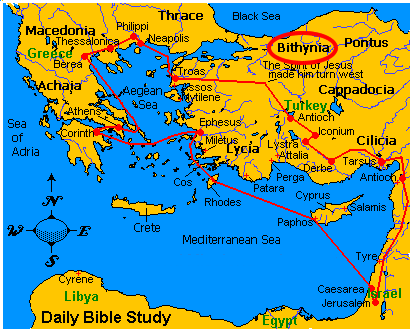
Actually, earthquakes were, and are, so common in the this region that
even if there were records of earthquakes that occurred some time between 27
and 33 CE in this area it would not be a surprise, but alas the closest
thing that we can find is this one reference by Phlegon of a supposed
earthquake that occurred in Bithynia.
The map below shows earthquakes over 4.0 on the Richter Scale recorded in
the Mediterranean region between 1964 and 1992. As you can see, earthquakes
are extremely common around Greece and Turkey, but not so common in the area
of Israel. Even if Phlegon's account has some basis in fact, he is only
talking about an earthquake in Bithynia, not Judea, and earthquakes in this
region are quite common.
source:
SEISMICITY OF THE MEDITERRANEAN AREA
As for the "eclipse", Phlegon's statements are physically impossible. A
solar eclipse can only last about seven minutes, not hours, and they are
only visible from specific areas, they can't be seen from multiple places in
the world when they occur, you have to be at the right place at the right
time. If a solar eclipse did take place at Bithynia, it wouldn't have been
visible in Judea. This could mean that what Phlegon recorded wasn't an
eclipse, but rather the supernatural power of God blacking out the sun, but
if this is the case then why does the only conformation of this come from
one person who is a known writer of tall tales, some time after the Gospels
have already been in circulation?
All in all, we have three major events that we should expect to be able
to confirm by the historical record: A blackout of the sun, an earthquake,
and mass raising of the dead. None of these things are confirmed by the
historical record, despite Christian apologists clearly making efforts to
search for sources of confirmation. As with the other Gospel claims that we
have discussed, there are clear scriptural sources for these claims, and the
most reasonable explanation for why these claims were made in the Gospels is
that the writers of the Gospels based their stories on the Hebrew
scriptures, not reality.
This is significant because it strengthens the challenge to the
historicity of all of the other passages in the Gospels that are based on
scriptures. Even in cases where events in the Gospels can be shown to have a
scriptural basis, some Christians claim that a scriptural basis does not
preclude an additional historic basis. Since many of the events in the
Gospels are historically unverifiable this is difficult to counter, but what
this demonstrates is that for each event in the Gospels that has both a
scriptural basis and is reasonably historically verifiable, the historical
evidence goes against the Gospels. Since every potentially verifiable story
element in the Gospels that is based on scriptures is not confirmed by the
historical evidence, a strong case is made that events in the Bible that
have a scriptural basis do not have a corresponding historical basis, thus
the burden of proof is on those proposing that such events are historical.
The earliest writings that we have (presumably) which actually mention
Jesus Christ come from someone called Paul. The only reliable information
that we really have about Paul comes from the letters in his name. Acts
of the Apostles also talks about Paul, but the reliability of Acts is dubious. The letters of Paul were
written by him to various other early "Christian" communities, though the
term Christian is not found in any of the works of Paul, nor indeed in any
of the books of the Bible except Acts and 1 Peter, both works that were
written later. Many different letters were falsely attributed to
Paul, which scholars over the past 500 years have attempted to weed out, though there
is still not 100% certainty about all of the letters. In addition to falsely
attributing letters to Paul, some editing of Paul's letters took place as
well, as happened with all of the works of the Bible. It is actually more
difficult to detect changes that were made to the letters of Paul than it is
to detect changes that were made to the Gospels because we have fewer
copies of the letters of Paul. Though the letters of Paul are estimated to
have been written around the middle of the 1st century, the earliest
knowledge of these letters that we have comes from the 2nd century, and
the earliest copies of these letters that we have comes from the 3rd and 4th centuries. In
addition, we do know that different copies of these letters were in
circulation. The Gnostic leader Marcion had copies of the letters of Paul
that he claimed were original and he wrote that his Catholic opponents had
inserted statements into their copies to make them comply with their
doctrine. Likewise, the Catholics charged that Marcion had deleted passages
from his copies. We also know that there were at least three different
copies of the letter to the Romans in circulation prior to the 4th century, a 14
chapter version, a 15 chapter version, and a 16 chapter version. A 16
chapter version is what we currently have in the Bible. There are also
differences between quoted passages by early Church fathers and what we have
now, as well as glaring omissions of quotes that we currently have in the
works of Paul that could have been used to establish doctrinal points by
early Church fathers. An excellent example of this is the passage from 1
Thessalonians 2, which states:
1 Thessalonians 2:
13 We also constantly give thanks to God for this, that when you
received the word of God that you heard from us, you accepted it not as
a human word but as what it really is, God’s word, which is also at work
in you believers. 14 For you, brothers, became imitators of the
churches of God in Christ Jesus that are in Judea, for you suffered the
same things from your own compatriots as they did from the Jews, 15 who
killed both the Lord Jesus and the prophets, and drove us out; they
displease God and oppose everyone 16 by hindering us from speaking to
the Gentiles so that they may be saved. Thus they have constantly been
filling up the measure of their sins; but God’s wrath has overtaken them
at last.
This passage is widely accepted by scholars as a later addition to the
Pauline text for the purpose of establishing a later doctrine, for several
reasons. One reason is that there is no evidence that these types of strong
divisions between Jews and non-Jews existed among the early Christians. Another is that this is the only statement to this effect in all of the
Pauline letters and it goes against many of his other statements about unity
between Jews and Gentiles. It also breaks the continuity of the
chapter, and if you take it out the chapter reads just fine without it. Yet
another reason is that there were no "churches" in Judea at this time. Lastly, the
statement that God's wrath has overtaken the Jews makes sense referring to the
destruction of Judea in 70 CE. There is no significant event that Paul could have been
referring to here when he wrote around 50 CE. There is also ample motive for
later Roman Church fathers to have inserted such a passage when they were
trying to establish these principles as a doctrine of the Church, which they
did do. What else is important about this passage is that it is one of the
passages in the letters of Paul that would seem to establish a historical
view of Jesus, however, as mentioned, this is regarded as a later addition.
This is important to understand for people who read the letters of Paul
uncritically, because some of the passages, such as this one, which seem to
put Jesus in a historical context, are actually later additions.
For more information on this see:
1 Thessalonians 2:13-16: A Deutero-Pauline Interpolation
All of this makes relying on the works of Paul to build a case or to
understand the early views of Jesus difficult, but not impossible. We do know one thing,
which is that any potential changes to the texts of Paul that have come down
to us today are most likely changes that would have been used to establish the
doctrines of Catholicism. It should also be noted that prior to their
inclusion in the Bible, the letters of Paul were not considered scripture or
divine, and thus modifications to them were not viewed as "changing
scripture". This is certainly something to keep in mind when dealing with
the works of Paul, but despite this, the letters of Paul are still critical
as the earliest writings about Jesus.
Between the works of Paul and the writing of the four canonical Gospels
several other Christian works were written. Neither the works of Paul nor
any of these other works give us details about the life of Jesus. Prior
to the Gospels there are various works that talk about Jesus in a variety of
ways, but none of them provide any details about a birth, life, ministry, or
death of Jesus.
The table below lists known early Christian works in the order that
they are most widely believed by Biblical scholars to have been written,
along with the dates that they are most widely believed to have been
originally written within, the order in which they actually appear in the
Bible, and who the most widely accepted authors of the books are. This information
comes from
http://www.earlychristianwritings.com/.
Keep in mind here the order in which these books are actually presented
in the Bible. The colors in the table correspond to how the books are
designated in the Bible.
- The Gospels
- The Acts of the Apostles
- The Epistles of Paul
- The General Epistles
- The Book of Revelation
| Date Written |
Order in Bible |
Book Name |
Description |
| 50-60 |
13 |
1 Thessalonians |
Authentic letter of Paul, written to congregation in
Thessalonica, Greece |
| 50-60 |
11 |
Philippians |
Authentic letter of Paul, written to congregation in Philippi,
Greece |
| 50-60 |
9 |
Galatians |
Authentic letter of Paul, written to congregation in Galatia, in
modern Turkey |
| 50-60 |
7 |
1 Corinthians |
Authentic letter of Paul, written to congregation in Corinth,
Greece |
| 50-60 |
8 |
2 Corinthians |
Authentic letter of Paul, written to congregation in Corinth,
Greece |
| 50-60 |
6 |
Romans |
Authentic letter of Paul, written to congregation in Rome |
| 50-60 |
18 |
Philemon |
Generally accepted as authentic letter of Paul written to
Philemon of Colossae |
| 50-80 |
12 |
Colossians |
Disputed letter of Paul, written to congregation in Colossae, in
modern Turkey |
| 50-95 |
19 |
Book of Hebrews |
Anonymous work of a Jewish nature that refers to Christ as an
apostle and high priest |
| 50-120 |
NA |
Didache |
Anonymous work that is almost impossible to date. Contains
sayings like those in the Gospels, but not attributed to Jesus. Has
description of Eucharist rituals, but not associated with the death
or body of Jesus. |
| 50-140 |
NA |
Gospel of Thomas |
Anonymous "Gnostic" sayings gospel with statements attributed to
Jesus. No mention of Christ, and most sayings contradict the
canonical Gospels, though a small number are shared by both. There
is no narrative or details of a life of Jesus. |
| 50-140 |
NA |
Oxyrhynchus Gospel |
Scraps of a sayings gospel (possibly Gnostic), mentions Jesus approaching "in a
vision" |
| 50-200 |
NA |
Sophia of Jesus Christ |
Anonymous Gnostic story about Jesus, possibly written after "the
Gospels", but dating is difficult |
| 65-80 |
2 |
Gospel of Mark |
Anonymous narrative story about the life of Jesus starting with
his baptism |
| 70-100 |
20 |
Epistle of James |
Letter of disputed authorship. Traditionally attributed to
"James the brother of Jesus", though the work itself makes no such
claim. |
| 70-120 |
NA |
Egerton Gospel |
Anonymous scrap of a narrative Gospel. One of the oldest
original pieces of text about Jesus. |
| 70-160 |
NA |
Gospel of Peter |
Anonymous "Gnostic" passion narrative similar to that in the
Gospel of Mark |
| 80-100 |
14 |
2 Thessalonians |
Regarded as a letter of unknown authorship that was written in Paul's name |
| 80-100 |
10 |
Ephesians |
Regarded as a letter of unknown authorship that was written in Paul's name |
| 80-100 |
1 |
Gospel of Matthew |
Anonymous narrative about Jesus based on Mark, but with the
addition of the virgin birth story and other elements |
| 80-110 |
21 |
1 Peter |
Regarded as a letter of unknown authorship that was written in Peter's name |
| 80-120 |
NA |
Epistle of Barnabas |
Letter about the sacrifice of Jesus. Refers to Jesus as "the
calf" who is sacrificed for sins |
| 80-130 |
3 |
Gospel of Luke |
Was perhaps signed at one time, but original signer
in unknown. The work is written in the form of a researched
historical account for someone named Theophilus. Luke is based on
Mark with additional elements. |
| 80-130 |
5 |
Acts of the Apostles |
Written by the same author as the Gospel of Luke, also as a
history for Theophilus. The work covers the period from the
resurrection of Jesus to the imprisonment of Paul. |
| 80-140 |
NA |
1 Clement |
Letter regarding problems befalling Christian communities. |
| 80-150 |
NA |
Gospel of the Egyptians |
Writing about "Salome", a woman in the Gospel of Mark. It states
that the end of suffering will only come when all women stop giving
birth, then the end of the world will come. |
| 80-150 |
NA |
Gospel of the Hebrews |
A story that may have been originally written in Hebrew or
Aramaic about "James the Just" |
| 80-250 |
NA |
Christian Sibyllines |
Book of Gnostic prophecies about the future |
| 90-95 |
27 |
Apocalypse of John |
Letter written by an unknown John, though traditionally ascribed
to "John the disciple of Jesus". The work is metaphorical tale of coming destruction
in the tradition of Jewish apocalyptic literature. |
| 90-120 |
4 |
Gospel of John |
Anonymous narrative story about Jesus, which has traditionally
been ascribed to "John the disciple of Jesus". Scholars agree that
this is not the case and that the author of this Gospel is also not
the same as the author of Apocalypse of John or the epistles of John.
May have been written in two stages. |
| 90-120 |
23 |
1 John |
Letter by someone named John warning against deceivers who say
that Jesus was not real |
| 90-120 |
24 |
2 John |
Letter by someone named John warning against deceivers who say
that Jesus was not real |
| 90-120 |
25 |
3 John |
Letter by someone named John emphasizing that their witness is
true |
| 90-120 |
26 |
Epistle of Jude |
Letter which claims to have been written by a Jude, brother of
James, but is generally considered by scholars to be of unknown
authorship. The
letter is a polemic against "godless men" who don't believe in
Jesus, and it also begins to outline the concept of the trinity. |
| 100-150 |
15 |
1 Timothy |
Regarded as a letter of unknown authorship that was written in Paul's name,
which seeks to support elements of Catholic doctrine |
| 100-150 |
16 |
2 Timothy |
Regarded as a letter of unknown authorship that was written in Paul's name,
which seeks to support elements of Catholic doctrine |
| 100-150 |
17 |
Titus |
Regarded as a letter of unknown authorship that was written in Paul's name,
which seeks to support elements of Catholic doctrine |
| 100-150 |
NA |
Apocalypse of Peter |
A work attributed to Peter by Clement, though only fragments
remain. Talks about the coming end of the world. |
| 100-150 |
NA |
Secret Book of James |
A letter claimed to have been written by James which talks about
Jesus and salvation |
| 100-160 |
NA |
Gospel of the Ebionites |
A work that attempted to harmonize the Gospels of Matthew and
Luke |
| 100-160 |
NA |
Gospel of the Nazoreans |
A work that quotes many passages from Matthew, but it also has
several variants that are different from the current Matthew |
| 100-160 |
22 |
2 Peter |
A letter written under the name of Simon Peter, but regarded by
scholars as of unknown authorship. The letter is a polemic against false
prophets and seeks to downplay expectations for the end of the
world, addressing questions that were rising about why the world had
not yet ended "as Jesus had promised" |
What we will discuss here are the books that were written prior to the
writing of the Gospel of Mark or shortly after, when many people had still not been
exposed to the Gospels.
Paul discussed several topics in his letters. Paul talked about the
persecution of those people who believed in Jesus Christ, he talked about how
to be "in Christ" by loving one another, he discussed issues of
circumcision and other practices that were different between Jews and "Gentiles", he discussed the hope for the coming of Christ to establish a new
kingdom, and he discussed a crucifixion of Christ.
What he did not discuss, however, are any details of the life of Jesus,
who killed Jesus, any details of his death beyond the claim that he was
crucified (not even indicating where or when), the teachings of Jesus, or
any events that are mentioned in the Gospels other than the crucifixion, and
he does not mention anything about an empty tomb, a virgin birth, the names
of his parents, or where he was supposedly from.
It's not just that Paul didn't have details about the life of Jesus, many
of the books in the New Testament contain no hint of information about a
historical Jesus. Indeed it is really only the Gospels and a few of the
later written books, such as 1 & 2 Timothy, and 2 Peter, etc., that clearly
describe a historical figure. Everything that comes before the Gospels, and
even some books that many scholars place shortly after the first Gospels,
don't talk about the Jesus of the Gospels at all, they just mention the name
"Jesus Christ", with no historical details, no context, no teachings,
nothing that really relates back to the Gospels, aside from the name, "Jesus
Christ". This is the case for the Pauline letters, the Book
of
Hebrews, the Epistle of James, 1 Peter, 1, 2, & 3 John, and the
Apocalypse of John
(Revelation).
When these sources do mention things that seem to relate to the Gospel
stories, they invariably contradict the Gospels. For example, 1 Peter
discusses the death of Christ, but does so in a way that is incompatible
with the Gospels.
1 Peter 3:
18 For Christ also died for sins once for all, the righteous for the
unrighteous, in order to bring us to God. He was put to death in the
flesh, but made alive in the spirit, 19 in which also he went
and made a proclamation to the spirits in prison, 20 who in former times
did not obey, when God waited patiently in the days of Noah, during the
building of the ark, in which a few, that is, eight people,
were saved through water. 21 And baptism, which this prefigured, now
saves you—not as a removal of dirt from the body, but as an appeal to
God for a good conscience, through the resurrection of Jesus Christ, 22
who has gone into heaven and is at the right hand of God, with angels,
authorities, and powers made subject to him.
The Gospels take a very strong position in making it clear that Jesus'
resurrection was "in the flesh", not "in the spirit".
After his resurrection Jesus is
depicted as walking around, touching people, having dinner, etc., in the
Gospels, which supports a major doctrine for Christians: that they are to expect
to be bodily resurrected. This passage flies in the face of
such a doctrine and clearly contradicts the Gospel accounts. It would be
inconceivable that someone would teach that Jesus were "made alive in the
spirit" if he had actually been witnessed to have come back to life "in the
flesh". Examples like this abound in the early epistles.
By the 1st century there were an abundance of religions in the
Greco-Roman world known as "mystery religions". There were hundreds of these
different mystery religions, which were like cults that worshiped specific
heroes or gods, such as Adonis, Dionysus, Mithras, and Osiris. Many of these
gods were savior type gods, who were said to take on various problems of
individuals or the world, and people were initiated into these religions
often through secret ceremonies, that included various rituals, such as
sacrifices, special meals, anointing, washings, etc.
We don't know a whole lot about these mystery religions, both because
most of them did not have written doctrines and their views were kept
somewhat secret, and also because what little original information there was
about them was not preserved or was destroyed by Christians once they
came to power, but we do know a little bit about them from some comments
made about them by early Christians. Both Justin Martyr and Tertullian made
comments that compare the Christian rites to the "mysteries" of other
religions.
And this food is called among us Eucharistia, of which no one is
allowed to partake but the man who believes that the things which we
teach are true, and who has been washed with the washing that is for the
remission of sins, and unto regeneration, and who is so living as Christ
has enjoined. For not as common bread and common drink do we receive
these; but in like manner as Jesus Christ our Saviour, having been made
flesh by the Word of God, had both flesh and blood for our salvation, so
likewise have we been taught that the food which is blessed by the
prayer of His word, and from which our blood and flesh by transmutation
are nourished, is the flesh and blood of that Jesus who was made flesh.
For the apostles, in the memoirs composed by them, have thus delivered
unto us what was enjoined upon them; that Jesus took bread, and when He
had given thanks, said, "This do ye in remembrance of Me, this is My
body"; and that, after the same manner, having taken the cup and given
thanks, He said, "This is My blood"; and gave it to them alone.
Which the wicked devils have imitated in the mysteries of Mithras,
commanding the same thing to be done. For, that bread and a cup of water
are placed with certain incantations in the mystic rites of one who is
being initiated, you either know or can learn.
- First Apology; Justin Martyr, 150 CE
Here Justin Martyr states that "wicked devils" have "imitated" these
mysteries in the Mithric religions because these rituals existed before the
Christian religion, so the claim was that Satan had "imitated" these
mysteries in advance of Jesus. Hopefully you can see the problem with this
logic, but, at any rate, it does tell us that the rituals of Christianity are
similar to the rituals of Mithraism.
Tertullian also commented on this subject:
Chapter XL.-No Difference in the Spirit of Idolatry and of Heresy. In
the Rites of Idolatry, Satan Imitated and Distorted the Divine
Institutions of the Older Scriptures. The Christian Scriptures Corrupted
by Him in the Perversions of the Various Heretics.
The question will arise, By whom is to be interpreted the sense of
the passages which make for heresies? By the devil, of course, to whom
pertain those wiles which pervert the truth, and who, by the mystic
rites of his idols, vies even with the essential portions of the
sacraments of God. He, too, baptizes some that is, his own
believers and faithful followers; he promises the putting away of sins
by a layer (of his own); and if my memory still serves me, Mithra there,
(in the kingdom of Satan) sets his marks on the foreheads of his
soldiers; celebrates also the oblation of bread, and introduces an image
of a resurrection, and before a sword wreathes a crown. What
also must we say to (Satan's) limiting his chief priest to a single
marriage? He, too, has his virgins; he, too, has his proficients in
continence. Suppose now we revolve in our minds the superstitions of
Numa Pompilius [legendary king of Rome, 8th-7th century BCE], and
consider his priestly offices and badges and privileges, his sacrificial
services, too, and the instruments and vessels of the sacrifices
themselves, and the curious rites of his expiations and vows: is it not
clear to us that the devil imitated the well-known moroseness of the
Jewish law? Since, therefore he has sown such emulation in his great aim
of expressing, in the concerns of his idolatry, those very things of
which consists the administration of Christ's sacraments, it follows, of
course, that the same being, possessing still the same genius, both set
his heart upon, and succeeded in, adapting to his profane and rival
creed the very documents of divine things and of the Christian saints.
- The Prescription Against Heretics;
Tertullian
He made the argument again in another work:
"Well, but the nations, who are strangers to all
understanding of spiritual powers, ascribe to their idols the imbuing of
waters with the self-same efficacy." (So they do) but they
cheat themselves with waters which are widowed. For washing is
the channel through which they are initiated into some sacred rites of
some notorious Isis or Mithras. The gods themselves likewise they honor
by washings. Moreover, by carrying water around, and sprinkling it, they
everywhere expiate country-seats, houses, temples, and whole cities: at
all events, at the Apollinarian and Eleusinian games they are baptized;
and they presume that the effect of their doing that is their
regeneration and the remission of the penalties due to their perjuries.
Among the ancients, again, whoever had defiled himself with murder, was
wont to go in quest of purifying waters. Therefore, if the mere nature
of water, in that it is the appropriate material for washing away, leads
men to flatter themselves with a belief in omens of purification, how
much more truly will waters render that service through the authority of
God, by whom all their nature has been constituted! If men think that
water is endued with a medicinal virtue by religion, what religion is
more effectual than that of the living God? Which fact being
acknowledged, we recognize here also the zeal of the devil rivaling the
things of God, while we find him, too, practicing baptism in his
subjects.
- On Baptism; Tertullian
So we know from this that many of the practices, such as baptism and
sacred meals, that were a part of the teachings of Paul were already in use
among the mystery religions in the Greco-Roman world. We also see that the
mysteries of Mithras "introduces an image of a resurrection". This
is important to understand when reading the works of Paul. Is it the case
that Paul's gospel and the early teachings about "Christ Jesus" were a
Jewish form of this same type of mystery religion? Let's look at the
writings of Paul to get an idea.
Romans 11:
5 So that you may not claim to be wiser than you are, brothers,
I want you to understand this mystery: a hardening has come upon part of
Israel, until the full number of the Gentiles has come in. 26 And so
all Israel will be saved; as it is written:
‘Out of Zion will come the Deliverer; he will banish ungodliness from
Jacob.’
27‘And this is my covenant with them, when I take away their sins.’
28 As regards the gospel they are enemies for your sake; but as
regards election they are beloved, for the sake of their ancestors;
29 for the gifts and the calling of God are irrevocable.
Here Paul seems to be talking about the coming of a future "Deliverer",
but he makes no mention at all of Jesus here. If Jesus had just been here
then why is Paul talking about old scriptures instead of Jesus Christ, who
had just been here?
This is similar to something that is also said in Philippians.
Philippians 3:
12 Not that I have already obtained this or have already been made
perfect; but I press on to make it my own, because Christ Jesus has made
me his own. 13 Brothers, I do not consider that I have made it my own;
but this one thing I do: forgetting what lies behind and straining
forward to what lies ahead, 14 I press on towards the goal for
the prize of the heavenly call of God in Christ Jesus. 15 Let
those of us then who are mature be of the same mind; and if you think
differently about anything, this too God will reveal to you. 16 Only let
us hold fast to what we have attained.
17 Brothers, join in imitating me, and observe those who live
according to the example you have in us. 18 For many live as enemies of
the cross of Christ; I have often told you of them, and now I tell you
even with tears. 19 Their end is destruction; their god is the belly;
and their glory is in their shame; their minds are set on earthly
things. 20 But our commonwealth is in heaven, and it is from
there that we are expecting a Saviour, the Lord Jesus Christ.
21 He will transform our humble bodies so that it may be conformed to
his glorious body, by the power that also enables him to make all things
subject to himself.
Here Paul says that they are expecting a Savior from heaven,
which is Jesus. He doesn't say that they are expecting him to come back, or
anything like that, but that they are expecting a Savior from heaven.
Back to Romans and the talk of mysteries:
Romans 16:
25 Now to the one who is able to strengthen you according to my gospel
and the proclamation of Jesus Christ, according to the
revelation of the mystery that was kept secret for long ages 26 but is
now disclosed, and through the prophetic writings is made known to all
the Gentiles, according to the command of the eternal God, to
bring about the obedience of faith— 27 to the only wise God, through
Jesus Christ, be the glory for ever! Amen.
This sounds like a very odd thing to say if one is talking about a Jesus
Christ that had just recently been on earth and proclaimed his message from
his own mouth, witnessed by thousands of people. Paul is saying that ancient
mysteries are being revealed and made known through prophetic writings, but
why wouldn't he be saying that these things were made known by Jesus
himself?
Romans 10, from prior to this passage, also highlights this problem.
Romans 10:
1 Brothers, my heart’s desire and prayer to God for them [the
Israelites] is that they may be saved. 2 I can testify that they have a
zeal for God, but it is not enlightened. 3 For, being ignorant of the
righteousness that comes from God, and seeking to establish their own,
they have not submitted to God’s righteousness. 4 For Christ is the end
of the law so that there may be righteousness for everyone who believes.
... 12 For there is no distinction between Jew and Greek; the same
Lord is Lord of all and is generous to all who call on him. 13 For,
‘Everyone who calls on the name of the Lord shall be saved.’
14 But how are they to call on one in whom they have not believed?
And how are they to believe in one of whom they have never
heard? And how are they to hear without someone to proclaim him?
15 And how are they to proclaim him unless they are sent? As it is
written, ‘How beautiful are the feet of those who bring good news!’ 16
But not all have obeyed the good news; for Isaiah says, ‘Lord, who has
believed our message?’ 17 So faith comes from what is heard, and
what is heard comes through the word about Christ.
The question with this passage is, if Jesus had just been on earth and
been ministering to the Jews and performing miracles in Galilee and Judea
and drawing large crowds, as the Gospels claim, then why does Paul ask here
if Jews cannot be blamed for not believing in Christ because they haven't
heard about him? Paul then says that faith comes from what is heard, and
what is heard is the word "about Christ". (Some translations also
read "of God") All of these things don't make sense if Jesus had
just been here on earth proclaiming his own message and demonstrating his
own miracles. This passage is followed by a passage where Paul asks again
"have they not heard", to which he rhetorically replies,
"indeed they have", followed by a passage from the Old Testament that
says, "Their voice has gone out to all the earth", meaning the
message of Christ through the messengers. Nowhere in this address, where it
would make perfect sense to state that Jesus had made himself known to the
Israelites, does Paul say anything about Jesus, he just quotes old
scriptures and talks about messengers of Christ.
1 Corinthians 2:
1 When I came to you, brothers, I did not come proclaiming the
mystery of God to you in lofty words or wisdom. 2 For I decided to know
nothing among you except Jesus Christ, and him crucified. 3 And
I came to you in weakness and in fear and in much trembling. 4 My speech
and my proclamation were not with plausible words of wisdom, but with a
demonstration of the Spirit and of power, 5 so that your faith might
rest not on human wisdom but on the power of God.
Here Paul is calling Jesus Christ, "and him crucified," a
mystery of God.
1 Corinthians 15:
50 What I am saying, brothers, is this: flesh and blood cannot inherit
the kingdom of God, nor does the perishable inherit the imperishable. 51
Listen, I will tell you a mystery! We will not all die, but we
will all be changed, 52 in a moment, in the twinkling of an eye, at the
last trumpet. For the trumpet will sound, and the dead will be
raised imperishable, and we will be changed. 53 For this perishable body
must put on imperishability, and this mortal body must put on
immortality. 54 When this perishable body puts on imperishability, and
this mortal body puts on immortality, then the saying that is written
will be fulfilled:
‘Death has been swallowed up in victory.’
55‘Where, O death, is your victory?
Where, O death, is your sting?’
56The sting of death is sin, and the power of sin is the law.
Here Paul claims that he is telling these people a "mystery", but why
would this be a mystery if Jesus Christ had just been on earth a few years
earlier to bring this very message to people, a message that he supposedly
proclaimed several times according to the Gospels, and which he demonstrated
by raising Lazarus, and then himself, from the dead himself? Beyond that, why
would Paul then refer to scripture as support for eternal life instead of
referring to Jesus himself?
Ephesians 3:
1 This is the reason that I Paul am a prisoner of Christ Jesus for the
sake of you Gentiles— 2 for surely you have already heard of the
commission of God’s grace that was given to me for you, 3 and how
the mystery was made known to me by revelation, as I wrote above
in a few words, 4 a reading of which will enable you to perceive my
understanding of the mystery of Christ. 5 In former generations this
mystery was not made known to humankind, as it has now been revealed to
his holy apostles and prophets by the Spirit: 6 that is, the
Gentiles have become fellow-heirs, members of the same body, and sharers
in the promise in Christ Jesus through the gospel.
There is uncertainly as to whether or not Ephesians is an authentic
letter from Paul, but regardless, how could a statement such as this be made
if Jesus Christ had just been here on earth? This states that Christ is
a mystery, and that the mystery of Christ has, "been revealed to his
holy apostles and prophets by the Spirit." It would not be said
that Jesus was revealed to his apostles by the Spirit if he had just
recently been on earth as a walking, talking, human being.
Colossians 1:
24 I am now rejoicing in my sufferings for your sake, and in my
flesh I am completing what is lacking in Christ’s afflictions for the
sake of his body, that is, the church. 25 I became its servant
according to God’s commission that was given to me for you, to
make the word of God fully known, 26 the mystery that has been hidden
throughout the ages and generations but has now been revealed to his
saints. 27 To them God chose to make known how great among the Gentiles
are the riches of the glory of this mystery, which is Christ in you, the
hope of glory. 28 It is he whom we proclaim, warning everyone
and teaching everyone in all wisdom, so that we may present everyone
mature in Christ.
Colossians is another work that may not be an authentic letter of Paul,
but here we are told that the "body of Christ" is "the church"!
We are told that God has chosen Paul to make his "mystery" known, which is
"Christ in you". The church is also called the body of
Christ in Ephesians as well.
Ephesians 4:
7 But each of us was given grace according to the measure of Christ’s
gift. 8 Therefore it is said,
‘When he ascended on high he made captivity itself a captive; he gave
gifts to his people.’
9 (When it says, ‘He ascended’, what does it mean but that he had also
descended first into the depths of the earth? 10 He who descended is the
same one who ascended far above all the heavens, so that he might fill
all things.) 11 The gifts he gave were that some would be
apostles, some prophets, some evangelists, some pastors and teachers, 12
to equip the saints for the work of ministry, for building up
the body of Christ, 13 until all of us come to the unity of the faith
and of the knowledge of the Son of God, to maturity, to the measure of
the full stature of Christ. 14 We must no longer be children,
tossed to and fro and blown about by every wind of doctrine, by people’s
trickery, by their craftiness in deceitful scheming. 15 But
speaking the truth in love, we must grow up in every way into him who is
the head, into Christ, 16 from whom the whole body, joined and knitted
together by every ligament with which it is equipped, as each part is
working properly, promotes the body’s growth in building itself up in
love.
Here we see several things. For one thing this passage quotes the Old
Testament scriptures (Psalm 68:18) in order to describe Christ, something
quite odd if Jesus had just been here. In interpreting the scriptures that
talk about ascension it says that he had to have descended first, but where
did he descend to? "The depths of the earth," in other words Hades,
the underworld, what we now call Hell. This is all metaphorical and mythical
talk based on scriptures, by why go into this if Jesus had just been
incarnated "in the flesh" on earth, walking around some 15-20 years ago? If
Jesus were just on earth walking and talking to people, why talk about
descending into the underworld here? It's not just that this talks about
Christ descending into the underworld, but nowhere in the letter does it
ever say anything about an earthly ministry of Jesus. If this were something
that were said in addition to a discussion of his earthly activity and his
teachings that would be one thing, but all of these letters just quote from
scripture and talk about Jesus in metaphorical ways like this.
The passage goes on to talk about the community as the "body
of Christ". Paul described the community or the church as the body
of Christ in almost all of his letters.
All of this mystery talk (and there is more of it in the various epistles
of the New Testament) is not only similar to what we believe was preached in
the other mystery religions, but much of it also precludes a prior earthy
ministry of Jesus!
Paul specifically tells us that his knowledge of Jesus Christ has not
come from any human, but has come to him directly by "revelation" from Jesus
Christ himself.
Galatians 1:
11 I want you to know, brothers, that the gospel I preached is not
something that man made up. 12 I did not receive it from any man, nor
was I taught it; rather, I received it by revelation
from Jesus Christ.
If Jesus Christ had just been on earth some 15 to 25 years prior to the
writing of this letter by Paul (presumably to present his message), then why
is it that the first person to write about the gospel (good news) of Jesus
Christ is someone who never witnessed his existence and who neither received
his message from him while he was on earth, nor received it from of any of
his supposed followers? Furthermore, if Jesus had just been here then why
would Paul be so adamant about saying that he received his gospel from
revelation? If Jesus were just here then the gospel from the mouth of Jesus
should have been seen as the most legitimate and authoritative, yet Paul
presents his message as more authoritative because it hasn't come from
anyone else. How could Paul's message from "revelation" compete with Peter's
message straight from the mouth of Jesus?
Of course, the whole idea that Jesus had come to earth and spread his
message is not presented until the Gospels are written, some 10 to 60 years
after the evangelism of Paul.
Critically, Paul also never used the term "disciple", he
referred to Peter and others as "apostles". This is actually very important.
Disciples are students, who we can expect would have been in personal
contact with their teacher. Apostles, on the other hand, are missionaries.
Galatians 2:
6 And from those who were supposed to be acknowledged leaders (what they
actually were makes no difference to me; God shows no partiality)—those
leaders contributed nothing to me. 7 On the contrary, when they
saw that I had been entrusted with the gospel for the uncircumcised,
just as Peter had been entrusted with the gospel for the circumcised
8(for he who worked through Peter making him an apostle to the
circumcised also worked through me in sending me to the Gentiles),
9 and when James and Cephas and John, who were acknowledged pillars,
recognized the grace that had been given to me, they gave to Barnabas
and me the right hand of fellowship, agreeing that we should go to the
Gentiles and they to the circumcised. 10 They asked only one thing, that
we remember the poor, which was actually what I was eager to do.
11 But when Cephas came to Antioch, I opposed him to his face,
because he stood self-condemned; 12 for until certain people came from
James, he used to eat with the Gentiles. But after they came, he drew
back and kept himself separate for fear of the circumcision faction. 13
And the other Jews joined him in this hypocrisy, so that even Barnabas
was led astray by their hypocrisy. 14 But when I saw that they were not
acting consistently with the truth of the gospel, I said to Cephas
before them all, ‘If you, though a Jew, live like a Gentile and not like
a Jew, how can you compel the Gentiles to live like Jews?’
This is one example of where Paul calls Peter an apostle and he says that
both he and Peter were called in the same manner. In all of his discussions
of the apostles Paul gives no indication that these people have literally
walked hand-in-hand with Jesus and seen his miracles first hand. Paul treats
these people as just another group of evangelicals like himself. It is only
with the Gospels that Peter and the others are called "disciples", meaning
people who were literally taught by Jesus; Paul never identified them as
such.
For more information see:
Disciples and Apostles in the New Testament
One view among scholars who do not believe that Jesus Christ existed is
that Paul and other early Christians viewed Jesus Christ as a real, but
heavenly, spiritual being whose crucifixion took place in a heavenly realm
physically located above the earth. Another view is that early Christians
viewed Jesus similarly to the way that Greeks viewed their heroes, as beings
who lived in some unspecified past. Others, such as some of the Gnostics,
viewed Jesus as a phantom, an idea, or even metaphorically.
Earl Doherty puts forward the view that at least Paul, and perhaps other
early Christians, saw Jesus Christ as a heavenly entity, whose crucifixion
was carried out in a spiritual place in the heavens above the earth.
The idea of multiple levels of heaven, in which various beings existed
and interacted with the world below, was indeed a part of the worldview at
the time in which Christianity came into existence, and is a part of many
apocalyptic Jewish stories that preceded Christianity as we shall later
discuss. Paul also talked about his own supposed trip up to "the third heaven".
2 Corinthians 12:
1 I must go on boasting. Although there is nothing to be gained, I will
go on to visions and revelations from the Lord. 2 I know a man
in Christ who fourteen years ago was caught up to the third heaven.
Whether it was in the body or out of the body I do not know—God knows. 3
And I know that this man—whether in the body or apart from the body I do
not know, but God knows— 4 was caught up to paradise. He heard
inexpressible things, things that man is not permitted to tell.
We can see here that Paul believed in the real levels of heaven, which
were believed to be in the air above the earth. It's also interesting that
happened 14 years prior, as this letter was probably
written around 52-56 CE, meaning that this would have supposedly taken place 38 or 40 CE, some 5 to 7 years after Jesus had supposedly just
been on earth. It seems quite strange that Paul would bother with a story
like this if Jesus had just been observed being bodily resurrected and
ascending to heaven just a few years prior. Nevertheless, this demonstrates
Paul's view of the levels of heaven and the reality of activities taking
place in these levels. It's also important to note here that Paul is
discussing of "visions and revelations", which seems to be what Paul is
talking about when he describes himself or others "seeing Jesus".
The main aspect of Paul's teachings which people identify with the Jesus
Christ of the Gospels is the crucifixion, so let's take a look at Paul's
statements on the crucifixion of Jesus. The works in which Paul talks about
a crucifixion of Jesus are Galatians, 1 Corinthians, 2 Corinthians, and
Romans. Let's start with Galatians:
Galatians 2:
15 "We who are Jews by birth and not 'Gentile sinners' 16 know that a
man is not justified by observing the law, but by faith in Jesus Christ.
So we, too, have put our faith in Christ Jesus that we may be justified
by faith in Christ and not by observing the law, because by observing
the law no one will be justified.
17 "If, while we seek to be justified in Christ, it becomes evident
that we ourselves are sinners, does that mean that Christ promotes sin?
Absolutely not! 18 If I rebuild what I destroyed, I prove that I am a
lawbreaker. 19 For through the law I died to the law so that I might
live for God. 20 I have been crucified with Christ and I no
longer live, but Christ lives in me. The life I live in the
body, I live by faith in the Son of God, who loved me and gave himself
for me. 21 I do not set aside the grace of God, for if righteousness
could be gained through the law, Christ died for nothing!"
This mentions crucifixion, but it is obviously very metaphorical in
nature and can certainly not be said to be evidence that Paul was talking
about a historical crucifixion event. Galatians 3 goes on to say:
Galatians 3:
1 You foolish Galatians! Who has bewitched you? Before your very
eyes Jesus Christ was clearly portrayed as crucified.
2 I would like to learn just one thing from you: Did you receive the
Spirit by observing the law, or by believing what you heard?
3 Are you so foolish? After beginning with the Spirit, are you now
trying to attain your goal by human effort? 4 Have you suffered so much
for nothing—if it really was for nothing? 5 Does God give you his Spirit
and work miracles among you because you observe the law, or because you
believe what you heard?
This paragraph is a little confusing. At one moment it looks like Paul is
clearly saying that these are witnesses of the crucifixion of Jesus, but
then you see that he says "portrayed" as crucified. The whole issue is
settled, however, when we take into account where the Galatians are, which
is in Galatia, in what is now Turkey.
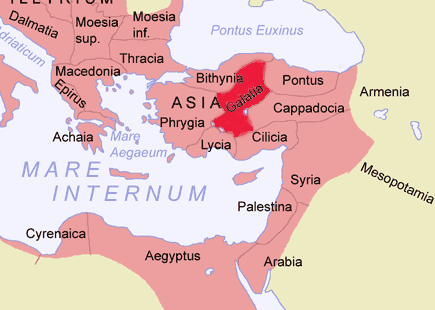
Obviously these people couldn't have been potential witnesses to a spur
of the moment crucifixion that took place in Jerusalem. This makes Paul's
comments on Jesus Christ being "portrayed" as crucified even more puzzling.
Paul is probably talking about something similar to what Tertullian
described regarding the use of images in Mithraic rituals. This certainly
indicates that Paul viewed the crucifixion of Christ somehow differently
than our understanding of the crucifixion as the event portrayed in the
Gospels. Paul also admonished the Galatians to "believe what you hear",
obviously not something that you have to tell people who are personal
witnesses to an event.
Paul goes on to discuss crucifixion a bit more. In Galatians 5 we read:
Galatians 5:
22 But the fruit of the Spirit is love, joy, peace, patience, kindness,
goodness, faithfulness, 23 gentleness and self-control. Against such
things there is no law. 24 Those who belong to Christ Jesus have
crucified the sinful nature with its passions and desires. 25
Since we live by the Spirit, let us keep in step with the Spirit. 26 Let
us not become conceited, provoking and envying each other.
Here again we see Paul talking about crucifixion in some metaphorical
sense, and, as usual, Paul makes no references to any words or teachings of
Jesus, he just offers his own pieces of advice and refers to "Christ Jesus"
in an abstract and metaphorical sense.
In Galatians 6 Paul mentions crucifixion one last time in the work, where
he states:
Galatians 6:
13 Not even those who are circumcised obey the law, yet they want you to
be circumcised that they may boast about your flesh. 14 May I
never boast except in the cross of our Lord Jesus Christ, through whom
the world has been crucified to me, and I to the world. 15
Neither circumcision nor uncircumcision means anything; what counts is a
new creation. 16 Peace and mercy to all who follow this rule, even to
the Israel of God.
Again we get metaphor from Paul, and no indication of knowledge of a
literal, historical, crucifixion of Jesus.
We can now move on to the book of Romans, where Paul mentions the
crucifixion of Jesus one time in Romans 6:
Romans 6:
1 What shall we say, then? Shall we go on sinning so that grace may
increase? 2 By no means! We died to sin; how can we live in it any
longer? 3 Or don't you know that all of us who were baptized into Christ
Jesus were baptized into his death? 4 We were therefore buried with him
through baptism into death in order that, just as Christ was raised from
the dead through the glory of the Father, we too may live a new life.
5 If we have been united with him like this in his death, we will
certainly also be united with him in his resurrection. 6 For we know
that our old self was crucified with him so that the body of sin might
be done away with, that we should no longer be slaves to sin— 7 because
anyone who has died has been freed from sin.
8 Now if we died with Christ, we believe that we will also live with
him. 9 For we know that since Christ was raised from the dead, he cannot
die again; death no longer has mastery over him. 10 The death he died,
he died to sin once for all; but the life he lives, he lives to God.
This passage certainly seems a little more concrete than the ones from
Galatians, and perhaps it does imply an earthly crucifixion, but still no
historical information is provided and there is still a good bit of metaphor
in use. There is also good reason to believe that this is talking about a
spiritual burial and raising of the dead, which we will discuss. Let's go
ahead and first look at the discussions of the crucifixion in 1 Corinthians.
1 Corinthians 1:
20 Where is the wise man? Where is the scholar? Where is the philosopher
of this age? Has not God made foolish the wisdom of the world? 21 For
since in the wisdom of God the world through its wisdom did not know
him, God was pleased through the foolishness of what was preached to
save those who believe. 22 Jews demand miraculous signs
and Greeks look for wisdom, 23 but we preach Christ crucified: a
stumbling block to Jews and foolishness to Gentiles, 24 but to those
whom God has called, both Jews and Greeks, Christ the power of God and
the wisdom of God. 25 For the foolishness of God is wiser than
man's wisdom, and the weakness of God is stronger than man's strength.
Here we have more metaphorical talk and nothing of any detail. It is also
peculiar to claim that "Jews demand miraculous signs,"
"but we preach Christ
crucified." According to the Gospels Jesus had just been among the Jews not
too long ago presenting them with miraculous signs, and the Jews had just
personally crucified Jesus, so this message of Paul seems a bit confusing if
one assumes that the Gospel accounts are historical. Let's skip ahead now to
2 Corinthians 13, and we will return to another passage from 1 Corinthians.
2 Corinthians 13:
2 I already gave you a warning when I was with you the second time. I
now repeat it while absent: On my return I will not spare those who
sinned earlier or any of the others, 3 since you are demanding proof
that Christ is speaking through me. He is not weak in dealing with you,
but is powerful among you. 4 For to be sure, he was crucified in
weakness, yet he lives by God's power. Likewise, we are weak in
him, yet by God's power we will live with him to serve you.
5 Examine yourselves to see whether you are in the faith; test
yourselves. Do you not realize that Christ Jesus is in you—unless, of
course, you fail the test?
This again is another passage that is heavy on metaphor and light on
substance. There isn't anything in this passage that compels us to believe
that Paul is talking about a real crucifixion that took place no earth.
There is one more passage that discusses the crucifixion of Jesus, however,
and that comes from 1 Corinthians 2:
1 Corinthians 2:
6 We do, however, speak a message of wisdom among the mature, but not
the wisdom of this age or of the rulers of this age, who are coming to
nothing. 7 No, we speak of God's secret wisdom, a wisdom that has been
hidden and that God destined for our glory before time began. 8
None of the rulers of this age understood it, for if they had, they
would not have crucified the Lord of glory. 9 However, as it is
written:
"No eye has seen, no ear has heard, no mind has conceived what God has
prepared for those who love him" — 10 but God has revealed it to us by
his Spirit.
The Spirit searches all things, even the deep things of God. 11 For who
among men knows the thoughts of a man except the man's spirit within
him?
This is the passage that is pointed to by those who claim that Paul did
consider Jesus in a recent historical context and that he described him as a
person who had recently been on earth and been executed, but there is more
to this passage than first meets the eye, and secondly, this passage still
gives us no details about Jesus' crucifixion; for example it does not
mention Pilate, the Romans, or even the Jews, just "the rulers". And who are
these rulers? The word in Greek that is originally used here is "archons",
which simply means "powers", "authorities", "rulers",
"princes", etc., but based on the
context it can either imply "earthly rulers" or "heavenly rulers". Indeed,
archons is used elsewhere in the Pauline letters to mean heavenly
rulers. We also know that the word was used in the "Old Testament" to mean
both earthly and heavenly rulers. Kittel's Unabridged Theological
Dictionary of the New Testament, an authoritative resource on the
meanings of words used in the New Testament, notes that archons is
used in the Greek version of the Hebrew scriptures, the Septuagint, in
relation to celestial powers whom the Messiah and his followers are in
conflict with. Certainly this is the best fit for Paul's usage of the word.
ἄρχων. [archon]:
In the LXX [Septuagint], too, the ἄρχων is one who exercises
authoritative influence; the term is used for the national, local or
tribal leader from Gn. to 2 Ch. In the historical books it is used for a
general, though sometimes we also read of the ἄρχοντες τῶν ἱερ�*ων (Neh.
12:7). In the later books it more often denotes officials of the
overlord of Palestine (ἄρχων τοῦ βασιλ�*ως, Da. 2:15).
In Da. Θ 10:13, 20f. cf. 12:1 (also Da. LXX: 10:13) it denotes
the celestial beings which guard and represent earthly states (popularly
identified with the corresponding peoples), and on the rank and power (→
ἀρχή) of which in the spirit world the position of these states depends.
The ἄρχων of Israel has the name of Michael. His victory (or that of the
One like a man) over the ἄρχοντες of the Persians and Greeks leads to
the dominion of the Jews over these peoples.
2 To a large extent the ἄρχοντες are opponents of the people of God who
are resisted by the One like a man (later the Messiah) and His allies,
and who will be defeated in the last days. In its conflict with earthly
enemies the people of God is really engaged with these celestial powers.
The same concept is found in Pesikt. Kah., 23 (150b–151a): שרי אמות
העולם ἄρχοντες ἐθνῶν τοῦ κόσμου, of Babylon, Greece etc. Cf. also M.
Ex., 15, 1 (36b, 6 f., Friedm.): In the future world God will call the
princes (שריהם) of the kingdoms to account before He calls the kingdoms
themselves.
- Kittel's Unabridged Theological Dictionary of the New Testament
Critically, we also know that several early Christians interpreted this
passage from Paul as meaning "heavenly rulers", not earthly rulers. The
significant Christian apologist Origen, writing in the 2nd century,
clearly understood the rulers, or princes, that Paul was talking about as
being heavenly rulers. Origen discussed this passage from Paul in his work
De Principiis, where he stated:
Accordingly, in the holy Scriptures we find that there are princes
over individual nations; as in Daniel we read that there was a prince of
the kingdom of Persia, and another prince of the kingdom of Græcia,
who are clearly shown, by the nature of the passage, to be not
human beings, but certain powers. In the prophecies of Ezekiel,
also, the prince of Tyre is unmistakably shown to be a kind of
spiritual power. When these, then, and others of the
same kind, possessing each his own wisdom, and building up his
own opinions and sentiments, beheld our Lord and Savior professing and
declaring that He had for this purpose come into the world, that all the
opinions of science, falsely so called, might be destroyed, not knowing
what was concealed within Him, they forthwith laid a snare for Him: for
"the kings of the earth set themselves, and the rulers assembled
together, against the Lord and His Christ." But their snares being
discovered, and the plans which they had attempted to carry out being
made manifest when they crucified the Lord of glory, therefore
the apostle says, "We speak wisdom among them that are perfect, but not
the wisdom of this world, nor of the princes of this world, who are
brought to naught, which none of the princes of this world knew: for had
they known it, they would not have crucified the Lord of glory."
- Origen;
De
Principiis
Here Origen clearly argues in the 2nd century that the "archons
of this world" are "not human beings", but are instead
"kind[s] of spiritual
power[s]".
But, we can also look at other passages in the Pauline corpus to see how
these terms are used in other situations.
Ephesians 3:
7 Of this gospel I have become a servant according to the gift of God’s
grace that was given to me by the working of his power. 8 Although I am
the very least of all the saints, this grace was given to me to bring to
the Gentiles the news of the boundless riches of Christ, 9 and to bring
to light what is the plan of the mystery hidden for ages by God who
created all things; 10 so that through the church the wisdom of
God in its rich variety might now be made known to the rulers and
authorities in the heavenly places. 11 This was in
accordance with the eternal purpose that he has carried out in Christ
Jesus our Lord, 12 in whom we have access to God in boldness and
confidence through faith in him.
It must be noted that the word for rulers that we have in the earliest
texts in this instance is not archons but another Greek word for
ruler, though this is not necessarily significant. A more problematic issue,
however, is that there is uncertainty as to whether Ephesians is an
authentic letter of Paul or a later pseudo-Pauline letter. Regardless, it
is in the Bible and attributed to Paul and it is still representative of
early Christian views about Jesus. There is another passage in Ephesians as
well, however, where archon is used, and this passage makes a
heavenly view of the rulers and Jesus quite clear:
Ephesians 2:
1 As for you, you were dead in your transgressions and sins, 2 in which
you used to live when you followed the ways of this world and of
the ruler [archon] of the kingdom of the air, the spirit who is
now at work in those who are disobedient. 3 All of us also
lived among them at one time, gratifying the cravings of our sinful
nature and following its desires and thoughts. Like the rest, we were by
nature objects of wrath. 4 But because of his great love for us, God,
who is rich in mercy, 5 made us alive with Christ even when we were dead
in transgressions—it is by grace you have been saved. 6 And God
raised us up with Christ and seated us with him in the heavenly realms
in Christ Jesus, 7 in order that in the coming ages he might show the
incomparable riches of his grace, expressed in his kindness to us in
Christ Jesus. 8 For it is by grace you have been saved, through
faith—and this not from yourselves, it is the gift of God— 9 not by
works, so that no one can boast. 10 For we are God's workmanship,
created in Christ Jesus to do good works, which God prepared in advance
for us to do.
This passage from Ephesians, perhaps, makes the passage from Romans 6
more clear. Here we clearly see a heavenly and spiritual "death" and
"resurrection" of "Christ Jesus". We also see here the term archon
used to clearly describe a ruler "of the kingdom of the air". Earl
Doherty states that many New Testament scholars, including S. G. F. Brandon,
C. K. Barrett, Jean Hering, Paula Fredriksen, S. D. F. Salmond, all
interpret Paul's passage in 1 Corinthians 2 as referring to spiritual
archons, not earthly ones. Some of these scholars are now deceased, but
they are all considered highly reputable New Testament scholars. This
reading of 1 Corinthians 2 is all the more understandable when one puts
Paul's view of Jesus in the context of other early apocalyptic Jewish
literature, which we will discuss later.
It is also important to note that Paul never mentions a "second coming"
or "return" of Christ, he only states that he will come, but never as though
he has already come before.
With all of this we can see that the first writings about "Jesus Christ"
do not portray Jesus as a recent person who had been on earth, performed
miracles, engaged in teachings, had crowds of followers, and proclaimed his
own message. The writings of Paul present Jesus Christ as a "mystery", who
is being revealed by Paul and others through the interpretation of scriptures and prophetic
writings. His "crucifixion" is described metaphorically and supernaturally,
not as a recent event that had just happened a few years prior on earth.
For more on this see:
Earliest Christianity (G.A. Wells)
THE JESUS PUZZLE (Earl Doherty)
Like the supposed founders of many religions, Jesus left no personal
writings of any kind, nor any trace of his existence. Indeed his supposed
bodily ascension into heaven precludes the possibility of there even being
any bodily evidence for his existence, if that story were to be believed. No
writing, graffiti, or evidence of any kind has ever been found from the
period in which he supposedly lived that establishes the existence of Jesus.
If we take the view that Jesus was indeed God, then it would be peculiar
that he was unable to write and chose to write nothing himself. Of course
the counter argument to this is that God wanted people to have faith so he
intentionally didn't leave any evidence of himself. Okay...
If we take the view of Jesus was a real person who was a teacher and the
leader of a religious movement, then we could expect that this person would
have produced his own writings, since other rabbis, theologians, and
teachers did. However, it is always possible that this person may not have
been able to write or that none of his writings were preserved. Still, if
we did have writings from Jesus that would certainly clear many things up,
but we don't.
If we are to take the Gospels as our guide to the life of Jesus Christ,
then we must look at Pontius Pilate as the figure who solidifies the period
in which Jesus must have lived. Pilate was the governor of Judea from 26 to
36 CE, a ten year period. The Jesus of the Gospels, then, had to have lived
and been killed during this period if the Gospels are true accounts.
Scholars go further and state that based on the information given in the
Gospels Jesus had to have died in either the year 27, 30, or 33 CE. Since,
aside from the dubious birth stories in Matthew and Luke, the Gospels deal
strictly with a supposed ministry of Jesus that lasted from 1 to 3 years, we
are looking at a date range from about 24 CE to 36 CE as the period during
which we could look for writings about Jesus that were produced during his
"lifetime".
Indeed the Gospels themselves state many times that "scribes" were
present during the various acts of Jesus, yet we have no records from these
supposed scribes. Nothing in the Jewish midrash of the time mentions
anything about Jesus Christ or any of the events in the Gospels.
Not only this, but there are many people that lived during the supposed
lifetime of Jesus, whose written works have been preserved, and whom we could
expect to have written about him. Here are some of the primary persons who
lived during the supposed lifetime of Jesus, whose works we have, and who we
could reasonably expect would have mentioned Jesus had he existed, yet they
do not:
| Person |
Description of them and their works |
|
Justus of Tiberias |
Jewish historian who lived in Galilee during the 1st
century and wrote two preserved works, a history of the Jewish War
of 66-70 and a chronicle of the Jewish people from Moses to the
death of Agrippa II in 100 CE, covering the period in which Jesus
supposedly lived. (Justus may have lived slightly after the supposed death
of Jesus) |
|
Philo of Alexandria |
Jewish historian, philosopher, theologian, and
community leader who lived from 20 BCE to 50 CE in Alexandria Egypt,
but reported on events throughout the Mediterranean world. He
specifically wrote about conflicts between Pontius Pilate and Jews
during Pilate's governorship of Judea. |
|
Pliny the Elder |
Roman historian and philosopher who lived from 23-79
CE. He traveled throughout the Roman Empire, though mostly in the
northern regions. Most of his works, over 200 manuscripts, are
preserved. |
|
Seneca the Younger |
Roman philosopher and statesman who lived from 3 BCE
to 65 CE. He traveled throughout the Roman Empire and was the
private tutor of Nero. His brother Gallio heard charges brought by
Jews against the apostle Paul, but he dismissed the charges. Many of
the works of Seneca survive, including over 100 letters on morality. |
|
Valerius Maximus |
Roman writer who lived from 20 BCE to 50 CE, who
traveled to various places in the Roman Empire, including eastern
portions of the empire. He wrote a popular series of books on
memorable sayings and deeds collected from throughout the empire in
30 CE. |
|
Velleius Paterculus |
Roman military officer and historian who lived from
20 BCE to 31 CE. He served in the military in the eastern portions
of the empire and wrote a surviving work, Compendium of Roman
History, which covers history up through 14 CE. Other materials
survive as well. His Compendium of Roman History actually
spends a lot of time discussing non-Romans as well. |
All of the people mentioned above lived during the same time that Jesus
supposedly lived and are prime candidates for being potential witnesses and
documenters of the existence of Jesus. Obviously not all of these people are
equally likely to have known of Jesus, but the two major candidates are the
Jewish writers, Justus and Philo. Philo is such a special case that I will
address him more fully in the next section.
The fact that Justus of Tiberias made no mention of the Christian Jesus
has "baffled" scholars for centuries, and for a long time some Christians
dismissed this as an early Jewish conspiracy to erase him from history. The
fact remains, however, that in the works of Justus of Tiberias there was a well
preserved history of the region, written by someone from Galilee around
the time that Jesus was supposedly alive and who lived many years beyond
that time, in which no mention of the Christian Jesus was made. Surely a Jew
from Galilee would have made at least some comment about Jesus if he existed
as described in the Gospels, or anything even remotely close to the Gospels,
would he not?
The overwhelming lack of commentary about Jesus in the historical
sources of his supposed time has troubled Christians from the very beginning. As
early as the 2nd century this lack of acknowledgement was noticed.
Indeed it was not long before forgeries attesting to the existence of
Jesus were produced. Other such evidences were either intentionally
manufactured or inadvertently created through the eye of the beholder.
There are several false attestations to Jesus that are of note, among
these are:
All of these supposed evidences from the time of Jesus are universally
accepted by scholars as fraudulent or corrupted.
Some of these supposed evidences for the existence of Jesus, and more,
have been relatively recent forgeries, produced at various times from the Middle Ages
through to the 20th century.
As early as the 2nd century forged letters from Pilate began circulating.
One of these letters was a letter that was supposedly from Pilate to the Roman Senate
detailing the events of the execution of Jesus. Other supposed letters of
Pilate were confessions and a correspondence with Herod Antipas. The period
from the 2nd to the 4th centuries saw a large volume of writings about
Jesus, with various anonymous writers adding many elements to the story of
Jesus. Many of these writings are included in what we commonly call the New Testament
apocrypha. The apocrypha includes things like the Gospel of Judas and the
Acts of Pilate. These types of works were written for a variety of reasons,
ranging from people simply wishing to write popular works or fill out
elements of the story, to political reasons and desires to shift the public
perception of various groups such as Jews or Romans, to attempts to further
establish the legitimacy of Jesus.
Many of these works have been deemed "inauthentic" by the Church basically
from the beginning and modern historians confirm that they are written
from imagination and based on other scriptures and are not themselves of any
historical value, other than attesting to the volume of clearly spurious
writing that took place in the early years of Christianity.
Other documents, such as the supposed Testimony of Phlegon and/or Thallus,
have been accepted by the Church at various times, but are now widely
debunked as historically inaccurate as already discussed. An even more
thorough discussion of this can be read via the link provided in the afore
presented list of false attestations.
Of all the potential witnesses to the life of Jesus, Philo of Alexandria
deserves special attention. Some of the reasons that Philo deserves special
attention include:
- Philo's writings foreshadow Christian ideas in many ways
- Almost all of the works of Philo are preserved
- Some of Philo's writings may have been used by the authors
of the Gospels
- Philo's life perfectly spans the supposed life of Jesus
- Philo was a community leader and active in the social movements of
his day
- Philo reported on the political and religious events of his day
- Philo provides the only contemporary account of Pontius Pilate in
all of ancient literature
- Philo personally knew several of the historical figures in the Jesus
story
- Philo would surely have written about someone like "Jesus Christ" if
he had known of him
Philo was a Hellenistic Jew who lived in Alexandria Egypt, but traveled
throughout the empire. Philo appears to have had both a Jewish and Greek
education, for he demonstrates that he was well versed in both schools of
thought, which he merged into his own worldview.
We know that Philo traveled to Jerusalem at least once and he also
traveled to Rome in 39 CE as head ambassador of the Jews to address
complaints about the practice of putting statues of Roman Emperors in Jewish
synagogues. Philo also made donations to the Temple in Jerusalem as well.
In addition to all of this, Philo was a grandson of Herod the Great and
knew Herod Agrippa I to whom he personally loaned money. Agrippa I was king
of the Jews of Judea from 41-44 CE. Philo's brother was also involved in
government. Philo's whole life was intimately tied to the politics and
events of the region and Jewish communities throughout the Roman Empire.
In 40 CE Philo wrote On the Embassy to Gaius, in which he
mentioned Pontius Pilate. Gaius refers to the emperor Caligula. Not only
does this work discuss the reign of Pontius Pilate in Judea, but it also
discusses a number of ideas that demonstrate Philo's deep concern for, and
knowledge of, issues directly related to the Jewish religion. Below is the portion which discusses
the reign of Pilate:
XXXVII. (294) But why need I invoke the assistance of foreign
witnesses when I have plenty with whom I can furnish you from among your
own countrymen and friends? Marcus Agrippa, your own grandfather on the
mother's side, the moment that he arrived in Judaea, when Herod,
my grandfather, was king of the country, thought fit to go up
from the sea-coast to the metropolis, which was inland. (295) And when
he had beheld the temple, and the decorations of the priests, and the
piety and holiness of the people of the country, he marveled, looking
upon the whole matter as one of great solemnity and entitled to great
respect, and thinking that he had beheld what was too magnificent to be
described. And he could talk of nothing else to his companions but the
magnificence of the temple and every thing connected with it. (296)
Therefore, every day that he remained in the city, by reason of his
friendship for Herod, he went to that sacred place, being delighted with
the spectacle of the building, and of the sacrifices, and all the
ceremonies connected with the worship of God, and the regularity which
was observed, and the dignity and honor paid to the high priest, and his
grandeur when arrayed in his sacred vestments and when about to begin
the sacrifices. (297) And after he had adorned the temple with all the
offerings in his power to contribute, and had conferred many benefits on
the inhabitants, doing them many important services, and having said to
Herod many friendly things, and having been replied to in corresponding
terms, he was conducted back again to the sea coast, and to the harbor,
and that not by one city only but by the whole country, having branches
strewed in his road, and being greatly admired and respected for his
piety. (298) What again did your other grandfather, Tiberius
Caesar, do? Does not he appear to have adopted an exactly similar line
of conduct? At all events, during the three and twenty years that he was
emperor, he preserved the form of worship in the temple as it had been
handed down from the earliest times, without abrogating or altering the
slightest particular of it.
XXXVIII. (299) Moreover, I have it in my power to relate one act of
ambition on his part, though I suffered an infinite number of evils when
he was alive; but nevertheless the truth is considered dear, and much to
be honored by you. Pilate was one of the emperor's lieutenants,
having been appointed governor of Judaea. He, not more with the object
of doing honor to Tiberius than with that of vexing the multitude,
dedicated some gilt shields in the palace of Herod, in the holy city;
which had no form nor any other forbidden thing represented on them
except some necessary inscription, which mentioned these two facts, the
name of the person who had placed them there, and the person in whose
honor they were so placed there. (300) But when the multitude heard what
had been done, and when the circumstance became notorious, then the
people, putting forward the four sons of the king, who were in no
respect inferior to the kings themselves, in fortune or in rank, and his
other descendants, and those magistrates who were among them at the
time, entreated him to alter and to rectify the innovation which he had
committed in respect of the shields; and not to make any alteration in
their national customs, which had hitherto been preserved without any
interruption, without being in the least degree changed by any king of
emperor. (301) But when he steadfastly refused this petition (for he was
a man of a very inflexible disposition, and very merciless as well as
very obstinate), they cried out: 'Do not cause a sedition; do not make
war upon us; do not destroy the peace which exists. The honor of the
emperor is not identical with dishonor to the ancient laws; let it not
be to you a pretence for heaping insult on our nation. Tiberius is not
desirous that any of our laws or customs shall be destroyed. And if you
yourself say that he is, show us either some command from him, or some
letter, or something of the kind, that we, who have been sent to you as
ambassadors, may cease to trouble you, and may address our supplications
to your master.' (302) But this last sentence exasperated him in the
greatest possible degree, as he feared least they might in reality go on
an embassy to the emperor, and might impeach him with respect to other
particulars of his government, in respect of his corruption, and his
acts of insolence, and his rapine, and his habit of insulting people,
and his cruelty, and his continual murders of people untried and
uncondemned, and his never ending, and gratuitous, and most grievous
inhumanity. (303) Therefore, being exceedingly angry, and being at all
times a man of most ferocious passions, he was in great perplexity,
neither venturing to take down what he had once set up, nor wishing to
do any thing which could be acceptable to his subjects, and at the same
time being sufficiently acquainted with the firmness of Tiberius on
these points. And those who were in power in our nation, seeing this,
and perceiving that he was inclined to change his mind as to what he had
done, but that he was not willing to be thought to do so, wrote a most
supplicatory letter to Tiberius. (304) And he, when he had read it, what
did he say of Pilate, and what threats did he utter against him!
But it is beside our purpose at present to relate to you how very angry
he was, although he was not very liable to sudden anger; since the facts
speak for themselves; (305) for immediately, without putting any thing
off till the next day, he wrote a letter, reproaching and reviling him
in the most bitter manner for his act of unprecedented audacity and
wickedness, and commanding him immediately to take down the shields and
to convey them away from the metropolis of Judaea to Caesarea, on the
sea which had been named Caesarea Augusta, after his grandfather, in
order that they might be set up in the temple of Augustus. And
accordingly, they were set up in that edifice. And in this way he
provided for two matters: both for the honor due to the emperor, and for
the preservation of the ancient customs of the city.
-
On the Embassy to Gaius; Philo
Here Philo has obviously demonstrated an in-depth knowledge of the
affairs of Judea during the rule of Pilate, and he does mention various
executions that took place under Pilate. Interestingly, however, Philo
accuses Pilate of being a cruel and bad ruler, yet in the Gospels Pilate is
portrayed as a fair and concerned ruler, who is forced to have Jesus
crucified against his own will by the Jewish mobs, quite the opposite of the
situation that Philo describes.
While it may or may not have been appropriate for Philo to have mentioned Jesus
in this particular writing, he demonstrates an in depth knowledge of the
happenings in Judea under Pilate and a concern for issues of justice and
religion. If Jesus existed as described in the Gospels then surely Philo
would have known about him. Philo had a personal knowledge of all of the
main historical figures in the Gospel stories and a personal interest in
the ideas that were later expressed in the Gospels. If Philo had known about
Jesus he surely would have written something about him. Instead, however, we
see writings from Philo, such as On the Embassy to Gaius, which
give no indication that anything special happened in Judea during the time
when Jesus was supposedly preaching and was killed according to the Gospels.
Many of Philo's ideas also influenced later Christians and were revered by
them, which is the main reason why virtually all of this works survive.
Clearly Philo's ideas were in line with Christianity in many ways. One
example of this is Philo's discussion of the Creation:
And Philolaus gives his testimony to this doctrine of mine in the
following words: "for God," says he "is the ruler and Lord of all
things, being one, eternal, lasting, immovable, himself like to himself,
and different from all other beings."
- A Treatise on the Account of the Creation
of the World, as Given by Moses; Philo
It is plain therefore that the creator of all created things, and the
maker of all the things that have ever been made, and the governor of
all the things which are subject to government, must of necessity be a
being of universal knowledge; and he is in truth the father, and
creator, and governor of all things in heaven and in the whole world;
and indeed future events are overshadowed by the distance of future
time, which is sometimes a short and sometimes a long interval. (31) But
God is the creator of time also; for he is the father of its father, and
the father of time is the world, which made its own mother the creation
of time, so that time stands towards God in the relation of a grandson;
for this world is a younger son of God, inasmuch as it is perceptible by
the outward sense; for the only son he speaks of as older than the
world, is Idea...
- On the Unchangeableness of God; Philo
For God, while he spake the word, did at the same moment create; nor
did he allow anything to come between the word and the deed;
- On The Birth Of Abel and the Sacrifices
Offered by Him and by His Brother Cain; Philo
Now the image of God is the Word, by which all the world was made.
- The Special Laws; Philo
Compare the above statements from Philo to the opening of the Gospel of
John:
John 1:
1 In the beginning was the Word, and the Word was with God, and the Word
was God. 2 He was with God in the beginning.
3 Through him all things were made; without him nothing was made that
has been made.
Philo also wrote about the mocking of a man as a Jewish king in 39 CE.
Philo's account of persecution remarkably resembles the later account
written in the Gospels about the trial and mocking of Jesus.
| (36) There was a certain madman named Carabbas ...
this man spent all his days and nights naked in the roads, minding
neither cold nor heat, the sport of idle children and wanton youths;
(37) and they, driving the poor wretch as far as the public
gymnasium, and setting him up there on high that he might be seen by
everybody, flattened out a leaf of papyrus and put it on his head
instead of a diadem, and clothed the rest of his body with a common
door mat instead of a cloak and instead of a scepter they put in his
hand a small stick of the native papyrus which they found lying by
the way side and gave to him;
(38) and when, like actors in theatrical spectacles, he had
received all the insignia of royal authority, and had been dressed
and adorned like a king, the young men bearing sticks on their
shoulders stood on each side of him instead of spear-bearers, in
imitation of the bodyguards of the king, and then others came up,
some as if to salute him, and others making as though they wished to
plead their causes before him, and others pretending to wish to
consult with him about the affairs of the state.
(39) Then from the multitude of those who were standing around
there arose a wonderful shout of men calling out Maris!; and this is
the name by which it is said that they call the kings among the
Syrians; for they knew that Agrippa [King Herod of the Jews] was by
birth a Syrian, and also that he was possessed of a great district
of Syria of which he was the sovereign;
- Flaccus IV; Philo |
27:26 Then released he Barabbas unto them: and when
he had scourged Jesus, he delivered him to be crucified.
27:27 Then the soldiers of the governor took Jesus into the
common hall, and gathered unto him the whole band of soldiers.
27:28 And they stripped him, and put on him a scarlet robe.
27:29 And when they had platted a crown of thorns, they put it
upon his head, and a reed in his right hand: and they bowed the knee
before him, and mocked him, saying, Hail, King of the Jews!
- Gospel of Matthew |
The mocking of individuals as kings was apparently not an uncommon
practice during this period, so it cannot be certain that the writers of the
Gospels drew specifically on this writing by Philo, but the similarities are
remarkable.
From all of this we can see that Philo was a prime candidate to be an
independent witness to Jesus Christ. Philo was aware of the goings-on in
Judea, he personally knew the historical persons associated with the story,
he is our only contemporary source of information on Pilate, he was
interested in the ideas expressed in Christianity, he wrote prolifically
about the events that took place in the Jewish communities of the
Mediterranean, and virtually all of his works have been preserved. Yet,
despite all this, not only does he not mention Jesus, but there is nothing
in his writings to indicate that anything remarkable happened during the
supposed time of Jesus.
This can be called an argument from absence, but this is a striking
absence. What the works of Philo, and also Justus, demonstrate is that we do
have high quality sources for potential independent witnesses to Jesus, it
is not as though we are lacking potential sources, but they make no mention
of Jesus Christ.
There are four primary non-Christian potential references to Jesus Christ
in the existing literature. All of these references are in works that were
written after the Gospels had been written and, as with all ancient works,
they come down to us through a long line of translations and hand copying.
In the later part of the 2nd century and afterwards "Jesus Christ" was
written about by increasing numbers of people, however these later
references are acknowledged by scholars today to have been based on the
regularly circulating stories about Jesus from the Gospels, not on
independent accounts of Jesus. The four main potential sources for independent
accounts of Jesus are as follows:
- Antiquity of the Jews by Josephus, written in 94 CE (two
separate references)
- The Annals by Tacitus, written in 109 CE
- Letter to Trajan by Pliny the Younger, written in 112 CE
- The Lives of the Caesars by Suetonius, written in 120 CE
The four sources listed above have long been recognized as the primary
documents that potentially attest to the historical existence of Jesus. These are the
same four sources listed in the 1910 copy of the Catholic Encyclopedia,
which is accessible on the Internet:
CATHOLIC ENCYCLOPEDIA: Early Historical Documents On Jesus Christ
It is important to note that this version of the Catholic Encyclopedia is
available on-line because it is no longer under copyright, however it does
not reflect the latest scholarship. It does, however, provide a reasonable
overview of the traditional positions and arguments.
Of these four sources the most important is Antiquity of the Jews
by Josephus, so we will discuss it last. Indeed, modern scholarship
universally recognizes a reference in Antiquity of the Jews, known
as the Testimonium Flavianum, as the only remaining potential historical
affirmation of the existence of Jesus Christ outside of the Bible. Despite
that, the reasons why the others source are no longer considered
witnesses to the existence of Jesus should still be explained.
Suetonius - The Lives of the Caesars
First let us tackle the reference
in the work by Suetonius.
3 He forbade men of foreign birth to use the Roman names so far as
those of the clans were concerned. Those who usurped the privileges of
Roman citizenship he executed in the Esquiline field. He restored to the
senate the provinces of Achaia and Macedonia, which Tiberius had taken
into his own charge. He deprived the Lycians of their independence
because of deadly intestine feuds, and restored theirs to the Rhodians,
since they had given up their former faults. He allowed the people of
Ilium perpetual exemption from tribute, on the ground that they were the
founders of the Roman race, reading an ancient letter of the senate and
people of Rome written in Greek to king Seleucus, in which they promised
him their friendship and alliance only on condition that he should keep
their kinsfolk of Ilium free from every burden. 4 Since the Jews
constantly made disturbances at the instigation of Chrestus, he expelled
them from Rome. He allowed the envoys of the Germans to sit in
the orchestra, led by their naïve self-confidence; for when they had
been taken to the seats occupied by the common people and saw the
Parthian and Armenian envoys sitting with the senate, they moved of
their own accord to the same part of the theatre, protesting that their
merits and rank were no whit inferior. 5 He utterly abolished the cruel
and inhuman religion of the Druids among the Gauls, which under Augustus
had merely been prohibited to Roman citizens; on the other hand he even
attempted to transfer the Eleusinian rites from Attica to Rome, and had
the temple of Venus Erycina in Sicily, which had fallen to ruin through
age, restored at the expense of the treasury of the Roman people. He
struck his treaties with foreign princes in the Forum, sacrificing a pig
and reciting the ancient formula of the fetial priests. But these and
other acts, and in fact almost the whole conduct of his reign, were
dictated not so much by his own judgment as that of his wives and
freedmen, since he nearly always acted in accordance with their
interests and desires.
-
The Lives of the Caesars (The Life of Claudius); Suetonius, 120
The one line in bold above is the only potential reference to "Jesus Christ"
that we get from Suetonius. This is a passage talking about the treatment of
foreigners in Rome by the Emperor Claudius. Of this, one line deals with the
Jews, whom Suetonius says were expelled from Rome in 49 CE by Claudius. As
"evidence for Jesus" this passage is fraught with problems. First of all,
we can only assume that Suetonius is talking about "Jesus Christ" by the use
of the name "Chrestus", which corresponds to nothing and is not a proper
Latin translation of the Greek Christos, though it is a proper Latin name.
Secondly, this passage implies that these Jews were being instigated by
someone in Rome in 49 CE, which would be impossible for the Jesus of the
Gospels since he was supposedly already dead by then.
Of course it is possible that some Jews in Rome in 49 CE were making
disturbances "in the name of Jesus Christ", but if that is what this is
indeed talking about then that certainly isn't evidence for the existence
of Jesus, it's only evidence for people doing things in the name of a god or
hero figure, which was not at all uncommon. Importantly, however, if this
did actually refer to Christians in Rome in 49 CE then this reference alone
would be evidence of the earliest existence of followers of Jesus in Rome.
All of these things make it highly unlikely that this is even refereeing to
"Jesus Christ" at all. The majority of Jews didn't believe in the Jesus
stories, thus it would be unlikely that "the Jews" would get expelled for
disturbances on behalf of Jesus because the majority of the Jews in Rome
wouldn't have participated in such an event in the first place.
Some Christians try to claim that the name Chrestus by itself could only
being talking about "Jesus Christ" because that is the only person that
would have been well known enough that a single reference to his name could
have been self-explanatory, but as we have already seen Jesus Christ was
certainly not well known at this time at all, thus this argument fails.
Even if this were referring to "Jesus Christ" it's obviously nothing more
than a hearsay comment being made in 120, it's hardly "evidence" for the
existence of Jesus.
Pliny the Younger - Letter to Trajan
Next we have the letter from Pliny the Younger, written in 112. From 111
to 113 Pliny the Younger was governor of Pontious and Bithynia, regions in
what is now northern Turkey. During his governorship Pliny the Younger came
into contact with Christians for the first time. As a governor Pliny was
responsible for seeing to it that all of the citizens paid their taxes,
recognized the Emperor as the head of the government, and worshiped the state
gods. Some Christians refused to honor the Roman gods and thus they were
charged with crimes. In his letter to Trajan, Pliny discussed his contact
with Christians.
The segment of the letter that mentions Christ is as follows:
Meanwhile, in the case of those who were denounced to me as
Christians, I have observed the following procedure: I interrogated
these as to whether they were Christians; those who confessed I
interrogated a second and a third time, threatening them with
punishment; those who persisted I ordered executed. For I had no doubt
that, whatever the nature of their creed, stubbornness and inflexible
obstinacy surely deserve to be punished. There were others possessed of
the same folly; but because they were Roman citizens, I signed an order
for them to be transferred to Rome.
Soon accusations spread, as usually happens, because of the
proceedings going on, and several incidents occurred. An anonymous
document was published containing the names of many persons. Those who
denied that they were or had been Christians, when they invoked the gods
in words dictated by me, offered prayer with incense and wine to your
image, which I had ordered to be brought for this purpose together with
statues of the gods, and moreover cursed Christ--none of which those who
are really Christians, it is said, can be forced to do--these I thought
should be discharged. Others named by the informer declared that they
were Christians, but then denied it, asserting that they had been but
had ceased to be, some three years before, others many years, some as
much as twenty-five years. They all worshipped your image and the
statues of the gods, and cursed Christ.
They asserted, however, that the sum and substance of their fault or
error had been that they were accustomed to meet on a fixed day before
dawn and sing responsively a hymn to Christ as to a god, and to bind
themselves by oath, not to some crime, but not to commit fraud, theft,
or adultery, not falsify their trust, nor to refuse to return a trust
when called upon to do so. When this was over, it was their custom to
depart and to assemble again to partake of food--but ordinary and
innocent food. Even this, they affirmed, they had ceased to do after my
edict by which, in accordance with your instructions, I had forbidden
political associations. Accordingly, I judged it all the more necessary
to find out what the truth was by torturing two female slaves who were
called deaconesses. But I discovered nothing else but depraved,
excessive superstition.
Letter to Trajan; Pliny the Younger, 112
As you can see, this letter does nothing to establish the historical
existence of Jesus, it merely talks about Pliny's interrogation of
Christians and the fact that some of them were willing to denounce Christ to
avoid punishment. There is no attestation to the existence of Jesus here.
This is no different than people who were later forced to denounce Zeus
under the Christians, or similar such things. By all indications Pliny
doesn't even show here that Christ is regarded as a person, he states that
Christ is treated as a god and that all he found of the religion was nothing
but "depraved, excessive superstition."
It should be noted that Trajan's reply to Pliny stated that he was not to
seek out Christians and that accusations against them be treated with care.
He went on to warn that, "this is both a dangerous kind of precedent and
out of keeping with the spirit of our age."
Tacitus - The Annals
Next we move on to the statement by Tacitus in The Annals,
written in 109 CE. The Annals is a large historical work that
documents the reigns of Roman Emperors. Tacitus gives a detailed mention of
"Christus" in a section discussing Nero and the fire of Rome.
But not all the relief that could come from man, not all the bounties
that the prince could bestow, nor all the atonements which could be
presented to the gods, availed to relieve Nero from the infamy of being
believed to have ordered the conflagration, the fire of Rome.
Hence to suppress the rumor, he falsely charged with the guilt, and
punished Christians, who were hated for their enormities. Christus, the
founder of the name, was put to death by Pontius Pilate, procurator of
Judea in the reign of Tiberius: but the pernicious superstition,
repressed for a time broke out again, not only through Judea, where the
mischief originated, but through the city of Rome also, where all things
hideous and shameful from every part of the world find their center and
become popular. Accordingly, an arrest was first made of all
who pleaded guilty; then, upon their information, an immense multitude
was convicted, not so much of the crime of firing the city, as of hatred
against mankind.
- The Annals; Tacitus, 109
Though the name "Christus" is used here, this is clearly a reference to
the "Jesus Christ" of the Gospels. There are several things of interest in
this reference, but it doesn't establish the historical existence of Jesus.
Indeed Tacitus is clearly relaying information that originally came from
Christians themselves.
It is peculiar that Nero would have laid the blame on Christians in 64
CE. This passage has puzzled historians for some time, because by all other
accounts Christians were still an extremely small and barely distinct group
of people by 64 CE. It's not certain what exactly would set Christians apart
from others so much in Rome at this time, how they would have been
distinguished from ordinary Jews, why they would have been hated, or if the
Christians persecuted by Nero were even the same Christians as those who
were believers in Jesus Christ since the term Christians was also
considered to derive from people calling themselves "anointed ones". Rome
was filled with literally hundreds of different religions and cults at this
time and it's somewhat astonishing that Christians of all these groups would
have been singled out, for we have nothing else that tells us realistically
what they would have been doing to draw attention to themselves.
Regardless of this peculiarity, this passage is generally deemed
authentic but it is widely recognized that it's not an independent witness
to the existence of Jesus. Some Christians have tried to claim that Tacitus
would have gotten his details about the death of Jesus from the Roman
archives, thereby establishing the historical reality of the crucifixion.
Not only is there no reason to think this, but there are good reasons to
conclude that this is not possible.
First of all, Tacitus uses the name "Christus", as though it is a given
first name. Tacitus apparently doesn't realize that "Christos" is a
religious title, meaning "Anointed One". If "Christus" is the name that
Tacitus is working from, which it is, then even if there were Roman records
to be looked at he could never have found them under that name and if he
had found them otherwise he would have seen another name on them,
presumably Yeshua or Iēsous, the Hebrew and Greek variants
of "Jesus". "Christus" corresponds to nothing, it's a mistake of translation,
or an assumption based on working backwards from the name "Christians".
Secondly, it's doubtful that there would have been any archival material to
even look at if it ever existed, since Tacitus is writing in 109, some 40 years
after the military destruction of Judea.
Thirdly, there would have been no reason for Tacitus to go to an archive
to write this passage. The information that he is passing on would have been
common knowledge by 109 CE, and this is an insignificant point amidst the
larger subject of this work, which is Nero himself. Christians aren't the
subject here, just a side note. We can't even say that the information
Tacitus is passing on would have been known in 64 CE. Since Tacitus is writing in
109, his information is likely more detailed than what would have been known
in 64, since by 109 the Gospels had probably already been in circulation for several
decades.
That this statement by Tacitus is not evidence for the existence of Jesus
is admitted to even by Christian scholars.
New Testament scholar John P. Meier acknowledges that here
Tacitus is only passing on information gleaned from Christians, he isn't
making an independent attestation to the existence of Jesus.
Tacitus and Pliny the Younger reflect instead what they have heard
Christians of their own day say. Despite various claims, no early
rabbinic text (the earliest being the Mishna, composed ca. A.D. 200)
contains information about Jesus, and later rabbinic texts simply
reflect knowledge of, and mocking midrash on, Christian texts and
preaching.
-
The Present State of the ‘Third Quest’ for the Historical Jesus: Loss
and Gain; J.P. Meier, 1999
Though Meier does acknowledge that the passages from Tacitus and Pliny
the Younger don't attest to the existence of Jesus, he does maintain that
the writings of Josephus provide some authentic independent verification of
the existence of Jesus Christ. There are two references to
"Jesus Christ" in the copies that we have of Josephus' Antiquity of the
Jews. The oldest copies of Antiquity of the Jews that we have
come from the 9th or 10th century. All existing copies of Antiquity
of the Jews that we have come down to us from Christian sources.
All of this is very important because the authenticity of the references
to "Jesus Christ" are very controversial and very much in question.
First let's address the most controversial and important reference to
"Jesus" in Antiquity of the Jews, known as Testimonium
Flavianum. As J.P. Meier indicates, the Testimonium is today
considered to be the only potential statement that independently bears
witness to the existence of Jesus Christ outside of Christian writings.
In modern times a brief passage about Jesus Christ known as the
Testimonium Flavianum found in Book 18 of Josephus’ Jewish Antiquities
has been considered to be the only extra-biblical witness to his
historicity. In ancient and medieval times it was the most frequently
quoted passage from Josephus' works, and it played no small role in
making Josephus the most widely read Greek-language historian of the
pre-modern Western world.
-
THE TESTIMONIUM FLAVIANUM CONTROVERSY FROM ANTIQUITY TO THE PRESENT;
Alice Whealey
The Testimonium Flavianum is presented below from the 1737
translation by William Whiston:
Now there was about this time Jesus, a wise man, if it be lawful to
call him a man; for he was a doer of wonderful works, a teacher of such
men as receive the truth with pleasure. He drew over to him both many of
the Jews and many of the Gentiles. He was [the] Christ. And when Pilate,
at the suggestion of the principal men amongst us, had condemned him to
the cross, those that loved him at the first did not forsake him; for he
appeared to them alive again the third day; as the divine prophets had
foretold these and ten thousand other wonderful things concerning him.
And the tribe of Christians, so named from him, are not extinct at this
day.
-
Antiquity of the Jews, Book XVIII;
Flavius Josephus, translation by William Whiston
A more recent translation of the Testimonium, from the
Loeb Classical Library, is as follows:
About this time there lived Jesus, a wise man if indeed one ought to
call him a man. For he was one who wrought surprising feats and was a
teacher of such people as accept the truth gladly. He won over many Jews
and many of the Greeks. He was the Messiah. When Pilate, upon hearing
him accused by men of the highest standing among us, had condemned him
to be crucified, those who had in the first place come to love him did
not cease. On the third day he appeared to them restored to life. For
the prophets of God had prophesied these and myriads of other marvelous
things about him. And the tribe of the Christians, so called after him,
has still up to now, not disappeared.
- Loeb Classical Library, vol. 9, pp.
49ff, translation by I. H. Feldman
There are three basic positions taken on this passage:
- The passage is completely authentic and was written by Josephus.
(This is a very small minority position.)
- The passage is partly authentic. Josephus wrote something about
Jesus, but later Christians altered it. (This is the favored position by
Christian apologists. This position may be the majority view at this
time.)
- The passage is completely inauthentic and the entire thing was added
later by Christians (or someone else). (This is a widely held position.
It has been the majority view at times, but may not be the majority view
at present. This is my position.)
In order for the Testimonium to have value as a verification for
the existence of Jesus two things need to be true:
- The Testimonium, or at least a meaningful portion of it,
needs to have been written by Josephus himself.
- Josephus needs to have been an independent witness to the
information contained in the Testimonum or to have used a
source which was an independent witness to this information, i.e. if
Josephus did write it, but he based his information on a Gospel or
another Christian source, then it is of no value in supporting the
existence of "Jesus."
What I argue, based on the evidence, is that it's most likely that this entire passage is a later
addition by someone else, and that if it wasn't added later in full and
Josephus did write something about Jesus here then his source was the Christian
story and therefore it doesn't provide any corroborating evidence for the
existence of Jesus anyway.
First let's look at the Christian defense of the Testimonium.
Almost no scholars maintain that the entire Testimonium is
authentic. The primary reason that the Testimonium is viewed as
problematic and likely to be wholly or partly inauthentic is the fact that
so much of what is said in the Testimonium is clearly very
Christian in nature and really couldn't have been said by a conservative
Jew like Josephus. Primarily, calling Jesus "the Messiah" is something that
only a Christian would do. The passage is so favorable to Jesus that one can
hardly imagine anyone but a Christian writing it, for if one believed these
things they would surely be a Christian themselves. Jewish scholars have
doubted the authenticity of the passage since the Middle Ages, and by the
16th century Christian scholars also began to doubt the authenticity of the
text. The passage has been a source of controversy ever since.
Because of the nature of the passage it is almost universally rejected as
authentic, even by Christians. If the passage is wholly authentic, in
fact, then it is certainly based on Christian sources and is therefore
definitely not an independent witness to the existence of Jesus, and thus it
does nothing to establish his existence.
The recognition of this fact by some of the more sophisticated Christian
apologists is why some of them argue against its total authenticity. Some
Christian apologists argue against the authenticity of the Testimonium
for reasons of intellectual honesty, and others because
they are attempting to position the Testimonium as a potentially
authentic corroboration of the existence of Jesus, which requires that parts
of it be inauthentic.
Taking the overwhelming majority position that the passage is at least
partially inauthentic, let us now consider the defense of the passage as
partly authentic.
Of those people who argue that the Testimonium is partly
authentic, there are two basic arguments:
- Later Christians added to what Josephus had written.
- Later Christians deleted portions of what Josephus had written,
and perhaps also made some additional changes as well.
First we will deal with the argument for deletions. The argument that
later Christians deleted portions of what Josephus had written is less
common than that later Christians simply added to what he had written, but
this argument has significant implications. If one takes the Testimonium
in its current form as something that was only added to by Christians, then
any original passage would have at least been neutral to Jesus, if not still
positive towards him. Many Christian apologists and scholars recognize that
it's very unlikely that this would be the case, and that if it were the case
then it almost certainly would mean that Josephus got his information from
Christian sources and therefore this wouldn't be an independent attestation
to Jesus even if a portion of it were authentic.
Because of this, some people have attempted to rescue the passage by
proposing that what Josephus had originally written was negative towards
Jesus and Christianity, and that this is why later Christians altered the
text. A hostile reference towards Jesus is seen as the most likely type of
reference that would be both authentic and independent, so this proposal has
appeal to scholars who seek to maintain that this passage offers evidence
for the existence of a real historical Jesus.
Frederick F. Bruce, a leading modern evangelical scholar during the later
portion of the 20th century, is one of the primary advocates of the claim
that the Testimonium was originally hostile and later Christians
deleted portions of it. His theoretical reconstruction of the passage is as
follows:
Now there arose at this time a source of further trouble
in one Jesus, a wise man who performed surprising works, a teacher of
men who gladly welcome strange things. He led away many
Jews, and also many of the Gentiles. He was the so-called
Christ. When Pilate, acting on information supplied by the chief men
around us, condemned him to the cross, those who had attached themselves
to him at first did not cease to cause trouble, and the
tribe of Christians, which has taken this name from him is not extinct
even today.
- Jesus and Christian Origins outside the
New Testament; F.F Bruce, 1974
Of this reconstruction F.F. Bruce had this to say:
The flavor of this rendering probably expresses Josephus' intention
more closely. It includes four emendations, which [appear in bold]
above. The first one, suggested by Robert Eisler, is the addition of the
phrase 'a source of further trouble' in the first sentence. This links
the paragraph more naturally to what has gone before, for Josephus has
been narrating various troubles which arose during Pilate's
Governorship. The second one, suggested by H.ST.J.Thackeray, is the
reading 'strange things' (gk. aethe) instead of 'true things' (gk.
alethe). To Josephus, Christianity was certainly more strange than true.
The third one, suggested by G.C.Richards and R.J.H.Shutt, is the
insertion of 'so-called' before 'Christ'... Some reference to our Lord's
designation as 'Christ' is required at this point; otherwise Josephus'
readers might not understand how in fact the 'tribe of Christians' got
its name from Jesus. The fourth, is not an emendation in the same sense
as the others. Josephus says that Jesus disciples 'did not cease', and
we have to ask, 'Did not cease to do what?' the answer will be in
accordance with the context, and in the kind of context we envisage,
'did not cease to cause trouble' makes good sense.
- Jesus and Christian Origins outside the
New Testament; F.F Bruce, 1974
The problem is, however, that this is all complete speculation and there
isn't any evidence to support it. Yes, if we suppose that Josephus were to
write about Jesus, this proposal by F.F. Bruce does perhaps sound plausible,
but writing things that we think Josephus could have said had he chosen to
write about this topic, assuming that he even knew who Jesus was, isn't the
point. We can all sit around proposing what hundreds of people "might" have
written about Jesus, but that isn't evidence, that's just us making things
up, and that's all that F.F. Bruce is doing here, engaging in a bit of
fancy.
His argument is also full of circular reasoning. He assumes from the
start that Josephus knows something about Jesus and Christianity, but if
this passage isn't authentic then Josephus likely knows nothing about him
or the religion. As we will see when looking at the other supposed reference
to Jesus Christ in the writings of Josephus, this passage is the only
potential
writing of Josephus that can establish his knowledge of Jesus and
Christianity. You can't use the passage in question to establish his
knowledge of Jesus, when in fact he may well have known nothing at all about
him, and thus none of the opinions that Bruce attributes to Josephus can be
presumed.
It's quite clear that this is an attempt to salvage the passage based on
speculation, wishful thinking, and a presumption that Josephus knows about
Jesus and Christianity, the only evidence for which is this very passage.
The other defense of the Testimonium states that what Josephus
originally wrote was not hostile towards Jesus or Christianity and that the
current version of the passage is basically what Josephus wrote, but that
later Christians added to it or slightly altered it. This has been proposed
by several people, and is at least based on more than just speculation, as
in the case of F.F. Bruce's proposal.
J.P. Meier, among others, has proposed a potential reconstruction of the
Testimonium. Meier's proposal, in A Marginal Jew, is as
follows:
About this time there appeared Jesus, a wise man, if indeed
one should call him a man. For he was a doer of startling
deeds, a teacher of people who receive the truth with pleasure. And he
gained a following both among many Jews and among many of Greek origin.
He was the Messiah. And when Pilate, because of an
accusation made by the leading men among us, condemned him to the cross,
those who had loved him previously did not cease to do so. For he appeared to them on the third day, living again, just as the divine
prophets had spoken of these and countless other wondrous things about him.
And up until this very day the tribe of Christians, named after him, has
not died out.
The portions in bold are those that Meier suggests were added by later
Christians and should be excluded from the passage in order to see its
original content.
There have been a variety of proposed reconstructions of the passage, all
of which vary slightly, but follow these same general lines. The reason for
removing these sections can easily be seen, they are the parts that seem
impossible for a non-Christian to have written. What is the basis for
excluding these passages however? Just the very fact that they seem
impossible for a non-Christian to have written them, and the fact that they would
obviously come from Christian sources if they were originally written by
Josephus.
Again, this is a case of simply sanitizing the passage to make its
writing by Josephus plausible, but once again we have no evidence to support
most of these speculations, we have only that - speculations.
The passage as we have it in all of our copies of Antiquity of the
Jews comes down to us from a manuscript that was quoted by the 4th
century Christian historian Eusebius, however there are other references to
this same passage from other writers shortly after the time of Eusebius'
first use of the passage which quote the passage differently. We have three
other primary references to the passage that differ from what we have today
and what Eusebius quoted. Some apologists for the passage propose that these
quotes are "closer to the original" than the source that Eusebius quoted
from, and the source that spawned the copies that have come down to us. There
are two Roman references, one by Ambrose and one by Jerome, and also an
Arabic reference by Agapios.
The two Roman references also come from the 4th century, after Eusebius,
and the Arabic reference comes from a 9th or 10th century work.
The quotation of the Testimonium by Jerome is as follows:
Josephus in the 18th book of Antiquities, most expressly acknowledges
that Christ was slain by the pharisees, on account of the greatness of
his miracles.... Now he wrote concerning our Lord after this manner: "At
the same time there was Jesus, a wise man, if yet it be lawful to call
him a man; for he was a doer of wonderful works, a teacher of those who
willingly receive the truth. He had many followers both of the Jews and
of the Gentiles -- he was believed to be the Christ.
And when by the envy of our principal men, Pilate had condemned him to
the cross, yet notwithstanding those who had loved him at first
persevered, for he appeared to them alive on the third day, as the
oracles of the prophets had foretold many of these and other wonderful
things concerning him: and the sect of Christians so named from him are
not extinct to this day."
Some people claim that this quotation by Jerome is basically an exact
copy what Josephus originally wrote, but most scholars also conclude that
even this is not accurate, and even this would have been unlikely to have
been written by Josephus. This would indicate at least two potential
variants of interpolations to the text, the one quoted by Eusebius and the
one by Jerome, but Ambrose also references the Testimonium in the
4th century, and his quotation of it is different still, leaving out the
reference to Christ altogether, providing us now with three variants.
In addition to these, we have an Arabic paraphrase of the passage in the
9th or 10th century work of Agapios, in which Agapios is discussing Jesus.
Agapios' version of the passage is as follows:
Similarly Josephus the Hebrew. For he says in the treatises that he
has written on the governance of the Jews:
At this time there was a wise man who was called Jesus. And his conduct
was good, and he was known to be virtuous. And many people from among
the Jews and the other nations became his disciples. Pilate condemned
him to be crucified and to die. And those who had become his disciples
did not abandon his discipleship. They reported that he had appeared to
them after his crucifixion and that he was alive; accordingly, he was
perhaps the Messiah concerning whom the prophets have recounted wonders.
There is even more speculation and debate about this reference. Many
Christian scholars, such as J.P. Meier, believe that this recounting of the
passage by Agapios is ultimately sourced from a version of the
Testimonium that is the same as our current version of it, but that
here Agapios says that he was "perhaps the Messiah" because of the
Islamic culture in which Agapios was writing, and that this does not reflect
the sourcing of this passage from a version of the Testimonium that
complies with Jerome's quotation. Thus this passage from Agapios doesn't
really add much to the Testimonium discussion.
The biggest problem with all of these other references to the
Testimonium is not only that they all also come after the 3rd century,
but they are all also almost exactly like what we currently have today, with
the only real variation being the passage about "Christ". Ambrose's reference
leaves the passage about Christ out completely, Jerome says that he was
"believed to be" the Christ, and Agapios says "perhaps" he was the Messiah.
Everything else, however, all of the other pieces of the passage which
scholars have long agreed upon as incompatible with having been written by
Josephus, are all there, so even with these passages we still have not
arrived at a "sanitized" version of the Testimonium that would
likely have been written by Josephus.
There isn't any existing reference to the Testimonium that
complies with the proposals like those made by J.P. Meier, of a
Testimonium that lacks claims what could really only have come from a
Christian source.
This leaves us with two real possibilities for which there is evidence,
either the entire Testimonium was inserted into the text some time
in the 3rd or 4th century by someone else, or the versions by Ambrose or
Jerome do essentially represent what Josephus really wrote.
If Josephus really did write something like what Jerome states that he
wrote, then his source for the information was certainly Christian, and thus
the reference is not an independent account of the existence of Jesus, it's
merely Josephus passing on the Christian story. This would still be somewhat
significant, it would at least show that Jews were aware of the story of
Jesus at this time outside of the Christian community and that the story was
believed and viewed as worth a minor mention, but that's about all that this
would show. Based on Josephus' other writings his attestation to miracles is
hardly reliable, for Josephus recounts the occurrence of dozens of miracles
in his works, from armies in the clouds to prophecies and signs of doom.
Obviously Josephus believed that these types of things could happen and
believed many common myths of his time, though his belief in the
resurrection of the dead is not supported by his other writings.
The question here is not whether Josephus would record miracles as facts,
we know he did that, but that he would record these specific miracles in the
way that this passage states them, because this would indicate that "Jesus
really was the Messiah", something which we know Josephus didn't believe.
Now that we have seen the defense of the Testimonium Flavianum
as fully or partly authentic, let's look at the arguments for why the
Testimonium should be considered a complete insertion into the text by
a different author. Points against authenticity are as follow:
- The passage contains overtly Christian content
- The overall passage is positive towards Jesus, even if the overtly
Christian parts are removed
- The passage interrupts the continuity of the writing
- Jesus is not mentioned in the Table of Contents
- There are stylistic variations from Josephus' style
- The passage is not referenced by anyone prior to Eusebius in the 4th
century
- The section on Pilate is similar to another section on Pilate in
Josephus' earlier writing The Jewish War, which does not contain the
Jesus reference
- Josephus never wrote anything else about Jesus
- The reference is quite small considering the subject matter, and the
fact that Josephus wrote more about John the Baptist and other "false
prophets"
- Full insertion of the paragraph is more likely than multiple
different
alterations
These arguments are quite significant, and you will notice that the
arguments against authenticity typically deal with the works of Josephus in
a more holistic manner than the arguments for authenticity, which tend to focus
on just the passage itself.
To evaluate the passage we must first consider the Testimonium
in context. The Testimonium appears in Book 18 of Antiquity of
the Jews. It is presented in context below, with the Testimonium
itself highlighted in bold.
1. But now Pilate, the procurator of Judea, removed the army from
Cesarea to Jerusalem, to take their winter quarters there, in order to
abolish the Jewish laws. So he introduced Caesar's effigies, which were
upon the ensigns, and brought them into the city; whereas our law
forbids us the very making of images; on which account the former
procurators were wont to make their entry into the city with such
ensigns as had not those ornaments. Pilate was the first who brought
those images to Jerusalem, and set them up there; which was done without
the knowledge of the people, because it was done in the night time; but
as soon as they knew it, they came in multitudes to Cesarea, and
interceded with Pilate many days that he would remove the images; and
when he would not grant their requests, because it would tend to the
injury of Caesar, while yet they persevered in their request, on the
sixth day he ordered his soldiers to have their weapons privately, while
he came and sat upon his judgment-seat, which seat was so prepared in
the open place of the city, that it concealed the army that lay ready to
oppress them; and when the Jews petitioned him again, he gave a signal
to the soldiers to encompass them routed, and threatened that their
punishment should be no less than immediate death, unless they would
leave off disturbing him, and go their ways home. But they threw
themselves upon the ground, and laid their necks bare, and said they
would take their death very willingly, rather than the wisdom of their
laws should be transgressed; upon which Pilate was deeply affected with
their firm resolution to keep their laws inviolable, and presently
commanded the images to be carried back from Jerusalem to Cesarea.
2. But Pilate undertook to bring a current of water to Jerusalem, and
did it with the sacred money, and derived the origin of the stream from
the distance of two hundred furlongs. However, the Jews were not pleased
with what had been done about this water; and many ten thousands of the
people got together, and made a clamor against him, and insisted that he
should leave off that design. Some of them also used reproaches, and
abused the man, as crowds of such people usually do. So he habited a
great number of his soldiers in their habit, who carried daggers under
their garments, and sent them to a place where they might surround them.
So he bid the Jews himself go away; but they boldly casting reproaches
upon him, he gave the soldiers that signal which had been beforehand
agreed on; who laid upon them much greater blows than Pilate had
commanded them, and equally punished those that were tumultuous, and
those that were not; nor did they spare them in the least: and since the
people were unarmed, and were caught by men prepared for what they were
about, there were a great number of them slain by this means, and others
of them ran away wounded. And thus an end was put to this sedition.
3. Now there was about this time Jesus, a wise man, if
it be lawful to call him a man; for he was a doer of wonderful works, a
teacher of such men as receive the truth with pleasure. He drew over to
him both many of the Jews and many of the Gentiles. He was [the] Christ.
And when Pilate, at the suggestion of the principal men amongst us, had
condemned him to the cross, those that loved him at the first did not
forsake him; for he appeared to them alive again the third day; as the
divine prophets had foretold these and ten thousand other wonderful
things concerning him. And the tribe of Christians, so named from him,
are not extinct at this day.
4. About the same time also another sad calamity put the Jews into
disorder, and certain shameful practices happened about the temple of
Isis that was at Rome. I will now first take notice of the wicked
attempt about the temple of Isis, and will then give an account of the
Jewish affairs. There was at Rome a woman whose name was Paulina; one
who, on account of the dignity of her ancestors, and by the regular
conduct of a virtuous life, had a great reputation: she was also very
rich; and although she was of a beautiful countenance, and in that
flower of her age wherein women are the most gay, yet did she lead a
life of great modesty.
- Antiquity of the Jews, Book XVIII; Flavius
Josephus, 94-100 CE
The first thing that you should notice is that the passage about Jesus
interrupts the flow of the writing. Paragraph 2 leads into paragraph 4,
while paragraph 3 is an interruption that goes off on a tangent that is not
related to the subject at hand. This alone is a pretty significant piece of
evidence, however it has been countered with the statement that Josephus did
sometimes interrupt his train of thought with digressions. Nevertheless,
this is a significant point against authenticity. The paragraph about Jesus could
be removed from the text and no loss would be apparent, indeed the text
would appear to be more consistent. The paragraph on Jesus adds noting to
the rest of the work.
In addition to this, each book in Antiquity of the Jews has a
detailed Tables of Contents, that mentions the details of the subjects
contained in each chapter. The passage on Jesus, despite being quite
important in it's content, is not listed in the book summary. Given the
content of the Testimonium, it is quite peculiar that there is no
mention of Jesus in the Table of Contents. A mention of someone who is the
Messiah, or who is believed to have been the Messiah, and who is claimed to
have risen from the dead and been a worker of wonder works, etc., would
surely warrant a mention one would think, even for a non-Christian audience,
however this is not the case. The Table of Contents for book 18 is as
follows:
These are the things contained in the eighteenth [volume] of the
histories of the Jewish antiquities by Josephus:
How Quirinius was sent by Caesar as an assessor of Syria and Judea and
custodian of the estate of Archelaus.
How Coponius, from the order of the knights, was sent as prefect of
Judea.
How Judas the Galilean persuaded the multitude not to register their
estates, until Joazar the high priest persuaded them rather to submit to
the Romans.
Certain sects, even as many of the philosophers among the Jews, and
certain laws.
How Herod and Philip the tetrarchs created cities for the honor of
Caesar.
How Samaritans threw the bones of dead men into the temple and defiled
the people for seven days.
How Salome the sister of Herod died and left her possessions to Julia
the wife of Caesar.
How Pontius Pilate wished to bear busts of Caesar secretly into
Jerusalem, and the people did not accept this, and rebelled.
What happened to the Jews in Rome at this time under the Samaritans.
An accusation of Pilate by Samaritans in the time of Vitellius, and how
Vitellius compelled him to go up to Rome to give account for what he had
done.
The war and defeat of Herod the tetrarch against Aretas the king of the
Arabs.
How Tiberius Caesar wrote to Vitellius to persuade Artabanus the
Parthian to send him hostages, and to make war against Aretas.
The death of Philip, and how his tetrarchy became a prefecture.
The sailing away of Agrippa to Rome, and how he was bound after having
been accused by his own freedman; in what manner he was set free by
Gaius upon the death of Tiberius and became king of the tetrarchy of
Philip.
How Herod went up to Rome and was banished, and how Gaius gifted his
tetrarchy to Agrippa.
The strife of the Jews and Greeks in Alexandria and the embassy from
each to Gaius.
Accusation of the Jews by Apion and of the fellow ambassadors for not
having a statue of Caesar.
How Gaius became irritated and sends Petronius the leader of Syria to
make war against the Jews, unless they wish to receive his statue.
The destruction that happened to the Jews in Babylon on account of the
brothers Asineus and Anileus.
The book encompasses a time span of 32 years.
- Translation from the Greek by Ben C. Smith
The fact that the Testimonium is highly favorable to Jesus as we
have it, and at least neutral, if not still positive, towards Jesus in any
reconstructed form that does not intentionally insert speculative hostile
comments, is also a significant mark against the authenticity of the
passage. This is made clear when one considers that every other reference
that Josephus made to people who were executed by Romans was quite negative.
Josephus was a Jew who was opposed to the apocalyptic and Messianic
movements of his day, and in addition to this he was writing Antiquity
of the Jews for the Romans. Josephus had every reason to portray people
who were condemned under the Romans as bad people who were justly executed.
In the Testimonium, however, Josephus would not only be implicating Jews,
but the Romans as well, in the wrongful execution of a good person. This is
inconsistent with everything else Josephus has written.
Several linguistic variations are also reported by scholars, but these
are countered by scholars who favor authenticity by claiming that there are
significant stylistic consistencies with Josephus as well.
Until the reference to the Testimonium passage by Eusebius in
324 we have no other references to the passage, even by Christian
apologists who had otherwise referenced works of Josephus, some of
whom had referenced Antiquity of the Jews specifically, and even
book 18.
Michael Hardwick reports in Josephus as an Historical Source in
Patristic Literature through Eusebius, that Justin Martyr, Theophilus Antiochenus, Melito of Sardis, Minucius Felix,
Irenaeus, Clement of Alexandria, Julius Africanus, Pseudo-Justin,
Tertullian, Hippolytus, Origen, Methodius, and Lactantius all fail to make
any reference to the Testimonium despite their demonstrated
familiarity with the works of Josephus and their defense of Christianity and
Jesus.
This means that if the Testimonium were original in any form
resembling what we have today, that it existed in a widely read work for
over 200 years without ever being mentioned. In addition to this, it would
have been, as far as we know, the only positive or neutral attestation to
Jesus outside of Christian writings during this time.
Most significant, perhaps, is the fact that Origen did reference passages
from Antiquity
of the Jews some time between 230 and 250, in his work Against
Celsus, yet he never mentioned the Testimonium. Here are Origen's references to Antiquity
of the Jews:
I would like to say to Celsus, who represents the Jew as accepting
somehow John as a Baptist, who baptized Jesus, that the existence of
John the Baptist, baptizing for the remission of sins, is related by one
who lived no great length of time after John and Jesus. For in the 18th
book of his Antiquities of the Jews, Josephus bears witness to John as
having been a Baptist, and as promising purification to those who
underwent the rite. Now this writer, although not believing in Jesus as
the Christ, in seeking after the cause of the fall of Jerusalem and the
destruction of the temple, whereas he ought to have said that the
conspiracy against Jesus was the cause of these calamities befalling the
people, since they put to death Christ, who was a prophet, says
nevertheless-being, although against his will, not far from the
truth-that these disasters happened to the Jews as a punishment for the
death of James the Just, who was a brother of Jesus (called Christ),-the
Jews having put him to death, although he was a man most distinguished
for his justice. Paul, a genuine disciple of Jesus, says that he
regarded this James as a brother of the Lord, not so much on account of
their relationship by blood, or of their being brought up together, as
because of his virtue and doctrine
-
Against Celsus; Origen
This short passage raises many issues. The first issue is Origen's
apparent reference to "the 18th book of his Antiquities", which is
the book that both the Testimonium is currently in and Josephus'
discussion of John the Baptist is in. Scholar Louis Feldman states that
"the 18th book of his Antiquities" is not in the original texts of
Origen, and claims that this is a later interpolation. This would not be
surprising, but it is an important issue because this would confirm absolutely that
Origen had read the 18th book, which would make his complete avoidance of
the Testimonium unexplainable by anything other than the fact that
it was not there at all when he read it.
Even though the phrase "the 18th book of his Antiquities"
may be an interpolation, his discussion of John the Baptist still indicates
that he probably did read the 18th book, which still brings us to the
question of how Origen could have read the 18th book and never made any
comment about the Testimonium passage, either right here or in any
of his other works. It seems highly unlikely to say the least.
There are other things to consider here as well however. Origen states
that Josephus didn't believe that Jesus was the Christ, which contradicts
the current version of the Testimonium, and neither the versions of
the Testimonium cited by Jerome or Ambrose lend support the
Origen's statement.
Origen also states that Josephus attributed the destruction of Jerusalem in
70 CE to the execution of James, who Origen believes is "James the Just", and
he ponders why this would be the case instead of attributing the destruction
of Jerusalem to the execution of Jesus himself. This is quite a confusing
issue, because Origen is getting confused here and talking about things that
don't appear in any works of Josephus that we have. (This will be discussed
in a moment)
Origen then goes on to attribute a reference to "Jesus (called Christ)"
to Josephus, which now appears in book 20 of Antiquity
of the Jews. He adds, however, that James was considered the "brother
of the Lord" by Paul (and presumably other Christians) due to his virtue,
not blood relationship. What Origen wrote about James does not correspond to
what is written in book 20 however, thus it is very uncertain that Origen
had actually read this book, and perhaps he was working from secondary
sources, or he got his sources confused.
We have to understand Origen's perspective here, and know that he is
attributing his views to Josephus, even though Josephus likely would have
had no idea what Origen was talking about. We will address the passage
in book 20 that refers to Jesus, the brother of James, soon, but for now it
must be said that this passage does not say anything about "James the Just" and
is probably not even talking about anything related to Christianity, this is
just a mistake made by Origen. The passage by Josephus is talking about something completely
different, but it is significant here that Origen clarifies the point that
Paul considered James the figurative brother of the Lord, not the literal
brother of the Lord.
At any rate, what we get from this passage by Origen is an example of
someone who was using the works of Josephus to make a defense of the
reputation and legacy of Jesus Christ, and who makes no mention of the Testimonium,
despite appearing to be familiar with information in book 18. This is
indeed very difficult to explain if the Testimonium existed at that
time in either a positive or neutral tone. Even if it were negative
it would probably have warranted some discussion by Origen, if not here then
at least in some other work. If there were a "negative Testimonium"
it's highly likely that Origen or someone else would have addressed it,
exactly because of the fact that Antiquity
of the Jews was such a highly regarded and widely read work. The
apologetic argument that early apologists would have ignored a negative or
neutral Testimonium simply doesn't hold weight, and that they would
have passed over the only positive or neutral reference to Jesus outside of
their own works is also unbelievable, especially since Origen is here going
to pains to make something out what he believes is a much more benign
reference to Jesus by Josephus.
Another issue with the Testimonium is the fact that much of what
is in Antiquity
of the Jews is very similar to what Josephus had written in his earlier
work, The Jewish War, which was about the war of 66-70 CE during
which Judea was destroyed, and the events leading up to it. Below is the
section of The Jewish War that discusses the reign of Pilate.
2. Now Pilate, who was sent as procurator into Judea by Tiberius,
sent by night those images of Caesar that are called ensigns into
Jerusalem. This excited a very among great tumult among the Jews when it
was day; for those that were near them were astonished at the sight of
them, as indications that their laws were trodden under foot; for those
laws do not permit any sort of image to be brought into the city. Nay,
besides the indignation which the citizens had themselves at this
procedure, a vast number of people came running out of the country.
These came zealously to Pilate to Cesarea, and besought him to carry
those ensigns out of Jerusalem, and to reserve them their ancient laws
inviolable; but upon Pilate's denial of their request, they fell down
prostrate upon the ground, and continued immovable in that posture for
five days and as many nights.
3. On the next day Pilate sat upon his tribunal, in the open
market-place, and called to him the multitude, as desirous to give them
an answer; and then gave a signal to the soldiers, that they should all
by agreement at once encompass the Jews with their weapons; so the band
of soldiers stood round about the Jews in three ranks. The Jews were
under the utmost consternation at that unexpected sight. Pilate also
said to them that they should be cut in pieces, unless they would admit
of Caesar's images, and gave intimation to the soldiers to draw their
naked swords. Hereupon the Jews, as it were at one signal, fell down in
vast numbers together, and exposed their necks bare, and cried out that
they were sooner ready to be slain, than that their law should be
transgressed. Hereupon Pilate was greatly surprised at their prodigious
superstition, and gave order that the ensigns should be presently
carried out of Jerusalem.
4. After this he raised another disturbance, by expending that sacred
treasure which is called Corban upon aqueducts, whereby he brought water
from the distance of four hundred furlongs. At this the multitude had
indignation; and when Pilate was come to Jerusalem, they came about his
tribunal, and made a clamor at it. Now when he was apprized aforehand of
this disturbance, he mixed his own soldiers in their armor with the
multitude, and ordered them to conceal themselves under the habits of
private men, and not indeed to use their swords, but with their staves
to beat those that made the clamor. He then gave the signal from his
tribunal [to do as he had bidden them]. Now the Jews were so sadly
beaten, that many of them perished by the stripes they received, and
many of them perished as trodden to death by themselves; by which means
the multitude was astonished at the calamity of those that were slain,
and held their peace.
- The Jewish War, Book II; Josephus
In this work, written around 75 CE, there is no mention of Jesus Christ.
This lends support to both the view that the Testimonium was a
later insertion by someone else, or that if Josephus did write it then his
source was Christian and developed after the dissemination of the Gospels.
It is also significant here that Josephus is talking about disturbances in
Judea, and interactions between the Romans and Jews in relation to
disturbances, but makes no mention of the Roman execution of a Jewish rebel,
blasphemer, prophet, or self-proclaimed "King of the Jews". If the Gospel
account of the death of Jesus were true, then surely the event would have
merited some mention here would it not?
Indeed there are several places in Josephus' other works that one would
expect Josephus to mention Jesus if he had indeed been aware of him and
written the Testimonium. For example, in his autobiography Josephus
wrote about the religious quests of his youth in which he named all of the
religious sects in Judea and his investigations into them, yet he made no
mention of Jesus or Christianity. This part of his life took place between
53 and 56 CE.
And when I was about sixteen years old, I had a mind to make trim of
the several sects that were among us. These sects are three: - The first
is that of the Pharisees, the second that Sadducees, and the third that
of the Essens, as we have frequently told you; for I thought that by
this means I might choose the best, if I were once acquainted with them
all; so I contented myself with hard fare, and underwent great
difficulties, and went through them all. Nor did I content myself with
these trials only; but when I was informed that one, whose name was
Banus, lived in the desert, and used no other clothing than grew upon
trees, and had no other food than what grew of its own accord, and
bathed himself in cold water frequently, both by night and by day, in
order to preserve his chastity, I imitated him in those things, and
continued with him three years. So when I had accomplished my desires, I
returned back to the city, being now nineteen years old, and began to
conduct myself according to the rules of the sect of the Pharisees,
which is of kin to the sect of the Stoics, as the Greeks call them.
-
The Life of Flavius Josephus, Josephus, 94-99 CE
It has to be recognized that the Testimonium
is quite short, and given the nature of what it says, it would be
astonishing that Josephus would make such a short commentary. We are, after
all, talking about a miracle working wise man, who had many followers, was
executed and came back to life, and was at least considered to be "the
Messiah". Why would Josephus relegate all of this to a few sentences and
then never say anything else about it, either in Antiquity
of the Jews itself or in his other works?
The answer to all this makes much more sense if we consider that Josephus
never heard of Jesus Christ at all.
With all of this we then have to ask how it is that the Testimonium
came into existence? The proposals by those who claim that Josephus wrote
some part of the Testimonium, but that later Christians altered it,
all require multiple changes to the text (aside from the proposal of just
changing the statement on Christ from "he was proclaimed to be" to "he
was"). If the text is different today from what Josephus wrote, then I would
argue that the simplest and most likely alteration is the full insertion of
the entire Testimonium itself by someone else at a later date.
For a long time this was believed to be the case, indeed it was
Protestant reformers in the late Renaissance and Enlightenment who proposed
this and proscribed to it, but they proposed that the Catholic Church
historian Eusebius intentionally inserted the passage in an effort of
deception. This is important to note, because it is important to recognize
that the belief that Eusebius inserted this passage was intentionally a claim
that was made by anti-Catholic Protestants, it is not a recent claim of
religious skeptics. Nevertheless, because of the fact that this claim had
been well established in the literature for centuries, it is still the most
widely discussed possibility for a fully insertion.
This claim really has very little merit however, and is unlikely. The
much more likely scenario, and I argue the most likely scenario for how this
passage came to be, is that the Testimonium is a marginal or
interlinear note that was accidentally incorporated into the text. This
is actually the most common way that ancient texts got corrupted, and the
passage has all the hallmarks of a note.
To understand how this type of thing happens, you need to understand
ancient manuscripts. This work would have been written on unbound media,
such as scrolls, but the process was essentially the same as the later usage of
bound books. The texts were written on pages with wide margins on the sides,
and the margins were used to make notes and corrections. When owners of the
texts studied them they would make notes in the margins, but when scribes of
the texts copied them, they would also make corrections in the margins. Many
times the margins got quite messy and mistakes were made when later scribes
went to copy the texts. Later scribes were supposed to read the margins and
then make any corrections that were indicated there in the copies that they
made. Thus, if an earlier scribe accidentally left out a passage and instead
appended it in the margins, the later scribe was supposed to incorporate
that passage in the body of the copy that he was making.
To get an idea of this we can look at some examples of manuscripts. The
examples below are of later copies of ancient works, but they demonstrate
how manuscripts were used and copied.
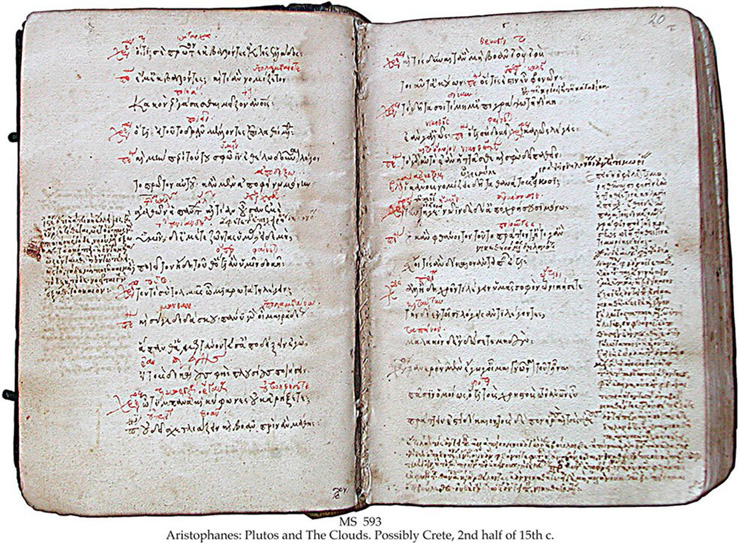
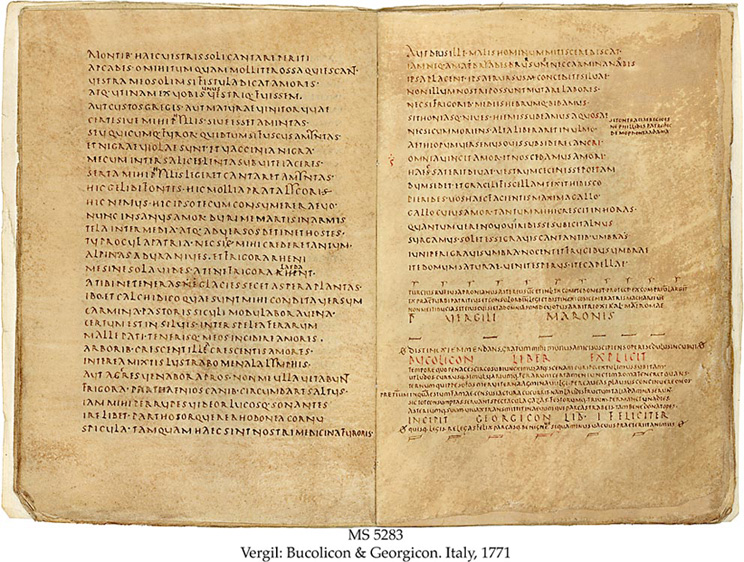
We see above different examples of marginal and interlinear notes.
The issue is that sometimes people made commentaries or personal notes in
the margins and sometimes they made corrections, but later scribes often
couldn't distinguish between the two, so sometimes notes got incorporated as
corrections.
In this way later notes got written into the text as if they were a part
of the original.
I contend that this is the most likely explanation for the Testimonium
passage.
At this point we can only speculate, but I propose this scenario:
Someone, either a Christian of Jewish heritage or a non-Christian, in the 2nd or 3rd
century was reading the section on Pilate and added a marginal note about
Jesus at the location where he thought Jesus would have fit into the
timeline of history. The person may have read the passage and thought, "oh
this is where Jesus came along", and added a note accordingly. The Testimonium
passage appropriately starts out, "About this time there
lived Jesus...". This is exactly what one would expect to find in a note. Some
later scribe then thought that this note was supposed to be part of the
text and incorporated it into the work. Later variations on the "Christ"
sentence could have occurred from that point
on, but the
rest of the Testimonium was simply inserted in full.
From that point on the copies of Antiquity
of the Jews that contained this passage were the ones most likely to
have been used and copied by Christians, thus a form of "natural selection"
took place, selecting for the preservation of copies that contained this
passage over ones that didn't.
This is what the evidence suggests. We don't have any evidence of a small
neutral passage that could have reasonably been written by Josephus, and we
have no evidence for a hostile passage. The only evidence that we have is
evidence from absence of for the first 200+ years of the existence of Antiquity
of the Jews, and then evidence for the existence of the full fledged
passage. That the Testimonium
was a marginal note which got integrated into the text explains why the Testimonium
is short, dense, interrupts the flow of the text, is not in the Table of
Contents, is not mentioned in The Jewish War, and why Josephus
never wrote anything else about Jesus Christ, and it is the only explanation
that does explain all of these things.
Almost all of the apologetic attempts to rescue the passage rely on the
existence of some intermediate passage that could have been written by
Josephus, but there is no evidence that any such passage ever existed. We
only have reasonable evidence to suggest that the passage was not there and
evidence of the passage basically as we see it today, we have no evidence for
anything in between.
That doesn't mean that it's impossible that Josephus wrote something
small and neutral originally, but based on the evidence we have, full
insertion by the innocent incorporation of a note seems the most likely
origin of the Testimonium Flavianum. The (distant) second most likely
scenario based on the evidence, I contend, is that Josephus wrote the entire
passage himself basically as we see it today, in which case his source was
certainly the Christian story itself, and thus even if Josephus did write it,
he certainly isn't a witness to anything other than the story of Jesus, not
Jesus himself.
Both of these most likely scenarios preclude the Testimonium Flavianum
from being evidence for the existence of Jesus. We know that Josephus
couldn't have been a personal witness anyway, he was born in 37 CE.
Within the past 50 years, and especially the past 20 years, there has
been a growing defense of the Testimonium Flavianum
and growing attempts to salvage at least some part of it as "original".
Today the majority opinion in scholarship is that some part of the Testimonium Flavianum
is original, but the growing defense of the Testimonium is a
product of the growing challenge to the historical existence of Jesus.
Originally almost all Protestants regarded the Testimonium has a
complete fraud, but this was before the idea that Jesus was a complete
myth existed. As the challenge to the existence of Jesus has grown
defenders of Jesus have had to look around for supporting evidence, and now
the Testimonium Flavianum
is really the one and only potential corroborating statement for the
existence of Jesus Christ, so there have been renewed efforts to defend it,
hence all of the proposals, based purely on speculation, about possible
"acceptable" versions of it that could have been written by Josephus, but
there is no evidence for any such versions, just wishful thinking.
The only remaining possible non-Christian attestation to the existence of
Jesus Christ, then, is the passing mention of "the brother of Jesus, who
was called Christ, whose name was James" in Antiquity
of the Jews, so let us now take a look at that.
First let's take a look at the passage in question:
1. And now Caesar, upon hearing the death of Festus, sent Albinus
into Judea, as procurator. But the king deprived Joseph of the high
priesthood, and bestowed the succession to that dignity on the son of
Ananus, who was also himself called Ananus. Now the report goes that
this eldest Ananus proved a most fortunate man; for he had five sons who
had all performed the office of a high priest to God, and who had
himself enjoyed that dignity a long time formerly, which had never
happened to any other of our high priests. But this younger Ananus, who,
as we have told you already, took the high priesthood, was a bold man in
his temper, and very insolent; he was also of the sect of the Sadducees,
who are very rigid in judging offenders, above all the rest of the Jews,
as we have already observed; when, therefore, Ananus was of this
disposition, he thought he had now a proper opportunity [to exercise his
authority]. Festus was now dead, and Albinus was but upon the
road; so he assembled the sanhedrim of judges, and brought before them
the brother of Jesus, who was called Christ, whose name was James, and
some others, [or, some of his companions]; and when he had
formed an accusation against them as breakers of the law, he delivered
them to be stoned: but as for those who seemed the most equitable of the
citizens, and such as were the most uneasy at the breach of the laws,
they disliked what was done; they also sent to the king [Agrippa],
desiring him to send to Ananus that he should act so no more, for that
what he had already done was not to be justified; nay, some of them went
also to meet Albinus, as he was upon his journey from Alexandria, and
informed him that it was not lawful for Ananus to assemble a sanhedrim
without his consent. Whereupon Albinus complied with what they said, and
wrote in anger to Ananus, and threatened that he would bring him to
punishment for what he had done; on which king Agrippa took the
high priesthood from him, when he had ruled but three months, and made
Jesus, the son of Damneus, high priest.
-
Antiquity of the Jews, Book XX; Flavius
Josephus, 94-100 CE
What is important to note here is that this is a passage that is
definitely talking about at least one Jesus, the son of Damneus. Indeed, the
name "Jesus" was quite common at the time. In fact the whole issue of the
name of Jesus is quite confusing, because Jesus and Joshua are really two
different interpretations of the exact same Hebrew name. "Jesus" is the
English form of the Latin form of the Greek translation of Yeshu'a, while
Joshua is the direct English translation of Yeshu'a, without going through
the Greek variant. So, in reality Jesus and Joshua are the exact same name,
or would have been the exact same name as far as Jews were concerned,
because to them both of these names would have been Yeshu'a.
That's not critically important here, but what is important is the fact
that both "Jesus" and "James" (in their Greek and Hebrew forms) were
extremely common names at the time. Indeed there are at least 19 or so "Jesuses"
listed between the Bible and the works of Josephus. Josephus himself lists
about 14.
1. Jesus son of Naue (Joshua of Nun)
2. Jesus son of Saul
3. Jesus, high priest, son of Phineas
4. Jesus son of the high priest Jozadak
5. Jesus son of Joiada
6. Jesus, high priest, son of Simon
7. Jesus, high priest, son of Phabes
8. Jesus, high priest, son of See
9. Jesus, high priest, son of Sirach (writer of Wisdom of Jesus son of
Sirach)
10. Jesus Christ
11. Jesus son of Damnaeus, became high priest
12. Jesus son of Gamaliel, became high priest
13. Jesus son of high priest Sapphas and military general
14. Jesus, chief priest, probably to be identified with 10 or 11
15. Jesus son of Gamalas, high priest
16. Jesus, brigand chief on borderland of Ptolemais
17. Jesus son of Sapphias
18. Jesus brother of Chares
19. Jesus a Galilean, perhaps to be identified with 15
20. Jesus in ambuscade, perhaps to be identified with 16
21. Jesus, priest, son of Thebuthi
22. Jesus, son of Ananias, rude peasant, prophesies the fall of Jerusalem.
Of the 28 high priests between the reign of King Herod the Great and the
destruction of the Temple in 70 CE, four of them were named Jesus.
So, it's important here to understand that both Jesus and James were very
popular names, and that the mere coupling of these names by themselves would
not in any way identify a Jesus as the same Jesus who is the subject of the
Gospels; one has to consider the passage and the subject of the writing.
This
chapter is discussing events that were taking place around 60 CE, some time
between about 60 and 66 CE. Nothing in this chapter or the passage has any
relationship to "Jesus Christ", and the use of "Christ" as an identifier is
quite odd, for Josephus never explains what this term means. One could argue
that if the Testimonium Flavianum
is authentic, then the Testimonium Flavianum
is what provides the explanation for who this Jesus is, but if the Testimonium Flavianum
as we have it is not authentic, at least including the reference to
"Christ", then this would be a completely oddball and unsupported reference.
Josephus also never uses the term "Christ" in any of this other works.
There is nothing else in Antiquity
of the Jews that would indicate that this James has any relationship to
Jesus Christ, or that anything in this discussion has any relationship to
him. In addition, since this is something that is occurring around 60 CE,
it would seem quite odd to identify James by his association to a person
whom the Jews had supposedly killed as a common criminal some 30 years prior
to the event, and 60 years prior to this writing.
Christians argue that this was done because "Jesus Christ" was so well
known that it makes the passage make sense, but as we have seen, no one
prior to Josephus had even written about Jesus Christ aside from some
Christians, so it certainly does not seem that he was well known.
A much more likely case here is that the Jesus mentioned as the brother
of James is the same Jesus who is the son of Damneus.
There are two possible explanations, then, for the inclusion of the
phrase "who is called Christ".
- The passage is authentic, but Jesus son of Damneus was also called
"Christ", which simply means anointed
- The phrase "who is called Christ" is a later insertion into
the text
The first thing to consider is that Jesus the son of Damneus was called
"Christ", which is actually quite possible. "Christ" is just a
transliteration of the Greek word Christos (Χριστου),
which is a translation of the Hebrew Mashiah, which simply means
anointed, or one who is anointed.
Jewish kings and high priests were called anointed ones, and
this is used many times in the Hebrew scriptures. It is only Christians who
assume that the term means "the one and only anointed one", but this passage
could also be translated:
...and brought before them the brother of Jesus, called The Anointed,
whose name was James, and some others...
Indeed, the Jewish Encyclopedia discusses the issues surrounding Christ,
Messiah, and anointing and states:
Septuagint translation of Hebrew "Mashiah" ("Messiah"=The Anointed),
applied by Christians exclusively to Jesus as the Messiah.
-
Christ - Jewish Encyclopedia
In post-exilic times, the high priest, filling the place formerly
occupied by the king, is spoken of as "ha-Kohen ha-Mashiah" (the
anointed priest; Lev. iv. 3, 5, 16; vi. 5), also (Dan. ix. 25, 26) as "Mashiah
Nagid" (an anointed one, a ruler) and simply "Mashiah" (an anointed
one), referring to Onias III.
-
Messiah - Jewish Encyclopedia
The most important use of mashah is in connection with certain sacred
persons. The principal and oldest of these is the king, who was anointed
from the earliest times (Judges, ix. 8, 15; I Sam. ix. 16, x. 1; II Sam.
xix. 10; I Kings, i. 39, 45; II Kings, ix. 3, 6, xi. 12). So exclusively
was Anointing reserved for the king in this period that "the Lord's
anointed" became a synonym for king (I Sam. xii. 3, 5, xxvi. 11; II Sam.
i. 14; Ps. xx. 7). This custom was older than the Hebrews. El-Amarna
Tablet No. 37 tells of the anointing of a king.
In that section of the Pentateuch known as the Priestly Code the high
priest is anointed (Ex. xxix. 7; Lev. vi. 13, viii. 12), and, in
passages which critics regard as additions to the Priestly Code, other
priests as well (Ex. xxx. 30, xl. 13-15). It appears from the use of
"anointed priest," in the sense of high priest (Lev. iv. 5-7, 16; Num.
xxxv. 25, etc.), that the high priest was at first the only one
anointed, and that the practice of anointing all the priests was a later
development (compare Num. iii. 3; Dillman on Lev. viii. 12-14; Nowack, "Lehrbuch
der Hebräischen Archäologie," ii.
...
Rabbinical tradition distinguishes also between the regular high priest
and the priest anointed for the special purpose of leading in war—mashuah
milhamah (Sotah, viii. 1; Yoma, 72b, 73a). According
to tradition (see Josippon, xx.; Chronicle of Jerahmeel, xci. 3; compare
I Macc. iii. 55), Judas Maccabeus was anointed as priest for the war
before he proclaimed the words prescribed in Deut. xx. 1-9.
Anointing stands for greatness (Sifre, Num. 117; Yer. Bik. ii. 64d):
consequently, "Touch not mine anointed" signifies "my great ones."
-
Anointing - Jewish Encyclopedia
Other issues that are related to this are the fact that Josephus is
writing around 95 CE, so is he saying explicitly that this Jesus was called
Mashiah before this event took place, or is he using a term that this Jesus
came to be known by, even though he may not have been known by that name at
this point in history? This is similar to a situation where someone writes a
passage about someone like Ronald Reagan today, and writes, "Ronald, who was
called the Gipper," even though they may be talking about a point in his
life prior to him having acquired that nickname.
This passage could simply be saying that Jesus son of Damneus was
considered a great person, or an already holy person, hence the reason that
he, the brother of James who was put to death, is being given the high
priesthood. This could also simply be using a description of Jesus son of Damneus that he was later called. This event supposedly happened around 62
CE, which is getting very close to the Jewish War with Rome, and this is a
term that was even more heavily used in relation to "war priests", or high
priests during a time of war, or priests who, in the Jewish tradition,
actually acted as generals. Jesus son of Damneus was not a high priest
during the war, but Jesus son of Sapphas was the son of a high priest and a
general in the war, it could be talking about him.
All in all, however, this is probably not the case. The phrase, '"who
was called Christ," was probably inserted into the text later.
One argument against this being authentic is that Josephus doesn't use
the term Christos anywhere else, so it does not appear likely that
this is original. If it were original, however, then there are certainly
many possibilities for reading the text, and it can't simply be presumed
that this is talking about the Jesus Christ of the Gospels, but more than
likely it isn't original in the first place.
The other arguments against this being original deal with the structure
of the sentence, the subject matter of the passage, the fact that even if
Jesus Christ existed he would be an odd person for Josephus to use as an
identifier for someone else, especially by brotherhood, and the fact that if
this were talking about "James the Just" (which it almost certainly isn't
for reasons we shall see) then this James himself would have been more
famous than Jesus at this point in time and this association would have made
no sense, as James himself, according to Christian legend, was a community
leader and well known person, though there is no reference to him in the
non-Christian literature (unless this is a reference to him).
Let's read the passage again, without "who was called Christ" in
the passage:
But this younger Ananus, who, as we have told you already, took the
high priesthood, was a bold man in his temper, and very insolent; he was
also of the sect of the Sadducees, who are very rigid in judging
offenders, above all the rest of the Jews, as we have already observed;
when, therefore, Ananus was of this disposition, he thought he had now a
proper opportunity [to exercise his authority]. Festus was now
dead, and Albinus was but upon the road; so he assembled the sanhedrim
of judges, and brought before them the brother of Jesus, whose name was
James, and some others, [or, some of his companions]; and when
he had formed an accusation against them as breakers of the law, he
delivered them to be stoned: but as for those who seemed the most
equitable of the citizens, and such as were the most uneasy at the
breach of the laws, they disliked what was done; they also sent to the
king [Agrippa], desiring him to send to Ananus that he should act so no
more, for that what he had already done was not to be justified; nay,
some of them went also to meet Albinus, as he was upon his journey from
Alexandria, and informed him that it was not lawful for Ananus to
assemble a sanhedrim without his consent. Whereupon Albinus complied
with what they said, and wrote in anger to Ananus, and threatened that
he would bring him to punishment for what he had done; on which
king Agrippa took the high priesthood from him, when he had ruled but
three months, and made Jesus, the son of Damneus, high priest.
What this passage would be saying is that Ananus was a priest who abused
his power. Ananus wrongly condemned James and some others to death, but the
equitable citizens wrote to Herod to complain about this, so Herod punished
Ananus by taking the high priesthood from him and giving it to James'
brother, Jesus (son of Damneus).
This story makes perfect sense, follows the typical writing style of
Josephus, and now the mention of Jesus as the brother of James has context
and relevancy. The story here is about Ananus, and how Jesus son of Damneus
obtained the high priesthood. The whole point of the sentence that mentions
James is to explain issues relevant to Jesus son of Damneus. If this
sentence were talking about Jesus Christ, then Jesus Christ would be the one
who has no relation to the story, and thus we would expect James to come
first in the sentence, because James would be who was being talked about,
but in this case Jesus is mentioned first because Jesus is who is being
talked about, at it only makes sense that Jesus is the one being talked
about if this is Jesus son of Damneus, whom the narrative is about.
We can also break the text down as follows:
[Ananus unlawfully] assembled the sanhedrim of judges, and brought
before them the brother of Jesus and some others; and when he had formed
an accusation against them as breakers of the law, he delivered them to
be stoned: but as for those who seemed the most equitable of the
citizens, and such as were the most uneasy at the breach of the laws,
they disliked what was done; ... Whereupon Albinus complied with what
they said, and wrote in anger to Ananus, and threatened that he would
bring him to punishment for what he had done; on which king Agrippa took
the high priesthood from him and made Jesus, the son of Damneus, high
priest.
"Jesus Christ", some guy that was presumably killed for being a false
prophet 30 years prior, is an obscure reference out of the blue that has no
relation to the narrative.
The story here makes sense if the James is the brother of Jesus son of
Damneus, because giving the high priesthood to Jesus would then be seen as a
form of reparation to the family for the wrongful death of James, and as a
further punishment to Ananus.
Why wouldn't Josephus put the "son of" identifier in the first reference
instead of after the fact? Well, for the very reason that "brother of Jesus,
who was called Christ, whose name was James" seems odd, because it's a
double qualifier and a cumbersome sentence. In addition, the strong point of
the passage is the naming of Jesus as the high priest, thus Josephus uses
the formality of identifying Jesus by his father when he states that he was
named the high priest.
Why didn't he identify James by his father instead? Because if James is
related to Jesus son of Damneus then this is implied, and Jesus is the more
important figure, he is the one who becomes high priest. It is also
possible, by the way, that "whose name was James" is a part of the
inserted text as well, and what was really added was "who was called
Christ, whose name was James".
The real question, however, is if this is James "the brother of Jesus Christ" of
the Gospels, and Christians claim that the Gospels are true, then that would
mean that this James would have to be in the line of David as well, and thus
if anything it would have made more sense to qualify James by his father
Joseph, who would had to have been in the line of David, and thus would have
been seen as prestigious name worth mentioning. Likewise, if this was "James
the Just", then why not identify him by his supposed prestigious position in
society, instead of a link to being the bother of Jesus? Josephus does this
when he mentions John the Baptist, whom he calls "John the Baptist",
identifying him not by his father, but by a title or by his deeds. This
passage really opens up a whole can of worms for Christians, because it
simply doesn't make sense if read with "who was called Christ" in
it, and it draws many other aspects of Christian lore into question.
There are also no other examples in the works of Josephus of identifying
someone in the manner that is used here if "who was called Christ" were
talking about a different person from Jesus son of Damneus, i.e. mentioning
the person being related first, and then the subject after, with an
explanation of who the person being related is in between.
So, if "who was called Christ" is not authentic, then how did it
get there? There are two likely possibilities, either it came from the insertion of
a note, or it was later inserted into the text as a correction based on
references made by Origen, which appear to cite Josephus a source for a link
between Jesus and James. Origen's citations, however, are highly
problematic and almost certainly spurious.
As with the Testimonium Flavianum, if this was inserted based on
a marginal or interlinear note then it was probably a completely innocent
mistake. These types of things happened. A Christian reading the work may
have seen the names Jesus and James together and jumped to the conclusion
that this was "Jesus Christ", and then made a note saying so. A later
scribe would have then just incorporated it, assuming it to be true, in
order to clarify the passage.
The other, and I believe more likely, possibility is that Origen's
passage that attributed to Josephus a claim that Jesus was called Christ is
actually a mistake on Origen's part, but this set a precedent leading others
believe that Josephus had actually said this.
Let's look again at Origen's citation of this passage from Against
Celsus:
I would like to say to Celsus, who represents the Jew as accepting
somehow John as a Baptist, who baptized Jesus, that the existence of
John the Baptist, baptizing for the remission of sins, is related by one
who lived no great length of time after John and Jesus. For in the 18th
book of his Antiquities of the Jews, Josephus bears witness to John as
having been a Baptist, and as promising purification to those who
underwent the rite. Now this writer, although not believing in Jesus as
the Christ, in seeking after the cause of the fall of Jerusalem
and the destruction of the temple, whereas he ought to have
said that the conspiracy against Jesus was the cause of these calamities
befalling the people, since they put to death Christ, who was a prophet,
says nevertheless-being, although against his will, not far from the
truth-that these disasters happened to the Jews as a punishment
for the death of James the Just, who was a brother of Jesus (called
Christ),-the Jews having put him to death, although he was a man most
distinguished for his justice. Paul, a genuine disciple of
Jesus, says that he regarded this James as a brother of the Lord, not so
much on account of their relationship by blood, or of their being
brought up together, as because of his virtue and doctrine
-
Against Celsus; Origen
Origen actually cites Josephus as a source for "brother of Jesus" three
times, and in every case, as in this one, he paraphrases and mentions things
that no one has ever been able to find in any works of Josephus. In fact in
The Jewish War, written about two decades before Antiquity,
Josephus attributed the destruction that befell the Jews to the deaths of
both Ananus the elder (the father of the corrupt Ananus) and either Jesus
son of Damneus or Jesus son of Gamaliel (he does not specify), whom he said
were shrewd negotiators and level-headed decision makers who opposed the war
against the Romans.
What appears to be the case is that Origen has somehow confused the works
of Josephus with the works of the early Christian chronicler Hegesippus.
Hegesippus is known as the earliest chronicler of Christian history, and he
was also an apologist. His works are universally acknowledged as highly
flawed and imaginative, basically inventing "history", but he did also use
historical sources. Origen's paraphrase above does correspond to passages in
the works of Hegesippus, and thus his citations of "Josephus" were probably
really citations of Hegesippus, or citations of commentaries that themselves
mixed the sources of Josephus and Hegesippus, or perhaps Hegesippus himself
is the source of the error; perhaps he claimed that Josephus made this
correlation.
Here is a passage from Hegesippus, which corresponds to Origen's passage
in Against Celsus:
James, the Lord's brother, succeeds to the government of the Church,
in conjunction with the apostles. He has been universally called the
Just, from the days of the Lord down to the present time. For many bore
the name of James; but this one was holy from his mother's womb. He
drank no wine or other intoxicating liquor, nor did he eat flesh; no
razor came upon his head; he did not anoint himself with oil, nor make
use of the bath. He alone was permitted to enter the holy place: for he
did not wear any woolen garment, but fine linen only. ... Therefore, in
consequence of his pre-eminent justice, he was called the Just, and
Oblias, which signifies in Greek Defense of the People, and Justice, in
accordance with what the prophets declare concerning him.
...
The aforesaid scribes and Pharisees accordingly set James on the
summit of the temple, and cried aloud to him, and said: "O just one,
whom we are all bound to obey, forasmuch as the people is in error, and
follows Jesus the crucified, do thou tell us what is the door of Jesus,
the crucified." And he answered with a loud voice: "Why ask ye me
concerning Jesus the Son of man? He Himself sitteth in heaven, at the
right hand of the Great Power, and shall come on the clouds of heaven."
And, when many were fully convinced by these words, and offered
praise for the testimony of James, and said, "Hosanna to the son of
David," then again the said Pharisees and scribes said to one another,
"We have not done well in procuring this testimony to Jesus. But let us
go up and throw him down, that they may be afraid, and not believe him."
And they cried aloud, and said: "Oh! oh! the just man himself is in
error." Thus they fulfilled the Scripture written in Isaiah: "Let us
away with the just man, because he is troublesome to us: therefore shall
they eat the fruit of their doings." So they went up and threw down the
just man, and said to one another: "Let us stone James the Just." And
they began to stone him: for he was not killed by the fall; but he
turned, and kneeled down, and said: "I beseech Thee, Lord God our
Father, forgive them; for they know not what they do."
And, while they were thus stoning him to death, one of the priests,
the sons of Rechab, the son of Rechabim, to whom testimony is borne by
Jeremiah the prophet, began to cry aloud, saying: "Cease, what do ye?
The just man is praying for us." But one among them, one of the fullers,
took the staff with which he was accustomed to wring out the garments he
dyed, and hurled it at the head of the just man.
And so he suffered martyrdom; and they buried him on the spot, and
the pillar erected to his memory still remains, close by the temple.
This man was a true witness to both Jews and Greeks that Jesus is the
Christ.
And shortly after Vespasian besieged Judaea, taking them captive.
-
Commentaries on the Acts of the Church; Hegesippus, 165-175
This is the only known account that precedes the writing of Origen which
resembles what he cites in Against Celsus, and it resembles his
account very well. The mixing up of authors was not uncommon, and these
types of confusions are not otherwise unknown. This is especially likely in
the case of Josephus and Hegesippus because we know that there was on-going
confusion about these two names, and some scholars think that Hegesippus is
actually a corruption of the name Josephus, meaning that these two different
writers may both have had the same name. In Greek Josephus is written
Iosippus, and some people have translated this as Hegesippus while
others translated it is Josephus. It is considered proper to translate it as
Josephus, but this was a common error that is more well known in relation to
later 4th century works that are wrongly attributed to a Hegesippus based on
the name Iosippus within the text.
How exactly Origen got confused we cannot know. Maybe he was confused
by the names? Maybe he got a scroll of Hegesippus that was wrongly
attributed to Josephus by someone else? We also know of another work was
that wrongly attributed to Josephus, which was probably written by the 3rd
century Christian writer Hippolytus, Discourse to the Greeks Concerning
Hades. Indeed this work is still commonly attributed to Josephus,
though scholars do not acknowledge it as such.
These types of mistakes happened, but that only explains Origen's
citation, what about the text from Josephus that we have today?
Well, either the phrase "who was called Christ" was an
independent insertion into the text of a marginal or interlinear note, or
Origen actually set the precedent and later scribes, when looking for
clarity, knew of Origen's work and inserted the phrase into Josephus
thinking that it was supposed to go there.
This again is not uncommon. Firstly, many scribes were familiar with many
works, and it would not be uncommon for later scribes who were copying
Josephus to have also read or copied Origen. Secondly, scribes were supposed
to make an effort to clarify ambiguous names, or to make corrections based
on other references. If they read a work that didn't have a passage that
someone else had claimed that it did have, they were then supposed to try
and figure out what was original and then make the correction, so if someone
had read one of Origen's three works where he claimed that Josephus said
that James was the brother of Jesus Christ, then when making their copies of
this passage in Josephus it would have looked to them like a mistake if the
phrase about Christ was not there, thus they would have added it.
So, what we can say with confidence about the "brother of Jesus, who
was called Christ, whose name was James" passage, is that the inclusion
of "who was called Christ" seems very much out of place and the
entire passage makes more sense when "who was called Christ" is
removed. This phrase is in the middle of a passage that is discussing Jesus
son of Damneus, and the passage is clear and meaningful without this phrase
present. Indeed, introducing a separate Jesus that is unrelated to the story
seems quite unlikely.
We also know that Origen is cited as the earliest confirmation of this
passage, but Origen's reference to Josephus is highly problematic and
doesn't comply with anything that we know of that has ever been written by
Josephus, and it is pretty unbelievable that Josephus would have made any
commentary on "James the Just", since this is just a Christian title and we
have no such existing commentary on "James the Just" from Josephus. It
appears that Origen somehow got his sources confused and mixed up the works
of Hegesippus with Josephus, leading him to falsely attribute to Josephus
a phrase that he never wrote.
This mistaken attribution by Origen then led other scribes to insert the text into
Josephus at the only place where a James was mentioned as the brother of a
Jesus, in a passage that is really clearly talking about a different Jesus.
With all of this we can see that there are certainly no solid independent
attestations to the existence of Jesus Christ in the non-Christian
literature. Modern scholarship recognizes that the Testimonium Flavianum
is the only reasonably possible independent witness to Jesus Christ in the
non-Christian literature, and there is nothing else aside from that
one passage that could even claim to confirm his existence.
The reality, however, is that even the Testimonium Flavianum
cannot be maintained as an affirmation of the existence of Jesus Christ. The Testimonium Flavianum
is by far best explained as the full insertion of a later note, and this was
the dominant view among Protestant scholars before the rise of the challenge
to the existence of Jesus. The Testimonium Flavianum
has only been strongly defended as at least partly authentic within the past
100 years, which corresponds to when the challenge to the existence of Jesus
emerged and became substantial. In short, the Testimonium Flavianum
is strongly defended now because Christian scholars know that it is the last
thread tying Jesus into history.
Additionally, the arguments related to the Testimonium Flavianum
have evolved substantially since it was first challenged. The first
challenge to the Testimonium Flavianum
was presented by Protestant scholars who believed that it was intentionally
inserted by the Catholic historian Eusebius in an attempt to misrepresent
history, making the Testimonium Flavianum
a product of some conspiracy. This is not likely, and not supported by the
nature of the passage, but the innocent insertion of a note, believing that
is was a part of the text, is both likely and fits the nature of the
passage.
It is interesting that so much effort goes into defending the claim of
the "empty tomb" of Jesus that appears in the ending scenes of the Gospels,
yet there is nothing in any of the writings that precede the Gospels that
makes any mention of either an "empty tomb" or any burial site or even a
crucifixion site. Would Paul have said nothing about the site of Jesus'
burial? Would Paul not have mentioned a visit to Golgotha, the location of
Jesus' crucifixion?
It's not just Paul, but indeed there is no evidence of any veneration of
any locations that are associated with Jesus in the Gospels until after the
Gospels were circulated. Most importantly, though, we find no evidence of any
veneration of the supposed tomb of Christ, which to this day remains an
unknown and unidentifiable locale.
In
Beyond Resurrection, New Testament scholar Alexander. J. M. Wedderburn
attempts to find evidence for the resurrection of Jesus and the "empty
tomb". He concludes that no such evidence exists and that Christians have to
remain agnostic as to the historical reality of this event and continue to
take it on faith. As a part of his investigation into the matter, Wedderburn
addresses the fact that we have no evidence of a veneration of the tomb of
Jesus following his supposed death. He considers the possibility that early
believers would simply not have cared about this site, but noting that the
site of the "empty tomb" would have been seen as the site of the
resurrection he asks, "Was that not in itself reason enough to note and
remember and cherish the site, regardless of whether it contained Jesus'
remains or not?"
This is certainly a significant issue. If Jesus were a real but mortal
person, and the Gospels are based on his real life, then we should expect
that there would have been some knowledge of his real death and his real
burial, yet we find no evidence of this. The earliest alternative stories
that we find about what happened to Jesus after the crucifixion didn't come
along until centuries after the Gospels were written. In effect, these are
nothing more than late developing legends that themselves have no connection
to history, they are just alternative explanations that seek to explain away
the so-called resurrection.
If, on the other hand, Jesus really was divine and really was
resurrected, and the Gospels accurately portray the events of his death and
resurrection, then we should still expect to find some continuous line of
veneration of the site of his burial and resurrection, but again we do not.
Certainly people would have been interested in visiting this empty tomb.
Certainly at least Paul would have mentioned it. After all, later Christians
were highly interested in trying to locate this supposed tomb, just as they
have been interested in locating his supposed place of birth, the hill upon
which he was crucified, and many other things, but we cannot honestly point
to any of these locations.
Indeed it is ironic that Christian apologists have tried to use the fact
that there is no evidence for veneration of a tomb of Jesus to "prove" the
"truth" of the resurrection. They argue that the lack of veneration proves
that there was no body to venerate, thus, he had to have been resurrected,
but all this pre-supposes that there was an actual Jesus to being with, and
that he was really crucified and buried in a manner according to the
Gospels. For these apologists Jesus definitely existed and was killed, so
therefore the only explanation for the lack of veneration of his burial site
is that he was resurrected and thus was no longer there.
But as Wedderburn noted, even an empty tomb would have been venerated if what
the Gospels say is in any way historical.
By far, the better explanation for why there was no veneration is that
there was no Jesus to venerate.
Indeed, this issue seems to have been recognized by the author of Luke
and Acts, for it is in both Luke and Acts that we have the story of Jesus' bodily
ascension into heaven. The claim that someone had bodily ascended into
heaven was actually not uncommon in the Greek and Roman world when applied
to mythical heroes whom the people wanted to bury and venerate. The claims
were then made that the hero had bodily ascended into heaven, leaving no
remains, and thus no need to search for his body.
Acts 1:
6 So when they met together, they asked him, "Lord, are you at this time
going to restore the kingdom to Israel?"
7 He said to them: "It is not for you to know the times or dates the
Father has set by his own authority. 8 But you will receive power when
the Holy Spirit comes on you; and you will be my witnesses in Jerusalem,
and in all Judea and Samaria, and to the ends of the earth."
9 After he said this, he was taken up before their very eyes,
and a cloud hid him from their sight.
10 They were looking intently up into the sky as he was going, when
suddenly two men dressed in white stood beside them. 11 "Men of
Galilee," they said, "why do you stand here looking into the sky? This
same Jesus, who has been taken from you into heaven, will come back in
the same way you have seen him go into heaven."
This story provides a convenient explanation for why nothing of Jesus
remained. People were perhaps asking, even if Jesus had been brought back to
life, then what? Where is his body now? The answer of course came in saying
that his entire body had gone to heaven, thus there were no traces of him
left, and that's why there is nothing of him to find.
Are we really to believe that a historical person who really existed had
to have bodily disappearance stories written about him to explain his lack
of presence even in death? For those to subscribe to a secular historical
view of Jesus, as a real man that is exaggeratedly described in the Gospels,
why would stories of bodily disappearance be crafted around a real man? Not
only do we have to ask this question about Jesus, however, but the question
is also raised about Mary, his supposed mother.
Mary, the supposed mother of Jesus, is never mentioned by Paul, nor in any
canonical work outside of the Gospels and Acts of the Apostles. If Jesus had
an earthly mother who was still alive, then why didn't Paul visit her? Why
wasn't the early Christian community caring for Mary? Paul never says
anything about taking care of the mother of the Lord or anything like this.
What happened to Mary when she died, why wasn't her grave venerated? For
that matter where is her grave? Well, according to later legend, Mary's body
ascended into heaven as well. Apparently the Church fathers realized the
predicament of this situation and crafted stories about her removal from the
face of the earth too.
And when the Lord's day came, at the third hour, just as the
Holy Spirit descended upon the apostles in a cloud, so Christ descended
with a multitude of angels, and received the soul of His beloved mother.
For there was such splendor and perfume of sweetness, and angels singing
the songs of songs, where the Lord says, As a lily among thorns, so is
my love among the daughters, that all who were there present fell on
their faces, as the apostles fell when Christ transfigured Himself
before them on Mount Thabor, and for a whole hour and a half no one was
able to rise. But when the light went away, and at the same time with
the light itself, the soul of the blessed virgin Mary was taken up into
heaven with psalms, and hymns, and songs of songs. And as the cloud went
up the whole earth shook, and in one moment all the inhabitants of
Jerusalem openly saw the departure of St. Mary.
And that same hour Satan entered into them, and they began to
consider what they were to do with her body. And they took up weapons,
that they might burn her body and kill the apostles, because from her
had gone forth the dispersions of Israel, on account of their sins and
the gathering together of the Gentiles. But they were struck with
blindness, striking their heads against the walls, and striking each
other. Then the apostles, alarmed by so much brightness, arose, and with
psalms carried the holy body down from Mount Zion to the valley of
Jehoshaphat. But as they were going in the middle of the road, behold, a
certain Jew, Reuben by name, wishing to throw to the ground the holy
bier with the body of the blessed Mary. But his hands dried up, even to
the elbow; whether he would or not, he went down even to the Valley of
Jehoshaphat, weeping and lamenting because his hands were raised to the
bier, and he was not able to draw back his hands to himself. And he
began to ask the apostles that by their prayer he might be saved and
made a Christian. Then the apostles, bending their knees, asked the Lord
to let him loose. And he, being healed that same hour, giving thanks to
God and kissing the feet of the queen of all the saints and apostles,
was baptized in that same place, and began to preach the name of our God
Jesus Christ.
Then the apostles with great honor laid the body in the tomb, weeping
and singing through exceeding love and sweetness. And suddenly
there shone round them a light from heaven, and they fell to the ground,
and the holy body was taken up by angels into heaven.
Then the most blessed Thomas was suddenly brought to the
Mount of Olivet, and saw the most blessed body going up to heaven,
and began to cry out and say: O holy mother, blessed mother, spotless
mother, if I have now found grace because I see you, make your servant
joyful through your compassion, because you are going to heaven.
-
The
Assumption of Mary; (falsely attributed to John) 5th century
This story, or at least the belief in the assumption of Mary, is an
article of faith for Catholics, something that they are "required" to accept
as true.
The fact of the matter is, however, that there is no evidence for Mary
and there was no discussion of Mary until the Gospel stories came along. If
there were a real Jesus, however, and there were a real Mary, then it seems
reasonable that the followers of Jesus would have been concerned to care for
Mary after his death and that she would have had some type of burial and
that her grave would have been venerated, but none of this is the case.
There are two claimed graves of Mary today, one in Jerusalem and one in
Ephesus, neither of which are authentic. The grave in Jerusalem is known to
have been created in the 6th or 7th century, and Ephesus is the island that
was home to the goddess Diana, where her shrines covered the land and she
was worshiped as a moon goddess. (Incidentally, images of Mary today
resemble the images of Diana) Mary appears for the first time in the Gospels
and disappears just as quickly, only becoming venerated centuries later in
the pattern of pagan goddess tradition.
There is no evidence for a legitimate grave, or even knowledge of a
grave, for either Jesus or Mary, and there is no sign of any discussion of a
tomb of Jesus, empty or occupied, until the advent of the Gospel stories.
Prior to the adoption of Catholicism by the Roman Empire in the 4th
century, there were many different beliefs about Jesus Christ. The Catholics
held a specific view of Jesus Christ as a real live, historical, person, who
was both God, the only son of God, and a fully human being. During the first
300 years of Christian belief, however, this was not the case. There were
many different groups of Christians early on, some of them include:
- Marcionism – Christ was a purely spiritual entity
- Nestorianism – Jesus and Christ were two different entities
- Docetism – Jesus appeared physical, but he was really incorporeal
- Apollinarism – Jesus had a human body and human soul, but a divine
mind
- Arianism- Jesus was the son of God, not God himself
- Catholicism – Jesus was fully human and fully divine, both God and
the son of God
Some of these different groups, which are often lumped together under the
name Gnostics, also used some of the Gospels and some of them even had
different versions of some of the Gospels and different versions of the
letters of Paul, in addition to other writings that they considered holy.
The Catholics, in fact, were late-developing group, that came along after
some of these other groups. We don't have much information from these
different groups in their own words, instead what we have mostly are
comments on these groups made by Catholics and other opponents of their
views. The question is, if Jesus Christ had just been a man on earth and led a
life like the one portrayed in the Gospels, then how could there be such a
wide variety of beliefs about who and what Jesus Christ was?
One of the most often noted and striking evidences of the doubts about
the historical existence of Jesus early on comes from the book of 2 John in
the Bible, which was written in the late 1st century or early 2nd
century. 2 John states:
2 John 1:
7 Many deceivers, who do not acknowledge Jesus Christ as coming
in the flesh, have gone out into the world. Any such person is
the deceiver and the antichrist. 8 Watch out that you do not lose what
you have worked for, but that you may be rewarded fully. 9 Anyone who
runs ahead and does not continue in the teaching of Christ does not have
God; whoever continues in the teaching has both the Father and the Son.
10 If anyone comes to you and does not bring this teaching, do not take
him into your house or welcome him. 11Anyone who welcomes him shares in
his wicked work.
The letter of 2 John is here talking about the fact that many people at
the time who did preach about Jesus Christ did not regard him as having
existed in flesh and blood. We find something similar in 1 John as well:
1 John 4:
1 Dear friends, do not believe every spirit, but test the spirits to see
whether they are from God, because many false prophets have gone out
into the world. 2 This is how you can recognize the Spirit of
God: Every spirit that acknowledges that Jesus Christ has come in the
flesh is from God, 3 but every spirit that does not acknowledge Jesus is
not from God. This is the spirit of the antichrist, which you
have heard is coming and even now is already in the world.
Many of the early Christian apologists that are now considered the
"correct ones" defended the belief in Jesus as both human and divine from
the many beliefs that Jesus Christ was something other than this.
Thus it is true to call Him man and to call Him not man; man, because
He was capable of death; not man, on account of His being diviner than
man. Marcion, I suppose, took sound words in a wrong sense, when he
rejected His birth from Mary, and declared that as to His divine nature
He was not born of Mary, and hence made bold to delete from the Gospel
the passages which have this effect. And a like fate seems to
have overtaken those who make away with His humanity and receive His
deity alone; and also those opposites of these who cancel His
deity and confess Him as a man to be a holy man, and the most righteous
of all men.
-
Commentary on the Gospel of John (Book X); Origen, 3rd century
In his commentary on the Gospel of John not only does Origen state that
the Gospels have to be read "spiritually" and not literally, but he also
notes here that Marcion did not consider Jesus to have been literally born
and that others did not believe in his humanity at all, instead only viewing
Jesus Christ as a god.
Now a person might say that these men, and those who hold a different
opinion, are yet near neighbors, being involved in like error. For those
men, indeed, either profess that Christ came into our life a mere man,
and deny the talent of His divinity, or else, acknowledging Him
to be God, they deny, on the other hand, His humanity, and teach that
His appearances to those who saw Him as man were illusory, inasmuch as
He did not bear with Him true manhood, but was rather a kind of phantom
manifestation. Of this class are, for example, Marcion and
Valentinus, and the Gnostics, who sunder the Word from the flesh, and
thus set aside the one talent, viz., the incarnation.
-
Domatical Treastise; Hippolytus, 3rd century
Here again we see a range of views about Christ, ranging from the belief
that he was just a man to the belief that he was just a god.
There are, to be sure, other things also quite as foolish (as the
birth of Christ), which have reference to the humiliations and
sufferings of God. Or else, let them call a crucified God "wisdom." But
Marcion will apply the knife to this doctrine also, and even with
greater reason. For which is more unworthy of God, which is more likely
to raise a blush of shame, that God should be born, or that He should
die? that He should bear the flesh, or the cross? be circumcised, or be
crucified? be cradled, or be coffined? be laid in a manger, or in a
tomb? Talk of "wisdom!" You will show more of that if you refuse to
believe this also. But, after all, you will not be "wise" unless you
become a "fool" to the world, by believing "the foolish things of God."
Have you, then, cut away all sufferings from Christ, on the
ground that, as a mere phantom, He was incapable of experiencing them?
We have said above that He might possibly have undergone the unreal
mockeries of an imaginary birth and infancy. But answer me at once, you
that murder truth: Was not God really crucified? And, having been really
crucified, did He not really die? And, having indeed really died, did He
not really rise again? Falsely did Paul "determine to know
nothing amongst us but Jesus and Him crucified;" falsely has he
impressed upon us that He was buried; falsely inculcated that He rose
again. False, therefore, is our faith also. And all that we hope
for from Christ will be a phantom.
-
On
the Flesh of Christ; Tertullian, 3rd century
In On the Flesh of Christ Tertullian admits that the birth story
of Jesus may not be true, but he maintains that he was still both a man and a
god. We will come back to this work in the next section when discussing the
arguments that were given in favor of Jesus having existed in this world "in
the flesh".
Our heretic must now cease to borrow poison from the Jew—"the asp,"
as the adage runs, "from the viper"—and henceforth vomit forth the
virulence of his own disposition, as when he alleges Christ to
be a phantom. Except, indeed, that this opinion of his will be
sure to have others to maintain it in his precocious and somewhat
abortive Marcionites, whom the Apostle John designated as antichrists,
when they denied that Christ was come in the flesh; not
that they did this with the view of establishing the right of the other
god (for on this point also they had been branded by the same apostle),
but because they had started with assuming the incredibility of an
incarnate God.
-
Against Marcion (Book III); Tertullian, 3rd century
Against Marcion is a long polemic against the Gnostic leader
Marcion, who, like many others, did not believe that Jesus Christ was a
flesh and blood human being, but nevertheless did believe in Jesus Christ.
It is important to note here that Marcion and all of the other so-called
heretics are people who called themselves Christians and believed in Jesus
Christ, but whose beliefs differed from those that we now call Catholic,
which literally means "universal".
Afterwards, again, followed Saturninus: he,
too, affirming that the innascible Virtue, that is God, abides in the
highest regions, and that those regions are infinite, and in the regions
immediately above us; but that angels far removed from Him made the
lower world; and that, because light from above had flashed refulgently
in the lower regions, the angels had carefully tried to form man after
the similitude of that light; that man lay crawling on the surface of
the earth; that this light and this higher virtue was, thanks to mercy,
the salvable spark in man, while all the rest of him perishes;
that Christ had not existed in a bodily substance, and had endured a
quasi-passion in a phantasmal shape merely; that a resurrection of the
flesh there will by no means be.
-
Against
All Heresies; Tertullian, 3rd century
To this is added one Cerdo. He introduces two first causes, that is,
two Gods—one good, the other cruel: the good being the superior; the
latter, the cruel one, being the creator of the world. He repudiates the
prophecies and the Law; renounces God the Creator; maintains
that Christ who came was the Son of the superior God; affirms that He
was not in the substance of flesh; states Him to have been only in a
phantasmal shape, to have not really suffered, but undergone a
quasipassion, and not to have been born of a virgin, nay, really not to
have been born at all. A resurrection of the soul merely does
he approve, denying that of the body.
-
Against
All Heresies; Tertullian, 3rd century
Close on their heels follows Apelles, a disciple of Marcion, ... The
Law and the prophets he repudiates. Christ he neither, like
Marcion, affirms to have been in a phantasmal shape, nor yet in
substance of a true body, as the Gospel teaches; but says, because He
descended from the upper regions, that in the course of His descent He
wove together for Himself a starry and airy flesh; and, in His
resurrection, restored, in the course of His ascent, to the several
individual elements whatever had been borrowed in His descent: and
thus—the several parts of His body dispersed—He reinstated in heaven His
spirit only. This man denies the resurrection of the flesh.
-
Against
All Heresies; Tertullian, 3rd century
Saturninus was another of those who believed in Jesus Christ, but did not
believe that he was a human being. Cerdo and Apelles did not believe Jesus
to have been born at all! How is it that so many people believed in a
phantom Jesus if was a man and his story was inspired by his life?
But, according to these men, neither was the Word made flesh, nor
Christ, nor the Savior, who was produced from [the joint contributions
of] all [the Æons]. For they will have it, that the Word and Christ
never came into this world; that the Savior, too, never became
incarnate, nor suffered, but that He descended like a dove upon the
dispensational Jesus; and that, as soon as He had declared the unknown
Father, He did again ascend into the Pleroma. Some, however, make the
assertion, that this dispensational Jesus did become incarnate, and
suffered, whom they represent as having passed through Mary just as
water through a tube; but others allege him to be the Son of the
Demiurge, upon whom the dispensational Jesus descended; while others,
again, say that Jesus was born from Joseph and Mary, and that the Christ
from above descended upon him, being without flesh, and impassible. But
according to the opinion of no one of the heretics was the Word of God
made flesh. For if anyone carefully examines the systems of them all, he
will find that the Word of God is brought in by all of them as not
having become incarnate (sine carne) and impassible, as is also the
Christ from above. Others consider Him to have been manifested as a
transfigured man; but they maintain Him to have been neither born nor to
have become incarnate; while others [hold] that He did not assume a
human form at all, but that, as a dove, He did descend upon that Jesus
who was born from Mary. Therefore the Lord's disciple, pointing them all
out as false witnesses, says, "And the Word was made flesh, and dwelt
among us."
-
Adversus Haereses (Book III); Irenaeus, 175
From Irenaeus, writing in the 2nd century, we see that by this early time
there was already a huge variety of beliefs about who or what Jesus Christ
was. Irenaeus was writing about 100 to 60 years after the Gospels had been
in circulation, and we can see that beliefs about Jesus were clearly
impacted by the Gospels, but that there were a variety of beliefs as well.
The talk about Christ descending in the form of a dove on a "dispensational
Jesus" is actually inspired by the Gospel of Mark, and many so-called
heretics used the Gospel of Mark. The variety of beliefs ranged from Christ
never having become incarnate at all, to Christ having entered into the body
of a human Jesus, to the Catholic belief that Jesus was Christ, and
that he was both human and divine.
Obviously there was much disagreement about the nature of Jesus Christ in
the early years, but interestingly enough, we know of at least one early
Christian bishop who seems to have never even heard of Jesus Christ,
Theophilus of Antioch who lived from approximately 115 to 185. We have three
books (letters) written by Theophilus while he was in Antioch, and his works
clearly show that his theology was very much Christian in nature, yet he
never mentioned Jesus Christ, and he explained Christianity in a way that
has nothing to do with any specific leader. Theophilus stated that God is
invisible and known by his works, such as the ordering of the seasons and
things of this nature. Theophilus defended the Christian doctrine of
resurrection and life after death by again referring to the seasons and the
growth of seeds and things like this. How could an early Christian defend
the doctrine of resurrection without mentioning Jesus Christ, unless he had
indeed never heard of him or the story of his death and resurrection?
Theophilus went on to state that the reason that Christians were called
Christians was because they anointed themselves with oil, saying nothing
about any supposed "Christ" figure.
CHAP. XII.--MEANING OF THE NAME CHRISTIAN.
And about your laughing at me and calling me "Christian," you know
not what you are saying. First, because that which is anointed is sweet
and serviceable, and far from contemptible. For what ship can be
serviceable and seaworthy, unless it be first caulked [anointed]? Or
what castle or house is beautiful and serviceable when it has not been
anointed? And what man, when he enters into this life or into the
gymnasium, is not anointed with oil? And what work has either ornament
or beauty unless it be anointed and burnished? Then the air and all that
is under heaven is in a certain sort anointed by light and spirit; and
are you unwilling to be anointed with the oil of God? Wherefore we are
called Christians on this account, because we are anointed with the oil
of God.
-
THEOPHILUS TO AUTOLYCUS (Book I), 180-185
Here we see the term Christian used as mentioned before, to mean
anointed. Theophilus went on to describe the creation of the world by God
via "The Word", and to defend the creation account of Genesis.
CHAP. X.--THE WORLD CREATED BY GOD THROUGH THE WORD.
God made all things out of nothing; for nothing was coeval with God:
but He being His own place, and wanting nothing, and existing before the
ages, willed to make man by whom He might be known; for him, therefore,
He prepared the world. For he that is created is also needy; but he that
is uncreated stands in need of nothing. God, then, having His own Word
internal within His own bowels, begat Him, emitting Him along with His
own wisdom before all things. He had this Word as a helper in the things
that were created by Him, and by Him He made all things. He is called
"governing principle" [arkh], because He rules, and is Lord of
all things fashioned by Him. He, then, being Spirit of God, and
governing principle, and wisdom, and power of the highest, came down
upon the prophets, and through them spoke of the creation of the world
and of all other things. For the prophets were not when the world came
into existence, but the wisdom of God which was in Him, and His holy
Word which was always present with Him. Wherefore He speaks thus by the
prophet Solomon: "When He prepared the heavens I was there, and when He
appointed the foundations of the earth I was by Him as one brought up
with Him." And Moses, who lived many years before Solomon, or, rather,
the Word of God by him as by an instrument, says, "In the beginning God
created the heaven and the earth." First he named the "beginning," and
"creation," then he thus introduced God; for not lightly and on slight
occasion is it right to name God. For the divine wisdom foreknew that
some would trifle and name a multitude of gods that do not exist. In
order, therefore, that the living God might be known by His works, and
that [it might be known that] by His Word God created the heavens and
the earth, and all that is therein, he said, "In the beginning God
created the heavens and the earth." Then having spoken of their
creation, he explains to us: "And the earth was without form, and void,
and darkness was upon the face of the deep; and the Spirit of God moved
upon the water." This, sacred Scripture teaches at the outset, to show
that matter, from which God made and fashioned the world, was in some
manner created, being produced by God.
-
THEOPHILUS TO AUTOLYCUS (Book II), 180-185
Here Theophilus has laid out a doctrine that is exactly like the
Christian doctrine in the Gospel of John in every way, but he does not
associate "The Word" with anyone named Jesus, he just talks about "him" as a
"helper of God". He says that knowledge of the Word was granted to the
prophets, such as Solomon, via the Spirit of God.
CHAP. XIV.--OF LOVING OUR ENEMIES.
And that we should be kindly disposed, not only towards those of our
own stock, as some suppose, Isaiah the prophet said: "Say to those that
hate you, and that cast you out, Ye are our brethren, that the name of
the LORD may be glorified, and be apparent in their joy." And the Gospel
says: "Love your enemies, and pray for them that despitefully use you.
For if ye love them who love you, what reward have ye? This do also the
robbers and the publicans." And those that do good it teaches not to
boast, lest they become men-pleasers. For it says: "Let not your left
hand know what your right hand doeth." Moreover, concerning subjection
to authorities and powers, and prayer for them, the divine word gives us
instructions, in order that "we may lead a quiet and peaceable life."
And it teaches us to render all things to all, "honor to whom honor,
fear to whom fear, tribute to whom tribute; to owe no man anything, but
to love all."
-
THEOPHILUS TO AUTOLYCUS (Book III), 180-185
Here we have teachings that we associate with Jesus, but not attributed
to him in any way. Instead Theophilus mentions a Gospel, but what Gospel is
that, perhaps something like the Gospel of Thomas, a sayings Gospel or a
book of proverbs? In another section Theophilus mentions the Gospel of
John, but there has been debate about the Gospel of John from the very
beginning. There seems to have a been an early "Gnostic" version of John
(see:
http://www.earlychristianwritings.com/john.html), which was later
altered by a different author to convert it into its current form, more
compliant with the synoptics. The section that Theophilus quotes makes no
mentions of Jesus and only talks about "The Word ".
And hence the holy writings teach us, and all the spirit-bearing
[inspired] men, one of whom, John, says, "In the beginning was the Word,
and the Word was with God," showing that at first God was alone, and the
Word in Him. Then he says, "The Word was God; all things came into
existence through Him; and apart from Him not one thing came into
existence." The Word, then, being God, and being naturally produced from
God, whenever the Father of the universe wills, He sends Him to any
place; and He, coming, is both heard and seen, being sent by Him, and is
found in a place.
-
THEOPHILUS TO AUTOLYCUS (Book II), 180-185
Notice that Theophilus never quotes the passage about the Word becoming
flesh, and he says that God sends the Word to any place at any time, but he
never says anything about the incarnation of Jesus.
How is it that Theophilus is basically aware of all the doctrines of
Christianity, but not aware of Jesus Christ himself? Perhaps it is because
these teachings preceded the idea of an incarnate "Jesus Christ", and only
later became associated with him via Paul and the Gospels and Theophilus is
member of this still existing line of Christianity. Perhaps, however,
Theophilus is aware of Jesus and just chose not to mention him? Whatever the
case may be, Theophilus is one of a small number of Christian writers from
the 2nd century, and in his works we can clearly see the existence of what
appears to be some form of Christianity without any Christ at all.
Overall we can see that it was by no means certain that Jesus Christ was
a real person who had recently been on earth, even within the first 300
years of his supposed existence according to the Gospels.
Though there was dispute about the nature of Jesus during the first few
centuries of Christianity, the Catholics and those of similar views did
defend the belief that Jesus Christ had existed on earth "in the flesh", so
surely they produced some meaningful evidence to support their beliefs
right? Wrong. The defenses of the belief that Jesus had existed "in the
flesh" were all made on theological grounds and through the use of
scriptures.
The humanity of Jesus Christ was basically defended on two grounds:
- Suffering and a flesh and blood sacrifice were required to create a
new covenant
- The resurrection of a flesh and blood Jesus proved that resurrection
of the flesh was possible
These are the two main reasons why apologists argued that Jesus had to
have existed "in the flesh".
Let's look at a few of the key discussions of Jesus' humanity.
The first place that we find a discussion of Jesus Christ as possessing
flesh and blood is perhaps the Book of Hebrews. The Book of Hebrews provides
theological discussion about the importance of flesh and blood, and
describes Jesus Christ as a "high priest", though the work never provides
any details of his life, only discussing him as a "high priest" who has come
to sacrifice himself for the world.
Hebrews 9:
6 Such preparations having been made, the priests go continually into
the first tabernacle to carry out their ritual duties; 7 but only the
high priest goes into the second, and he but once a year, and not
without taking the blood that he offers for himself and for the
sins committed unintentionally by the people. 8 By this the
Holy Spirit indicates that the way into the sanctuary has not yet been
disclosed as long as the first tabernacle is still standing. 9 This is a
parable of the present time, during which gifts and sacrifices are
offered that cannot perfect the conscience of the worshipper, 10 but
deal only with food and drink and various baptisms, regulations for the
body imposed until the time comes to set things right.
11 But when Christ came as a high priest of the good things
to come, then through the greater and more perfect tabernacle
(not made with hands, that is, not of this creation), 12 he
entered once for all into the Holy Place, not with the blood of goats
and calves, but with his own blood, thus obtaining eternal redemption.
13 For if the blood of goats and bulls, with the sprinkling of the ashes
of a heifer, sanctifies those who have been defiled so that their flesh
is purified, 14 how much more will the blood of Christ, who
through the eternal Holy Spirit offered himself without blemish to God,
purify your conscience from acts that lead to death, to worship the
living God!
15 For this reason he is the mediator of a new covenant, so
that those who are called may receive the promised eternal inheritance,
because a death has occurred that redeems them from the transgressions
under the first covenant. 16 Where a will is involved, the death of the
one who made it must be established. 17 For a will takes effect only at
death, since it is not in force as long as the one who made it is alive.
18 Hence not even the first covenant was inaugurated without blood. 19
For when every commandment had been told to all the people by Moses in
accordance with the law, he took the blood of calves and goats, with
water and scarlet wool and hyssop, and sprinkled both the scroll itself
and all the people, 20 saying, ‘This is the blood of the covenant that
God has ordained for you.’ 21 And in the same way he sprinkled with the
blood both the tabernacle and all the vessels used in worship. 22
Indeed, under the law almost everything is purified with blood, and
without the shedding of blood there is no forgiveness of sins.
Here we see the development of the theological reasoning in support of a
flesh and blood Christ: "without the shedding of blood there is no
forgiveness of sins." This is a concept derived from the Hebrew
scriptures, as pointed out in the passage itself, and based on Jewish tradition.
Among the Jews, and other people, blood sacrifices were seen an essential
part of the interaction with God, and blood itself was seen as essential to
form a covenant with God. By this reasoning, Jesus Christ had to shed real
blood in order to create a new covenant.
In his First Apology one of the first Christian apologists,
Justin Martyr, defended the existence of Jesus "in the flesh".
And the first power after God the Father and Lord of all is the Word,
who is also the Son; and of Him we will, in what follows, relate
how He took flesh and became man. For as man did not make the
blood of the vine, but God, so it was hereby intimated that the blood
should not be of human seed, but of divine power, as we have said above.
And Isaiah, another prophet, foretelling the same things in
other words, spoke thus: "A star shall rise out of Jacob, and a flower
shall spring from the root of Jesse; and His arm shall the nations
trust." And a star of light has arisen, and a flower has sprung from the
root of Jesse—this Christ. For by the power of God He was
conceived by a virgin of the seed of Jacob, who was the father of Judah,
who, as we have shown, was the father of the Jews; and Jesse was His
forefather according to the oracle, and He was the son of Jacob and
Judah according to lineal descent.
-
First Apology; Justin Martyr, 2nd century
As you can see, his defense of the "flesh" of Christ consists of appeals
to Hebrew scriptures. The "proof" of the flesh of Christ here is
theological.
In another work, Justin Martyr explained the importance of the flesh of
Christ.
If He had no need of the flesh, why did He heal it? And what is most
forcible of all, He raised the dead. Why? Was it not to show what the
resurrection should be? How then did He raise the dead? Their souls or
their bodies? Manifestly both. If the resurrection were only spiritual,
it was requisite that He, in raising the dead, should show the body
lying apart by itself, and the soul living apart by itself. But now He
did not do so, but raised the body, confirming in it the promise of
life. Why did He rise in the flesh in which He suffered, unless
to show the resurrection of the flesh? And wishing to confirm this, when
His disciples did not know whether to believe He had truly risen in the
body, and were looking upon Him and doubting, He said to them, "You have
not yet faith, see that it is I;" Luke 24:32, etc. and He let them
handle Him, and showed them the prints of the nails in His hands.
And when they were by every kind of proof persuaded that it was Himself,
and in the body, they asked Him to eat with them, that they might thus
still more accurately ascertain that He had in verity risen bodily; and
He did eat honey-comb and fish. And when He had thus shown them
that there is truly a resurrection of the flesh, wishing to show them
this also, that it is not impossible for flesh to ascend into heaven (as
He had said that our dwelling-place is in heaven), "He was taken up into
heaven while they beheld," as He was in the flesh. If,
therefore, after all that has been said, any one demand demonstration of
the resurrection, he is in no respect different from the Sadducees,
since the resurrection of the flesh is the power of God, and,
being above all reasoning, is established by faith, and seen in works.
-
On
the Resurrection; Justin Martyr, 2nd century
Here Martyr argues that Christ's existence in the flesh is essential to
support the doctrine of resurrection of the flesh (which is present in a few
passages in the later Hebrew scriptures, such as Daniel). All of Justin Martyr's
arguments in support of the fleshy existence of Jesus Christ go back to the
scriptures. They all rely on both interpretations of the Hebrew scriptures
and on the accuracy and literal truthfulness of the Gospels. Justin Martyr
bases his view of the humanity of Jesus on the belief that the Gospels are
real history, for the Gospels are his proof.
Below Irenaeus both defends the humanity of Jesus Christ and comments on
the meaning of his humanity.
And inasmuch as the apostle [John] has not pronounced against the
very substance of flesh and blood, that it cannot inherit the kingdom of
God, the same apostle has everywhere adopted the term "flesh and
blood" with regard to the Lord Jesus Christ, partly indeed to establish
His human nature (for He did Himself speak of Himself as the
Son of man), and partly that He might confirm the salvation of
our flesh. For if the flesh were not in a position to be saved,
the Word of God would in no wise have become flesh. And if the blood of
the righteous were not to be inquired after, the Lord would certainly
not have had blood [in His composition]. But inasmuch as blood cries out
from the beginning [of the world], God said to Cain, when he had slain
his brother, "The voice of your brother's blood cries to Me." And as
their blood will be inquired after, He said to those with Noah, "For
your blood of your souls will I require, [even] from the hand of all
beasts;" and again, "Whosoever will shed man's blood, it shall be shed
for his blood." In like manner, too, did the Lord say to those who
should afterwards shed His blood, "All righteous blood shall be required
which is shed upon the earth, from the blood of righteous Abel to the
blood of Zacharias the son of Barachias, whom you slew between the
temple and the altar. Verily I say unto you, All these things shall come
upon this generation." He thus points out the recapitulation
that should take place in his own person of the effusion of blood from
the beginning, of all the righteous men and of the prophets,
and that by means of Himself there should be a requisition of their
blood. Now this [blood] could not be required unless it also had
the capability of being saved; nor would the Lord have summed up these
things in Himself, unless He had Himself been made flesh and blood after
the way of the original formation [of man], saving in his own person at
the end that which had in the beginning perished in Adam.
-
Against Heresies; Irenaeus, 2nd century
We see here that Irenaeus makes it clear that the "human nature" of Jesus
was something that had to be "established". Irenaeus goes on to
discuss the significance of the human nature of Jesus, which is to support the
doctrine of salvation of the flesh and to fulfill scripture. We can see here
that Irenaeus' defense of the humanity of Jesus Christ rests on the
scriptures and theological reasoning.
Tertullian below makes it clear that the humanity of Jesus was certainly
in question, for he asks the question: "Did it [his flesh] ever exist?"
They who are so anxious to shake that belief in the resurrection
which was firmly settled before the appearance of our modern Sadducees,
as even to deny that the expectation thereof has any relation whatever
to the flesh, have great cause for besetting the flesh of Christ
also with doubtful questions, as if it either had no existence at all,
or possessed a nature altogether different from human flesh.
For they cannot but be apprehensive that, if it be once
determined that Christ's flesh was human, a presumption would
immediately arise in opposition to them, that that flesh must by all
means rise again, which has already risen in Christ. Therefore
we shall have to guard our belief in the resurrection from the same
armory, whence they get their weapons of destruction. Let us examine our
Lord's bodily substance, for about His spiritual nature all are
agreed. It is His flesh that is in question. Its verity
and quality are the points in dispute. Did it ever exist? whence was it
derived? and of what kind was it? If we succeed in demonstrating it, we
shall lay down a law for our own resurrection. Marcion, in
order that he might deny the flesh of Christ, denied also His nativity,
or else he denied His flesh in order that he might deny His nativity;
because, of course, he was afraid that His nativity and His flesh bore
mutual testimony to each other's reality, since there is no nativity
without flesh, and no flesh without nativity.
-
On
the Flesh of Christ; Tertullian, 3rd century
In making his argument, Tertullian accuses those who do not believe in
bodily resurrection of having a motive to deny the existence of Christ in
the flesh, but of course this only highlights his own motives for
proclaiming the flesh of Christ. In reality it is true that both sides in
this debate made their arguments along theological grounds. Neither group,
the ones who believed in the humanity of Christ nor the ones who didn't,
supported their arguments with anything other than scriptures and
theological a priori arguments.
It is interesting that Tertullian bases many of his arguments about the
humanity of Christ on Jesus' nativity, and in truth the nativity stories in
the Gospels are the elements of the Jesus story
that are most in question and most widely rejected as historical by
scholars. Clearly, the nativity stories of Matthew and Luke are themselves elements that have been prepended onto the
Gospel of Mark after the fact for
theological reasons.
In the 3rd century Gregory Thaumaturgus set out twelve articles of faith,
which he viewed as essential for believers. He considered that those who did
not hold these views should be considered "anathema", which means cutoff,
cursed, condemned, or exterminated.
If any one says that the body of Christ is uncreated, and
refuses to acknowledge that He, being the uncreated Word of God, took
the flesh of created humanity and appeared incarnate, even as it is
written, let him be anathema.
Explication:
How could the body be said to be uncreated? For the uncreated is the
passionless, invulnerable, intangible. But Christ, on rising
from the dead, showed His disciples the print of the nails and the wound
made by the spear, and a body that could be handled, although He also
had entered among them when the doors were shut, with the view of
showing them at once the energy of the divinity and the reality of the
body.
Yet, while being God, He was recognized as man in a natural manner;
and while subsisting truly as man, He was also manifested as God by His
works.
...
If any one affirms that Christ, just like one of the prophets,
assumed the perfect man, and refuses to acknowledge that, being
begotten in the flesh of the Virgin, He became man and was born in
Bethlehem, and was brought up in Nazareth, and advanced in age, and on
completing the set number of years (appeared in public and) was baptized
in the Jordan, and received this testimony from the Father, "This is my
beloved Son," even as it is written, let him be anathema.
Explication:
How could it be said that Christ (the Lord) assumed the perfect man
just like one of the prophets, when He, being the Lord Himself, became
man by the incarnation effected through the Virgin? Wherefore it
is written, that "the first man was of the earth, earthy." But
whereas he that was formed of the earth returned to the earth, He that
became the second man returned to heaven. And so we read of the
"first Adam and the last Adam." And as it is admitted that the second
came by the first according to the flesh, for which reason also Christ
is called man and the Son of man; so is the witness given that the
second is the Savior of the first, for whose sake He came down from
heaven. And as the Word came down from heaven, and was made
man, and ascended again to heaven, He is on that account said to be the
second Adam from heaven.
...
If any one affirms that Christ assumed the man only in part,
and refuses to acknowledge that He was made in all things like us, apart
from sin, let him be anathema.
Explication:
How could one say that Christ assumed the man only in part, when
the Lord Himself says, "I lay down my life, that I might take it
again, for the sheep; " and, "My flesh is meat indeed, and my blood is
drink indeed; " and, "He that eats my flesh, and drinks my blood, has
eternal life? "
-
Twelve Topics on the Faith; Gregory Thaumaturgus, 3rd century
Here we see several things. The very first article addresses the issue of
Christ's existence, stating that those people who do not accept that Christ
came to earth in human form are to be considered anathema. Clearly this was
a major issue to be addressed. Each of the various defenses of the humanity
of Christ that are provided by Thaumaturgus fall back on scripture and
theology.
Basil of Caesarea, in the 4th century, wrote a letter to address doubts
about the existence of Jesus among a congregation of Christians in Sozopolis,
in what is now Turkey.
If, then, the sojourn of the Lord in flesh has never taken
place, the Redeemer paid not the fine to death on our behalf, nor
through Himself destroyed death's reign. For if what was
reigned over by death was not that which was assumed by the Lord, death
would not have ceased working his own ends, nor would the
sufferings of the God-bearing flesh have been made our gain; He would
not have killed sin in the flesh: we who had died in Adam should not
have been made alive in Christ; the fallen to pieces would not
have been framed again; the shattered would not have been set up again;
that which by the serpent's trick had been estranged from God would
never have been made once more His own. All these boons are undone by
those that assert that it was with a heavenly body that the Lord came
among us. And if the God-bearing flesh was not ordained to be assumed of
the lump of Adam, what need was there of the Holy Virgin?
...
Just as the death which is in the flesh, transmitted to us through Adam,
was swallowed up by the Godhead, so was the sin taken away by the
righteousness which is in Christ Jesus, so that in the
resurrection we receive back the flesh neither liable to death nor
subject to sin.
-
To the Sozopolitans; Basil of Caesarea, 4th century
As with other theologians who defended the humanity of Jesus, Basil
provided theological reasoning to support the existence of Jesus in the
flesh. If Jesus didn't really exist in the flesh, suffer, and die, reasons
Basil, then we have no reason to believe in resurrection and eternal life,
therefore we have to believe that Jesus existed "in flesh".
These examples, and many more like them, show that even the earliest
defenses of the human existence of Jesus never used any supporting evidence
from outside the Hebrew scriptures or the Gospels. The only "evidences" for
Jesus, even as early as the 2nd century, were supposed prophesies in the
Hebrew scriptures (which obviously aren't evidence) and the Gospel writings.
It is quite telling that one of the earliest defenses of the existence of
Jesus cites the book of Isaiah.
The question then arises, if Jesus did not exist then how did Christianity and the story of Jesus develop? This is an subject that
certainly requires more research and the question cannot yet be answered in
full
detail, nor may it ever be, but a general outline for this development can
be laid out:
- Development of apocalyptic and Messianic traditions in Judaism from
the 6th century BCE to the 1st century CE
- Fusion of apocalyptic and Messianic Judaism with Hellenistic culture
- Emergence of "Jesus Christ" mystery religion among Hellenistic Jews
- Development of "flesh" based Christ theology within the mystery
religion
- Writing of allegorical Christ narrative(s?)
- Writing of pseudo-historical Christ narratives
- Development and defense of historical Christ theology
- Development of post-canon dogma
- Elimination of remaining non-historical Christ theologies
Understanding the development of Christianity of course requires an
understanding of Jewish history. The Jewish people were, for most of their
known history prior to Christianity (and afterwards for that matter until
recent times), the oppressed subjects of other people.
This had a certain effect on the character of Jewish religion and cosmology.
Because of the oppressed nature of the Jews, themes of suffering, saviors,
and salvation became important to their culture. Jewish culture was, at the
same time, quite fragmented. The "monotheism" of the Jews actually led to
quite a bit of internal conflicts and we see in the Old Testament many
stories about conflicts that arose between the Jewish tribes because some
group or person was not worshiping God correctly or was worshiping a different god.
Likewise, the Jews developed a very scripturally based religion, unlike
many of the religions of the surrounding civilizations, which were less
strict in nature. The Greeks, Romans, and Egyptians, for example, have no
"Bible" that we can refer to to examine their religious beliefs. These
cultures didn't have strictly defined religious beliefs, their religions
were instead more open and pertained more to ritual. Religion also played a
larger role in Jewish culture than it did in other cultures such as the
Greeks. Among the Greeks and Romans law was secular, cosmology and the
natural world were understood through philosophy and science, and ethics and
morality were also under the domain of philosophy. Among the Jews, however,
all of these things fell under the domain of religion, as the Jewish
historian Josephus noted in his work Against Apion.
Now there are innumerable differences in the particular customs and
laws that are among all mankind, which a man may briefly reduce under
the following heads: Some legislators have permitted their governments
to be under monarchies, others put them under oligarchies, and others
under a republican form; but our legislator had no regard to any of
these forms, but he ordained our government to be what, by a strained
expression, may be termed a Theocracy, by ascribing the authority and
the power to God, and by persuading all the people to have a regard to
him, as the author of all the good things that were enjoyed either in
common by all mankind, or by each one in particular, and of all that
they themselves obtained by praying to him in their greatest
difficulties. He informed them that it was impossible to escape God's
observation, even in any of our outward actions, or in any of our inward
thoughts.
- Against Apion; Josephus
Within Jewish literature there were traditions, or tendencies, to
reinterpret older stories and to draw references to older stories when
writing new stories. There was also a history of writing pseudo-prophetic
literature that foretold and "fulfilled" prophecies within the same work,
i.e. where the same author wrote of prophecies and then also wrote of their
fulfillment. Much of Jewish history is written using prophesy after the
fact, where in the telling of the history the actors in the narrative
give prophecies and then the narrative plays out those prophecies.
In the 4th century BCE the Jews, who had been semi-independent for about two
centuries, were conquered by the Greeks and this began the wider integration
of Jewish and Hellenistic culture. From the 6th century through to the 1st
century the primary residence of Jews was the region of Israel, but during
this whole time Jews also spread throughout the Mediterranean. With the
conquest of Alexander the Great integration of Jews into other cultures
increased, and the Jewish religion became increasingly weakened through
cultural competition and conversion of Jews to other religions.
This process is recoded and discussed in detail in many of the writings
of the Hellenistic period, both in scriptures and secular
historical documents. One example of this is recorded in the Book of 1
Maccabees, which documents the conquering of the Jews by Alexander the
Great:
11: In those days lawless men came forth from Israel, and misled
many, saying, "Let us go and make a covenant with the Gentiles round
about us, for since we separated from them many evils have come upon
us."
12: This proposal pleased them,
13: and some of the people eagerly went to the king. He authorized them
to observe the ordinances of the Gentiles.
14: So they built a gymnasium in Jerusalem, according to Gentile custom,
15: and removed the marks of circumcision, and abandoned the holy
covenant. They joined with the Gentiles and sold themselves to do evil.
...
41: Then the king wrote to his whole kingdom that all should be one
people,
42: and that each should give up his customs.
43: All the Gentiles accepted the command of the king. Many even from
Israel gladly adopted his religion;
- 1 Maccabees written ~ 100 BCE
During the Hellenistic period a wide range of Jewish cultural practices
developed, with a whole spectrum of Jewish integration into Hellenistic
culture, from some Jews who completely abandoned their traditional religion
and culture, to some Jews who partially adopted different religions and
cultures while also maintaining some of their traditional beliefs and
customs, to some Jews, mostly those living in and around Jerusalem, who
maintained strict separation from other cultures and held to their
traditional culture and religion. This was an issue of on-going conflict
within the Jewish culture, with various Jews criticizing one another for
their cultural practices. The Jews who integrated into the other cultures
criticized those who did not for being obstinate and backwards, and those
who didn't integrate criticized those who did for abandoning their god and
their heritage.
In the 2nd century BCE, after Greek interference with Jewish religious
practices, Judas Maccabees defeated the local Greek army and established an
independent Jewish kingdom, known as the Hasmonean Kingdom, which was a
theocracy ruled by members of the Maccabees family. This period of
independence lasted less than 100 years, after which the Jews were
re-conquered by the Romans and ruled as a semi-autonomous province. King
Herod the Great was the first of the Rome-backed Jewish kings who presided
over Judea, in concert with Roman governors.
By the 1st century CE Jews had spread throughout much of the Roman
Empire, this is what is known as the Jewish diaspora. The dominant language
of Jews by this time was Greek, not Hebrew or Aramaic.
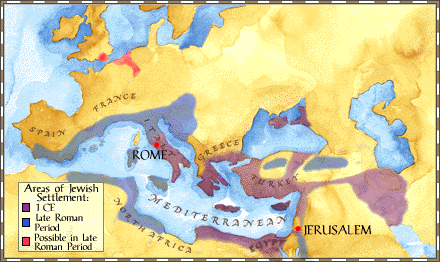
Greek was the language that was spoken by virtually all Jews who lived
outside of Judea and the surrounding area, and even many Jews in Judea knew
at least some Greek. This is why, starting in the 3rd century BCE, Jews in
Alexandria, Egypt began translating the Hebrew scriptures into Greek, a
project that was completed in the 1st century BCE producing what is known as
the Septuagint, so named because approximately seventy scribes worked on the
translation, and legend had it that the translations of all seventy-odd
scribes came out exactly the same, word-for-word, thus proving that the work
was a flawless translation. In reality, however, not only was the
translation flawed, but many Jews knew that it was flawed and in some cases
efforts were made by Judean Jews to get some errors corrected but this did
not always happen. After its publication the Septuagint became the most
widely used scripture among diaspora Jews.
When the Jews were re-conquered by the Romans in the 1st century BCE, a
new era of apocalyptic and Messianic literature and theology emerged.
Below is a timeline outlining some of the major events that relate to the
development of Christianity. The dates that many of the written works were
produced is uncertain, an in some cases the proposed dates of authorship
range by more than 100 years, but best estimates based on scholarship are
provided. The sources used for information on writings is:
http://www.earlyjewishwritings.com/ and
http://www.earlychristianwritings.com/
| Time |
Events |
| 586 BCE |
Jews conquered by Babylonians |
| 538 BCE |
Jews liberated by Persian King Cyrus |
| 538-332 BCE |
Jews ruled by Persians, but fairly autonomous |
| 332 BCE |
Jews conquered by Alexander the Great. Beginning of Hellenistic
period |
| ~170 BCE |
Wisdom of Jesus son of Sirach written, book of wisdom
sayings influenced by both Greek and Jewish ideas |
| ~170 BCE |
Apocalypse of Weeks written, earliest known piece of
apocalyptic Jewish literature |
| ~165 BCE |
Book of Daniel written (one of the last of the
canonical books of the prophets) |
| 165 BCE |
Judas Maccabees defeats Greek Army |
| ~150 BCE |
Martyrdom of Isaiah written |
| 140 BCE |
Hasmonean Kingdom (Israel) established by Maccabees family |
| ~100 BCE - 100 CE |
The books of Maccabees written |
| 63 BCE |
Judea conquered by Romans |
| ~60 BCE |
Wisdom of Solomon written, contains passion narrative
that is paraphrased by Mark and Matthew |
| 44 BCE |
Death of Julius Caesar – Rome moves towards military
dictatorship |
| 37 BCE |
Herod declared King of the Jews by Roman authority |
| 20 BCE - 50 CE |
Jewish theologian Philo integrates Greek philosophy and Jewish
theology |
| 4 BCE- 27/33 CE |
Supposed lifetime of Jesus |
| ~0 |
Apocryphon of Ezekiel written |
| 26-36 |
Pontius Pilate governor over Judea |
| 36 |
John the Baptist killed by Herod according to Josephus |
| ~48-64 |
Letters of Paul written – First mention of “Jesus Christ” |
| ~50 |
Assumption of Moses written |
| 63 |
Jewish revolt against Roman authority in Judea |
| 67-70 |
Judea destroyed by Roman army |
| ~75 |
Gospel of Mark written |
| ~90-120 |
Gospel of Matthew and Gospel of Luke written |
| ~90 |
Apocalypse of Abraham written |
| ~90 |
Apocalypse of Adam written (independent Gnostic/Jewish
salvation story) |
| ~95 |
Apocalypse of John written |
| 95-98 |
Josephus writes Antiquity of the Jews |
| ~110 |
Gospel of John written (or completed) |
| 109 |
Tacitus writes Annals, refers to Christians being
persecuted in Rome in 64 CE |
| 112 |
Pliny the Younger writes letter to Trajan about Christians |
| ~120 |
Ascension of Isaiah written |
| 132-135 |
Bar Kokhba's Revolt (2nd Jewish War) – Bar Kokhba named The
Messiah by Jews |
| ~200-300 |
Economic decline in Rome and period of imperial turmoil |
| 313 |
Edict of Milan - Constantine allowed freedom of all religions |
| 325 |
Council of Nicaea - summoned by Constantine to create official
Christian (Catholic) doctrine |
| 330 |
Creation of “Constantine Bible” - Unified “Old” and “New”
scriptures |
| 362 |
Emperor Julian “the Apostate” declares Christianity a fiction
created by wicked men |
| ~380 |
Theodosius declares Catholicism the official state religion of
Rome |
| 394 |
Battle of the Frigidus, Theodosius defeats remaining pagan
armies in the Empire, all of Europe now officially Christian |
The 1st century BCE and the 1st century CE were periods of immense
turmoil for Jews living in Judea, and Jews living throughout the empire were
likewise caught up in the politics and strife of the time as well. Some diaspora
Jews were very concerned about the goings on in Judea, while others were not. Jews
throughout the empire were integrating into Greek and Roman society in a
variety of ways and to a variety of degrees. During this time, however, in
both Judea and in the diaspora communities, many apocalyptic and Messianic
works were written, in both Semitic languages and Greek, and many different Messianic
movements emerged.
Indeed "Christianity", or the cult of "Jesus Christ", was just one small
segment of this trend within Hellenistic Judaism. Many Jewish works of this
time talk of prophecies, impending doom, and coming saviors. The Christian
Bible is an even smaller sub-set of the writings about Jesus Christ.
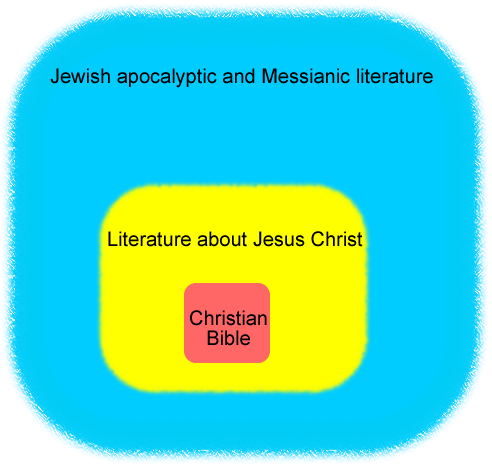
We also know that "mystery religions" were very popular among the Greeks
and Romans at this time. We have very little information on the mystery
religions partly because many of them were secretive and partly because most
of them didn't have written scriptures. Instead, these mystery religions
practiced secretive rituals and spoke in parables and riddles. The
participants were encouraged to have visions and were exhorted into
spiritual ecstasy. It appears very much that what Paul is describing in his
letters is just such a mystery religion, where followers have visions,
receive revelations, follow strict codes of conduct, and engage in secret
practices.
A Jesus Christ mystery religion could have existed for an unspecified
amount of time without leaving much evidence, for we hardly have any
evidence of the other mystery religions either, and aside from Paul we have
little or
no other evidence for Christ worship during the time of Paul. We also know
that Paul repeatedly talks about his "relationship" with Jesus Christ,
having seen him after his resurrection, having received his knowledge from
him, and having been revealed to him.
Galatians 1:
14 I was advancing in Judaism beyond many Jews of my own age and was
extremely zealous for the traditions of my fathers. 15 But when
God, who set me apart from birth and called me by his grace, was pleased
16 to reveal his Son in me so that I might preach him among the
Gentiles, I did not consult any man, 17 nor did I go up to
Jerusalem to see those who were apostles before I was, but I went
immediately into Arabia and later returned to Damascus.
As already discussed, Paul also talked about others seeing Jesus Christ
"portrayed" as crucified and had visions of his resurrection. The early cult of Jesus Christ, of which Paul
was a part, seems very much to have been the product of an intersection
between the larger Jewish apocalyptic and Messianic movements and the
Hellenistic mystery religions. As noted, apostles and disciples are very
different things, and the apostles that Paul speaks of are people like
himself, people who are part of the Messianic mystery religion, not people
who have literally "walked hand-in-hand in Jesus".
In order to understand the larger apocalyptic and Messianic trends in
Judaism, let's look at some examples of non-Christian Jewish literature
from the 2nd century BCE through the 1st century CE. We can begin with
The Book of Enoch, which was probably written some time in the 2nd
century BCE and then added to in the 1st century BCE. The Book of Enoch
is quite long. In The Book of Enoch, Enoch is a scribe of "the
great Lord and King of peace" who documents the punishments of angels
and rulers of the age. In The Book of Enoch the evil angels are
cast into the eternal fire and the Son of man comes to establish a new reign
of the righteous for ever and ever.
6 Again the Lord said to Raphael, Bind Azazyel hand and foot; cast
him into darkness; and opening the desert which is in Dudael, cast him
in there.
7 Throw upon him hurled and pointed stones, covering him with darkness;
8 There shall he remain for ever; cover his face, that he may not see
the light.
9 And in the great day of judgment let him be cast into the
fire.
10 Restore the earth, which the angels have corrupted; and announce life
to it, that I may revive it.
11 All the sons of men shall not perish in consequence of every secret,
by which the Watchers have destroyed, and which they have taught, their
offspring.
12 All the earth has been corrupted by the effects of the teaching of
Azazyel. To him therefore ascribe the whole crime.
13 To Gabriel also the Lord said, Go to the biters, to the reprobates,
to the children of fornication; and destroy the children of fornication,
the offspring of the Watchers, from among men; bring them forth, and
excite them one against another. Let them perish by mutual slaughter;
for length of days shall not be theirs.
14 They shall all entreat you, but their fathers shall not obtain their
wishes respecting them; for they shall hope for eternal life, and that
they may live, each of them, five hundred years.
15 To Michael likewise the Lord said, Go and announce his crime to
Samyaza, and to the others who are with him, who have been associated
with women, that they might be polluted with all their impurity. And
when all their sons shall be slain, when they shall see the perdition of
their beloved, bind them for seventy generations underneath the earth,
even to the day of judgment, and of consummation, until the
judgment, the effect of which will last for ever, be completed.
16 Then shall they be taken away into the lowest depths of the
fire in torments; and in confinement shall they be shut up for ever.
17 Immediately after this shall he, together with them, burn and perish;
they shall be bound until the consummation of many generations.
18 Destroy all the souls addicted to dalliance, and the offspring of the
Watchers, for they have tyrannized over mankind.
19 Let every oppressor perish from the face of the earth;
20 Let every evil work be destroyed;
21 The plant of righteousness and of rectitude appear, and its produce
become a blessing.
22 Righteousness and rectitude shall be forever planted with delight.
23 And then shall all the saints give thanks, and live until they have
begotten a thousand children, while the whole period of their youth, and
their sabbaths shall be completed in peace. In those days all the earth
shall be cultivated in righteousness; it shall be wholly planted with
trees, and filled with benediction; every tree of delight shall be
planted in it.
24 In it shall vines be planted; and the vine which shall be planted in
it shall yield fruit to satiety; every seed, which shall be sown in it,
shall produce for one measure a thousand; and one measure of olives
shall produce ten presses of oil.
25 Purify the earth from all oppression, from all injustice,
from all crime, from all impiety, and from all the pollution which is
committed upon it. Exterminate them from the earth.
26 Then shall all the children of men be righteous, and all
nations shall pay me divine honors, and bless me; and all shall adore
me.
27 The earth shall be cleansed from all corruption, from every
crime, from all punishment, and from all suffering; neither will I again
send a deluge upon it from generation to generation for ever.
28 In those days I will open the treasures of blessing which are
in heaven, that I may cause them to descend upon earth, and upon all the
works and labor of man.
29 Peace and equity shall associate with the sons of men all the
days of the world, in every generation of it.
...
1 Thus the Lord commanded the kings, the princes, the
exalted, and those who dwell on earth, saying, Open your eyes, and lift
up your horns, if you are capable of comprehending the Elect One.
2 The Lord of spirits sat upon the throne of his glory.
3 And the spirit of righteousness was poured out over him.
4 The word of his mouth shall destroy all the sinners and all
the ungodly, who shall perish at his presence.
5 In that day shall all the kings, the princes, the exalted, and
those who possess the earth, stand up, behold, and perceive, that he is
sitting on the throne of his glory; that before him the saints shall be
judged in righteousness;
6 And that nothing, which shall be spoken before him, shall be spoken in
vain.
7 Trouble shall come upon them, as upon a woman in travail, whose labor
is severe, when her child comes to the mouth of the womb, and she finds
it difficult to bring forth.
8 One portion of them shall look upon another. They shall be astonished,
and shall humble their countenance;
9 And trouble shall seize them, when they shall behold this Son of woman
sitting upon the throne of his glory.
10 Then shall the kings, the princes, and all who possess the
earth, glorify him who has dominion over all things, him who was
concealed; for from the beginning the Son of man existed in secret, whom
the Most High preserved in the presence of his power, and revealed to
the elect.
11 He shall sow the congregation of the saints, and of the elect; and
all the elect shall stand before him in that day.
12 All the kings, the princes, the exalted, and those who rule
over all the earth, shall fall down on their faces before him, and shall
worship him.
13 They shall fix their hopes on this Son of man, shall pray to
him, and petition him for mercy.
14 Then shall the Lord of spirits hasten to expel them from his
presence. Their faces shall be full of confusion, and their faces shall
darkness cover. The angels shall take them to punishment, that vengeance
may be inflicted on those who have oppressed his children and his elect.
And they shall become an example to the saints and to his elect. Through
them shall these be made joyful; for the anger of the Lord of spirits
shall rest upon them.
15 Then the sword of the Lord of spirits shall be drunk with their
blood; but the saints and elect shall be safe in that day; nor the face
of the sinners and the ungodly shall they thenceforwards behold.
16 The Lord of spirits shall remain over them:
17 And with this Son of man shall they dwell, eat, lie down, and
rise up, for ever and ever.
-
The Book of Enoch, 2nd - 1st century BCE
Clearly, this apocalyptic work contains many of the themes that we also
find in the Gospel stories, and even in the ideas of Paul. Indeed it is the
argument of those like Earl Doherty that the "rulers" which Paul speaks of
are similar to those that we see discussed in works such as this, the angels
who have power over the nations. It seems, also, that the Epistle of Jude
quotes from The Book of Enoch:
1 Enoch 1:
9 And behold! He cometh with ten thousands of His holy ones to execute
judgment upon all, and to destroy all the ungodly; and to convict all
flesh of all the works of their ungodliness which they have ungodly
committed, and of all the hard things which ungodly sinners have spoken
against Him.
Jude:
14 And Enoch also, the seventh from Adam, prophesied of these, saying,
"Behold, the Lord cometh with ten thousands of his saints,15 To execute
judgment upon all, and to convince all that are ungodly among them of
all their ungodly deeds which they have ungodly committed, and of all
their hard speeches which ungodly sinners have spoken against him."
Notice that the author of Jude implies that this was a prophesy of Enoch
recorded back in ancient times, but it's really a part of this 2nd century
BCE story. Clearly early Jewish Christians viewed "Jesus Christ" in the
light of apocalyptic and Messianic traditions.
We can now look to the Martyrdom of Isaiah, believed to have
been written around the 2nd century BCE, and then later combined with
a Christian work called the Ascension of Isaiah. There is general
agreement that chapters 1-5 of The Martyrdom and Ascension of Isaiah are pre-Christian and the later
chapters are Christian. We will look here at only the first 5 chapters. The
Martyrdom of Isaiah is about the visions of the prophet Isaiah. In
the story Isaiah predicts destruction and his own death. In the story Beliar
is a ruler of the heavenly realms, who comes into the hearts of men and
directs there deeds.
Chapter 1:
7. Isaiah said to Hezekiah the king, but not in the presence of Manasseh
only did he say unto him: 'As the Lord lives, and the Spirit which
speaks in me lives, all these commands and these words will be made
of no effect by Manasseh thy son, and through the agency of his hands
I shall depart mid the torture of my body.
8. And Sammael Malchira will serve Manasseh, and execute all his desire,
and he will become a follower of Beliar rather than of me:
9. And many in Jerusalem and in Judea he will cause to abandon
the true faith, and Beliar will dwell in Manasseh, and by his hands I
shall be sawn asunder.'
...
Chapter 2:
7. And, when Isaiah, the son of Amoz, saw the lawlessness which was
being perpetrated in Jerusalem and the worship of Satan and his
wantonness, he withdrew from Jerusalem and settled in Bethlehem
of Judah.
...
Chapter 3:
6. And Belchira accused Isaiah and the prophets who were with him,
saying: 'Isaiah and those who are with him prophesy against Jerusalem
and against the cities of Judah that they shall be laid waste and
[against the children of Judah and] Benjamin also that they shall go
into captivity, and also against thee, O lord the king, that thou shalt
go [bound] with hooks and iron chains':
7. But they prophesy falsely against Israel and Judah.
8. And Isaiah himself hath said: 'I see more than Moses the prophet.'
9. But Moses said: 'No man can see God and live'; and Isaiah hath said:
'I have seen God and behold I live.'
10. Know, therefore, O king, that he is lying. And Jerusalem also he
hath called Sodom, and the princes of Judah and Jerusalem he hath
declared to be the people of Gomorrah. And he brought many accusations
against Isaiah and the prophets before Manasseh.
11. But Beliar dwelt in the heart of Manasseh and in the heart
of the princes of Judah and Benjamin and of the eunuchs and of
the councilors of the king.
...
Chapter 5:
2. And when Isaiah was being sawn in sunder, Belchira stood up,
accusing him, and all the false prophets stood up, laughing and
rejoicing because of Isaiah.
3. And Belchira, with the aid of Mechembechus, stood up before
Isaiah, [laughing] deriding;
4. And Belchira said to Isaiah: 'Say, "I have lied in all that I have
spoken, and likewise the ways of Manasseh are good and right.
5. And the ways also of Belchira and of his associates are good."
6. And this he said to him when he began to be sawn in sunder.
7. But Isaiah was [absorbed] in a vision of the Lord, and though his
eyes were open, he saw them (not).
8. And Belchira spoke thus to Isaiah: "Say what I say unto thee and I
will turn their hearts, and I will compel Manasseh and the princes of
Judah and the people and all Jerusalem to reverence thee.
9. And Isaiah answered and said: "So far as I have utterance [I say]:
Damned and accused be thou and all they powers and all thy house.
10. For thou canst not take [from me] aught save the skin of my body."
11. And they seized and sawed in sunder Isaiah, the son of Amoz, with a
wooden saw.
12. And Manasseh and Belchira and the false prophets and the princes and
the people [and] all stood looking on.
13. And to the prophets who were with him he said before he had been
sawn in sunder: "Go ye to the region of Tyre and Sidon; for for me only
hath God mingled the cup."
14. And when Isaiah was being sawn in sunder, he neither cried
aloud nor wept, but his lips spoke with the Holy Spirit until he was
sawn in twain.
-
The
Martyrdom and Ascension of Isaiah, ~2nd century BCE
It must be noted that the linked text is of The Martyrdom and
Ascension of Isaiah as we have it today, which contains the Christian
half, and also some Christian interpolations in chapters 3 and 4. The
section above only quotes the sections that are agreed to be pre-Christian.
From this we can see that in the story Isaiah predicts his own death, his
death is caused by evil heavenly rulers, he is accused of being a false
prophet but in fact is he a true prophet, he is put on trial and accused of
blasphemy, and his passion narrative is like
that of Jesus, he is mocked and he did not cry or weep.
We have already looked at 2 Maccabees but we can review a section here
again:
While she was still speaking, the young man said, 'What are you
waiting for? I will not obey the king’s command, but I obey the command
of the law that was given to our ancestors through Moses. But you, who
have contrived all sorts of evil against the Hebrews, will certainly not
escape the hands of God. For we are suffering because of our own
sins. And if our living Lord is angry for a little while, to
rebuke and discipline us, he will again be reconciled with his own
slaves. But you, unholy wretch, you most defiled of all mortals, do not
be elated in vain and puffed up by uncertain hopes, when you raise your
hand against the children of heaven. You have not yet escaped the
judgment of the almighty, all-seeing God. For our brothers after
enduring a brief suffering have drunk of ever-flowing life, under God’s
covenant; but you, by the judgment of God, will receive just punishment
for your arrogance. I, like my brothers, give up body and life for the
laws of our ancestors, appealing to God to show mercy soon to our nation
and by trials and plagues to make you confess that he alone is God,
and
through me and my brothers to bring to an end the wrath of the Almighty
that has justly fallen on our whole nation.'
The king fell into a rage, and handled him worse than the others,
being exasperated at his scorn. So he died in his integrity, putting his
whole trust in the Lord.
- 2 Maccabees 7, ~ 100 BCE
As already noted, the killing of the seven brothers was called a
"ransom for the sin of our nation". We see in this the continuing
development of the theme of passion narratives and atonement for
the sins of a nation through the deaths of men. We also see the
expectation of an eternal afterlife.
Getting closer to the time of Christianity we have the Apocalypse of Adam.
There is disagreement as to whether the Apocalypse of Adam was
written before or after at advent of Christianity, but is generally
acknowledged to be independent of Christian tradition, even if it were
written during the 1st or 2nd century CE, though dating the work is difficult.
The work was presumably written some time between the 1st century BCE and
the 2nd century CE and is of a Gnostic nature.
Once again, for the third time, the illuminator of knowledge will
pass by in great glory, in order to leave (something) of the seed of
Noah and the sons of Ham and Japheth - to leave for himself
fruit-bearing trees. And he will redeem their souls from the day of
death. For the whole creation that came from the dead earth will
be under the authority of death. But those who reflect upon the
knowledge of the eternal God in their heart(s) will not perish. For they
have not received spirit from this kingdom alone, but they have received
(it) from a [...] eternal angel. [...] illuminator [...] will come upon
[...] that is dead [...] of Seth. And he will perform signs and wonders
in order to scorn the powers and their ruler.
Then the god of the powers will be disturbed, saying, "What is the
power of this man who is higher than we?" Then he will arouse a great
wrath against that man. And the glory will withdraw and dwell in holy
houses which it has chosen for itself. And the powers will not see it
with their eyes, nor will they see the illuminator either. Then they
will punish the flesh of the man upon whom the holy spirit came.
Then the angels and all the generations of the powers will use the
name in error, asking, "Where did it (the error) come from?" or "Where
did the words of deception, which all the powers have failed to
discover, come from?"
Now the first kingdom says of him that he came from [...]. A spirit
[...] to heaven. He was nourished in the heavens. He received the glory
of that one and the power. He came to the bosom of his mother. And thus
he came to the water.
...
The third kingdom says of him that he came from a virgin
womb. He was cast out of his city, he and his mother. He was brought to
a desert place. He was nourished there. He came and received glory and
strength. And thus he came to the water.
The fourth kingdom says of him that he came from a virgin.
[...] Solomon sought her, he and Phersalo and Sauel and his armies,
which had been sent out. Solomon himself sent his army of demons to seek
out the virgin. And they did not find the one whom they sought, but the
virgin who was given them. It was she whom they fetched. Solomon took
her. The virgin became pregnant and gave birth to the child there. She
nourished him on a border of the desert. When he had been nourished, he
received glory and power from the seed from which he was begotten. And
thus he came to the water.
...
But the generation without a king over it says that God chose
him from all the aeons. He caused a knowledge of the undefiled one of
truth to come to be in him. He said, "Out of a foreign air, from a great
aeon, the great illuminator came forth. And he made the
generation of those men whom he had chosen for himself shine, so that
they could shine upon the whole aeon"
...
Then the peoples will cry out with a great voice, saying,
"Blessed is the soul of those men because they have known God with a
knowledge of the truth! They shall live forever, because they have not
been corrupted by their desire, along with the angels, nor have
they accomplished the works of the powers, but they have stood in his
presence in a knowledge of God like light that has come forth from fire
and blood.
"But we have done every deed of the powers senselessly. We have
boasted in the transgression of all our works. We have cried against the
God of truth because all his works [...] is eternal. These are against
our spirits. For now we have known that our souls will die the death."
Then a voice came to them, saying "Micheu and Michar and Mnesinous,
who are over the holy baptism and the living water, why were you crying
out against the living God with lawless voices and tongues without law
over them, and souls full of blood and foul deeds? You are full of works
that are not of the truth, but your ways are full of joy and rejoicing.
Having defiled the water of life, you have drawn it within the will of
the powers to whom you have been given to serve them.
"And your thought is not like that of those men whom you persecute
[...] desire [...]. Their fruit does not wither. But they will be known
up to the great aeons, because the words they have kept, of the God of
the aeons, were not committed to the book, nor were they written. But
angelic (beings) will bring them, whom all the generations of men will
not know. For they will be on a high mountain, upon a rock of truth.
Therefore they will be named "The Words of Imperishability and Truth,"
for those who know the eternal God in wisdom of knowledge and teaching
of angels forever, for he knows all things."
These are the revelations which Adam made known to Seth, his son, And
his son taught his seed about them. This is the hidden knowledge
of Adam, which he gave to Seth, which is the holy baptism of those who
know the eternal knowledge through those born of the word and the
imperishable illuminators, who came from the holy seed: Yesseus,
Mazareus, Yessedekeus, the Living Water.
-
Apocalypse of Adam, ~1st century BCE to 2nd century CE
This story is somewhat difficult to understand, but it is about secret
knowledge that Adam gave to his son Seth. This story talks about a "god of
the powers", something again similar to the "rulers" mentioned in the
Pauline letters. The "illuminator of knowledge" is a man who comes into the
world that has greater knowledge than the "gods", or rulers of the middle
heavens. Thirteen different kingdoms, presumably of the heavens, put fourth
wrong explanations for where the "illuminator of knowledge" came from, but
then the story says that the "generation without a king over it", again
presumably a spiritual ruler, says that the illuminator was chosen by God.
The illuminator brings uncorrupted knowledge of God, which brings salvation
to those men who receive this knowledge.
Whether this work was written before the supposed time of Jesus or after
makes little difference, because it is clearly of an independent
tradition that is not affected by Christianity, on this scholars do
generally agree. It
was, nevertheless, written around the same time that the Christian stories
were written and shares similar themes.
We now turn to Wisdom of Solomon, written some time between the
2nd century BCE and the 1st century CE. Most scholars agree that Wisdom
of Solomon was written in the 1st century BCE, just shortly before
Jesus was supposedly born. Wisdom of Solomon is included in some
Bibles as a deuterocanonical work. Wisdom of Solomon is
deuterocanonical because it was originally written in Greek, hence it is not
a part of the Hebrew Bible. In fact, the passion story of Jesus is patterned
on passages in Wisdom of Solomon, as well as on passages from the
protocanonical scriptures. Wisdom of Solomon states that God
created life with the intention that all life be immortal, but that the
wicked brought death into the world. The work then goes on to state
that those who do not believe in God live for the moment and do not believe
in life after death, thus they are sinful and oppress the weak. But, says
Wisdom of Solomon, the weak shall be protected by the Lord and have
eternal reward.
Chapter 1:
1 Love justice, you who judge the earth; think of the LORD in goodness,
and seek him in integrity of heart;
2 Because he is found by those who test him not, and he manifests
himself to those who do not disbelieve him.
...
16 It was the wicked who with hands and words invited death, considered
it a friend, and pined for it, and made a covenant with it, Because they
deserve to be in its possession,
Chapter 2:
1 they who said among themselves, thinking not aright: "Brief and
troublous is our lifetime; neither is there any remedy for man's dying,
nor is anyone known to have come back from the nether world.
...
12 Let us beset the just one, because he is obnoxious
to us; he sets himself against our doings, Reproaches us for
transgressions of the law and charges us with violations of our
training.
13 He professes to have knowledge of God and styles himself a child of
the LORD.
14 To us he is the censure of our thoughts; merely to see him is a
hardship for us,
15 Because his life is not like other men's, and different are his ways.
16 He judges us debased; he holds aloof from our paths as from things
impure. He calls blest the destiny of the just and boasts that God is
his Father.
17 Let us see whether his words be true; let us find out what
will happen to him.
18 For if the just one be the son of God, he will defend him and
deliver him from the hand of his foes.
19 With revilement and torture let us put him to the test that
we may have proof of his gentleness and try his patience.
20 Let us condemn him to a shameful death; for according to his
own words, God will take care of him."
21 These were their thoughts, but they erred; for their wickedness
blinded them,
22 And they knew not the hidden counsels of God; neither did
they count on a recompense of holiness nor discern the innocent souls'
reward.
23 For God formed man to be imperishable; the image of his own nature he
made him.
24 But by the envy of the devil, death entered the world, and they who
are in his possession experience it.
...
Chpater 3:
1 But the souls of the just are in the hand of God, and no torment shall
touch them.
2 They seemed, in the view of the foolish, to be dead; and their passing
away was thought an affliction
3 and their going forth from us, utter destruction. But they are in
peace.
4 For if before men, indeed, they be punished, yet is their hope
full of immortality;
-
Wisdom of Solomon; ~1st century BCE
Compare this to the passion story of Jesus in the Gospel of Matthew
(or any Gospel). As already noted, much of the passion narrative from the
Gospels is based on other scriptures as well, but here we will compare only
to the Wisdom of Solomon:
Matthew 27:
22 Pilate said to them, "Then what shall I do with Jesus called
Messiah?" They all said, "Let him be crucified!"
23 But he said, "Why? What evil has he done?" They only shouted the
louder, "Let him be crucified!"
...
39 Those passing by reviled him, shaking their heads
40 and saying, "You who would destroy the temple and rebuild it in three
days, save yourself, if you are the Son of God, (and) come down from the
cross!"
41 Likewise the chief priests with the scribes and elders mocked him and
said,
42 "He saved others; he cannot save himself. So he is the king of
Israel! 25 Let him come down from the cross now, and we will believe in
him.
43 He trusted in God; let him deliver him now if he wants him. For he
said, 'I am the Son of God.'"
As you can see the Gospel of Matthew practically quotes
Wisdom of Solomon, but whereas Wisdom of Solomon is talking
about a just one and son of God in general terms, the Gospels apply this
narrative specifically to Jesus. The closeness of chapters 1 through 3 of
Wisdom of Solomon to the Gospels has long been recognized by
Christians, with early Christian apologists simply calling Wisdom of
Solomon a prophesy for Jesus.
The dating and significance of the next two works that we will look at
are controversial, for there is not agreement as to when they were written
or their relationship to the Christian tradition. Indeed this difficultly
exists because of the nature of the works. Some scholars who see Gospel
themes in these works believe that they must have been written after the
Gospels. These works are The Odes of Solomon and Didache.
First let's look at The Odes of Solomon, which is very difficult
to date. In fact, Biblical scholars date The Odes of Solomon after
the writing of the Gospels based primarily on the fact that there are similar
themes in The Odes of Solomon and the Gospels and scholars assume
that the only explanation can be that the Odes copied from the Gospels,
but as we shall see, there are good reasons to reject this claim and
actually put The Odes of Solomon before the Gospels, which could
have far reaching implications for the Gospels.
The Odes of Solomon never mention the name Jesus, and several of
the odes are very different from any known Christian ideas. I will present
here the odes that contain seemingly Christian themes.
ODE 19:
1 A cup of milk was offered to me: and I drank it in the sweetness of
the delight of the Lord. 2 The Son is the cup and He who was
milked is the Father: 3 And the Holy Spirit milked Him: because His
breasts were full, and it was necessary for Him that His milk should be
sufficiently released; 4 And the Holy Spirit opened His bosom and
mingled the milk from the two breasts of the Father and gave the mixture
to the world without their knowing: 5 And they who receive in its
fullness are the ones on the right hand. 6 The Spirit opened the womb of
the Virgin and she received conception and brought forth; and the Virgin
became a Mother with many mercies; 7 And she travailed and brought forth
a Son, without incurring pain; 8 And because she was not
sufficiently prepared, and she had not sought a midwife (for He brought
her to bear) she brought forth, as if she were a man, of her own will; 9
And she brought Him forth openly, and acquired Him with great dignity,
10 And loved Him in His swaddling clothes and guarded Him kindly, and
showed Him in Majesty. Hallelujah.
ODE 42:
1 I stretched out my hands and approached my Lord: 2 For the
stretching of my hands is His sign: 2 My expansion is the outspread tree
which was set up on the way of the Righteous One. 4 And I became
of no account to those who did not take hold of me and I shall be with
those who love me. 5 All my persecutors are dead; and they sought after
me who hoped in me, because I was alive: 6 And I rose up and am with
them; and I will speak by their mouths. 7 For they have despised those
who persecuted them; 8 And I lifted up over them the yoke of my love; 9
Like the arm of the bridegroom over the bride, 10 So was my yoke over
those that know me: 11 And as the couch that is spread in the house of
the bridegroom and bride, 12 So is my love over those that
believe in me. 13 And I was not rejected though I was reckoned to be so.
14 I did not perish, though they devised it against me. 13
Sheol saw me and was made miserable: 16 Death cast me up and many along
with me. 17 I had gall and bitterness, and I went down with him to the
utmost of his depth: 18 And the feet and the head he let go, for they
were not able to endure my face: 19 And I made a congregation of living
men amongst his dead men, and I spake with them by living lips: 20
Because my word shall not be void: 21 And those who had died ran
towards me: and they cried and said, Son of God, have pity on us, and do
with us according to thy kindness. 22 And bring us out from the bonds of
darkness: and open to us the door by which we shall come out to thee. 23
For we see that our death has not touched thee. 24 Let us also be
redeemed with thee: for thou art our Redeemer. 25 And I heard their
voice; and my name I sealed upon their heads: 26 For they are free men
and they are mine. Hallelujah.
ODE 24:
1 The Dove fluttered over the Messiah, because He was her head;
and she sang over Him and her voice was heard: 2 And the
inhabitants were afraid and the sojourners were moved: 3 The birds
dropped their wings and all creeping things died in their holes: and the
abysses were opened which had been hidden; and they cried to the Lord
like women in travail: 4 And no food was given to them, because it did
not belong to them; 5 And they sealed up the abysses with the seal of
the Lord. And they perished, in the thought those that had existed from
ancient times; 6 For they were corrupt from the beginning; and the end
of their corruption was life: 7 And every one of them that was imperfect
perished: for it was not possible to give them a word that they might
remain: 8 And the Lord destroyed the imaginations of all them
that had not the truth with them. 9 For they who in their hearts were
lifted up were deficient in wisdom and so they were rejected, because
the truth was not with them. 10 For the Lord disclosed His way and
spread abroad His grace: and those who understood it, know His holiness.
Hallelujah.
ODE 39:
1 Great rivers are the power of the Lord: 2 And they
carry headlong those who despise Him: and entangle their paths: 3 And
they sweep away their fords, and catch their bodies and destroy their
lives. 4 For they are more swift than lightning and more rapid, and
those who cross them in faith are not moved; 5 And those who
walk on them without blemish shall not be afraid. 6 For the sign in them
is the Lord; and the sign is the way of those who cross in the name of
the Lord; 7 Put on, therefore the name of the Most High, and know Him
and you shall cross without danger, for the rivers will be subject to
you. 8 The Lord has bridged them by His word; and He walked and crossed
them on foot: 9 And His footsteps stand firm on the water, and are not
injured; they are as firm as a tree that is truly set up. 10 And the
waves were lifted up on this side and on that, but the footsteps of our
Lord Messiah stand firm and are not obliterated and are not defaced. 11
And a way has been appointed for those who cross after Him and for those
who adhere to the course of faith in Him and worship His name.
Hallelujah.
-
The Odes of Solomon, ? (Most scholars say after 70 CE due to Gospel
parallels)
These are the four main odes that lead scholars to date the work after
the Gospels, and perhaps it was written after the Gospels, but there are
serious issues to address. The most significant issue, I believe, is in
relation to Ode 39. Ode 39 discusses walking on water, and Christian
scholars believe that this passage must be patterned after the Gospel
accounts of Jesus walking on water. Scholars who believe in the existence of
Jesus presume that the story of walking on water in the Gospels was inspired
by some real act Jesus performed, and thus this discussion of walking on
water would have to be based on that event, it couldn't be the other way
around, but let's take a closer look. Isaiah 43, from the Old Testament,
reads as follows:
Isaiah 43:5-6:
"When you pass through the waters, I will be with you; and when you pass
through the rivers, they will not sweep over you. ... For I am the LORD,
your God, the Holy One of Israel, your Savior;"
Read Ode 39 again. Now, Christian scholars claim that The Odes of
Solomon were most likely influence by the Gospel of John, so I
will compare this passage to the walking on water account from the
Gospel of John, but you are free to compare it against the other
Gospels as well, they compare no more favorably.
John 6:
16 When evening came, his disciples went down to the lake, 17
where they got into a boat and set off across the lake for Capernaum. By
now it was dark, and Jesus had not yet joined them. 18 A strong wind was
blowing and the waters grew rough. 19 When they had rowed twenty-five or
thirty stadia, they saw Jesus approaching the boat, walking on the
water; and they were terrified. 20 But he said to them, "It is I; don't
be afraid." 21 Then they were willing to take him into the boat, and
immediately the boat reached the shore where they were heading.
22 The next day the crowd that had stayed on the opposite shore of
the lake realized that only one boat had been there, and that Jesus had
not entered it with his disciples, but that they had gone away alone. 23
Then some boats from Tiberias landed near the place where the people had
eaten the bread after the Lord had given thanks. 24 Once the crowd
realized that neither Jesus nor his disciples were there, they got into
the boats and went to Capernaum in search of Jesus.
Read Ode 39 again. Clearly, if anything, the Gospel account copies from
the ode, not the other way around. The ode is clearly, if anything, based on
Isaiah 43, not the Gospel account. The ode talks about rivers, not a lake,
and it says nothing about a boat. The passage from Isaiah says that the
"Lord, your God, the Holy One of Israel, your Savior," is the one who
is with you, and that is certainly enough of a passage to arrive at the
notion of the Lord Messiah being with you. There is really no question, Ode
39 is closer to Isaiah 43 than it is to John 6 (or Mark, Matthew, or Luke).
If anything, the development of this theme seems to be from Isaiah 43 to Ode
39 to the Gospels, or both the Ode and the Gospels are independently derived
from Isaiah 43.
Ode 24, if post-Gospel, deviates from the Gospels and is Gnostic in
nature. Ode 42 discusses the stretching out of the hands (basically in the
form of a cross) and mentions a tree set upon the way of the "Righteous One",
but the references are cryptic and the rest of the passage does not really
comply with the Gospel accounts. Ode 19 is even more bizarre, talking about
the "milking" of God's breasts and a virgin birth.
If you visit the link you will see that the linked translation contains
the notes of a Christian commenter, who seems puzzled by the passages.
Christians are confused by this work because they feel that it has to come
after the Gospels, because they realize that the similarities to the story of
Jesus are too close for this to have been written before the life of Jesus,
but I would argue that the differences between the odes and the Gospels are
too much for the odes to have been based on the Gospels or the Christian
story, unless it were a highly different version of the Christian story.
The work never mentions the name Jesus and has no solid tie-ins to
the Gospels. I would argue that The Odes of Solomon are a possible
step in the development of the Jesus Myth. The odes may well reflect a set
of "pre-Jesus" ideas that later evolved and became a part of the Jesus
story. That the ideas in the odes would evolve into the Jesus story seems much more
likely than the Jesus story evolving into the odes. This position, however,
is of course untenable to those who believe in the reliability of the
Gospels.
We can now move on to another controversial work that has received even
more attention, Didache. Didache is a work that was known
to some of the early Christian apologists, but was later lost. A copy of
Didache was rediscovered in the 19th century and the work has puzzled
scholars ever since. Scholars do agree that Didache as we have it
today has had some alterations to it over time, but most also agree that
there is still much original in the work as well. Most scholars call
Didache the oldest non-canon piece of Christian literature, but just
how old it is is disputed.
Didache contains many sayings which are similar to those
attributed to Jesus in the Gospels, especially in Matthew, but these sayings
are not attributed to Jesus in Didache. The work is also considered
highly Jewish in nature, using several Jewish themes. Didache also
goes into extensive discussions about rules concerning the treatment of
apostles and prophets, making no mention of disciples of Jesus, but rather
apostles in general. Unlike The Odes of Solomon, however,
Didache does briefly mention Jesus in two passages dealing with the
ritual Thanksgiving meal.
Chapter 9:
1. Now concerning the Thanksgiving [Eucharist], thus give thanks.
2. First, concerning the cup: We thank you, our Father, for the
holy vine of David Your servant, which You made known to us through
Jesus Your Servant; to You be the glory for ever.
3. And concerning the broken bread: We thank You, our Father,
for the life and knowledge which You made known to us through Jesus Your
Servant; to You be the glory for ever.
4. Even as this broken bread was scattered over the hills, and
was gathered together and became one, so let Your Church be gathered
together from the ends of the earth into Your kingdom; for Yours is the
glory and the power through Jesus Christ for ever.
5. But let no one eat or drink of your Thanksgiving [Eucharist], but
they who have been baptized into the name of the Lord; for concerning
this also the Lord has said, Give not that which is holy to the dogs.
Chapter 10:
1. But after you are filled, thus give thanks:
2. We thank You, holy Father, for Your holy name which You caused to
tabernacle in our hearts, and for the knowledge and faith and
immortality, which You made known to us through Jesus Your Servant;
to You be the glory for ever.
3. You, Master almighty, created all things for Your name's sake; You
gave food and drink to men for enjoyment, that they might give thanks to
You; but to us Thou freely gave spiritual food and drink and life
eternal through Your Servant.
4. Before all things we thank You that You are mighty; to You be the
glory for ever.
5. Remember, Lord, Your Church, to deliver it from all evil and to make
it perfect in Your love, and gather it from the four winds, sanctified
for Your kingdom which You have prepared for it; for Yours is the power
and the glory for ever.
6. Let grace come, and let this world pass away. Hosanna to the God of
David! If any one is holy, let him come; if any one is not so, let him
repent. Maran atha. Amen.
7. But permit the prophets to make Thanksgiving as much as they desire.
-
The
Didache, ?(Most scholars date to some time between 50 and 120 CE)
Christian scholar Burton Mack, of the Claremont School of Theology, had
this to say about these passages in Didache:
The prayer of thanksgiving (eucharist) for the community meal in
chapters 9 and 10 are also significant. That is because they do
not contain any reference to the death of Jesus. Accustomed as we are to
the memorial supper of the Christ cult and the stories of the last
supper in the synoptic gospels, it has been very difficult to imagine
early Christians taking meals together for any reason other than to
celebrate the death of Jesus according to the Christ myth. But here in
the Didache a very formalistic set of prayers is assigned to the cup and
the breaking of bread without the slightest association with the death
and resurrection of Jesus. The prayers of thanksgiving are for
the food and drink God created for all people and the special,
"spiritual" food and drink that Christians have because of Jesus.
Drinking the cup symbolizes the knowledge these people have that
they and Jesus are the "Holy Vine of David," which means that they
"belong to Israel." Eating the bread symbolizes the knowledge
these people have of the life and immortality they enjoy by belonging to
the kingdom of God made known to them by Jesus, God's child. And it is
serious business. No one is allowed to "eat or drink of your Eucharist
except those who have been baptized in the Lord's name" (Did. 9:5). We
thus have to imagine a highly self-conscious network of congregations
that thought of themselves as Christians, had developed a full
complement of rituals, had much in common with other Christian groups of
centrist persuasions, but continued to cultivate their roots in a Jesus
movement where enlightenment ethics made much more sense than the
worship of Jesus as the crucified Christ and risen son of God.
- Burton Mack; Who Wrote the New Testament
We can compare the passages from Didache to the Last Supper meal
in the Gospel of Matthew to see the differences between the two:
Matthew 26:
26 While they were eating, Jesus took bread, gave thanks and broke it,
and gave it to his disciples, saying, "Take and eat; this is my body."
27 Then he took the cup, gave thanks and offered it to them, saying,
"Drink from it, all of you. 28 This is my blood of the covenant, which
is poured out for many for the forgiveness of sins. 29 I tell you, I
will not drink of this fruit of the vine from now on until that day when
I drink it anew with you in my Father's kingdom."
As with The Odes of Solomon, is it more likely that the Gospel
account would evolve into what we see in Didache, or that what we
see in Didache would evolve into the Gospel account? Didache
is a highly Jewish work, which has sayings in it that are similar to those
in the Gospels, but not attributed to Jesus, and it contains rituals that
cannot conceivably be tied to the Gospel accounts of similar rituals or the
Gospel story.
In Didache we again see Jesus mentioned not as a real
flesh and blood entity, but as a spiritual mediator, and the eucharist
ritual in Didache makes no reference either the body or blood of
Jesus.
Instead the eucharist ritual talks about bread that is scattered over the
land and then collected together, which actually sounds very similar to the
story of the dismemberment and scattering of the body of Osiris (also
symbolized by bread), which was later collected together by Isis and
resurrected, though this may just be a coincidence. The eucharist rituals in
Didache really defy the Gospel account of the Christian story. It's
not really conceivable how these rituals could have been inspired by the
life, deeds, and words of Jesus if the Gospel accounts are accurate, which
is something that most Christian scholars will not consider, so they instead
try to gloss over this issue or explain it away as having been written by
confused people. What makes far more sense, however, is that Didache
represents a step in the evolution of the Christ myth, written by a people
who had no concept of a human Jesus who had been on earth, and that these
types of eucharistic rituals evolved over time and developed into the
rituals that we find in the Gospels, focused on the "body" and "blood" of
Christ. It is important to note that a eucharist ritual was also mentioned
and practiced by Paul.
Regardless of The Odes of Solomon and Didache, we
have seen that there was certainly a developing body of literature and
theology within Jewish culture that foreshadowed the story of Jesus Christ.
The merger of these apocalyptic and Messianic ideas with the Hellenistic
mystery religions could certainly have produced the movement of which Paul
was a part. The letters of Paul give little indication of a "flesh and blood" Jesus,
but later works,
such as the Book of Hebrews, provide theological reasoning for a
"flesh and blood" Jesus. The idea that real blood had to be spilled to
create a covenant was introduced, and perhaps the drinking of symbolic blood
and the eating of symbolic flesh within the mystery religions also
contributed to the development of the need for a Jesus with real blood and real
flesh.
Whether the Gospel of Mark was written with these issues in mind
is not certain, but after it was written the idea of a flesh and blood
Christ suddenly had a form onto which it could attach itself. Indeed, the
Gospel of Mark seems to have been written as an allegorical tale,
along the very same lines as the other apocalyptic and Messianic literature
of the Jews. Like the other apocalyptic and Messianic stories of the Jews,
the Gospel of Mark was based heavily on the scriptures, probably
with no second thoughts about it, for this is how such literature was written
within that culture.
The reception of the work, however, was a critical factor, because unlike
other Jewish apocalyptic and Messianic literature, the Gospel of Mark
was also widely read by a non-Jewish audience, the "Gentiles" who had been
participating in the mystery religion. It is also important to note that
most of the apocalyptic and Messianic literature prior to the Gospel of
Mark was written in Semitic languages, Hebrew, Aramaic, and others,
while a distinguishing feature of "Christian" literature is that it was all
written in Greek. Non-Jews wouldn't have had the
cultural background to understand the nature of these writings, and they
perhaps took it too literally, not understanding it as allegorical and based
on scripture, but
viewing it as real history.
Whether the Gospel of Matthew was written with the intent of
portraying it as history is questionable, but is it seems that at least the
Gospel
of Luke was written as a historical document, even though it was based
on the Gospel of Mark and other sources.
Following this, in the 2nd century defenders of the "flesh and blood"
historical Jesus began to emerge, such as Justin Martyr and Irenaeus. These
defenders of the flesh, then, immediately set out countering the beliefs of
the Gnostics and others whose religious traditions were older than theirs.
The defenders of the flesh immediately found themselves besieged with many
different people who had completely different views of who or what "Jesus
Christ" was. The four now canonical Gospels became the key documents for the
defense of a flesh and blood historical Jesus and we see that theology and
the Gospels are the weapons used in the defense of Jesus' humanity.
Pre-Gospel evidence was never appealed to, and yet, even though the defense
of the humanity of Jesus began in the 2nd century, this defense began almost
as soon as the Gospels were written. In other words, the Gospels were quite
new, perhaps less than 20 years old, when they became the primary go-to
documents to defend the existence of Jesus. Even when Origen, wrongly it
seems, turned to Josephus to defend Jesus, he was still using a source that,
even if it had been accurate, would have only been produced near the end
of the 1st century. The defenders of the flesh never appealed to any
evidence that was actually from the time of Jesus' life, and this was within
100 to 200 years of his supposed existence.
Various dogmas that are not found in the Gospels were developed by the
emerging Catholics, such as the trinity, the doctrine of "fully human and
fully divine", the "Father is equal to the Son", etc., and when the
Catholics came into power within the Roman State they used their power to
eliminate all of the other various beliefs about Jesus Christ, passing down
only the view (which it was required to believe) that Jesus Christ had come
"in the flesh", suffered, died, and bodily ascended to heaven.
CONCERNING THE MOST EXALTED TRINITY AND THE CATHOLIC FAITH,
AND PROVIDING THAT NO ONE SHALL DARE TO PUBLICLY OPPOSE THEM.
1. The Emperors Gratian, Valentinian, and Theodosius to the people of
the City of Constantinople.
We desire that all peoples subject to Our benign Empire shall live
under the same religion that the Divine Peter, the Apostle, gave to the
Romans, and which the said religion declares was introduced by himself,
and which it is well known that the Pontiff Damasus, and Peter, Bishop
of Alexandria, a man of apostolic sanctity, embraced; that is to say, in
accordance with the rules of apostolic discipline and the evangelical
doctrine, we should believe that the Father, Son, and Holy
Spirit constitute a single Deity, endowed with equal majesty, and united
in the Holy Trinity.
(1) We order all those who follow this law to assume the
name of Catholic Christians, and considering others as demented and
insane, We order that they shall bear the infamy of heresy; and when the
Divine vengeance which they merit has been appeased, they shall
afterwards be punished in accordance with Our resentment, which we have
acquired from the judgment of Heaven.
Dated at Thessalonica, on the third of the Kalends of March, during
the Consulate of Gratian, Consul for the fifth time, and Theodosius.
2. The Same Emperors to Eutropius, Prætorian Prefect.
Let no place be afforded to heretics for the
conduct of their ceremonies, and let no occasion be offered for them to
display the insanity of their obstinate minds. Let all persons
know that if any privilege has been fraudulently obtained by means of
any rescript whatsoever, by persons of this kind, it will not be valid.
Let all bodies of heretics be prevented from holding unlawful
assemblies, and let the name of the only and the greatest God be
celebrated everywhere, and let the observance of the Nicene Creed,
recently transmitted by Our ancestors, and firmly established by the
testimony and practice of Divine Religion, always remain secure.
(1) Moreover, he who is an adherent of the Nicene Faith, and
a true believer in the Catholic religion, should be understood to be one
who believes that Almighty God and Christ, the Son of God, are one
person, God of God, Light of Light; and let no one, by rejection,
dishonor the Holy Spirit, whom we expect, and have received
from the Supreme Parent of all things, in whom the sentiment of a pure
and undefiled faith flourishes, as well as the belief in the undivided
substance of a Holy Trinity, which true believers indicate by the Greek
word .... These things, indeed, do not require further proof,
and should be respected.
(2) Let those who do not accept these doctrines cease to
apply the name of true religion to their fraudulent belief; and let them
be branded with their open crimes, and, having been removed from the
threshhold of all churches, be utterly excluded from them, as We forbid
all heretics to hold unlawful assemblies within cities. If, however, any
seditious outbreak should be attempted, We order them to be driven
outside the walls of the City, with relentless violence, and We
direct that all Catholic churches, throughout the entire world, shall be
placed under the control of the orthodox bishops who have embraced the
Nicene Creed.
Given at Constantinople, on the fourth of the Ides of January, under
the Consulate of Flavius Eucharius and Flavius Syagrius.
...
The following is the text of the letter of the Emperor Justinian,
Victorious, Pious, Happy, Renowned, Triumphant, always Augustus, to
John, Patriarch, and most Holy Archbishop of the fair City of Rome:
(1) Therefore, We present to Your Holiness the fact that
certain infidels and persons who do not belong to the Holy Catholic and
Apostolic Church of God have, like Jews and apostates, dared to dispute
matters which are properly accepted, glorified, and preached by all
priests in accordance with your doctrines, denying that Our Lord Jesus
Christ is the only begotten Son of God, and that Our Lord was born of
the Holy Spirit and of the Holy, Glorious, and always Virgin Mary, the
Mother of God, and became a man and was crucified, and that he
is one of the persons of the Holy Trinity, who are all of one substance,
and who should be adored and exalted along with the Father and the Holy
Spirit, and that he is consubstantial with the Father according to
divinity, and consubstantial with ourselves according to humanity, and
susceptible of the sufferings of the flesh, but not susceptible of the
same as a deity. For these persons refusing to acknowledge Our Lord
Jesus Christ as the only begotten Son of God, and Our Lord as one of the
Holy Trinity, and of the same substance with the other persons composing
it, appear to follow the evil doctrine of Nestor, who asserts that there
is one Son of God according to grace, whom he styles the Word of God,
and another Son whom he calls Christ.
(2) All the priests of the Holy Catholic and Apostolic Church and the
most Reverend Abbots of the Holy Monasteries, acknowledging Your
Holiness, and solicitous for the prosperity and unity of the Holy
Churches of God, which they receive from the Apostolic See of Your
Holiness, making no changes in the ecclesiastical condition which has
existed up to this time, and still exists; with one voice, confess,
glorify, and preach that Our Lord Jesus Christ is the only
begotten Son and the Word of God, and that Our Lord, born of His Father
before all centuries and times, Who descended from Heaven in the last
days, was born of the Holy Spirit and the Holy and Glorious Virgin Mary,
the Mother of God; became a man and was crucified; is of the same
substance as the Holy Trinity to be adored and glorified with the Father
and the Holy Spirit; for we do not acknowledge any other God, Word or
Christ, but one alone, and the same of like substance with the Father,
in accordance with divinity, and of like substance with us in accordance
with humanity, Who could suffer in the flesh, but could not suffer as a
deity; and Whom, Himself perfect in divinity as well as humanity, we
receive and confess as being what the Greeks call [...]. And, as the
only begotten Son and Word of God was born of His Father before
centuries and times existed, and as He, in later times, descended from
Heaven, was born of the Holy Spirit and the Holy ever Virgin Mary, the
Mother of God, Our Lord Jesus Christ having become a man, is properly
and truly God. Hence we say that the Holy and Glorious Virgin Mary is
properly and truly the Mother of God, not for the reason that God
obtained speech and origin from her, but because in the last days He
descended from Heaven, and, incarnated through Her, became a man, and
was born; whom we confess and believe (as has already been stated), to
be of the same substance with the Father according to deity, and of the
same substance with ourselves according to humanity, whose miracles and
sufferings voluntarily sustained by Him while in the flesh we
acknowledge.
(3) Moreover, we recognize four Sacred Councils, that is to say, the
one composed of three hundred and eighteen Holy Fathers who assembled in
the City of Nicea; and that of the hundred and fifty Holy Fathers who
met in this Imperial City; and that of the Holy Fathers who first
congregated at Ephesus; and that of the Holy Fathers who met at
Chalcedony, as your Apostolic See teaches and proclaims. Hence,
all priests who follow the doctrine of your Apostolic See believe,
confess, and preach these things.
(4) Wherefore We have hastened to bring to the notice of Your
Holiness, through the most blessed Bishops Hypatius and Demetrius (so it
may not be concealed from Your Holiness), that these tenets are denied
by some few wicked and judaizing monks, who have adopted the perfidious
doctrines of Nestor.
(5) Therefore We request your paternal affection, that you, by your
letters, inform Us and the Most Holy Bishop of this Fair City, and your
brother the Patriarch, who himself has written by the same messengers to
Your Holiness, eager in all things to follow the Apostolic See of Your
Blessedness, in order that you may make it clear to Us that Your
Holiness acknowledges all the matters which have been set forth above,
and condemns the perfidy of those who, in the manner of Jews, have dared
to deny the true Faith. For in this way the love of all persons for you,
and the authority of your See will increase, and the unity of the Holy
Church will be preserved unimpaired, when all the most blessed bishops
learn through you and from those who have been dispatched by you, the
true doctrines of Your Holiness. Moreover, We beg Your
Blessedness to pray for Us, and to obtain the beneficence of God in Our
behalf.
-
The Code of Justinian; 529-534 CE
Jesus and the
cast of Christian characters were humanized in the traditional manner
of Greek and Roman art and the concept of the Christian God was integrated with
Greek philosophy, adding concepts such as the omnipotence, omnipresence, and
omniscience of God to the religion, and various aspects of pre-Christian
culture were integrated into the religion, such as the celebration of the
"birth of Jesus" on December 25th, The Birthday of the Invincible Sun.
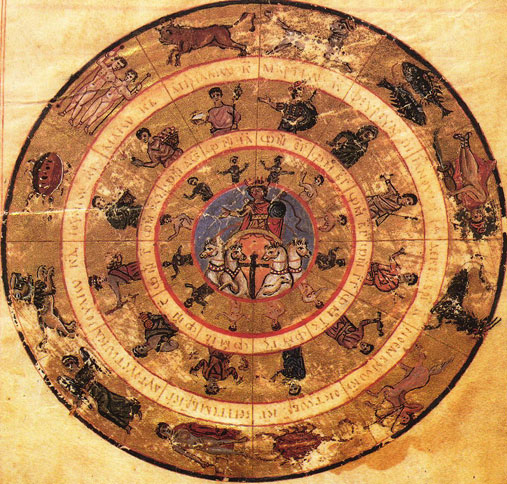
Helios surrounded by 12 virgins, 12 disciples, and 12 signs of the zodiac
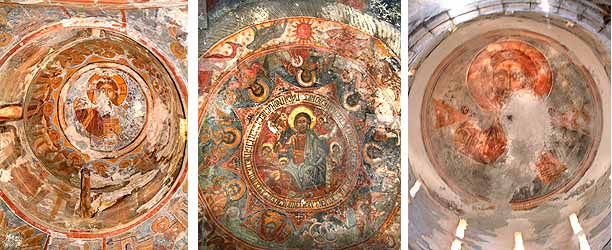
Center image showing Jesus with disciples and zodiac
Apollo with halo
Apollo with halo
Christ as the sun-god from tomb in St. Peter's Basilica, discovered in 1942
Early image of Christ with Halo as "The Good Shepherd"
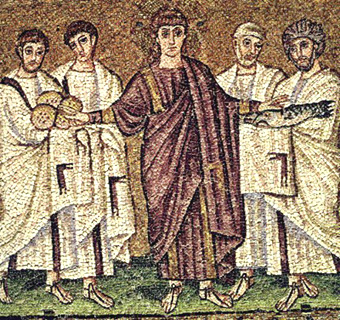
Jesus performing "miracle of loaves and fishes" depicted in royal robes
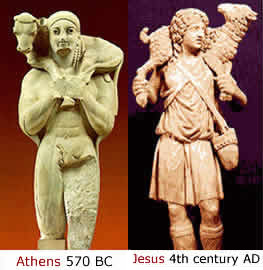
"The Good Shepherd"
Zeus - 4th century BCE
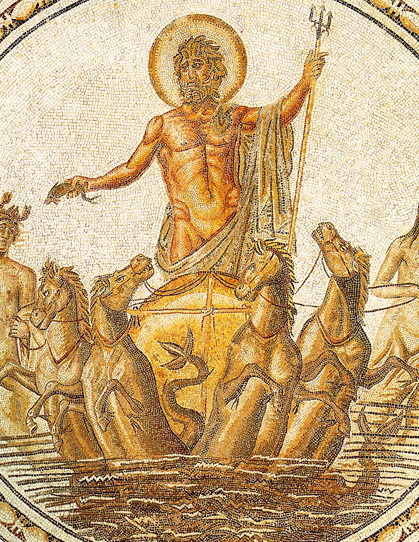
Neptune
Dionysus
Jesus
Isis and Horus mosaic from The House of Dionysus
Eirene the goddess of peace holding her son Ploutos
Messalina with Britannicus - 45 CE, based on Eirene and Ploutos
Madonna and child
Diana of Ephesus shrine with blessing hands
Virgin Mary shrine with blessing hands
Diana of Ephesus with moon goddess symbol on head
Virgin Mary standing on moon goddess symbol
Hera Queen of Heaven
Mary Queen of Heaven
Pre-Christian Roman figure of angel
Greek angels of death, Hypnos (sleeping death) and Thanatos (violent death)
Archangel Michael
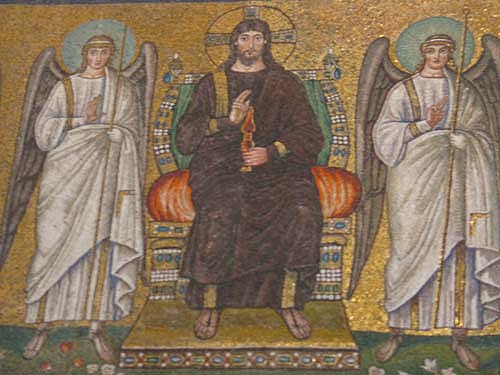
Christ Enthroned
Pan chasing shepherd
Pan tempting Aphrodite
Modern depiction of The Devil
Classic Roman image of Mithras killing bull
Classic Medieval Christian image of Samson killing lion
Conclusion and Summary
The proposition that "Jesus Christ" never existed relies on much more
than simply stating that we don't have evidence for his existence or that
the Gospels are unbelievable. Showing that the story of Jesus Christ is not
based on a person in any meaningful way requires showing that the story of
Jesus Christ is better explained as having developed through non-historical
methods than it is through historical methods. We can identify literary
sources and traditions that are not only capable of providing all of the
material for the Jesus story, but indeed it is clear that the Jesus story is
developed from these source materials, and this fact undermines the
possibility that the stories are based on observed historical events. If the
crucifixion of Jesus were based on an observed historical event, then we
should not expect that virtually every line of the crucifixion narrative
comes from existing Hebrew scriptures (including themes that were
mistranslated in the Greek sources that were used). Not only does the
scriptural basis of the Jesus stories undermine their historical
credibility, but we also have historical facts, or lack thereof, which
corroborate Jesus' absence of existence.
The suspicion that Jesus never existed was first seriously entertained
(within the past thousand years) and addressed in a scholarly fashion in the
19th century. A major flaw in the first generation of "Jesus Myth theories",
however, was that they often relied on parallels between the story of Jesus and
"pagan" myths. This happened because the first generation of Jesus Myth
scholarship emerged from Protestant criticism of Catholicism and there was a
tendency at the time to view Catholicism, and much of early Christian
history, as "corrupted by paganism". There were good reasons to think this,
because many of the later developing Christian traditions and institutions,
such as Christmas, the veneration of Mary, and the Catholic hierarchy, are
indeed based on pre-Christian Roman practices and institutions. But these
later developments cannot be confused with the pre-Catholic period of
Christianity. Indeed there are Hellenistic influences on the Christian story
and theology, but these influences were largely a part of Hellenistic
Judaism itself.
The development of the Jesus Christ story is best explained not as simply a "paganization"
of Judaism, but as a part of Jewish literary tradition. What did set
Christianity apart, however, was its crossover status into non-Jewish
communities, where Jewish literary traditions were not understood. A
combination of factors then led to its growing acceptance. The destruction
of Judea left many diaspora Jews in despair and without a grounding for
traditional Judaism, so the story of Jesus had appeal to them. Unlike most
of the Greek and Roman religions, Christianity was highly evangelical with
its claims of salvation and "truth". People living in the Roman Empire had
grown up with messages of confidence and strength, but in the 3rd and 4th
centuries Rome went through a series of hardships so the Christian story of
suffering, redemption, and humility, rooted in the history of Jewish
hardships, appealed to a people who were surrounded by religions based on a
culture of superiority that was now failing. For those who looked deeper
into the religion, many were impressed with the degree to which the life of
Jesus seemed to have been so completely foretold by the earlier Hebrew
scriptures. The numerous parallels between the Gospels and the "Old
Testament" convinced many that the religion "had to be true", how else could
one account for so many "fulfilled prophecies"? They declined to understand,
however, that the parallels are there because the Gospels are made-up
stories based on the Hebrew scriptures. As Christians began filling the
ranks of the military in the 4th century Constantine and other emperors had
reasons to cater to the religion, and they found that people who were
willing to die to spread their religion to new lands made for good soldiers.
For those who claim that the "rapid" (actually over a period of about 200
years) spread of Christianity cannot be explained without a real central
Jesus figure, the reality is that even if Jesus were real he played no role
in the spread of the religion. We absolutely know that the major spread of
the religion happened after the writing of the Gospels. Even the spreading
of the religion prior to the Gospels occurred due to apostolistic
evangelism, the works of Paul and other writings are a testament to this.
Paul did not interact with one single group of people that had already
interacted with Jesus. People claim that the apostles wouldn't have gone to
such efforts to spread the religion if they had not been certain of the
truth of their religion because they had personal contact with Jesus, but
Paul himself, the only apostle that we actually do have written records
from, is proof that this is false, because we know for a fact that Paul
never saw a "flesh and blood" Jesus and Paul emphasized over and over again
how important his "revelations" from Jesus were. By all accounts the most
active and important apostle that we know of, Paul, never had personal
contact with Jesus.
Not only can Christianity be explained without a real historical Jesus at
its core, but the historical facts that we do have are best explained if
Jesus never existed.
See Also:
Jesus Myth Part II - Follow-up, Commentary, and Expansion
The Gospel of Mark as Reaction and Allegory
Bibliography:
Note: Much of this article puts forward original ideas and is
based on readings of the English translations of primary source material.
The primary source materials for the article are those that are included in
the body of the article. Additional resources which may not have previously
been linked or referenced above are noted below.
Lowder, Jeffery Jay. Historical Evidence and the Empty Tomb Story.
Journal of Higher Criticism, 8:2 (Fall 2001), pp. 251-93
Price, Robert M. The Incredible Shrinking Son of Man. Prometheus
Books, 2003
Price, Robert M. The Pre-Nicene New Testament: Fifty-four Formative Texts.
Signature Books, 2006
Society of Biblical Literature. The Harper Collins Study Bible Including
Apocryphal Deuterocanonical Books with Concordance. Harper Collins
Publishers, 2006
Carrier, Richard. Luke and Josephus. 2000.
http://www.infidels.org/library/modern/richard_carrier/lukeandjosephus.html
Carrier, Richard. Thallus: an Analysis. 1999.
http://www.infidels.org/library/modern/richard_carrier/thallus.html
Troughton, G.M. Echoes in the Temple? Jesus, Nehemiah, and Their Actions
in the Temple. Journal of Biblical Studies, April 2003.
http://www.journalofbiblicalstudies.org/Issue7/Echoes in the Temple.pdf
Crapo, Richley H. An Anthropologist Looks at the Judeo-Christian Scriptures.
http://cc.usu.edu/~fath6/contents-bible.htm
Just, Felix ,S.J., Ph.D. Electronic New Testament Educational Resources.
http://catholic-resources.org/Bible/index.html
Kirby, Peter. Early Christian Writings.
http://www.earlychristianwritings.com/
Kirby, Peter. Early Jewish Writings.
http://www.earlyjewishwritings.com/
Pearse, Roger. The Tertullian Project.
http://www.tertullian.org/
Turton, Michael A. Historical Commentary on the Gospel of Mark.
http://users2.ev1.net/%7Eturton/GMark/GMark_index.html
The Catholic Encyclopedia. 1917.
http://www.newadvent.org/cathen/index.html
Jewish Encyclopedia. 1906.
http://www.jewishencyclopedia.com/
|